BANK COMM(03328)

Search documents
交通银行将于2026年1月28日派发中期股息每10股1.563元
Zhi Tong Cai Jing· 2025-11-20 08:56
Core Viewpoint - The company, Bank of Communications, announced a mid-term dividend distribution of 1.563 yuan per 10 shares, to be paid on January 28, 2026, for the six months ending June 30, 2025 [1] Summary by Category - **Dividend Announcement** - The company will distribute a mid-term dividend of 1.563 yuan for every 10 shares [1]

交通银行(03328) - 建议派发截至2025年6月30日止六个月之中期股息(更新)
2025-11-20 08:47
免責聲明 | 香港交易及結算所有限公司及香港聯合交易所有限公司對本公告的內容概不負責,對其準確性或完整性亦不發表任何聲明,並明確表示,概不對因 | 公告全部或任何部份內容而產生或因倚賴該等內容而引致的任何損失承擔任何責任。 | | --- | --- | | | 股票發行人現金股息(可選擇貨幣)公告 | | 發行人名稱 | 交通銀行股份有限公司 | | 股份代號 | 03328 | | 多櫃檯股份代號及貨幣 | 不適用 | | 相關股份代號及名稱 | 不適用 | | 公告標題 | 建議派發截至2025年6月30日止六個月之中期股息(更新) | | 公告日期 | 2025年11月20日 | | 公告狀態 | 更新公告 | | 更新/撤回理由 | 更新(i)股東批准日期,(ii)除淨日,(iii)為符合獲取股息分派而遞交股份過戶文件之最後時 | | | 限,(iv)暫停辦理股份過登記手續之日期,(v)記錄日期及(vi)股息派發日。 | | 股息信息 | | | 股息類型 | 中期(半年期) | | 股息性質 | 普通股息 | | 財政年末 | 2025年12月31日 | | 宣派股息的報告期末 | 2025年6月 ...
交通银行(03328) - 拟於二零二五年十二月十二日(星期五)举行之临时股东会之代表委任表格
2025-11-20 08:39
(於中華人民共和國註冊成立的股份有限公司) (股份代號:03328) 擬於二零二五年十二月十二日(星期五)舉行之臨時股東會之代表委任表格 | 本人╱吾等持有的全部H股 | | --- | | 股份中質押H股股份數目 | | 本人╱吾等持有的全部H股 | | 股份中質押H股股份所佔比例 | 本人╱吾等 (附註1) , , 地址為 , 為本人 ╱ 吾等之代表,代表本人 ╱ 吾等出席貴行將於二零二五年十二月十二日(星期五)上午九時三十分假座中華 人民共和國(「中國」)上海市銀城中路188號交銀金融大廈舉行之臨時股東會(「臨時股東會」)及其任何續會,以審議 並酌情通過召開臨時股東會通告所載之決議案,並代表本人╱吾等以本人╱吾等之名義依照下列指示 (附註4) 就該等決 議案投票。 普通決議案 (非累積投票議案) 贊成 (附註4) 反對 (附註4) 棄權 (附註4) 1. 審議及酌情批准2025年半年度利潤分配方案。 股東簽名 (附註7) : 日期: 附註: 9. 股東或其代表出席臨時股東會時須出示其身份證明文件。 (附註2) 1. 請用正楷填上登記在股東名冊之股東全名及地址。 2. 請填上以 閣下名義登記與本代表委任表 ...
交通银行(03328) - 临时股东会通告
2025-11-20 08:35
香港交易及結算所有限公司及香港聯合交易所有限公司對本通告之內容概不負責,對其準確性或完整性亦 不發表任何聲明,並明確表示,概不就因本通告全部或任何部分內容而產生或因倚賴該等內容而引致之任 何損失承擔任何責任。 何兆斌 (於中華人民共和國註冊成立的股份有限公司) (股份代號:03328) 臨時股東會通告 茲通告交通銀行股份有限公司(「本行」)將於2025年12月12日(星期五)上午九時 三十分假座中華人民共和國(「中國」)上海市銀城中路188號交銀金融大廈舉行臨時股 東會(「臨時股東會」),藉以處理下列事項: 普通決議案(非累積投票議案) 1. 審議及酌情批准2025年半年度利潤分配方案。 承董事會命 交通銀行股份有限公司 公司秘書 中國上海 2025年11月20日 委任超過一名股東代理人之股東,其股東代理人只能按實際擁有股份以投票方式行使表決權。股東 須以書面形式委任代理人,並由委任人簽署或由其以書面形式授權之授權人簽署。如股東為法人, 委任書須加蓋法人公章或由其董事或正式授權之代表簽署。如該委任書由委託人之授權人簽署,則 該授權委託書或其他授權文件必須經過公證證明。 – 1 – 附註: 1. 暫停辦理H股股 ...
交通银行(03328) - 2025年半年度利润分配方案 及 临时股东会通告
2025-11-20 08:30
此乃要件 請即處理 香港交易及結算所有限公司及香港聯合交易所有限公司對本通函之內容概不負責,對其準確性或完整性亦 不發表任何聲明,並明確表示概不就因本通函全部或任何部份內容而產生或因依賴該等內容而引致之任何 損失承擔任何責任。 閣下如對本通函任何方面或應採取之行動有任何疑問,應諮詢 閣下之股票經紀或其他持牌證券商、銀行 經理、律師、專業會計師或其他專業顧問。 閣下如已將名下之交通銀行股份有限公司的全部股份出售或轉讓,應立即將本通函連同隨附之代表委任表 格送交買主或承讓人,或經手買賣或轉讓之銀行、持牌證券商或其他代理,以便轉交買主或承讓人。 (於中華人民共和國註冊成立的股份有限公司) (股份代號:03328) 2025年半年度利潤分配方案 及 臨時股東會通告 本行謹訂於2025年12月12日(星期五)上午九時三十分假座中國上海市銀城中路188號交銀金融大廈舉行 臨時股東會,臨時股東會通告載於本通函的第6頁至第7頁。 如 閣下欲委任代表出席臨時股東會, 閣下須按隨附的代表委任表格上印列之指示填妥及交回表格。H 股持有人須盡快將代表委任表格交回本行於香港之H股股份過戶登記處香港中央證券登記有限公司,其地 址為香港灣 ...
交通银行涨2.12%,成交额9.17亿元,主力资金净流入1.41亿元
Xin Lang Zheng Quan· 2025-11-20 02:41
Core Viewpoint - The stock price of Bank of Communications has shown a positive trend, with significant trading activity and a notable increase in shareholder numbers, indicating potential investor confidence and interest in the bank's performance [1][2]. Group 1: Stock Performance - As of November 20, the stock price of Bank of Communications increased by 2.12%, reaching 7.69 CNY per share, with a trading volume of 9.17 billion CNY and a turnover rate of 0.46%, resulting in a total market capitalization of 679.518 billion CNY [1]. - Year-to-date, the stock price has risen by 4.05%, with a 3.22% increase over the last five trading days, a 6.81% increase over the last 20 days, and a 1.99% increase over the last 60 days [1]. Group 2: Financial Performance - For the period from January to September 2025, Bank of Communications reported a net profit attributable to shareholders of 699.94 billion CNY, reflecting a year-on-year growth of 1.90% [2]. - The bank has cumulatively distributed dividends amounting to 3,377.62 billion CNY since its A-share listing, with 836.94 billion CNY distributed over the past three years [3]. Group 3: Shareholder Information - As of September 30, 2025, the number of shareholders of Bank of Communications reached 320,800, an increase of 21.95% from the previous period, while the average number of circulating shares per shareholder decreased by 19.86% to 89,152 shares [2]. - Among the top ten circulating shareholders, China Securities Finance Corporation holds 1.892 billion shares, remaining unchanged, while Hong Kong Central Clearing Limited reduced its holdings by 375 million shares to 1.021 billion shares [3].
智通ADR统计 | 11月20日
智通财经网· 2025-11-19 22:42
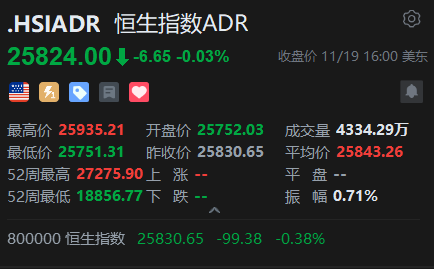
Market Overview - The Hang Seng Index (HSI) closed at 25,824.00, down by 6.65 points or 0.03% as of November 19, 16:00 Eastern Time [1] - The index's highest price during the day was 25,935.21, while the lowest was 25,751.31, with a trading volume of 43.34 million shares [1] Major Blue-Chip Stocks Performance - HSBC Holdings closed at HKD 107.800, down by HKD 1.800 or 1.64% compared to the previous close [2][3] - Tencent Holdings closed at HKD 622.500, down by HKD 1.000 or 0.16% [3] - Alibaba Group (ADR) saw an increase, closing at HKD 156.400, up by HKD 1.800 or 1.16% [3] - Xiaomi Group closed at HKD 38.820, down by HKD 1.960 or 4.81% [3] - AIA Group closed at HKD 77.950, down by HKD 0.600 or 0.76% [3] Stock Price Changes - The stock prices of major companies showed mixed results, with some experiencing declines while others saw slight increases [2][3] - Notable declines included Kuaishou Technology, which closed at HKD 63.500, down by HKD 1.150 or 1.78% [3] - Ctrip Group saw an increase, closing at HKD 574.500, up by HKD 10.000 or 1.77% [3]






金融圈突发!2人被终身禁业!
中国基金报· 2025-11-19 14:56
【导读】交银金租被罚款80万元,2人被禁止从事银行业工作终身 中国基金报记者 晨曦 公开信息显示,马宾曾在交银金租工作多年,历任总经理助理、副总裁等职。2023年8月,中纪委通报马宾被查消息;同年11月,马宾被 开除党籍,所涉犯罪问题移送检察机关依法审查起诉。 通报指出,马宾违反国家法律法规,利用职务便利为他人在工作调动、职务晋升、船舶融资租赁业务中提供帮助谋取利益,非法收受他人 巨额财物,涉嫌受贿犯罪。 另外,方修志曾以"交银金租航运业务总监"等身份多次参加公开活动。2017年相关报道称,交银金租是当年在油轮新造船领域最大的投资 商,方修志是交银金租航运事业部负责人,该部门以订造大型集装箱船而闻名,也通过订造新造船、签署售后回租协议投资油轮领域。 公开信息显示,交银金租成立于2007年12月,是经国务院批准成立的首批5家银行系金融租赁公司之一,为交通银行全资控股子公司,注 册资本为200亿元。交银金租是中国银行业协会金融租赁专业委员会主任单位、上海市银行同业公会金融租赁专业委员会主任单位。 交银金租在业内较早开启航运、航空领域专业化、国际化转型发展道路。目前,公司船舶规模超470艘,航运租赁资产规模超150 ...

2026年银行二永债年度策略:供需两弱下的逆风局
Shenwan Hongyuan Securities· 2025-11-19 13:42
Core Insights - The report indicates a challenging environment for perpetual bonds in the banking sector, with both supply and demand expected to remain weak in 2026 [2][3] - The net supply of perpetual bonds is projected to stabilize at a low level, with significant contributions from TLAC bonds [2][3] - Demand for bank perpetual bonds is facing challenges due to regulatory changes and market conditions, impacting their attractiveness [2][3] Supply - The net supply of perpetual bonds has decreased significantly, with 2025's issuance at 1.38 trillion yuan, down from previous years, and net financing dropping to 363 billion yuan [8][12] - The supply is expected to remain low in 2026, with net financing projected to be around 400-500 billion yuan, characterized by a decline in large banks' issuance and an increase from smaller banks [2][3] - TLAC bonds are anticipated to provide some relief to the supply side, with a projected net supply of around 300 billion yuan in 2026 [2][3] Demand - Bank perpetual bonds continue to be a crucial component of the credit bond market, but demand is weakening due to regulatory changes and market dynamics [2][3] - The implementation of new accounting standards for insurance companies may reduce their investment capacity in perpetual bonds, although the overall impact is expected to be manageable [2][3] - The demand from banks for self-managed investments is likely to stabilize, while mutual funds may face challenges due to new fee regulations, impacting their allocation to perpetual bonds [2][3] Valuation - The report highlights the potential for a shift in the relative valuation of perpetual bonds due to weak supply and demand dynamics [3][3] - Credit spreads for perpetual bonds may face upward pressure if participation from funds and insurance companies diminishes, with projected spreads for 3-year AAA-rated bonds in the range of 25-60 basis points [3][3] - The valuation of different bond types is expected to diverge, with higher-grade bonds potentially facing upward pressure on spreads [3][3] Strategy - The report suggests a tactical approach to trading opportunities in high-grade bank perpetual bonds, with a focus on price differences between new and existing bonds [3][3] - For mid-sized banks' perpetual bonds, it is recommended to actively monitor value propositions while being cautious of non-redemption risks [3][3] - TLAC bonds are noted for their dual value in both allocation and trading, with a particular emphasis on floating rate bonds [3][3]

专访交通银行杨立文:零售信贷业务的转型升级之道
21世纪经济报道· 2025-11-19 06:12
Core Viewpoint - The article emphasizes the importance of consumer spending as a key driver of economic growth, highlighting the proactive measures taken by the government and financial institutions like Bank of Communications to stimulate consumption through retail credit initiatives [4][5][6]. Group 1: Government Policies and Economic Context - The Chinese government has been actively promoting consumption and expanding domestic demand through various policies, including subsidies, tax incentives, and the issuance of consumption vouchers [5]. - Since 2014, consumption has consistently been one of the three main drivers of economic growth, with a projected retail sales total of 48.8 trillion yuan in 2024, reflecting a 3.5% increase from the previous year [4][5]. - The contribution rate of consumption to economic growth is expected to be 44.5%, underscoring its critical role in the national strategy for expanding domestic demand [4]. Group 2: Bank of Communications' Strategy - Bank of Communications is aligning its retail credit business with national strategies to enhance consumer spending and improve living standards, focusing on integrating supply and demand through institutional frameworks [6][11]. - The bank has launched the "Jiao Yin Hui Dai" personal loan brand, which combines consumer and business loans to meet diverse financial needs, emphasizing a one-stop service model [8][9]. - The bank's retail loan growth has outpaced the market, driven by a commitment to high-quality development and effective risk management [11][12]. Group 3: Digital Transformation and Innovation - The bank is leveraging digital technology to enhance its retail loan services, implementing an integrated credit approval process that simplifies customer interactions [13][14]. - Advanced technologies, including artificial intelligence, are being utilized to improve operational efficiency and risk management across the loan lifecycle [13][14]. - The bank aims to create a digital operating model that enhances customer experience and expands service coverage, particularly for new consumer segments [16][19]. Group 4: Risk Management and Talent Development - Bank of Communications is focusing on intelligent risk management, enhancing its fraud prevention systems and developing a dynamic monitoring and early warning system [20]. - The bank is committed to cultivating a workforce skilled in digital and data analysis to support its evolving business needs and improve frontline operational capabilities [19][20]. - The bank's risk management strategy includes a comprehensive collection and recovery system to maintain asset quality while expanding its loan portfolio [20].