EVERGRANDE(03333)

Search documents
近30家上市房企退市,“退市潮”或将持续2-3年
Sou Hu Cai Jing· 2025-11-05 02:07
Core Viewpoint - The recent trend of listed real estate companies exiting the capital market is characterized by a predominance of passive delistings and an increase in active privatization delistings, indicating a significant restructuring and reshuffling within the industry over the next 2-3 years [1][11]. Summary by Sections Delisting Trends - In October 2023, two listed real estate companies, Winking Property and the previously high-performing Shankun Property, announced their exit from the capital market [1]. - Since the first delisting of New Power Holdings in 2023, nearly 23 listed real estate companies have exited the A+H share market within three years, with 7 companies opting for privatization since 2021 [1][2]. Reasons for Delisting - The delisting of companies like Shankun Property and Evergrande reflects a broader trend of performance decline among listed real estate firms due to liquidity crises and ongoing industry adjustments [2]. - Companies listed on the Hong Kong Stock Exchange face mandatory delisting if they remain suspended for 18 months, while A-share companies often trigger delisting due to stock prices falling below 1 yuan for 20 consecutive trading days [2][3]. Privatization Movement - The number of companies choosing to privatize has notably increased, with several firms, including Winking Property and Dayue City, considering privatization as a strategic response to market pressures [7][9]. - The reasons for privatization include ongoing market and operational pressures, the need for strategic adjustments, and the desire to enhance operational efficiency [9][10]. Financial Performance - Winking Property has reported continuous losses since 2022, with a significant loss of 3.26 billion yuan in 2024, highlighting the financial pressures driving privatization decisions [9]. - The sales revenue of Winking Property has drastically decreased from 26 billion yuan in 2021 to 7.02 billion yuan in 2024, further emphasizing the challenges faced by the company [9]. Future Outlook - The combination of passive delistings and active privatizations illustrates the current phase of "clearing" and "restructuring" within the industry, suggesting that this trend will continue in the coming years [11].

日本经济面临“美国挑战”,特朗普“着急”降息,人民币升值影响几何?
Sou Hu Cai Jing· 2025-10-24 08:23
Group 1: Global Economic Trends - Recent capital markets have seen fluctuations in gold prices, A-shares hovering around 3900 points, and a 98.9% probability of a 25 basis point rate cut by the Federal Reserve in October [1] - The U.S. Federal Reserve's interest rate cut is driven by a need to stabilize the economy amidst weak growth and fluctuating inflation, with a focus on maintaining balance in stocks, bonds, and currencies [6] - Historical patterns indicate that when the Federal Reserve cuts rates, global tensions often escalate, suggesting a correlation between U.S. monetary policy and international stability [6] Group 2: Investment Opportunities - Long-term investment strategies should focus on core assets such as leading internet companies in Hong Kong and consumer stocks in A-shares, as they are most sensitive to global monetary conditions [7] - The semiconductor and innovative pharmaceutical sectors are highlighted as growth areas that could benefit from lower interest rates, easing valuation pressures [7] - The recent surge in copper prices is attributed to increased demand from AI data centers and military spending, with significant price increases observed in related stock indices [10][12] Group 3: Currency and Market Dynamics - The Chinese yuan has experienced three notable appreciation cycles, often correlating with strong economic performance and financial liberalization, leading to increased foreign investment in A-shares [8] - The rise in the yuan's value typically signals enhanced international investor confidence in the Chinese economy, which in turn supports A-share market performance [8][11] Group 4: Company-Specific Developments - BYD's stock has seen a decline of approximately 30% from its peak, coinciding with a reduction in its sales target for 2025, raising concerns among investors [14] - Alibaba, Tencent, and SMIC have attracted significant capital inflows, indicating a trend towards investing in technology leaders within the Hong Kong market [16][17] - Wanda Group's strategy of selling off assets while maintaining a strong portfolio of operational properties is crucial for managing its debt crisis and ensuring cash flow stability [18]





中国房价下跌,套住外资10000亿元!
Sou Hu Cai Jing· 2025-10-23 08:36
Core Insights - The Chinese real estate market is experiencing significant declines, with September data showing a 0.64% month-on-month drop in second-hand residential prices, the largest in a year, and a 0.41% drop in new residential prices, the largest in 11 months [1] - Continuous price declines have led to a prolonged downturn in the real estate market, resulting in developer defaults, delayed property deliveries, increased bank bad debts, reduced local government revenues, and a decrease in household wealth [3] - Foreign investors have incurred substantial losses, with approximately $140 billion (equivalent to 10 trillion RMB) trapped in the Chinese real estate market [3][5] Foreign Investment Impact - Over the past 15 years, foreign institutional investment in China's real estate sector, including various property types, has totaled around $140 billion [5] - Many foreign investors expected sustained demand in the Chinese real estate market but were caught off guard by significant price drops, with some properties falling to levels seen a decade ago [5] - Major asset management firms, such as BlackRock and Carlyle, have begun to sell off their commercial properties in China at substantial losses due to the ongoing market slump [7][12] Specific Case Studies - BlackRock's fund faced foreclosure by Standard Chartered Bank for failing to repay loans, resulting in the loss of two buildings in Shanghai, originally purchased for 1.2 billion RMB, which were later sold for approximately 680 million RMB, leading to a loss of 420 million RMB for BlackRock [9][10] - Carlyle sold a 31-story office building in Shanghai for just over 50% of its original purchase price from 2015, amid rising vacancy rates that have increased from 4.6% to 22% [12] - Blackstone, a major foreign owner of logistics parks in China, has also sold properties at significant losses, indicating a broader trend of foreign divestment from the Chinese real estate market [15]


许家印23亿美元家族信托可能被击穿
第一财经· 2025-10-21 13:08
Core Viewpoint - Family trusts, while widely used for wealth inheritance, can become "wealth traps" if not properly understood or misused, as evidenced by the recent court ruling on Xu Jiayin's family trust, which highlights the limitations of such legal structures in asset protection [4][20]. Group 1: Family Trust Functions - Family trusts serve three main functions: wealth transmission and planning, risk isolation and asset protection, and tax planning and privacy protection [3]. Group 2: Xu Jiayin's Family Trust Case - Xu Jiayin established a $2.3 billion family trust before the Evergrande debt crisis, funded by over 50 billion RMB in dividends from 2009 to 2022, aimed at securing family wealth [6]. - The Hong Kong High Court ruled that the trust was invalid due to fraudulent asset transfer, as it was set up with the intent to evade creditors [7]. - The court found that the trust's funding was questionable, as the dividends were derived from a company already showing signs of financial distress [8]. Group 3: Legal Foundations of Family Trusts - The legitimacy of a family trust relies on the lawful source of its assets; if the funds are deemed illegitimate, the trust can be invalidated [12]. - The independence of the trust is crucial; if the grantor retains control over the assets, the trust's protective features may be compromised [13][14]. Group 4: Risks Associated with Family Trusts - Five major risks of family trusts include: 1. Legitimacy of funding sources [12]. 2. Lack of independence leading to loss of protective benefits [13]. 3. Illegitimate motives for establishment, such as evading debts [15]. 4. Cross-jurisdictional legal conflicts and execution challenges [16]. 5. Risks from third-party management leading to asset loss [18]. Group 5: Lessons and Recommendations - The Xu Jiayin case illustrates that the protective function of family trusts is not absolute; flaws in motivation, funding, or independence can lead to legal vulnerabilities [20]. - The case emphasizes that offshore trusts are not immune to legal scrutiny, as international cooperation in asset recovery is increasing [20]. - Effective family business succession relies more on sound institutional frameworks than on reliance on specific financial tools [21].

恒大地产集团武汉公司所持10.64亿元股权被冻结
Sou Hu Cai Jing· 2025-10-17 03:45
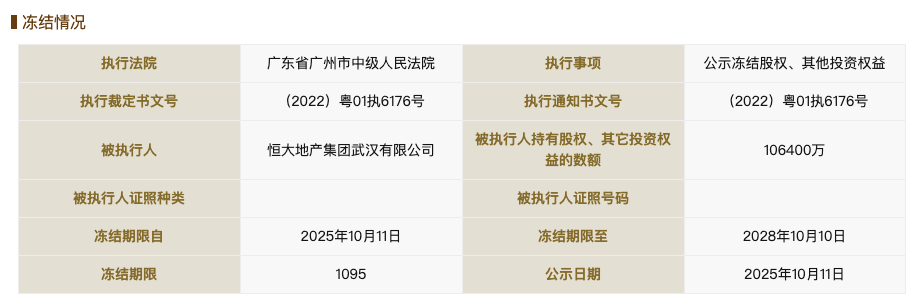
Core Points - Evergrande Real Estate Group Wuhan Co., Ltd. has a new equity freeze information added on October 11, with the frozen equity amounting to 1.064 billion RMB [1] - The frozen equity pertains to Wuhan Donghu Evergrande Real Estate Development Co., Ltd., with the freeze period set from October 11, 2025, to October 10, 2028 [1][2] - The executing court for this action is the Guangzhou Intermediate People's Court in Guangdong Province [2] Company Information - Evergrande Real Estate Group Wuhan Co., Ltd. was established in July 2006, with a registered capital of approximately 1.45 billion RMB [2] - The legal representative of the company is Kong Deheng, and it is jointly held by Evergrande Real Estate Group Co., Ltd. and Guangzhou Xinyuan Investment Co., Ltd. [2]
恒大地产集团武汉公司被冻结10.64亿元股权
Mei Ri Jing Ji Xin Wen· 2025-10-17 03:36
Core Viewpoint - Recently, Evergrande Real Estate Group's Wuhan subsidiary has had a significant equity freeze, indicating ongoing financial challenges within the company [1] Group 1 - The equity freeze involves Wuhan Donghu Evergrande Real Estate Development Co., Ltd. with a frozen equity amount of 1.064 billion RMB [1] - The freeze is set to last from October 11, 2025, to October 10, 2028 [1] - The executing court for this equity freeze is the Intermediate People's Court of Guangzhou, Guangdong Province [1]
许家印家族信托金身被“破”? 香港高院裁决清盘人接管其全部资产
智通财经网· 2025-10-17 03:32
Core Viewpoint - The recent court ruling regarding Xu Jiayin, founder of Evergrande, has raised significant discussions about the effectiveness of offshore family trusts in asset protection, indicating that such structures may not be immune to legal scrutiny and intervention [1][13][16]. Group 1: Court Ruling and Asset Management - The Hong Kong High Court appointed liquidators as the receivers of all assets belonging to Xu Jiayin, including those controlled through offshore companies, marking a significant legal precedent in the treatment of offshore trusts [1][3][5]. - The court's decision was influenced by Xu's non-compliance with asset disclosure orders, which raised concerns about potential asset flight, leading to the need for a more invasive investigation into his asset structures [2][4][11]. - The ruling allows liquidators to identify, preserve, and investigate Xu's assets, but does not grant them the authority to dispose of these assets without further court approval [4][11]. Group 2: Legal Implications for Offshore Trusts - The court emphasized that the effectiveness of offshore trusts in asset isolation is not absolute, and the actual control over assets can lead to legal actions that penetrate these structures [8][15]. - Legal experts noted that the ruling serves as a warning to those relying on offshore trusts for asset protection, highlighting that such arrangements must be established on legitimate grounds and with independent oversight [14][15]. - The ruling reflects a judicial principle that prioritizes substantive control over formal ownership, allowing courts to act against perceived fraudulent asset transfers [7][15]. Group 3: Future Considerations and Market Impact - The case may influence high-net-worth individuals and the wealth management industry, prompting a reevaluation of the perceived safety of offshore family trusts [16]. - The outcome of the liquidators' investigations and the cooperation between Hong Kong and U.S. courts will be crucial in determining the future of Xu's offshore trust assets [16]. - The ruling may lead to stricter compliance standards and scrutiny in the establishment of trusts, as reliance on complex structures to evade debt obligations could be challenged in court [13][16].
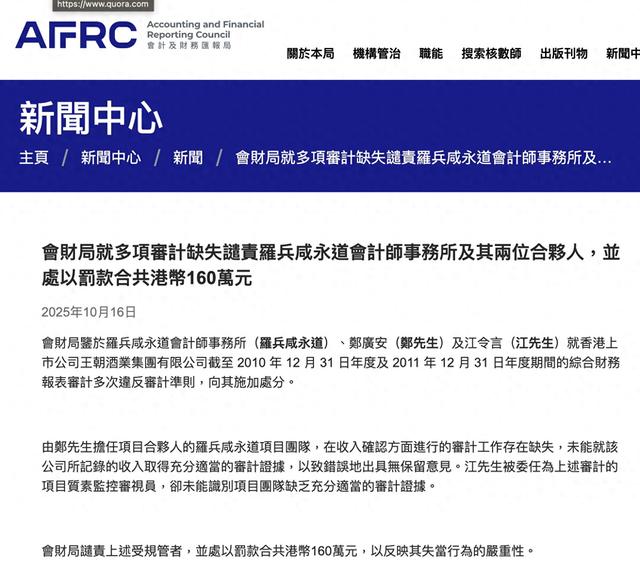
普华永道再陷审计风波:王朝酒业案罚款160万港元,“四大”光环失色
Guan Cha Zhe Wang· 2025-10-16 16:00
Core Viewpoint - PwC Hong Kong has been reprimanded and fined a total of HKD 1.6 million for significant deficiencies in its audit work for Dynasty Fine Wines, highlighting a severe trust crisis facing the firm amid multiple regulatory penalties in recent years [1][5]. Group 1: Audit Failures and Penalties - PwC failed to obtain sufficient and appropriate audit evidence regarding revenue recognition during the audits of Dynasty Fine Wines for the years 2010 and 2011, despite issuing an unqualified opinion [1][3]. - The firm faced a record penalty of RMB 441 million from the Ministry of Finance and the China Securities Regulatory Commission for its role in Evergrande's financial misstatements, marking the most severe punishment in Chinese auditing history [5][6]. - The internal investigation into Dynasty Fine Wines revealed that a significant amount of claimed sold wine products had not been delivered and remained in third-party warehouses [1][3]. Group 2: Financial Performance and Client Loss - PwC's revenue in the Chinese market dropped from CNY 7.925 billion in 2022 to CNY 7.137 billion in 2023, reflecting a broader decline in its financial performance [2][8]. - Since the penalty related to Evergrande was imposed in March 2024, all eight of PwC's major A-share audit clients have announced their termination of contracts, collectively contributing CNY 478 million in audit fees, which accounted for over half of its audit revenue [2][7]. - The firm has seen a 5.6% decline in revenue in the Asia-Pacific region for the fiscal year 2024, amounting to USD 9.3 billion, attributed to a slowdown in demand in mainland China [2][8]. Group 3: Industry Impact and Competitive Landscape - The exposure of the Dynasty Fine Wines case coincides with a period of unprecedented client attrition for PwC, leading to significant restructuring within the firm, including layoffs across multiple offices [7][8]. - Over 60% of clients lost by PwC have shifted to other "Big Four" firms, with significant numbers moving to Ernst & Young, KPMG, and Deloitte [8]. - Domestic accounting firms such as Lixin, Tianjian, and Xinyongzhonghe have begun to benefit from this reshuffling, breaking the long-standing dominance of the "Big Four" in securing high-quality clients [9].
550多亿元遭全球冻结!许家印 “海外梦” 碎了!离岸信托不再安全
Sou Hu Cai Jing· 2025-10-15 14:23
Core Insights - The Hong Kong High Court's landmark ruling on September 16, 2025, authorized liquidators to take control of Xu Jiayin's assets, including those in his offshore family trust, leading to the freezing of $7.7 billion (approximately 55 billion RMB) in assets across 12 countries and regions [1][5][6] Group 1: Legal and Financial Implications - The ruling dismantled the myth that offshore trusts are a foolproof means of asset protection, emphasizing that actual control over assets negates the independence of the trust [6][12] - The court's decision was based on principles of "substance over form" and "fraudulent asset transfer," indicating that debtors cannot shield wealth from creditors through trusts while incurring massive debts [6][12] - Xu Jiayin's family trust, established in 2019 with $2.3 billion (approximately 1.64 billion RMB) in assets, was found to be under his control, undermining its intended protective function [5][6] Group 2: Financial Condition of Evergrande - Evergrande's total liabilities reached 2.38 trillion RMB, with 320.3 billion RMB overdue domestically and $19.1 billion overseas, resulting in 750,000 unfinished housing projects and numerous suppliers trapped in debt [3][5] - The company's market capitalization plummeted from over 370 billion HKD at its peak to just 2.15 billion HKD, reflecting a loss of over 99% in value [3][5] - Following its delisting from the Hong Kong Stock Exchange on August 25, 2025, Evergrande faced a complete lack of funding options in the capital market, with retail investors left holding worthless shares [3][5] Group 3: Asset Details and Recovery Efforts - The liquidators initiated a global asset recovery operation, targeting Xu Jiayin's luxury properties, including 33 high-end residences in central London and a commercial building in Manhattan valued at $750 million [8][12] - The assets were structured through offshore companies, but investigations revealed that Xu Jiayin retained decision-making power, rendering the trust ineffective for asset protection [8][12] - The ongoing legal battles within Xu Jiayin's family, particularly involving his ex-wife, highlight the complexities and potential conflicts arising from asset distribution within the trust [9][12] Group 4: Lessons and Broader Implications - The case serves as a cautionary tale for business leaders about the risks of using legal loopholes for asset protection, emphasizing the importance of legitimate wealth planning [12][14] - The increasing scrutiny of offshore trusts and the legal frameworks surrounding them indicate a shift towards protecting creditor rights over debtor interests in financial crises [6][12] - The downfall of Evergrande illustrates the consequences of poor financial management and the need for a balanced approach to risk and reward in business operations [14]

许家印家族信托被击穿?真相是→
Di Yi Cai Jing· 2025-10-13 13:09
Core Viewpoint - Recent news regarding Xu Jiayin's overseas family trust being "pierced" has gained significant attention, but the actual court ruling is less dramatic than portrayed online [1][8] Summary by Sections Court Ruling Details - The Hong Kong High Court's ruling on September 16 was in response to Evergrande Group's application for a receiver to manage Xu Jiayin's assets, following a previous court order for liquidation [1][4] - The ruling confirmed that the receiver would oversee Xu Jiayin's assets, but did not explicitly mention the overseas family trust in the scope of the takeover [4][7] Asset Management and Disclosure - Xu Jiayin was previously ordered to disclose assets valued at over 50,000 HKD, but failed to comply, leading to the appointment of a receiver to ensure enforcement of the injunction [2][4] - The receiver has the authority to access information about the assets but does not have the power to dispose of them [4] Trust and Legal Implications - The court's references to "trust" were primarily in the context of legal precedents and did not directly address Xu Jiayin's trust [5][7] - Legal experts argue that the notion of the trust being "pierced" is premature, as the ruling is procedural and does not affect the substantive rights to the assets [8][9] Factors Influencing Trust Validity - The potential for the family trust to be "pierced" depends on various factors, including the design of the trust, legal jurisdiction, and whether there are indications of fraudulent behavior [9][10] - Common scenarios for trust "piercing" include intentional misuse of trust assets or procedural failures in trust management [10]