
CATL(03750)

Search documents
宁德时代(03750)股东将股票由香港上海汇丰银行转入花旗银行 转仓市值18.1亿港元
智通财经网· 2025-12-03 00:50
宁德时代发布公告,公司于2025年12月1日与博裕天枢(宁波)自有资金投资有限责任公司、宁波市甬元 投资基金有限公司等合作方签署了《博裕新智新产(宁波)股权投资合伙企业(有限合伙)有限合伙合同》 (以下简称"《有限合伙合同》"),公司作为有限合伙人之一参与投资"博裕新智新产(宁波)股权投资合伙 企业(有限合伙)"(以下简称"基金"、"合伙企业"),于基金完成首次交割后,基金认缴出资金额为人民币 40.01亿元,其中公司作为有限合伙人认缴出资人民币5亿元,持有基金12.497%的认缴比例。 智通财经APP获悉,香港联交所最新资料显示,12月2日,宁德时代(03750)股东将股票由香港上海汇丰 银行转入花旗银行,转仓市值18.1亿港元,占比2.4%。 ...

宁德时代(03750.HK)截至11月30日累计回购1599万股A股
Ge Long Hui· 2025-12-02 12:22
格隆汇12月2日丨宁德时代(03750.HK)公告,截至2025年11月30日,公司通过深圳证券交易所股票交易 系统以集中竞价交易方式累计回购公司A股股份1599万股,占公司同日A股总股本的0.3628%,最高成 交价为317.63元/股,最低成交价为231.50元/股,成交总金额为人民币4,385,504,687.90元(不含交易费 用)。 ...
宁德时代(03750) - 海外监管公告-关於回购公司A股股份的进展公告
2025-12-02 12:13
香港交易及結算所有限公司及香港聯合交易所有限公司對本公告之內容概不負責,對其準確性 或完整性亦不發表任何聲明,並明確表示概不就因本公告全部或任何部份內容而產生或因倚賴 該等內容而引致之任何損失承擔任何責任。 Contemporary Amperex Technology Co., Limited 寧德時代新能源科技股份有限公司 (於中華人民共和國註冊成立的股份有限公司) (股份代號:3750) 海外監管公告 關於回購公司A股股份的進展公告 本公告乃根據香港聯合交易所有限公司證券上市規則第13.10B條而作出。 茲載列寧德時代新能源科技股份有限公司(「本公司」)於深圳證券交易所網站 (http://www.szse.cn/)及巨潮資訊網( www.cninfo.com.cn )所發佈之《寧德時代新能 源科技股份有限公司關於回購公司A股股份的進展公告》,僅供參閱。 承董事會命 寧德時代新能源科技股份有限公司 董事長、執行董事兼總經理 曾毓群先生 中國•寧德,二零二五年十二月二日 於本公告日期,本公司董事會成員包括執行董事曾毓群先生、潘健先生、李平先 生、周佳先生、歐陽楚英博士及趙豐剛先生;及獨立非執行董事吳育輝博 ...
摩根大通减持宁德时代(03750)105.4228万股 每股作价469.5233港元
智通财经网· 2025-12-02 11:28
智通财经APP获悉,香港联交所最新数据显示,11月26日,摩根大通减持宁德时代(03750)105.4228万 股,每股作价469.5233港元,总金额约为4.95亿港元。减持后最新持股数目约为1155.95万股,持股比例 为7.41%。 ...

智通AH统计|12月2日
智通财经网· 2025-12-02 08:19
Group 1 - The top three companies with the highest AH premium rates are Northeast Electric (00042) at 900.00%, Hongye Futures (03678) at 272.78%, and Sinopec Oilfield Service (01033) at 262.34% [1] - The bottom three companies with the lowest AH premium rates are CATL (03750) at -5.04%, China Merchants Bank (03968) at -0.84%, and Heng Rui Medicine (01276) at 2.24% [1] - The companies with the highest deviation values are Guanghe Tong (00638) at 43.63%, Northeast Electric (00042) at 37.21%, and Beijing Jingcheng Machinery Electric (00187) at 23.54% [1] Group 2 - The top ten AH stocks by premium rate include Zhejiang Shibao (01057) at 261.04%, Beijing Jingcheng Machinery Electric (00187) at 247.49%, and Chenming Paper (01812) at 244.44% [1] - The bottom ten AH stocks by premium rate include Weichai Power (02338) at 5.66%, Midea Group (00300) at 8.00%, and Zijin Mining (02899) at 8.86% [2] - The top ten AH stocks by deviation value also include Dazhong Public Utilities (01635) at 17.92% and Shandong Xinhua Pharmaceutical (00719) at 12.79% [2]

6家公司AH股倒挂背后:流通股比例小,外资更爱行业龙头
Xin Lang Cai Jing· 2025-12-02 07:05
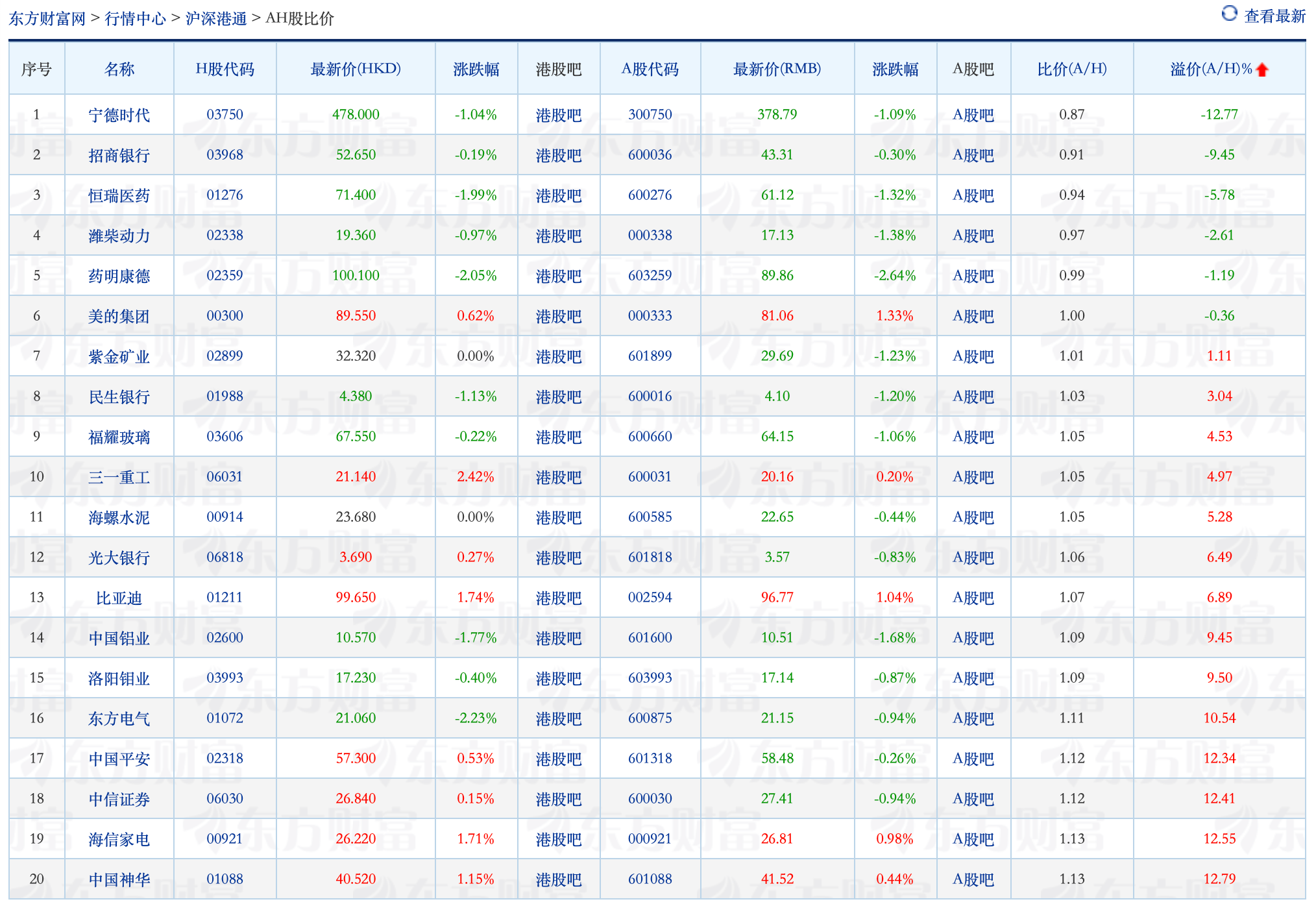
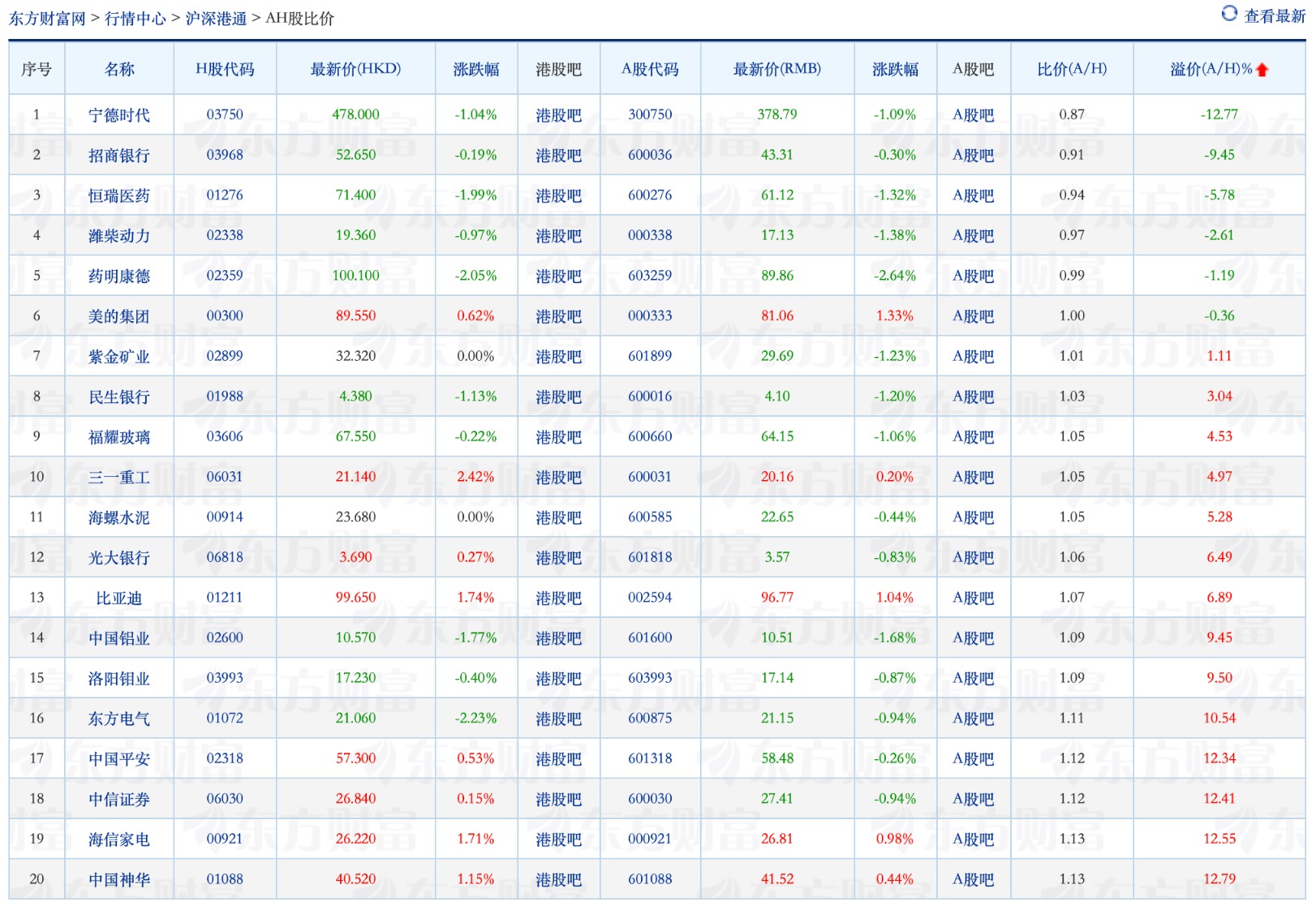
Core Insights - The article discusses the phenomenon of six companies having higher stock prices in the Hong Kong market (H-shares) compared to their A-share counterparts, which is contrary to the typical market behavior where A-shares usually trade at a premium due to lower transaction costs and better liquidity [1][3]. Group 1: Market Dynamics - The Hang Seng AH Share Premium Index (HSAHP) remains above 120, indicating a 20% premium of A-shares over H-shares on average [1][3]. - The six companies, including Ningde Times (300750.SZ, 03750.HK), are identified as newly listed stocks expected to debut by 2025, contributing to their higher H-share prices due to limited circulation [1][3]. Group 2: Investor Behavior - There is a noted preference among foreign investors for industry leaders in niche markets, which makes it challenging to find comparable stocks in the international market, leading to the observed price discrepancies [1][3].
6家AH股“倒挂”背后:流通股比例小,外资更爱行业龙头
第一财经· 2025-12-02 06:29
Core Viewpoint - A-shares have lower trading costs and better market liquidity compared to H-shares, with a current premium of about 20% for A-shares as indicated by the Hang Seng AH Premium Index (HSAHP) being above 120. However, certain companies like CATL have shown a reverse phenomenon where H-shares are priced higher than A-shares [2][4]. Group 1: Market Dynamics - The phenomenon of H-shares trading at a premium over A-shares is attributed to the smaller market capitalization of H-shares compared to A-shares, leading to relative scarcity in liquidity [5]. - Among the six companies exhibiting this "inversion," three are newly listed, resulting in lower liquidity for H-shares, which can lead to inflated prices due to concentrated holdings by large institutions [5][6]. - As institutional investors gradually exit their positions, the liquidity of H-shares is expected to increase, potentially narrowing the premium of H-shares over A-shares [5]. Group 2: Characteristics of A-H Share Companies - Companies with inverted pricing typically share common traits: they are large enterprises with stable operating histories and solid financials, often in traditional industries like finance and energy [6]. - The valuation of these companies tends to be higher in the A-share market, reflecting differing expectations from overseas investors regarding future growth potential [6][8]. Group 3: Foreign Investment Preferences - Foreign investors prefer industry leaders that have a competitive edge in the market, which are often scarce in the international market [8]. - These leading companies usually possess strong brand recognition, stable profitability, and good governance structures, aligning with foreign investors' long-term investment criteria [8][9]. - The preference for H-shares over A-shares is also influenced by the perceived monopolistic characteristics of certain companies, which can lead to higher valuations in the H-share market [9].


6家AH股“倒挂”背后:流通股比例小,外资更爱行业龙头
Di Yi Cai Jing· 2025-12-02 06:25
Core Viewpoint - The phenomenon of "AH share premium inversion" is observed in six companies, where H-shares are priced higher than A-shares, attributed to low liquidity and foreign investors' preference for industry leaders [1][2]. Group 1: Market Dynamics - The Heng Seng AH Share Premium Index (HSAHP) remains above 120, indicating a 20% premium of A-shares over H-shares [1]. - The six companies experiencing this inversion include CATL, China Merchants Bank, Hengrui Medicine, Weichai Power, WuXi AppTec, and Midea Group [2]. - The market sees a preference for newly listed stocks in the H-share market, which have lower liquidity, leading to higher valuations [2]. Group 2: Liquidity and New Listings - The "inversion" stocks are characterized by a high proportion of newly listed shares, with three of the six companies listed for less than a year [2]. - The market capitalization of H-shares is often significantly smaller than that of A-shares, contributing to the liquidity scarcity and price inversion [2]. - As institutional investors gradually exit their IPO allocations, the liquidity in the H-share market is expected to increase, potentially narrowing the premium [2]. Group 3: Foreign Investment Preferences - Foreign investors show a strong preference for industry leaders that have established market positions and stable financials [3][4]. - These companies typically operate in traditional sectors such as finance, energy, and infrastructure, which have predictable profit models [3]. - The preference for H-shares is also driven by the perception of higher growth potential and better governance structures in these companies [4]. Group 4: Examples of Inversion - BYD and China Merchants Bank are highlighted as typical examples of companies where H-shares occasionally exhibit a premium over A-shares [5]. - The presence of monopolistic characteristics in H-shares can attract foreign investment, as these companies are often seen as irreplaceable in the global market [5].

6家AH股“倒挂”背后:流通股比例小 外资更爱行业龙头|市场观察
Di Yi Cai Jing· 2025-12-02 05:01
Core Insights - A-shares have lower trading costs and better market liquidity compared to H-shares, with a current premium of approximately 20% for A-shares as indicated by the Hang Seng AH Premium Index (HSAHP) being above 120 [1][2] - A peculiar situation has arisen where H-shares of certain companies, such as CATL, are trading at higher prices than their A-shares, attributed to factors like limited liquidity and the preference of overseas investors for industry leaders [1][2][3] Group 1: Market Dynamics - The six companies experiencing H-share price premiums over A-shares include CATL, China Merchants Bank, Hengrui Medicine, Weichai Power, WuXi AppTec, and Midea Group [2] - The phenomenon of H-share price premiums is linked to the smaller market capitalization of H-shares compared to A-shares, leading to relative scarcity in liquidity [2][3] - Newly listed companies in the H-share market tend to have lower trading volumes, which can lead to inflated prices due to concentrated holdings by large institutions [2][3] Group 2: Investor Preferences - Foreign investors show a preference for industry leaders that have established market positions and stable financials, often leading to higher valuations in the H-share market [4][5] - Companies with strong brand recognition and stable profitability are more likely to attract foreign investment, as these factors align with the long-term investment strategies of international investors [4][5] - The preference for H-shares over A-shares is also influenced by the perceived growth potential and governance standards of the companies involved [4][5] Group 3: Specific Company Examples - CATL's H-shares were observed to have a premium of over 30% shortly after listing, which has since narrowed to approximately 13% as liquidity increased [2] - Other examples of companies with close pricing between H-shares and A-shares include BYD and China Merchants Bank, reflecting positive market sentiment regarding their growth prospects and governance [5]
6家AH股“倒挂”背后:流通股比例小,外资更爱行业龙头|市场观察
Di Yi Cai Jing· 2025-12-02 04:52
Core Insights - A-shares have lower trading costs and better market liquidity compared to H-shares, with an overall premium of 20% for A-shares as indicated by the Hang Seng AH Premium Index (HSAHP) remaining above 120 [1][2] - A peculiar situation has arisen where H-shares of certain companies, such as CATL, are trading at higher prices than their A-shares, attributed to factors like limited liquidity and the preference of overseas investors for industry leaders [1][2][3] Group 1: Market Dynamics - The six companies experiencing H-share price premiums over A-shares include CATL, China Merchants Bank, Hengrui Medicine, Weichai Power, WuXi AppTec, and Midea Group, with others like Zijin Mining and BYD showing closer price alignment [2][3] - The phenomenon of "inverted pricing" is largely due to the smaller market capitalization of H-shares compared to A-shares, leading to relative scarcity in liquidity which drives up prices [2][3] Group 2: Investor Preferences - Foreign investors show a strong preference for industry leaders that are scarce in the international market, often leading to higher valuations for these companies in H-shares [4][5] - Companies with stable financials and established operational histories, particularly in traditional sectors like finance and energy, tend to attract more foreign investment, reflecting differing growth expectations between domestic and international investors [3][4] Group 3: Future Outlook - As large institutional investors gradually exit their positions, the liquidity of H-shares is expected to increase, potentially narrowing the premium of H-shares over A-shares [2][4] - The case of CATL illustrates this trend, where its H-share premium over A-shares decreased from over 30% to approximately 13% following the unlocking of shares held by certain investors [2][4]