
CALB(03931)

Search documents
四部门部署规范电池产业竞争秩序,宁德时代等13家电池企业参会
Ju Chao Zi Xun· 2026-01-08 10:39
Core Viewpoint - The meeting held by multiple government agencies aims to regulate the competitive order in the power and energy storage battery industry, addressing irrational behaviors that disrupt market order and hinder sustainable development [2][3]. Group 1: Meeting Overview - The meeting was attended by 16 key enterprises, including 13 power and energy storage battery companies and 3 system integrators, to discuss industry regulation [3]. - The meeting emphasized the rapid development of China's power and energy storage battery industry, which has gained a competitive advantage globally, but faces challenges such as blind construction and price competition [2][3]. Group 2: Demand Forecast - A significant decline in domestic demand for new energy lithium batteries is expected in early 2026, with a projected decrease of at least 30% in sales of new energy passenger vehicles due to changes in tax policies [4]. - Factors contributing to the demand drop include adjustments in the new energy vehicle purchase tax, the end of subsidy rush for commercial vehicles, limited impact from exports, and weak domestic energy storage market demand [4]. Group 3: Industry Impact - The decline in demand may lead to overcapacity issues for battery manufacturers, affecting revenue and profits [5]. - The overall development pace of the industry may be disrupted, impacting both upstream and downstream enterprises [5]. - Investors may see negative effects on the stock performance of related battery production companies due to the anticipated demand decline [5].





2025年磷酸铁锂市场盘点:名义产能653万吨,总产量增长61.5%,月产量突破40万吨
鑫椤储能· 2026-01-08 06:31
Core Viewpoint - The production of lithium iron phosphate (LFP) is projected to reach 3.915 million tons by 2025, representing a year-on-year growth of 61.5% [1] Monthly Production Trends - In 2025, LFP production is expected to show a steady increase throughout the year, with monthly outputs of 200,000 to 300,000 tons from January to May, 300,000 to 400,000 tons from June to October, and exceeding 400,000 tons in November and December [3] Capacity Analysis - By the end of 2025, nominal LFP production capacity is expected to reach 6.53 million tons, an increase of 950,000 tons from 5.58 million tons at the end of 2024. However, significant idle capacity exists due to high costs, outdated equipment, lack of technology, and insufficient funding [5] - The nominal production capacity of companies capable of mass production will total 5.7235 million tons, up 742,500 tons from 4.981 million tons in 2024 [5] Company Market Share - Hunan Youneng leads the market with approximately 30% share, while other companies hold less than 10%. The second tier includes Wanrun New Energy, Defang Nano, Fulian Shenghua, Youshan Technology, Longpan Lithium Source, and Guoxuan High-Tech, each with market shares between 5% and 10% [8] - The third tier consists of Taifeng Xianxing, Anda Technology, GCL-Poly Energy, Dingsheng Technology, Jintang Times, Rongtong High-Tech, Wanhu Chemical, and Sichuan Langsheng, each with market shares exceeding 2% [8] Production Growth Rates - Among the top 20 companies, Zhongchu Innovation's 100,000-ton production line is expected to fully release in 2025, with a staggering growth rate of 1578%. Other companies like Bangpu Recycling and Wanhu Chemical also show growth rates exceeding 200%, while Anda Technology, GCL-Poly Energy, and Fulian Shenghua exceed 100% [9] Process Technology - The phosphate iron process accounts for 82.1% of production, followed by ferrous oxalate, ferric nitrate, iron red, and hydrothermal methods. The latter three processes have the potential to transition from niche to mainstream as they have already achieved mass production of high-pressure solid products [11]


GGII:2025年国内电池产业链投资扩产总结
高工锂电· 2026-01-07 10:11
Core Viewpoint - The article suggests that 2026 is expected to mark the beginning of a new healthy and orderly development cycle for China's lithium battery new energy industry [3][19]. Investment Overview - In 2025, over 282 public investment projects related to the lithium battery industry chain in China are anticipated, with a total investment exceeding 820 billion yuan, representing a year-on-year growth of over 74% [4]. - The investment projects are primarily concentrated in East and Central China, with regions like Fujian, Shandong, and Jiangsu leading in lithium battery and material manufacturing due to their rich chemical resources and strategic enterprise layouts [6]. Regional Distribution - The Southwest region, particularly Sichuan, is expected to dominate the investment in lithium battery positive materials, accounting for 59% of the projects, with a significant production capacity of over 350 GWh [11]. - Negative materials investment is more evenly distributed, with North and Northwest China favored due to lower electricity costs [11]. - The electrolyte projects are mainly concentrated in East China, benefiting from a robust industrial chain and proximity to downstream markets [11]. Overseas Expansion - Chinese lithium battery companies are increasingly focusing on overseas markets, with significant investments in Thailand, Spain, and Portugal, driven by favorable geopolitical conditions and local demand [7]. - Notable projects include the establishment of a zero-carbon AI super factory in Portugal and a joint venture factory in Spain by CATL and Stellantis [7]. Solid-State and Sodium Battery Development - In 2025, solid-state battery projects are expected to be concentrated in East China, with planned capacities of 74 GWh and total investments of 28 billion yuan [15]. - The sodium battery sector is projected to see significant growth, with planned capacities of 81 GWh and total investments of 32.2 billion yuan, primarily in the Southwest region [15]. Market Outlook - The lithium new energy industry is emerging from a challenging period characterized by supply-demand imbalances and declining prices, with positive signals indicating a recovery starting in 2025 [18]. - The demand for solid-state batteries and sodium batteries is expected to accelerate, with the latter projected to achieve a 100% increase in shipments by 2026 [19].


天溯计量:公司的检测业务已广泛服务于中创新航、巨湾技研等新能源电池企业,以及广汽集团等新能源车企
Mei Ri Jing Ji Xin Wen· 2026-01-07 03:53
Group 1 - The company is currently focused on testing services for consumer batteries, power batteries, and energy storage batteries, and does not involve solid-state battery testing [1] - The company's testing services have been widely utilized by over 2,000 new energy enterprises, including notable clients such as Zhongchuang Xinhang, Ju Wan Technology, Yiwei Lithium Energy, and Honeycomb Energy [1] - The company also provides services to new energy vehicle manufacturers like GAC Group, GAC Aion, and Xpeng Motors [1]

储能爆发、供需紧张、价格普涨 GGII发布2026中国新能源电池十大预测
Zhi Tong Cai Jing· 2026-01-06 12:28
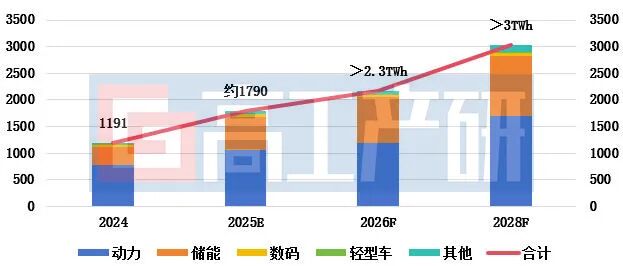
Core Insights - The core prediction for the Chinese lithium battery industry in 2026 indicates a total shipment volume exceeding 2.3 TWh, with a year-on-year growth of nearly 30% [1][2]. - The energy storage lithium battery shipments are expected to surpass 850 GWh, with a growth rate exceeding 35%, while power batteries (including those for passenger and commercial vehicles) will exceed 1.3 TWh, growing over 20% [1][2]. Industry Trends - The independent energy storage market in China is experiencing unexpected growth, supported by capacity price subsidy policies, which have improved the internal rate of return (IRR) for energy storage stations to between 6-12% [3]. - The demand for energy storage is driven by increased needs in Europe and the U.S., particularly in data centers [3]. Market Dynamics - The concentration of orders among leading companies has led to capacity shortages for major manufacturers, while smaller companies face idle capacity, highlighting a core contradiction in supply and demand [2][8]. - The "anti-involution" policy is effectively guiding industry expansion towards leading firms with technological and scale advantages, moving away from blind expansion [2][8]. Supply Chain and Pricing - The lithium battery supply chain is expected to see a collective price increase of over 10% due to tight supply and rising upstream material costs [11][12]. - The price of battery-grade lithium carbonate is projected to stabilize above 120,000 yuan/ton, with potential peaks exceeding 150,000 yuan/ton [11][12]. Production Capacity - The lithium battery industry is entering a third round of expansion, with new effective production capacity expected to exceed 700 GWh in 2026, primarily concentrated among top manufacturers [9]. - The demand for lithium battery equipment is anticipated to grow significantly, with market demand exceeding 65 billion yuan [9]. Emerging Technologies - Solid-state battery shipments are projected to exceed 15 GWh, driven by advancements in core materials and processes, although mass production remains a challenge [14]. - Sodium-ion battery shipments are expected to double to over 10 GWh, with the NFPP route dominating the market due to its cost-effectiveness and performance advantages [16][17]. IPO Trends - 2026 is expected to see a surge in IPO applications from lithium battery industry players, particularly in materials, equipment, and energy storage integration sectors [15]. - Companies with strong technological advantages and binding relationships with major clients are likely to accelerate their IPO processes [15].

年度榜单丨2025年中国储能电池出货量TOP20发布
起点锂电· 2026-01-06 11:04
Global Energy Storage Battery Shipment Analysis and Forecast - The report from Qidian Research Institute SPIR indicates that global energy storage battery shipments are projected to reach 358 GWh in 2024 and 637 GWh in 2025, representing a year-on-year growth of 77.93%. By 2030, shipments are expected to reach 2380 GWh. The main drivers for this growth include the transition in the global energy structure towards renewable energy sources like solar and wind, which increases the demand for energy storage batteries [2][3] - The demand for energy storage on the grid side is also expected to grow rapidly due to the increasing need for stability and flexibility in power systems, especially with the large-scale integration of renewable energy sources. Grid-side storage can effectively balance power supply and demand fluctuations, enhancing system stability [2] Market Concentration and Competitive Landscape - By 2025, the concentration ratio (CR6) of the energy storage cell industry is expected to reach around 50%, indicating a highly concentrated competitive landscape characterized by "one strong player and many strong challengers" along with emerging dark horses. CATL remains the leader, while companies like Chuangneng New Energy have rapidly entered the top five within four years [6] - Lithium iron phosphate (LFP) has become the dominant choice for energy storage cells, holding over 90% of the global market share. The ability to innovate in storage technology and control costs has become a significant competitive barrier for leading companies. The industry is anticipated to undergo a deep reshuffling period in the next two years, where technological innovation and scale advantages will be crucial for companies aiming to emerge as dark horses [8] Top 20 Energy Storage Battery Suppliers in China for 2025 - According to Qidian Research Institute SPIR, the top 20 energy storage cell suppliers in China for 2025 include CATL, EVE Energy, Chuangneng New Energy, Zhongchuang Innovation, Ruipu Lanjun, BYD, Guoxuan High-Tech, Penghui Energy, Rongjie Energy, Ganfeng Lithium, Zhongtian Energy, Xinwanda, Desay Battery, Haishida, Lishen Battery, Trina Storage, Kunyu Power, Nandu Power, Dufeng New Energy, and Xinneng An [9]

中创新航(03931) - 截至2025年12月31日止月份之股份发行人的证券变动月报表
2026-01-06 08:31
股份發行人及根據《上市規則》第十九B章上市的香港預託證券發行人的證券變動月報表 截至月份: 2025年12月31日 狀態: 新提交 致:香港交易及結算所有限公司 公司名稱: 中創新航科技集團股份有限公司 呈交日期: 2026年1月6日 I. 法定/註冊股本變動 | 1. 股份分類 | 普通股 | 股份類別 | H | | 於香港聯交所上市 (註1) | | 是 | | | --- | --- | --- | --- | --- | --- | --- | --- | --- | | 證券代號 (如上市) | 03931 | 說明 | H股 | | | | | | | | | 法定/註冊股份數目 | | | 面值 | | 法定/註冊股本 | | | 上月底結存 | | | 761,499,395 | RMB | | 1 RMB | | 761,499,395 | | 增加 / 減少 (-) | | | 0 | | | RMB | | 0 | | 本月底結存 | | | 761,499,395 | RMB | | 1 RMB | | 761,499,395 | | 2. 股份分類 | 普通股 | 股份類別 | 其 ...
2026开门红!宁德时代/国轩/中创新航三大项目101GWh新动态!
起点锂电· 2026-01-05 10:33
宁德时代加码贵州,新增产能30GWh 据贵州日报2025年12月31日发布消息显示, 宁德时代近期已与 贵安新区 正式签署 投资合作协议。 根据协议,宁德时代将在已建成投产的宁德时代(贵州)新能源动力及储能电池生产制造基地一期项目的基础上, 投资建设二期项目,规划 设计年产能30GWh动力及储能电池。 项目占地面积约550亩,将 延续"灯塔+零碳工厂"标准,打造高自动化产线,与一期形成协同效应。 回溯来看, 宁德时代 贵州基地一期于2021年11月落地,2023年10月建成投产,年产能同样为 30GWh。 随着二期项目落地,宁德时代在 贵安新区的总产能将达60GWh。 2025年末,锂电扩产潮还在持续!起点锂电注意到,在12月又有三大电池项目签约落地、进度更新,合计新增产能达到101 GWh。 01 据观察,2025年以来, 宁德时代持续开启产能大扩张模式。 11月, 江苏时代新能源灯塔工厂产业基地三期(LY9)项目签约落地溧阳高新区, 计划总投资不超过100亿元,新建年产能60GWh新能源 灯塔工厂产业基地三期项目(即LY9项目)。目前, 江苏时代已成为宁德时代最大制造基地之一, 不完全统计,宁德时代在溧阳 ...
全球储能年度最具竞争力10强排行榜(2025)|独家
24潮· 2026-01-04 23:06
Group 1 - The core viewpoint of the article highlights the intensifying competition in the global energy storage market, particularly driven by Chinese companies, which have signed overseas orders totaling approximately 280.35 GWh, significantly surpassing the new installed capacity of 81.5 GWh in 2024 [2][3] - The article discusses the impact of Western countries, led by the US and Europe, implementing trade policies aimed at increasing the costs of "Made in China" products to curb the competitiveness of Chinese energy storage solutions [2] - The historical context of the energy storage industry is provided, noting that it has undergone multiple economic and policy cycles, leading to both the rise and fall of numerous companies [3] Group 2 - The analysis from 24潮产业研究院 (TTIR) suggests that only companies with global layouts, strong market expansion capabilities, financial health, and significant brand influence will thrive in the future [3] - Major technology companies like Tesla, Huawei, BYD, and CRRC are increasingly penetrating the energy storage sector, which is expected to have a profound impact on the future landscape and development trends of the industry [3][4] - Starting in 2025, TTIR plans to release a "Top 10 Most Competitive Global Energy Storage Companies" ranking, evaluating companies based on five primary dimensions and various sub-dimensions to provide insights into their competitive strengths [4][6] Group 3 - The ranking will focus on key players in the energy storage industry, assessing their global influence, sustainability, technological innovation, operational management, and capital control [4][6] - The article includes a detailed breakdown of the evaluation criteria, with global industry influence accounting for 42%, sustainability for 22%, technological innovation for 12%, operational management for 12%, and capital control for 12% [6][7] - The preliminary rankings for the most competitive companies in the energy storage sector include Huawei, Tesla, BYD, and CATL, with Huawei leading at a score of 85.36 [9][19]



研判2025!中国飞机储能系统行业背景、产业链全景、发展现状及未来发展趋势分析:低空经济赋能增长,飞机储能系统市场规模迈向三百亿新程[图]
Chan Ye Xin Xi Wang· 2026-01-04 01:10
Core Insights - The aircraft energy storage system is a critical component for multi-electric and fully electric aircraft, integrating energy storage media, power conversion, control management, and safety protection to efficiently store and release energy as needed [1][2][3] - China is prioritizing the development of aircraft energy storage systems, implementing various policies to support technological research, airworthiness certification, and industrialization goals, laying a foundation for overcoming airworthiness barriers and accelerating commercialization [1][8] - The industry is experiencing rapid transformation, with a market characterized by chemical energy storage dominance and diverse technological supplements, including solid-state and hydrogen fuel cells as key technological directions [1][12] Industry Overview - The aircraft energy storage system integrates energy storage media, power conversion, control management, and safety protection, providing stable power supply for critical systems during various flight phases [2][3] - The system's core functions include emergency power supply, auxiliary power during high-demand phases, energy recovery capabilities, and stabilization of power grid fluctuations [3][4] Policy Support - China has introduced multiple policies to support the aircraft energy storage system industry, including the "Green Aviation Manufacturing Development Outline (2023-2035)" and "General Aviation Equipment Innovation Application Implementation Plan (2024-2030)" [7][8] - These policies focus on technological research subsidies, airworthiness certification, and expanding demonstration application scenarios, clearly defining core technology development directions and industrialization goals [7][8] Industry Chain - The industry chain is closely linked, with upstream focusing on core equipment and material supply, midstream on system integration and solutions, and downstream covering diverse application scenarios [8][9] - Key components include lithium-ion batteries, hydrogen fuel cells, and energy management systems, with battery costs being the largest component of the industry chain value [8][10] Current Market Dynamics - The market for aircraft energy storage systems is expected to grow rapidly, with projections indicating a market size exceeding 30 billion yuan by 2030 [1][12][14] - The low-altitude economy is a strategic emerging industry in China, driving demand for aircraft energy storage systems, particularly in eVTOL and industrial drone applications [12][13] Key Players - Major companies in the aircraft energy storage system industry include CATL, BYD, and Zhongxin Innovation, with a market share concentration among the top three companies exceeding 50% [14][15] - These companies are focusing on high energy density batteries and hybrid storage solutions, with significant advancements in energy density and system integration capabilities [15][16] Future Trends - The industry is expected to see three core development trends: diversification of technology routes, deepening of industry chain collaboration, and precise adaptation to market demands driven by the low-altitude economy [16][17][19] - Future technological advancements will focus on optimizing mainstream lithium batteries and developing solid-state and hydrogen fuel cells, while hybrid storage systems will become more prevalent [16][17] - The market structure will evolve from emergency backup systems to include core power and auxiliary control systems, driven by diverse application scenarios [19]
