
BANK OF CHINA(03988)

Search documents
贝莱德:在中国银行的持股比例升至6.16%
Ge Long Hui· 2026-01-12 10:12
格隆汇1月12日|香港交易所信息显示,贝莱德在中国银行H股的持股比例于01月06日从5.96%升至 6.16%。 ...

中国银行入选“2025中国企业ESG百强”榜单
Xin Lang Cai Jing· 2026-01-12 10:02
附:"2025中国企业ESG百强"榜 新浪财经ESG评级中心提供包括资讯、报告、培训、咨询等在内的14项ESG服务,助力上市公司传播ESG理念,提升ESG可持续发展表现。点 击查看【 ESG评级中心服务手册】 在全球可持续发展浪潮席卷而来的当下,ESG(环境、社会、公司治理)已成为衡量企业高质量发展的核心标尺,更是连接企业价值与社会价值的关键纽 带。随着国内ESG生态体系的加速完善,政策监管持续收紧、资本市场对ESG表现的关注度不断飙升,企业的可持续发展能力愈发成为其核心竞争力的重 要组成部分。 在此行业背景下,新浪财经重磅发布"2025中国企业ESG百强"榜单。该榜单依托新浪财经专业的ESG评级体系,以5000余家A股上市公司及在港上市内地 企业为评价对象,创新性搭建18套行业ESG评价模型,纳入150余项ESG指标,通过量化模型综合演算,对企业ESG表现进行全面、客观的综合评价,最 终筛选出中国ESG实践的标杆企业。榜单不仅为行业树立了发展典范,更为投资者提供了极具参考价值的决策依据。 中国银行在环境、社会、公司治理领域开展了大量工作,积累了丰富的创新实践与扎实的落地成果。凭借在ESG各领域的卓越表现,中 ...


中国银行多举措筑牢反诈防线 守护民众“钱袋子”
Qi Lu Wan Bao· 2026-01-12 08:47
Core Viewpoint - The article highlights the increasing severity of telecom network fraud, which has become industrialized, organized, and cross-border, with fraudsters utilizing big data and psychological tactics for targeted scams [1] Group 1: Fraud Characteristics - Fraudsters tailor their schemes based on different demographics, targeting the elderly with impersonations of friends or law enforcement, young people with online shopping and gaming traps, and corporate finance personnel with impersonations of executives requesting fund transfers [1] Group 2: Prevention Measures - The Bank of China emphasizes key prevention points for the public, including not disclosing important information like bank card passwords and SMS verification codes, being cautious of enticing offers with "zero threshold," "no collateral," and "high returns," and verifying identities through multiple channels before making fund transfers [1] - The bank has established a "police-bank linkage" mechanism to monitor and verify abnormal transactions in real-time, successfully intercepting multiple fraud cases [1] - The bank recommends downloading the National Anti-Fraud Center APP, which activates fraud warning features to enhance mobile security [1] Group 3: Public Awareness - Prevention of fraud relies not only on technological measures but also on raising public awareness, as illustrated by catchy slogans used in anti-fraud campaigns [2] - The bank calls for collective efforts from the public to strengthen the anti-fraud defense and protect personal and family assets [3]
中国银行珠海南坑支行喜迎乔迁开业
Nan Fang Du Shi Bao· 2026-01-12 08:25
历经数月精心筹备,中国银行珠海南坑支行(以下简称"南坑中行")于2026年1月12日乔迁开业!新址 位于珠海市香洲区紫荆路93号铭泰城市广场"焕MALL"一楼。乘着此次迁址的东风,南坑中行将致力于 持续提升客户体验,为周边居民和企业带来更具效率与温度的金融服务。 南坑中行行长郭少华表示,南坑中行将以迁址为契机,继续秉承"金融为民"初心,坚持以客户为中心, 进一步扩大业务覆盖面和金融服务半径,为香洲城区广大新老客户提供高效贴心的全品类金融服务。 下一步,南坑中行将紧跟地区发展步调,不断打造"专业化、特色化、差异化、优质化"的核心竞争力, 扎根珠海,联通港澳,服务湾区。通过不断提升金融服务质效,拓宽金融服务边界,让更加优质专业的 现代化金融成果更多、更便捷地惠及广大珠海市民及周边企事业单位,在服务地方经济民生发展中持续 彰显中国银行的责任担当。 此次乔迁开业,南坑中行充分贯彻"以人为本"理念,以全新面貌呈现在客户面前:网点分区更为合理, 业务动线更加流畅,各类标识简洁清晰,功能完善的各类智能服务设施可满足多元化业务需求,为客户 提供更加智能、便捷、温暖的金融服务。 ...

2025年全球最赚钱银行,被中国包场了!
Jin Tou Wang· 2026-01-12 08:22
Group 1 - The ranking of the world's most profitable banks in 2025 shows that the top four positions are held by Chinese banks, with Industrial and Commercial Bank of China (ICBC) at the first place, followed by China Construction Bank (CCB), Agricultural Bank of China (ABC), and Bank of China (BOC) [1] - Among the top 10 banks globally, six are from China, and in the top 20, there are ten Chinese banks, indicating a significant presence in the global banking sector [3] - Chinese banks accounted for 25% of the total profits of over 11 trillion yuan generated by the world's top 1000 banks, amounting to approximately 2.6 trillion yuan [3] Group 2 - China's total bank savings have surpassed 80 trillion yuan, which is higher than the combined savings of the United States, Germany, and Japan, showcasing a leading savings rate [4] - The trend of high savings has led to challenges for banks, as the lack of loan demand affects profitability, prompting a continuous decline in interest rates [4] - The one-year fixed deposit rate has fallen below 1%, and the five-year rate has dropped to 1.3%, indicating a shift in the banking landscape [4] Group 3 - Since 2010, China has experienced two significant rounds of deposit "migration" and one round of deposit return, influenced by the growth of the asset management industry and regulatory changes [5] - From 2018 to 2023, the introduction of new regulations and market conditions led to a rebound in resident deposit growth, reaching 20% by 2023 [7] - As of 2024, with declining deposit rates and a recovering capital market, a new wave of deposit migration is expected, with a projected 30 trillion yuan in fixed deposits maturing [8] Group 4 - Many depositors are shifting their funds into bank wealth management products, with the scale of these products exceeding 32 trillion yuan by the third quarter of 2025 [8] - The average annualized return of alternative products, such as "Stable Profit Treasure," is reported at 2.32%, attracting younger investors [8] - The ongoing trend of wealth diversification in a low-interest-rate environment emphasizes the need for individuals to enhance their financial literacy and adapt their investment strategies [10]



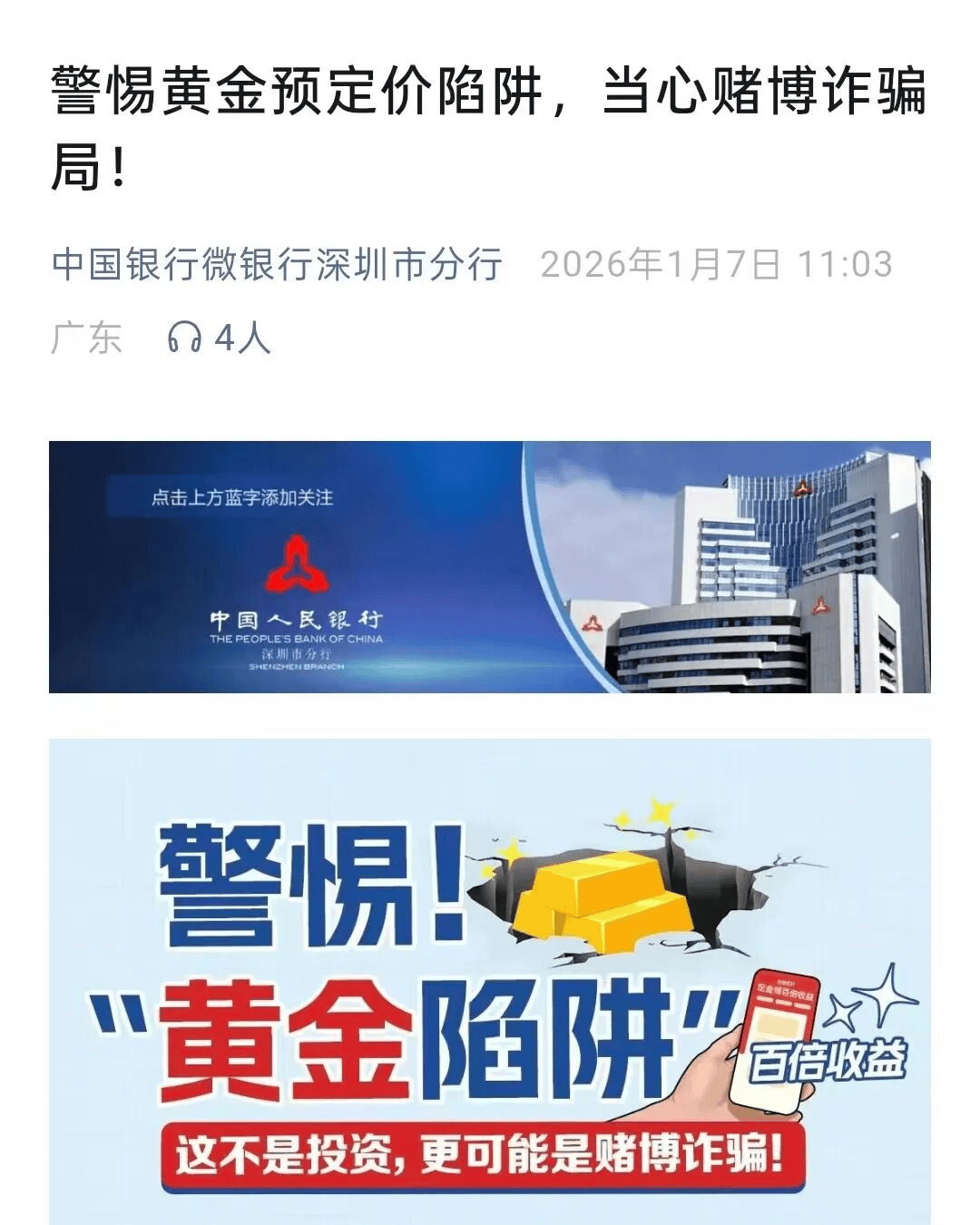
黄金首次突破4600美元关口,中国银行深圳分行紧急提示:警惕黄金预定价陷阱
Sou Hu Cai Jing· 2026-01-12 07:32
Core Viewpoint - The international gold market has achieved a significant breakthrough in early 2026, with spot gold prices surpassing $4600 per ounce for the first time, driven by continuous purchases from central banks and high investment interest in gold [1][2]. Group 1: Historical Price Records - As of January 12, 2026, the London spot gold price reached a peak of $4601.38 per ounce, marking a daily increase of over 2% [2]. - In 2025, international gold prices saw a cumulative increase of over 60%, the largest annual gain in nearly 46 years, setting the stage for the new high [2]. - Domestic gold prices also surged, with Shenzhen's real-time gold sales reaching 1018.27 yuan, reflecting a strong correlation with international price movements [2]. Group 2: Risk Warnings from Major Banks - Major state-owned banks, including Bank of China and Industrial and Commercial Bank of China, have issued risk warnings and adjusted trading rules to guide investors towards more rational participation in gold investments [3][7]. - Bank of China has specifically warned against "gold pre-pricing" investment traps, highlighting the risks of illegal trading platforms that lure investors with promises of low thresholds and high returns [7]. - Industrial and Commercial Bank has raised the minimum investment threshold for its gold accumulation products from 1000 yuan to 1100 yuan, indicating a proactive approach to risk management [7]. Group 3: Central Bank's Role - The strong performance of gold prices is closely linked to the People's Bank of China's ongoing accumulation of gold, with reserves reaching 74.15 million ounces as of December 2025, an increase of 30,000 ounces from the previous month [9]. - The central bank has been increasing its gold holdings for 14 consecutive months, reinforcing gold's significance in reserve asset allocation [9]. Group 4: Divergent Market Outlook - Market institutions have differing views on the future trajectory of gold prices, with a consensus on short-term high volatility [11]. - The World Gold Council suggests that current gold prices reflect expectations of stable global economic growth and a potential interest rate cut cycle, predicting a short-term fluctuation within a ±5% range [11]. - Various macroeconomic scenarios indicate potential price movements: a 5% increase if economic growth slows, a 15%-30% rise in case of a deep recession, and a 5%-20% decline if a strong economic recovery strengthens the dollar [11]. - Analysts from Everbright Securities express an optimistic outlook, predicting a target price of $4950 per ounce for gold in 2026, emphasizing its role as a crucial asset in investment portfolios amid rising geopolitical risks and inflation pressures [11].
金价持续上涨 国有大行接连发布相关黄金交易提示或规则调整
Sou Hu Cai Jing· 2026-01-11 23:26
Core Viewpoint - The recent rise in gold prices has led to increased trading risks, prompting major Chinese banks to issue warnings about potential scams and illegal trading practices in the gold investment sector [1] Group 1: Gold Price Trends - As of last week, COMEX gold futures rose by 1.29%, reaching $4,518.4 per ounce, with a cumulative increase of 4.34% for the week [1] Group 2: Warnings from Chinese Banks - China Bank and Industrial and Commercial Bank of China have issued alerts regarding "gold investment" and "gold pre-pricing" scams, which are often promoted through social networks [1] - The Shenzhen branch of China Bank specifically warned about illegal trading platforms that lure investors with promises of low entry costs and high returns, such as "1,000 yuan can leverage one kilogram of gold," which are actually fraudulent schemes [1] Group 3: Nature of the Scams - These platforms simulate futures trading, allowing investors to bet on price movements while requiring a margin and a deposit of 2% to 5% of the gold price [1] - If gold prices fluctuate significantly and the deposit is insufficient to cover the difference, the platform may demand additional funds from investors or forcibly close their positions [1]
中国银行:以A轮融资为起点,配置600亿专项资金
Sou Hu Cai Jing· 2026-01-11 22:41
Core Viewpoint - The Bank of China has launched the "Innovation and Technology Customer Cultivation Plan" aimed at fostering high-level technological self-reliance and addressing critical bottleneck issues in key sectors through a comprehensive financial service model [2]. Group 1: Financial Support and Structure - The plan will allocate a total of 60 billion yuan, consisting of 10 billion yuan for equity investment and 50 billion yuan for credit funds, to support the cultivation of at least 100 high-quality enterprises with core technologies [2][3]. - The initiative will start with pilot programs in five cities: Beijing, Shanghai, Nanjing, Wuxi, Changzhou, Shenzhen, and Hangzhou [2]. Group 2: Implementation Strategy - The Bank of China will adopt a "pilot first, gradual promotion" approach to expand the program to other national technology innovation hubs [3]. - A "combined equity and loan funding pool" will be established to support the entire value chain, including various funds tailored for different stages of enterprise development [3]. Group 3: Collaborative and Support Mechanisms - The plan emphasizes a unified understanding and process coordination to create comprehensive financing solutions through expert consultations and joint evaluations [3]. - An "innovation ecosystem alliance" will be formed with various partners, including state-owned investment institutions and leading venture capital firms, to provide a rich platform for financial and non-financial resource integration [3].

金价持续走高 国有大行筑牢交易安全线
Zheng Quan Shi Bao· 2026-01-11 17:00
Core Viewpoint - The recent rise in gold prices has led to increased trading risks, prompting major Chinese banks to issue warnings and adjust trading rules to protect investors [1][2]. Group 1: Gold Trading Risks - Since January 2026, major state-owned banks in China, including Bank of China and Industrial and Commercial Bank of China, have issued warnings regarding gold trading risks [1]. - The COMEX gold futures rose by 1.29% to $4,518.4 per ounce last Friday, with a weekly increase of 4.34% [1]. - Illegal trading platforms are attracting investors with promises of "low thresholds, high returns, and quick paybacks," which are essentially scams disguised as gold investment opportunities [1]. Group 2: Regulatory Adjustments - Bank of China has warned about illegal platforms that simulate futures trading, allowing investors to bet on price movements while requiring margin payments [1][2]. - The Shenzhen Municipal Office for the Prevention and Control of Illegal Financial Activities has issued risk alerts, stating that various gold and jewelry dealers are not licensed financial institutions and lack the qualifications to engage in gold asset management or public deposit solicitation [2]. - Industrial and Commercial Bank of China has raised the minimum investment for its gold accumulation business from 1,000 yuan to 1,100 yuan, effective January 8 [2]. Group 3: Risk Assessment Changes - Starting January 12, 2026, personal clients must undergo a risk assessment to engage in gold accumulation services, requiring a minimum risk tolerance rating of C3 - Balanced or higher [3]. - Previously, clients only needed a C1 - Conservative rating to participate in gold accumulation services [3]. - The adjustments reflect the need for investors to have a higher risk tolerance due to increased volatility in gold prices [3].

银行行业2025年度业绩前瞻:利息收入有望回正
ZHESHANG SECURITIES· 2026-01-11 15:27
Investment Rating - The industry investment rating is "Positive" [3][17] Core Insights - Interest income is expected to return to positive growth, supported by an improvement in net interest margins in Q4 2025, which will offset other non-interest impacts [1] - For the full year 2025, listed banks are projected to see a net profit growth rate of 1.8% and revenue growth of 1.2%, both showing a quarter-on-quarter improvement [1] - Quality city commercial banks are expected to lead the sector, with revenue and profit growth rates projected between 5-10% for 2025 [1] Summary by Relevant Sections Industry Outlook - The overall outlook for 2025 indicates an improvement in net profit and revenue growth for listed banks, primarily due to the alleviation of margin pressures and increased provisions [1] - The asset scale of listed banks is expected to grow by 9.0% year-on-year, reflecting a slowdown compared to previous quarters due to weak credit demand [1] Key Drivers - **Margin Stabilization**: Q4 2025 is expected to see a 2 basis point improvement in net interest margin to 1.32%, driven by a larger decline in funding costs compared to asset yields [1] - **Non-Interest Income**: Non-interest income is projected to grow by 3.2% year-on-year, a decrease from earlier quarters, with a slight positive trend in commission income [1] - **Credit Quality**: The credit cost ratio is expected to decline to 0.67%, indicating a stable improvement in non-performing loans, particularly in retail lending [1] Investment Recommendations - The report suggests that banks with new growth drivers are likely to see significant value recovery, recommending major state-owned banks and select city commercial banks as key investment targets [1][2]
