
MICROSOFT(04338)

Search documents
微软云服务受到欧盟反垄断部门的审查
Xin Lang Ke Ji· 2025-11-26 07:09
Core Viewpoint - Microsoft Azure cloud services are under investigation by the EU antitrust authorities due to concerns about potential anti-competitive practices [1] Group 1: EU Antitrust Investigation - The EU is conducting an informal investigation into Microsoft's cloud services, focusing on whether the company is using its market power to eliminate competitors [1] - EU regulators have inquired with Microsoft's competitors and customers regarding possible violations related to Microsoft's cloud services [1] - The investigation aims to determine if Microsoft is leveraging confidential information to compete against cloud service providers in the market [1] Group 2: Microsoft's Response and Developments - In response to the scrutiny, Microsoft announced a new suite of artificial intelligence solutions aimed at improving cloud services for non-profit organizations [1] - The new AI suite is designed to transform how non-profits and fundraisers engage with donors, manage activities, and optimize operations [1] - On the same day, the EU regulatory body approved Microsoft's nearly $69 billion acquisition of Activision Blizzard [1]
消息称欧盟下周批准微软690亿美元收购动视暴雪交易
Xin Lang Ke Ji· 2025-11-26 07:04
Core Points - The European Union is expected to approve Microsoft's $69 billion acquisition of Activision Blizzard next week, with a likely date of May 15 [1] - Microsoft has reached licensing agreements with competitors in cloud gaming, including Nvidia, Boosterid from Ukraine, and Ubitus from Japan, which has influenced the EU's decision [1] - The acquisition would position Microsoft as the third-largest gaming company in terms of revenue, following Tencent and Sony, once completed [2] Regulatory Status - The acquisition has already received approval from six countries: Saudi Arabia, Brazil, Serbia, Chile, Japan, and South Africa, while awaiting decisions from the US, UK, and EU [2] - The UK antitrust authority recently blocked the deal, citing concerns over its impact on future competition in the cloud gaming market [2] - Microsoft has engaged a prominent lawyer to challenge the UK's ruling [2]

投行韦德布什力挺AI浪潮:押注微软(MSFT.US)和英伟达(NVDA.US)等十大科技股,断言“当前绝非泡沫”
Zhi Tong Cai Jing· 2025-11-25 12:56
Group 1 - The core viewpoint of the articles is that the current environment is not an AI bubble, with significant growth in AI-related transactions among large enterprises [1][2] - Analysts from Wedbush Securities, led by Daniel Ives, observed nearly a 20% acceleration in AI transaction flows among large enterprises, driven by end-user clients focusing on application scenarios before 2026 [1] - The "AI revolution" is still in its early stages, with a new wave of AI strategy deployments expected as more enterprise clients recognize the importance of AI [1] Group 2 - The team predicts that technology giants' capital expenditures will range between $550 billion and $600 billion by 2026, with massive AI-related spending emerging from governments, global Fortune 2000 companies, and regions like Asia and the Middle East [1] - Five key reasons are provided to support the assertion that the current environment is not an AI bubble, including the fact that the consumer-side "AI revolution" has not yet started and that less than 5% of U.S. companies have implemented AI strategies [1] - Concerns regarding circular financing between OpenAI and Nvidia are deemed misplaced, as both companies are seen as foundational players in the upcoming multi-trillion-dollar AI construction wave [2] Group 3 - The remaining list of recommended technology stocks includes Palantir (PLTR.US), AMD (AMD.US), Tesla (TSLA.US), Apple (AAPL.US), Meta (META.US), Alphabet (GOOGL.US), Crowdstrike (CRWD.US), and Palo Alto Networks (PANW.US) [2] - Despite recent investor concerns, the analysts maintain a positive outlook on technology stocks through the end of the year and into 2026 [2]
谷歌市值冲击四万亿美元,超过微软进入美股总市值前三
Di Yi Cai Jing· 2025-11-25 12:24
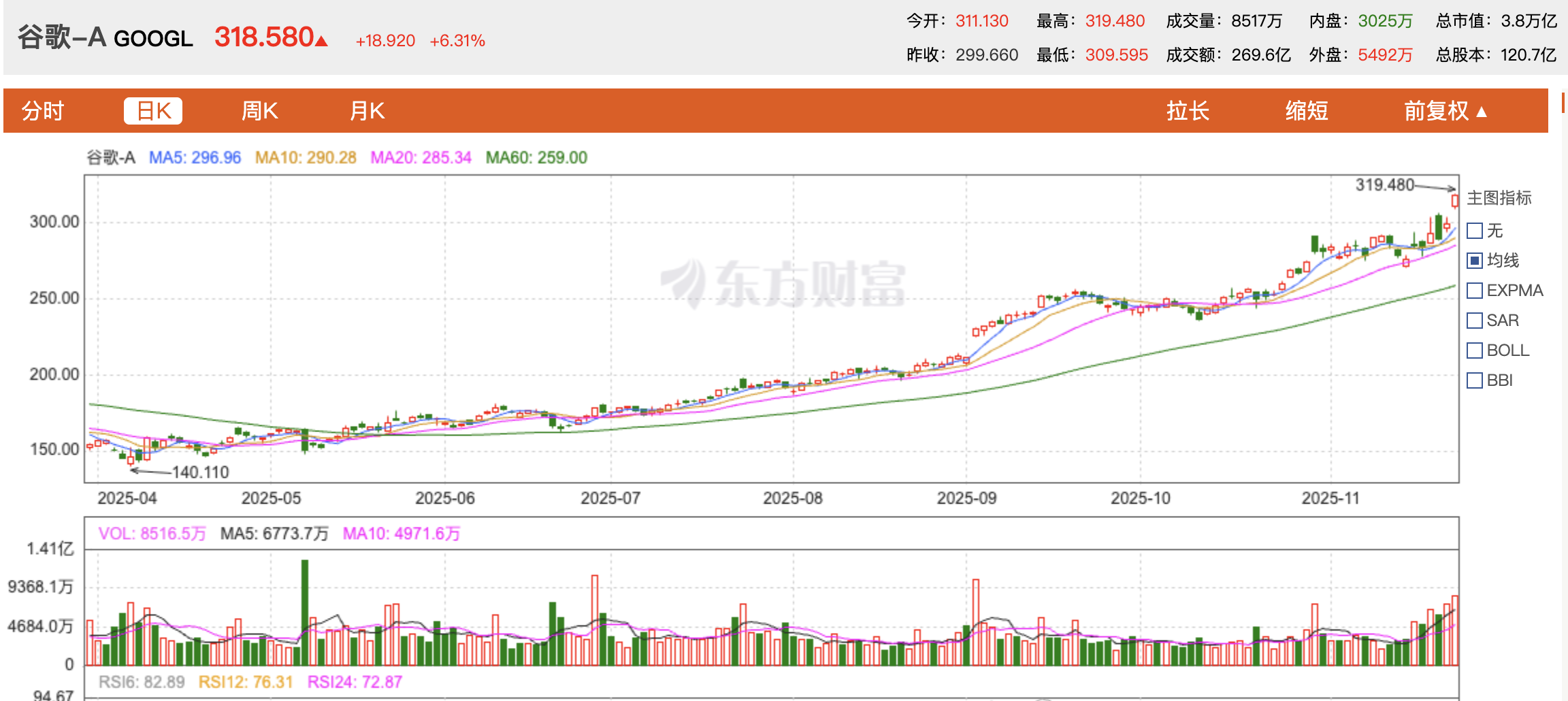
Core Insights - Google's stock has surged over 20% in the past month, with a significant increase of over 4% before market opening on November 25, potentially pushing its market capitalization to over $4 trillion for the first time [1][4] - The release of new AI models, Gemini 3 Pro and Nano Banana Pro, has generated excitement in the AI community, allowing Google to surpass OpenAI and achieve record market valuations [1][4] - Google's TPU chips are being marketed to clients, including Meta, which is considering a multi-billion dollar investment to integrate Google's TPU into its data centers, marking a strategic shift for Google [4][6] Financial Performance - Google's stock price has risen from approximately $190 per share at the beginning of the year to $318.58, reflecting a year-to-date increase of over 67% [4][5] - As of November 25, Google's market capitalization exceeded $3.8 trillion, surpassing Microsoft's $3.52 trillion, placing it among the top three companies in the U.S. stock market [1][4] AI Strategy and Market Position - The Gemini 3 series is seen as a pivotal milestone in Google's AI strategy, potentially allowing it to reclaim a leading position in the AI race against OpenAI [5][6] - Monthly active users for Gemini have surpassed 650 million, with over 2 billion users engaging with AI features in search, indicating a growing user base [5] - Google’s comprehensive approach, covering chips, cloud services, large models, and applications, positions it uniquely in the AI landscape, contrasting with competitors that rely on rented computing power [7] Market Trends and Investor Sentiment - The stock prices of competitors like Nvidia and Microsoft have seen declines, while Google's stock and its partner Broadcom have experienced significant gains, indicating a shift in investor confidence [5][6] - Loop Capital upgraded Google's parent company rating from "hold" to "buy," raising the target price from $260 to $320, reflecting positive market sentiment [6] - Berkshire Hathaway has increased its stake in Google, becoming the company's tenth-largest shareholder, further highlighting investor interest [6]


雷军花1亿港元增持小米;微软发布7B小语言模型丨科技风向标
2 1 Shi Ji Jing Ji Bao Dao· 2025-11-25 02:14
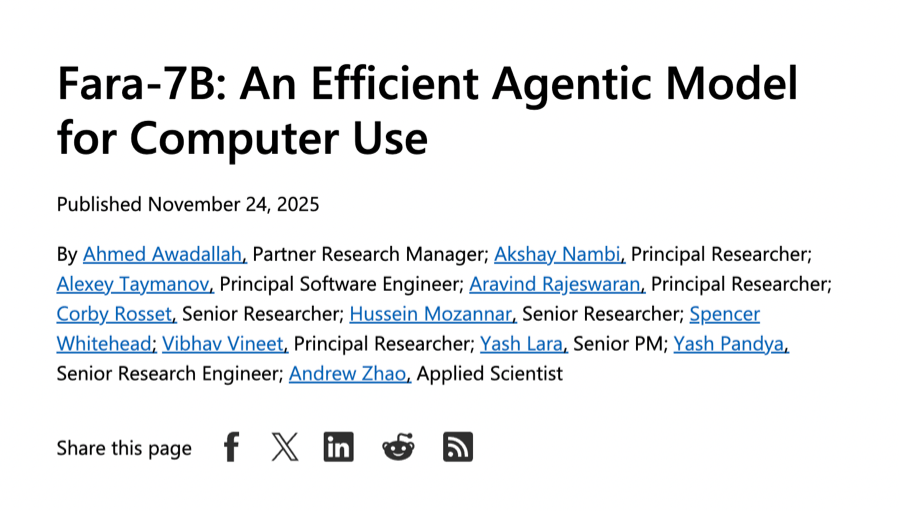
Group 1: Technology Developments - Microsoft launched FARA-7B, a small language model designed for computer use, featuring 7 billion parameters and advanced performance compared to larger models [2] - Anthropic released Claude Opus 4.5, which excels in coding and intelligent agent tasks, indicating a significant shift in future work methods [4] - OpenAI introduced a shopping search feature in ChatGPT, allowing users to find suitable products through personalized buyer guides [5] Group 2: Company Responses and Financial Updates - Industrial Fulian's stock fell by 7.80% amid rumors of a performance downgrade, but the company clarified that its fourth-quarter operations are proceeding as planned and no adjustments have been made to profit targets [7] - Lei Jun, founder of Xiaomi, purchased 2.6 million shares at an average price of approximately 38.58 HKD per share, totaling over 100 million HKD, increasing his stake to about 23.26% [9] - Wanxing Technology announced that several products have integrated with Google's new image generation and editing model, Nano Banana Pro [12] Group 3: Market and Investment Activities - The online issuance of "domestic GPU first stock" Moer Thread had an effective subscription rate of 0.03635054% after the call-back mechanism was activated, with an issue price of 114.28 CNY per share [20] - Hanqi Technology completed a multi-million B round financing aimed at establishing a research and production base in East China, focusing on semiconductor packaging automation [21] Group 4: Financial Performance - Wenyuan Zhixing reported a 144.3% year-on-year revenue increase to 171 million CNY in Q3 2025, with Robotaxi business revenue soaring by 761% to 35.3 million CNY [22]




雷军花1亿港元增持小米;微软发布7B小语言模型丨新鲜早科技
2 1 Shi Ji Jing Ji Bao Dao· 2025-11-25 01:55
Group 1: Technology Developments - Microsoft launched FARA-7B, a small language model designed for computer use, featuring 7 billion parameters and advanced performance compared to larger models [2] - Anthropic released Claude Opus 4.5, which excels in coding, intelligent agents, and everyday tasks, indicating a significant shift in work methods [3] - OpenAI introduced a shopping research feature in ChatGPT, allowing users to find suitable products through personalized buyer guides [4] Group 2: Company Responses and Financial Updates - Industrial Fulian's stock fell by 7.80% due to rumors of performance downgrades, but the company clarified that its fourth-quarter operations are proceeding as planned and no adjustments have been made [5] - Xiaomi's founder Lei Jun purchased 2.6 million shares at an average price of approximately 38.58 HKD per share, totaling over 100 million HKD, increasing his stake to about 23.26% [7] - Wanxing Technology announced that several products have integrated with Google's new image generation and editing model, Nano Banana Pro [11] Group 3: Market Performance and Innovations - Qianwen App achieved over 10 million downloads within a week, becoming the fastest-growing AI application to date [6] - Ziguang Corporation's 800G CPO silicon optical switch has achieved mass production capabilities, supporting high bandwidth and multiple ports [16] - The first wafer flatness measurement device from Zhongke Feicai has been delivered to HBM field customers, designed for high-precision geometric and nano morphology detection [18] Group 4: Financial Performance - Wenyuan Zhixing reported a 144.3% year-on-year revenue increase to 171 million CNY in Q3 2025, with Robotaxi business revenue soaring by 761% [21]

美股科技巨头股价走势分化,谷歌、博通涨约6%,英伟达、微软均跌0.7%




Mei Ri Jing Ji Xin Wen· 2025-11-24 15:06
每经AI快讯,11月24日,美股科技巨头股价走势分化,谷歌、博通涨约6%,英伟达、微软均跌0.7%。 (文章来源:每日经济新闻) ...
比尔·盖茨当年未拿下的经典文字冒险游戏《魔域》,现被微软采用MIT开源,引发全球开发者狂欢!
3 6 Ke· 2025-11-24 11:38
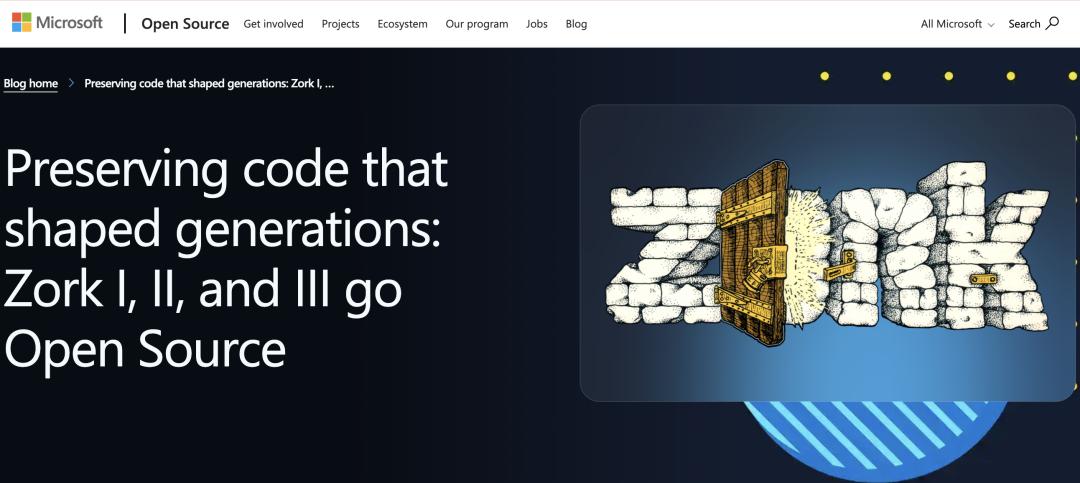
Core Insights - Microsoft has officially open-sourced the source code of the classic text adventure game "Zork" trilogy, which includes "Zork I," "Zork II," and "Zork III," under the MIT license, allowing anyone to view, study, and build upon the code [1][9][10] - This move is part of Microsoft's broader open-source strategy, which aims to engage enthusiasts and developers in learning and creating based on historical software [1][9] - The Zork games are significant in the history of computer gaming, having established foundational elements of interactive storytelling and text-based adventure games [3][5][15] Microsoft and Zork's History - Microsoft acquired the rights to the Zork IP as part of its 2023 acquisition of Activision Blizzard, which had previously obtained the rights through its purchase of Infocom, the original publisher of Zork [7][9] - Microsoft had shown interest in acquiring Zork as early as the 1980s, with Bill Gates being a fan of the game [7][9] Technical Aspects - The Zork games were originally developed using a virtual machine engine called Z-Machine, which allowed the same game content to run on multiple platforms without needing to be rewritten for each one [4][5] - The open-sourced code includes not only the game source but also accompanying documentation, build instructions, and clear licensing information [9][10] Community and Educational Impact - The open-sourcing of Zork is intended to provide students, teachers, and developers with access to historically significant code for educational purposes [9][15] - The initiative has been well-received by the gaming community, with many expressing nostalgia and appreciation for the impact Zork has had on their lives [15][17]
谷歌、微软“双杀”逼近,OpenAI陷入空前危机
3 6 Ke· 2025-11-24 11:09
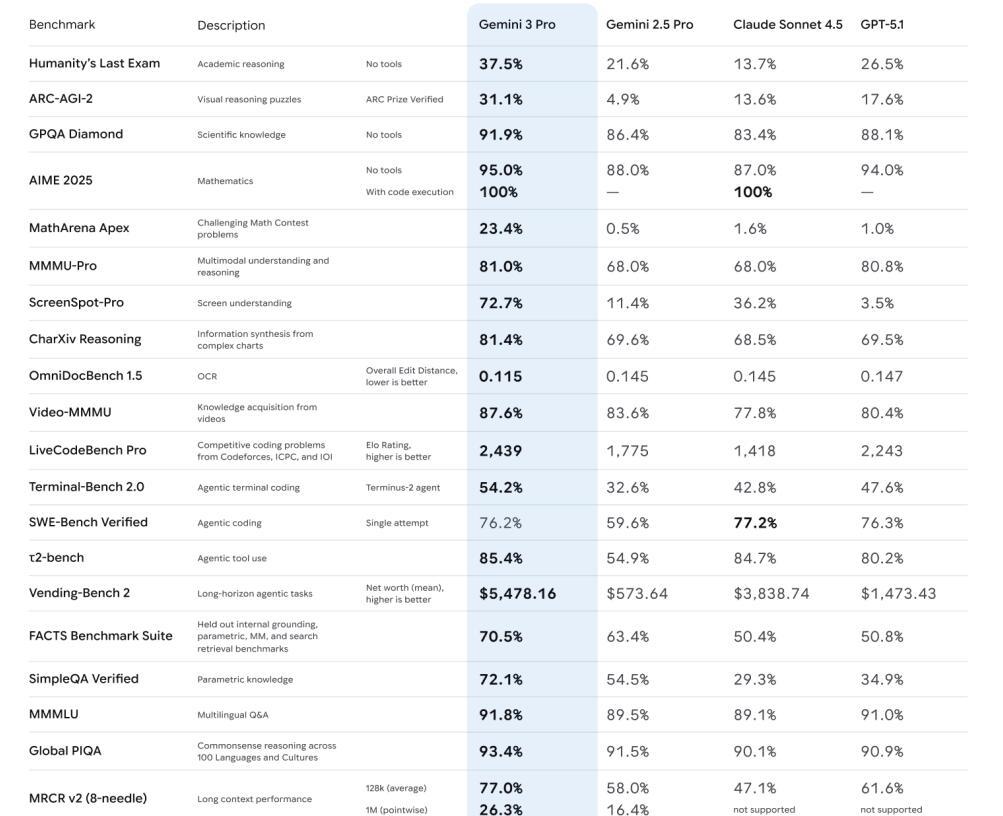
Core Insights - OpenAI faces significant challenges as its main partner Microsoft and chip giant Nvidia form a $350 billion strategic partnership with competitor Anthropic, nearly doubling Anthropic's valuation since September [1] - Google's release of its latest AI model, Gemini 3, reportedly surpasses OpenAI's recently launched GPT-5.1 in early tests, indicating a shift in competitive dynamics within the AI sector [1] - The market sentiment remains unstable, with concerns over an AI bubble leading to a tech stock sell-off, despite Nvidia's strong earnings report reigniting investor interest [1] Market Dynamics - Analysts express divided opinions on OpenAI's ability to maintain its leading position, with some predicting that competitors like Anthropic and Google will continue to erode OpenAI's market share [2] - Mike O'Rourke from JonesTrading highlights Google's scale and industry position as factors that could allow Gemini to capture market share from OpenAI [2] - AI skeptic Gary Marcus argues that OpenAI has squandered its technological lead, suggesting that Google has caught up [2] Competitive Performance - Gemini 3 Pro demonstrates significant advantages over competitors in multimodal processing capabilities, outperforming GPT-5.1 and Claude 4.5 in various benchmarks [3] - In specific tests, Gemini 3 Pro achieved notable scores, such as 37.5% in Humanity's Last Exam and 95.0% in AIME 2025, surpassing its predecessors and competitors [4] User Engagement and Market Position - Google claims its Gemini application has 650 million monthly active users, while OpenAI's ChatGPT reportedly reached 800 million weekly active users, indicating a narrowing user gap [5] - Nvidia's agreement to provide AI hardware to Anthropic suggests a potential weakening of OpenAI's computational resource advantage, enhancing Anthropic's R&D capabilities [5] Financial Strategy and Valuation Concerns - OpenAI plans to invest over $1.4 trillion in data center construction over the next few years, despite incurring significant quarterly losses [6] - The aggressive capital expenditure strategy raises concerns about the sustainability of OpenAI's high valuation amid fierce competition and potential revenue growth limitations [6]
微软AI CEO最新访谈:AI没有自我意识,不会成为新的物种
3 6 Ke· 2025-11-24 08:08
Group 1 - Mustafa Suleyman, CEO of Microsoft AI and co-founder of DeepMind, discusses the future of AI and its integration into daily life, predicting that by 2040, AI will have environmental awareness and will seamlessly assist in tasks like ordering groceries and scheduling [1][7][10] - The healthcare sector is identified as a significant opportunity, with predictions that everyone will have access to medical superintelligence for just $20 a month, drastically improving healthcare quality and accessibility [2][10] - Traditional education is expected to evolve, with a shift towards integrated skills that combine user experience, research, and aesthetics, rather than solely focusing on technical knowledge [2][11][13] Group 2 - AI is anticipated to handle mundane tasks and information processing, allowing humans to focus on innovation, integration, and communication [3][8] - The concept of "social intelligence" in AI is highlighted as the next breakthrough, enabling AI to better understand group dynamics and adjust communication styles in collaborative settings [2][20][23] - Mustafa emphasizes that AI should serve humanity and not be granted equal moral status, cautioning against the potential dangers of attributing human-like qualities to AI [5][6][19]