HTSC(06886)

Search documents
非银金融行业周报:利率引发保险调整,仍然看好非银板块长期表现-20260302
East Money Securities· 2026-03-02 08:37
Investment Rating - The report maintains an "Outperform" rating for the non-bank financial sector [2] Core Views - The non-bank financial sector is expected to show potential investment opportunities despite recent adjustments, particularly in the insurance segment, which is undergoing valuation adjustments due to interest rate changes [1][8] - The report highlights that the non-bank sector has experienced significant adjustments, suggesting that valuation levels are now attractive for potential investments [1][8] Summary by Sections 1. Securities Business Overview and Weekly Review - The China Securities Regulatory Commission (CSRC) has introduced new regulations for private fund information disclosure, effective from September 1, which aims to enhance transparency and reduce hidden risks in the private fund industry [14] - Major indices showed mixed performance, with the non-bank financial index declining by 1.90% compared to the Shanghai Composite Index's increase of 1.08% [16][19] - The average price-to-book (PB) ratio for the securities sector is reported at 1.34, indicating it is at the 31st percentile of its historical range [18][41] 2. Insurance Business Overview and Weekly Review - A new policy framework for low-altitude insurance has been established, aiming to create a comprehensive insurance system for low-altitude activities by 2030 [44][45] - The policy includes key initiatives such as mandatory insurance for unmanned aerial vehicles and the development of a product system covering the entire low-altitude industry chain [45][46] - The low-altitude insurance initiative is expected to open new growth avenues for the insurance industry, enhancing product development and risk management capabilities [46] 3. Market Liquidity Tracking - The central bank conducted a net withdrawal of 5,774 billion yuan in the open market during the week, indicating a tightening of liquidity conditions [53]


金融行业周报(2026、03、01):外资机构座谈会召开,坚定金融市场改革决心-20260301
Western Securities· 2026-03-01 09:06
Investment Rating - The report does not explicitly state an investment rating for the non-bank financial sector, but it provides insights into various segments such as insurance, brokerage, and banking, indicating potential investment opportunities and strategies [1][2][3]. Core Insights - The non-bank financial index decreased by 1.18% this week, underperforming the CSI 300 index by 2.26 percentage points. The insurance sector saw a decline of 3.74%, while the brokerage sector fell by 0.39%. In contrast, the diversified financial index increased by 3.90% [1][10]. - The insurance sector is experiencing a short-term adjustment due to profit-taking, a shift of funds towards growth sectors, and a lack of policy and earnings reports. However, the medium-term outlook remains positive as insurance companies are expected to increase equity allocations in 2026, supported by economic recovery and low valuations [2][14]. - The brokerage sector is expected to benefit from the recent capital market planning discussions, which emphasize market openness and reform. The report suggests that leading brokerages with strong cross-border capabilities will likely gain from these developments [2][16]. - The banking sector is viewed as a potential investment opportunity, particularly as macroeconomic conditions improve. The report recommends focusing on banks with high earnings elasticity, high dividend yields, and those expected to benefit from convertible bond catalysts [3][19]. Summary by Sections Insurance Sector - The insurance sector's index fell by 3.74%, underperforming the CSI 300 index by 4.82 percentage points. The decline is attributed to profit-taking and a shift in market sentiment towards growth sectors [2][13]. - Despite the short-term pullback, the long-term outlook for the insurance sector is optimistic, with expectations of increased equity allocations and a favorable economic environment supporting valuation recovery [14][15]. - Recommended stocks include New China Life Insurance, China Pacific Insurance, China Ping An, and China Life Insurance [15]. Brokerage Sector - The brokerage sector index decreased by 0.39%, underperforming the CSI 300 index by 1.47 percentage points. The sector's price-to-book (PB) ratio is currently at 1.33x, indicating a mismatch between earnings and valuations [2][16][17]. - The report highlights the importance of selecting brokerages based on their strengths and potential for mergers and acquisitions, recommending firms like Guotai Junan and Huatai Securities [17][18]. - The recent discussions by the China Securities Regulatory Commission signal a commitment to market reform and openness, which could benefit leading brokerages [16]. Banking Sector - The banking sector index fell by 0.92%, underperforming the CSI 300 index by 2.00 percentage points. The sector's PB ratio is at 0.50x, suggesting potential undervaluation [3][18]. - The report emphasizes the banking sector's resilience and potential for recovery as macroeconomic conditions improve, recommending banks with strong earnings potential and high dividend yields [19]. - Suggested banks for investment include Hangzhou Bank, Ningbo Bank, and China Merchants Bank, among others [19].




AI助力金融公司降本增效,板块波动后迎配置机遇
GF SECURITIES· 2026-03-01 08:06
Core Insights - The report emphasizes that AI technology is driving cost reduction and efficiency improvements in financial companies, presenting a configuration opportunity for the sector after recent volatility [1] - The report highlights the ongoing influx of incremental capital into the market, suggesting that the stability of the capital market enhances the sector's tool attributes, making it a favorable investment opportunity [1] Group 1: Market Performance - As of February 28, 2026, the Shanghai Composite Index rose by 1.98%, while the Shenzhen Component Index increased by 2.80% [9] - The average daily trading volume in the Shanghai and Shenzhen markets reached 2.44 trillion yuan, a 15.60% increase month-on-month [4] Group 2: Industry Dynamics and Weekly Commentary Insurance Sector - Short-term stock price fluctuations do not alter the positive long-term fundamentals of the insurance sector, with expectations for improved long-term premium and fee differentials [14] - The approval of AI applications in insurance pricing has raised concerns about potential disruptions in the core insurance value chain, leading to a temporary decline in domestic insurance stocks [14] - The report suggests that leading insurance companies are likely to accelerate digital transformation through AI applications, enhancing their competitive edge [14] Securities Sector - The "15th Five-Year" planning meeting for foreign capital institutions was held, indicating a deepening of capital market openness [15] - The meeting aims to incorporate foreign institutions' suggestions into the planning process, enhancing the market's internationalization and stability [16] - The report anticipates that the capital market's institutional opening will accelerate, creating new opportunities for securities firms, particularly in cross-border business [20] Group 3: Investment Recommendations - The report recommends focusing on specific stocks within the insurance sector, including China Ping An, China Life, and New China Life, due to their strong fundamentals and growth potential [14] - In the securities sector, firms such as Guotai Junan, Huatai Securities, and CITIC Securities are highlighted as having significant investment opportunities due to their competitive advantages and market positioning [4][14]



1月1.84亿股民涌入炒股软件
2 1 Shi Ji Jing Ji Bao Dao· 2026-02-27 13:29
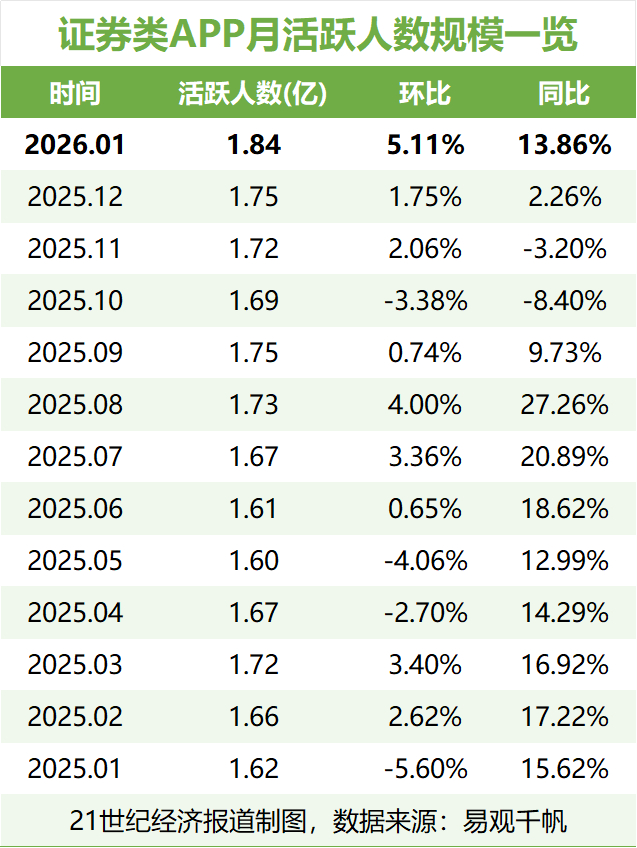
Core Insights - The A-share market is experiencing a "spring rally" in 2026, leading to increased trading activity and a surge in active users of stock trading apps, reaching 184 million in January 2026, a year-on-year increase of 13.86% and a month-on-month increase of 5.11% [1][2][3] User Activity Trends - The monthly active users of securities apps showed a fluctuating upward trend from January 2025 to January 2026, with a peak of 172 million in March 2025, followed by a decline to 160 million in May 2025, before rising again to 184 million in January 2026 [1][2] - The significant growth in January 2026 is attributed to the spring market conditions and a low base effect from the previous year's January due to fewer trading days caused by the Spring Festival [3] Leading Apps and Market Dynamics - Among the top 30 apps, "Tonghuashun" leads with 38.75 million active users in January 2026, followed by "Dongfang Caifu" and "Dazhihui" with 19.29 million and 13.76 million users, respectively [5][6] - The overall active user growth for securities apps is stable, with most apps experiencing a month-on-month growth rate between 5% and 7%, and year-on-year growth rates generally between 10% and 20% [5][6] Market Sentiment and New Accounts - The number of new accounts opened in January 2026 increased by 213% year-on-year, indicating strong investor interest in entering the market [7] - The balance of margin trading has reached historical highs, with new margin trading accounts totaling 190,500 in January, reflecting a month-on-month increase of 29.5% and a year-on-year increase of 157% [7] AI Integration in Securities Apps - The integration of AI tools into investment decision-making processes is enhancing user engagement, with over 30 securities firms deploying localized AI models for various services [9] - Major brokerages are utilizing AI for stock diagnosis, industry analysis, and asset allocation, transitioning from mere trading tools to comprehensive wealth management platforms [9][10] Future Trends in Securities Apps - The competition among securities apps is shifting from user scale to service value, with a focus on long-term client trust and the integration of AI capabilities into advisory services [10][11] - The industry is expected to see three key trends: deepening intelligent services, upgrading content ecosystems, and accelerating scenario integration to enhance user stickiness [11]




关于同意华泰证券股份有限公司为中金唯品会奥特莱斯封闭式基础设施证券投资基金提供主做市服务的公告
Xin Lang Cai Jing· 2026-02-27 10:14
Group 1 - The announcement states that Huatai Securities Co., Ltd. will provide primary market-making services for the closed-end infrastructure securities investment fund named "Vipshop Outlet" starting from March 2, 2026 [1] - The fund is identified by the code 508082 and aims to enhance market liquidity and stable operation [1] - The announcement is in accordance with the Shanghai Stock Exchange's self-regulatory rules regarding market-making for listed funds [1]
华泰证券2月26日获融资买入1.47亿元,融资余额61.97亿元
Xin Lang Cai Jing· 2026-02-27 05:54
Group 1 - The core viewpoint of the news is that Huatai Securities is experiencing fluctuations in its financing and stock performance, with a notable decrease in financing net purchases and a significant drop in operating revenue year-on-year [1][2]. Group 2 - As of February 26, Huatai Securities' stock price fell by 1.15%, with a trading volume of 1.488 billion yuan. The financing buy-in amount was 147 million yuan, while the financing repayment was 219 million yuan, resulting in a net financing buy of -72.28 million yuan [1]. - The total margin trading balance for Huatai Securities reached 6.209 billion yuan, with the financing balance of 6.197 billion yuan accounting for 3.95% of the circulating market value, which is below the 20th percentile level over the past year [1]. - On the same day, the company repaid 9,900 shares in securities lending and sold 21,800 shares, with a selling amount of 468,500 yuan, while the securities lending balance was 11.2393 million yuan, exceeding the 70th percentile level over the past year [1]. Group 3 - As of September 30, Huatai Securities had 195,500 shareholders, a decrease of 6.96% from the previous period, while the average circulating shares per person increased by 7.62% to 38,566 shares [2]. - For the period from January to September 2025, Huatai Securities reported operating revenue of 27.129 billion yuan, a year-on-year decrease of 13.67%, while the net profit attributable to shareholders increased by 1.69% to 12.733 billion yuan [2]. Group 4 - Huatai Securities has cumulatively distributed dividends of 42.893 billion yuan since its A-share listing, with 13.994 billion yuan distributed over the past three years [3]. - As of September 30, 2025, the top ten circulating shareholders included Hong Kong Central Clearing Limited, which held 442 million shares (a decrease of 108 million shares), and China Securities Finance Corporation, which maintained its holding of 153 million shares [3].
加速出海!证券基金业推进国际化布局
Shen Zhen Shang Bao· 2026-02-26 17:49
Group 1: Securities Firms' Internationalization - Over 10 securities firms have been actively expanding into overseas markets in the past year, with companies like Western Securities and First Capital announcing the establishment of wholly-owned subsidiaries in Hong Kong [1][2] - Notably, Northeast Securities and Huazhong Securities have received approval from the CSRC to increase capital for their Hong Kong subsidiaries, with Northeast Securities investing 500 million HKD [2] - Major firms like China Merchants Securities have set a record by increasing capital for their overseas subsidiaries by up to 9 billion HKD, highlighting the competitive landscape among top-tier firms [2] Group 2: Growth of QDII Funds - The total scale of QDII funds has surpassed 1 trillion yuan, reaching 1,006.4 billion yuan, marking a 60% year-on-year increase [5] - The successful performance of many QDII funds, with 30 products seeing net value growth exceeding 50%, has driven significant interest and investment in these products [5] - Public funds are increasingly collaborating with overseas institutions to enhance their international presence and provide asset allocation services to global clients [5] Group 3: Challenges and Opportunities - Despite the rapid internationalization, Chinese securities firms still lag behind international peers in brand influence, global pricing capabilities, and network layout [3] - The revenue contribution from international clients for top Chinese securities firms is only 20% to 30%, compared to 40% for leading international investment banks, indicating room for improvement [3]


券商国际业务系列专题之一:赋能金融强国,券商国际业务迎新篇
GUOTAI HAITONG SECURITIES· 2026-02-26 11:11
Investment Rating - The report assigns an "Accumulate" rating for the industry [4]. Core Insights - The international business of securities firms has become a significant growth driver, with contributions to overall profits increasing from 0.7% in 2018 to 8.2% in the first half of 2025 [15]. - The strategic importance of international business has risen, with major Chinese securities firms increasing capital investments in their international subsidiaries [17]. - The internationalization of securities firms is essential for building a world-class investment bank and enhancing capital allocation and asset pricing power in global markets [30]. Summary by Sections 1. Recent Trends in International Business - International business has become a key focus for securities firms, primarily serving the needs of clients "going out" and "bringing in" [7]. - The revenue from international business for 18 listed securities firms reached CNY 49.57 billion in 2024, a year-on-year increase of 43% [8]. - The net profit from international subsidiaries of these firms totaled CNY 13.75 billion in 2024, reflecting a year-on-year growth of 239% [13]. 2. The Necessity of Internationalization - The internationalization of securities firms aligns with the trend of Chinese enterprises expanding globally, necessitating enhanced financial services [22]. - Historical examples from leading global investment banks like Goldman Sachs and Morgan Stanley illustrate the importance of internationalization for growth and competitiveness [26]. 3. Current Focus Areas in International Business - The majority of international business is driven by investment income, with wealth management and investment banking also showing growth potential [3]. - There is a growing demand for cross-border wealth management services among Chinese residents, which could become a new growth engine for international business [3]. - The increasing frequency of overseas financing and cross-border mergers and acquisitions by Chinese companies highlights the need for robust investment banking services [3]. 4. Future Prospects of International Business - The international business of securities firms is expected to become a major direction for expansion, especially as domestic fixed-income self-operated businesses face challenges [44]. - The international business is characterized by higher leverage and return on equity (ROE), which could drive improvements in overall profitability for leading firms [48].
万顺新材:接受华泰证券等投资者调研

Mei Ri Jing Ji Xin Wen· 2026-02-26 09:52
Group 1 - Company Wan Shun New Materials announced that it will accept investor research on February 26, 2026, from 14:00 to 16:00, with representatives Huang Wei and Yang Shizhe participating to answer investor questions [1] Group 2 - The real estate market witnessed a significant event where over 100,000 participants overwhelmed servers to observe eight real estate companies competing for a "racecourse," resulting in 243 rounds of bidding over nine hours, with a total transaction value of 23.6 billion yuan [1] - A new land price record was set in Guangzhou, with the floor price reaching 85,000 yuan per square meter [1]
海外看中国:高端消费复苏启示录-华泰证券
Sou Hu Cai Jing· 2026-02-26 09:25
Group 1 - The high-end consumption market in China shows initial signs of recovery in 2025, characterized by rational recovery and structural differentiation, with the domestic personal luxury goods market's year-on-year decline narrowing to 3%-5% [1][21] - The market recovery follows a "J-shaped" pattern, with sales expected to turn positive in Q4 2025, showing a year-on-year growth of 1%-3% [1][21] - The recovery is driven by multiple factors, including a significant narrowing of the price gap between domestic and international luxury goods to around 12%, and the implementation of consumption-promoting policies [1][8] Group 2 - Consumer preferences are shifting from "material possession" to "experience first," with high-end service consumption, such as luxury hotels and health care, showing strong performance [1][31] - The luxury goods sector is experiencing a K-shaped differentiation, with beauty and personal care products growing by 4%-7%, while categories like leather goods and watches are declining by 8%-11% and 14%-17%, respectively [1][34] - The high-net-worth population is increasingly concentrated in eastern regions, with business owners now making up 54% of this demographic, becoming a core consumer force [2][9] Group 3 - The recovery in high-end consumption is attributed to a combination of factors, including consumer confidence restoration, policy support, and the adaptation of foreign brands to local market needs [1][8] - The average spending on luxury goods is expected to decrease slightly by about 4%, reflecting a more cautious consumer sentiment [28] - The high-end service sector, particularly in health and wellness, is projected to see increased spending, with intentions to spend on travel and health rising significantly among high-net-worth individuals [43][44]