
HTSC(06886)

Search documents
机构研究周报:关注新安全资产,人民币汇率或趋向6.7
Wind万得· 2026-03-29 23:09
Core Viewpoints - Geopolitical risks are shifting the logic of safe assets towards hard assets that enhance national resilience, with global funds moving from US stocks to non-US markets and cyclical sectors [5] - The Chinese yuan is expected to appreciate across the board, potentially approaching 6.7 against the US dollar, supported by strong export pricing power and a favorable trade balance [21] Economic Performance - In the first two months, industrial enterprises in China saw a profit increase of 15.2% year-on-year, with total profits reaching 10,245.6 billion yuan, driven by a recovery in domestic demand and supportive growth policies [3] - The mining sector's profits rose by 9.9%, while the manufacturing sector's profits increased by 18.9%, indicating a transition from passive destocking to active restocking [3] Equity Market Insights - CICC emphasizes a redefinition of safe assets, suggesting that Chinese assets may benefit from global asset reallocations due to their relative safety [5] - Wells Fargo highlights that price increase trades are becoming a core focus, driven by major project rollouts and rising oil prices, suggesting a favorable environment for cyclical sectors [6] - Zhonggeng Fund identifies six major investment themes based on the 14th Five-Year Plan, including modern industrial systems and green low-carbon initiatives [7] Industry Research - Huatai Securities projects significant growth in green electricity demand, estimating a need for 6.59 trillion kWh by 2035, which will benefit green electricity operators [12] - China Europe Fund notes that advancements in AI are expected to drive demand across various sectors, including large model APIs and security software [13] - Huaxia Fund recommends gradually accumulating positions in Hong Kong tech stocks, as current pessimism may have overshot, presenting long-term investment opportunities [14] Macro and Fixed Income - Bosera Fund anticipates that the internationalization of the yuan will enhance the attractiveness of yuan-denominated bonds, especially in a rising interest rate environment [22] - Guotai Fund warns that gold's safe-haven appeal is under pressure due to liquidity shocks, but its long-term value remains significant amid concerns over dollar credibility [23] Asset Allocation Strategies - Jiashi Fund advises investors to build a diversified and dynamic asset allocation strategy to navigate increased global economic volatility and achieve stable long-term growth [25]


【十大券商一周策略】调整是机会!坚守中国优势制造业
券商中国· 2026-03-29 14:57
Group 1 - The article emphasizes the importance of maintaining focus on China's advantageous manufacturing sector while awaiting decisions in April, amidst geopolitical tensions and supply chain disruptions [2] - It highlights the differences between current industrial demand impacts from energy supply disruptions compared to the oil crises of the 1970s and 1980s, noting a shift towards re-industrialization globally [2] - The article suggests three key areas to watch: acceleration of global electrification, domestic re-sourcing from overseas, and increased supply chain diplomacy [2] Group 2 - The article discusses the current market adjustment as an opportunity for investment in Chinese assets, noting that China's energy consumption from oil and gas is below 30%, which is lower than the global average [3] - It points out China's relatively stable security situation, economic environment, and complete supply chain system as unique advantages that are scarce globally [3] - The article recommends focusing on sectors such as technology manufacturing, including power equipment, new energy, and AI-related fields, while also considering high dividend yield investments [3] Group 3 - The article indicates that the market is currently experiencing a cautious trading environment due to geopolitical factors and liquidity tightening, with a focus on finding certainty in sectors like lithium batteries [5] - It suggests that the upcoming earnings reports in April may help stabilize market pricing and return focus to fundamental performance [5] - The article advises attention to sectors that can benefit from high oil prices and have cost pass-through capabilities, such as coal and electricity [5] Group 4 - The article notes that the recent easing of tensions in the US-Iran conflict has led to a recovery in market sentiment, but warns of potential escalation risks [6] - It suggests that the A-share market has adjusted sufficiently and is poised for potential upward movement, focusing on energy security and high cash flow products [6] - The article highlights sectors such as new energy, storage, and AI computing as areas of interest for investment [6] Group 5 - The article discusses the need for substantial actions to stabilize the capital market amidst liquidity shocks, emphasizing that the current market downturn may not lead to significant risks [7] - It points out that the capital market's stability will depend on when substantial actions are taken to support it [7] - The article recommends focusing on sectors with improving economic conditions, such as petrochemicals, coal, and construction materials [7] Group 6 - The article reiterates that the current market environment is characterized by uncertainty due to geopolitical tensions, but the long-term bull market for A-shares remains intact [9] - It emphasizes the importance of energy security and industrial upgrades as clear investment themes that support market resilience [9] - The article suggests that sectors with high earnings certainty and improving conditions will attract investor focus as earnings reports are released [9]




金融行业周报(2026、03、29):投资驱动保险券商利润高增,息差企稳助推银行业绩改善-20260329
Western Securities· 2026-03-29 12:57
Investment Rating - The report does not explicitly state an overall investment rating for the financial industry but provides specific recommendations for various sectors and companies within the industry [4]. Core Insights - The financial industry experienced a decline this week, with the non-bank financial index down by 3.98%, underperforming the CSI 300 index by 2.57 percentage points. The banking sector, however, showed resilience with a decline of only 0.71%, outperforming the CSI 300 index by 0.7 percentage points [10][1]. - The insurance sector reported significant profit growth driven by investments, although Q4 results were impacted by stock market volatility. The long-term fundamentals of the insurance industry remain intact, suggesting potential for valuation and performance recovery [1][17]. - The brokerage sector saw a 3.61% decline, with 14 listed brokerages reporting a combined revenue of 271.68 billion yuan and a net profit of 109.02 billion yuan, reflecting year-on-year increases of 37.7% and 54.8%, respectively [2][18]. - The banking sector's performance showed marginal improvement, with 13 listed banks reporting revenue and net profit growth of 0.85% and 1.08%, respectively. The net interest income is expected to stabilize, contributing to a more favorable outlook for 2026 [3][21]. Summary by Sections Insurance Sector - The insurance sector index fell by 5.52%, underperforming the CSI 300 index by 4.11 percentage points. The annual reports of listed insurance companies showed significant profit growth driven by investments, with notable Q4 declines due to market fluctuations [1][14]. - The net profit growth for major insurers was led by China Taiping (+221%), followed by China Life (+44%) and New China Life (+38%). The new business value (NBV) also saw substantial increases across the board [14][17]. - Recommendations include China Ping An, China Taiping, and New China Life, with a focus on long-term value recovery in the sector [4][17]. Brokerage Sector - The brokerage sector index decreased by 3.61%, with a reported combined revenue of 271.68 billion yuan and a net profit of 109.02 billion yuan from 14 listed brokerages, indicating strong recovery driven by market conditions [2][18]. - The return on equity (ROE) for these brokerages improved by 1.56 percentage points to 7.5%. The report suggests that the brokerage sector is experiencing a significant recovery in profitability [18][19]. - Recommended stocks include Guotai Junan, Huatai Securities, and Xingye Securities, focusing on firms with strong fundamentals and potential for mergers and acquisitions [4][19]. Banking Sector - The banking sector index fell by 0.71%, with 13 listed banks reporting revenue and net profit growth of 0.85% and 1.08%, respectively. The net interest margin is expected to stabilize, contributing to a positive outlook for 2026 [3][21]. - The report highlights that the asset quality remains stable, with a slight decrease in the non-performing loan ratio to 1.21% and an average provision coverage ratio of 232% [22][24]. - Recommended banks include Hangzhou Bank and Bank of China (H), with a focus on banks with high dividend yields and strong earnings potential [4][24].




非银金融行业投资策略周报:资本市场改革深化,行业基本面趋势向好-20260329
GF SECURITIES· 2026-03-29 12:48
Core Viewpoints - The non-bank financial industry is experiencing a positive trend in its fundamentals due to deepening capital market reforms, with a projected 30% profit growth over the next 25 years [5][10] - The average daily trading volume in the Shanghai and Shenzhen markets is 21.1 trillion CNY, reflecting a 4.5% decrease week-on-week [5] - The net profit of 150 securities companies is expected to reach 219.439 billion CNY in 2025, representing a year-on-year increase of 31.2% [5] Group 1: Industry Performance - As of March 28, 2026, the Shanghai Composite Index is at 3913.72 points, down 1.09%, while the Shenzhen Component Index is at 13760.37, down 0.76% [10] - The non-bank financial sector indices have seen declines of 3.55% and 5.72% for securities and insurance, respectively [10] Group 2: Insurance Sector Insights - The insurance sector's annual reports show a slowdown in growth due to changes in the market environment in Q4, but the long-term trend remains positive [16] - The net profit growth for insurance companies is expected to be in double digits for the year, despite a high base in 2024 [16] - Key stocks to watch in the insurance sector include China Pacific Insurance, Ping An Insurance, and China Life Insurance [16] Group 3: Securities Sector Developments - The introduction of a "light asset, high R&D" recognition standard has been expanded to the main board, enhancing the inclusivity of the capital market [17][18] - The new standards aim to improve the flexibility of refinancing rules and guide funds towards key technology sectors [18] - The adjustments to the standards include raising the R&D investment ratio for the ChiNext board from 3% to 5%, reinforcing the board's positioning [21] Group 4: Investment Recommendations - The report suggests focusing on companies with strong quarterly performance catalysts, including CITIC Securities, Huatai Securities, and China Merchants Securities [5] - In the insurance sector, recommended stocks include China Taiping, New China Life, and AIA Group [16] - For Hong Kong stocks, quality dividend stocks such as China Shipbuilding Leasing and Hong Kong Exchanges are highlighted [5]

券商板块月报:券商板块2026年2月回顾及3月前瞻
Zhongyuan Securities· 2026-03-27 10:24
Investment Rating - The report maintains a "Market Perform" rating for the brokerage sector, indicating a synchronized performance with the market [1]. Core Insights - The brokerage index experienced a decline of 2.08% in February 2026, underperforming the CSI 300 index, which saw a slight increase of 0.09% [4][7]. - The average Price-to-Book (P/B) ratio for the brokerage sector fluctuated between 1.398 and 1.433, indicating a downward trend compared to the historical average of 1.52 since 2016 [12][4]. - The report highlights a significant divergence within the brokerage sector, with only 13 out of 42 listed brokerages showing an increase in stock prices during February [8][10]. Summary by Sections Market Performance - The brokerage index attempted a rebound in early February but ultimately closed lower, reflecting a weak short-term trend [7]. - The average trading volume in February dropped significantly, with a total transaction volume of 408.6 billion yuan, marking a 60.3% decrease month-on-month [7][20]. Key Market Factors - The brokerage sector's performance was influenced by a decline in equity market activity, with average daily trading volume falling to 2.31 trillion yuan, a 24.1% decrease from the previous month [20][21]. - Margin financing balances slightly decreased by 1.7% to 26,692 billion yuan, although this still represents a 40.6% year-on-year increase [26][27]. Business Outlook - For March 2026, the brokerage sector is expected to face continued pressure on self-operated business performance due to external geopolitical risks and market volatility [35][42]. - The investment outlook remains cautious, with a focus on leading brokerages and those with strong wealth management capabilities, as well as smaller firms that are developing competitive advantages [6][40].


非银金融行业深度报告:券商出海系列报告之一:风正帆悬,券商国际业务蓄势启新程
Soochow Securities· 2026-03-27 03:24
Investment Rating - The report maintains an "Overweight" rating for the non-bank financial industry, specifically focusing on the international business of brokerage firms [1]. Core Insights - Multiple driving forces are converging, marking a strategic opportunity period for brokerage firms to expand internationally. This includes policy empowerment, market expansion, and profit optimization [5][11]. - The international business of brokerage firms is steadily advancing, with significant growth potential as contributions from overseas operations increase [30]. - Long-term growth opportunities remain abundant, with various business lines collaborating to unlock growth ceilings [11][30]. Summary by Sections 1. Multiple Driving Forces Converging - **Policy Empowerment**: National strategies and improved regulatory frameworks are solidifying the foundation for brokerage firms' international expansion. The central financial work conference emphasizes the necessity of cultivating first-class investment banks as a core task for building a financial powerhouse [11][12]. - **Market Expansion**: The Hong Kong IPO market is significantly expanding due to ongoing reforms, with 117 companies listed in 2025, raising HKD 286.3 billion, a 224.8% year-on-year increase [14][15]. - **Profit Optimization**: Overseas operations exhibit a notable return on equity (ROE) advantage compared to domestic businesses. For instance, in the first half of 2025, the ROE for major brokerage firms' overseas subsidiaries was significantly higher than their overall company ROE [25][26]. 2. Accelerated International Business Layout - **Contribution from Overseas Operations**: The contribution from international business is steadily increasing, with a compound annual growth rate of 20% from 2018 to 2024 for overseas revenue among selected listed brokerage firms [30]. - **Investment Income Dominance**: The revenue structure of overseas operations is primarily driven by investment income, supported by wealth management and investment banking services [30]. 3. Long-term Growth Potential - **Comparison with International Peers**: Chinese brokerage firms' international business revenue is currently only 25% of Goldman Sachs' overseas revenue, indicating substantial growth potential [11][30]. - **Development Opportunities Across Business Lines**: Various business lines are poised for development, with increasing demand for cross-border investment banking and wealth management services as Chinese enterprises expand internationally [11][30]. 4. Investment Recommendations - The report recommends focusing on leading brokerage firms with strong international business capabilities, such as CITIC Securities, CICC, Huatai Securities, and others, which are expected to benefit significantly from the internationalization trend [5][30].
券商出海系列报告之一:风正帆悬,券商国际业务蓄势启新程
Soochow Securities· 2026-03-27 02:49
Investment Rating - The report maintains an "Overweight" rating for the non-bank financial industry, specifically focusing on the international business of brokerage firms [1]. Core Insights - Multiple driving forces are converging, marking a strategic opportunity period for brokerage firms to expand internationally. This includes policy empowerment, market expansion, and profit optimization [5][11]. - The international business of brokerage firms is steadily advancing, with significant growth potential as contributions from overseas operations increase [30]. - Long-term growth opportunities remain abundant, with various business lines collaborating to unlock growth ceilings [11][30]. Summary by Sections 1. Multiple Driving Forces Converging - **Policy Empowerment**: National strategies emphasize the necessity for brokerage firms to expand internationally, with supportive policies being established to facilitate this transition [11][12]. - **Market Expansion**: The Hong Kong IPO market is significantly expanding due to ongoing reforms, providing ample opportunities for brokerage firms to engage in new markets [14][15]. - **Profit Optimization**: Overseas operations exhibit a notable return on equity (ROE) advantage compared to domestic businesses, driven by higher leverage and operational efficiency [19][22]. 2. Accelerated International Business Development - **Increasing Contribution from Overseas Operations**: The number of overseas subsidiaries has grown, with a focus on regions like Hong Kong and Southeast Asia, enhancing the overall revenue structure of brokerage firms [30]. - **Dominance of Investment Income**: Investment income is the primary revenue source for overseas operations, supported by wealth management and investment banking services [30][31]. 3. Long-term Growth Potential - **Comparative Gaps with Global Leaders**: Chinese brokerage firms still lag behind international leaders like Goldman Sachs in terms of international revenue, indicating substantial growth potential [11][30]. - **Development Opportunities Across Business Lines**: Various sectors within the brokerage industry are poised for growth, including cross-border investment banking and wealth management, driven by increasing demand for international services [11][30]. 4. Investment Recommendations - The report recommends focusing on leading brokerage firms with strong international business capabilities, such as CITIC Securities, CICC, Huatai Securities, and others, which are expected to benefit from the ongoing internationalization trend [5][30].
证券ETF华安(516200)开盘跌0.91%,重仓股东方财富跌0.99%,中信证券跌0.33%
Xin Lang Cai Jing· 2026-03-27 01:40
Group 1 - The Securities ETF Huashan (516200) opened down 0.91% at 0.982 yuan on March 27 [1][2] - Major holdings of the Securities ETF Huashan experienced declines, including Dongfang Wealth down 0.99%, CITIC Securities down 0.33%, and Guotai Junan down 0.78% [1][2] - The performance benchmark for the Securities ETF Huashan is the CSI All Share Securities Company Index return, managed by Huashan Fund Management Co., Ltd. [1][2] Group 2 - Since its establishment on March 9, 2021, the Securities ETF Huashan has returned -1.01%, with a return of -11.09% over the past month [1][2]


证券ETF南方(512900)开盘跌0.29%,重仓股东方财富跌0.45%,中信证券跌0.32%
Xin Lang Cai Jing· 2026-03-26 01:32
Group 1 - The Securities ETF Southern (512900) opened down 0.29% at 1.045 yuan on March 26 [2][4] - Major holdings in the ETF include Dongfang Caifu down 0.45%, CITIC Securities down 0.32%, Guotai Junan down 0.23%, Huatai Securities down 0.37%, GF Securities down 0.27%, China Merchants Securities down 0.07%, Dongfang Securities down 0.22%, Dongxing Securities down 0.16%, and Industrial Securities down 0.16%, while Shenwan Hongyuan remained unchanged [2][4] - The performance benchmark for the Securities ETF Southern is the CSI All Share Securities Company Index return, managed by Southern Fund Management Co., Ltd., with a fund manager named Sun Wei [2][4] Group 2 - Since its establishment on March 10, 2017, the ETF has returned 4.70%, but it has seen a decline of 10.11% over the past month [2][4] - A MACD golden cross signal has formed, indicating potential upward momentum for certain stocks [2][4]
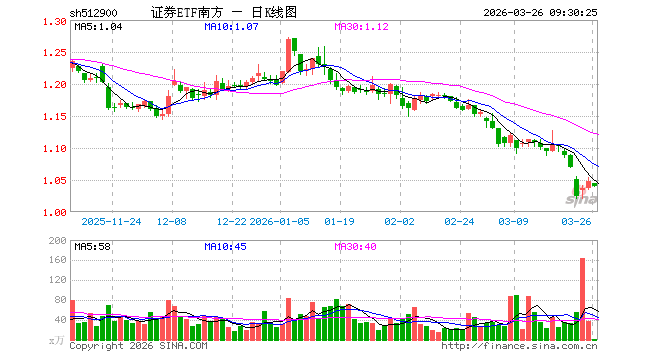
证券ETF鹏华(159993)开盘跌0.18%,重仓股东方财富跌0.45%,中信证券跌0.32%
Xin Lang Cai Jing· 2026-03-26 01:32
Group 1 - The Securities ETF Penghua (159993) opened at a decline of 0.18%, priced at 1.134 yuan [1][2] - Major holdings in the Securities ETF Penghua include Dongfang Caifu, which opened down 0.45%, and other securities firms such as CITIC Securities down 0.32%, Huatai Securities down 0.37%, and GF Securities down 0.27% [1][2] - The performance benchmark for the Securities ETF Penghua is the National Securities Leading Index return, managed by Penghua Fund Management Co., with a return of 13.55% since its establishment on December 26, 2019, and a recent one-month return of -10.12% [1][2] Group 2 - The article mentions the formation of a MACD golden cross signal, indicating potential upward momentum for certain stocks [3]