
H股可转债

Search documents
同日公告!华泰、华安、东北证券齐拓海外,券商出海按下加速键
券商中国· 2026-02-11 10:25
Core Viewpoint - Chinese securities firms are accelerating their overseas business expansion, with significant capital injections to enhance their international operations and competitiveness [1][2][4]. Group 1: Recent Developments - Huatai Securities announced the issuance of HKD 10 billion H-share convertible bonds to support its overseas business development, with an estimated net fundraising of HKD 9.925 billion [2]. - Northeast Securities received approval from the China Securities Regulatory Commission (CSRC) to establish a subsidiary in Hong Kong with an investment of HKD 500 million, marking a strategic move to enhance its international presence [2][3]. - Huaxin Securities also announced a capital increase of HKD 500 million for its Hong Kong subsidiary, which serves as a platform for its international development strategy [3]. Group 2: Industry Trends - The current high profitability of overseas operations for securities firms is driving increased capital allocation to international subsidiaries, as they exhibit higher return on equity (ROE) compared to domestic operations [1][5]. - In January, GF Securities raised over HKD 61 billion through a share placement and convertible bonds, with plans to allocate 70% of the funds to support international business development [4][5]. - The trend of capital increases for international subsidiaries is not limited to smaller firms; major players like CITIC Securities and Guotai Junan are also significantly investing in their international operations [5].






靴子落地!华泰证券100亿港元H股可转债完成发行,后续怎么走?
Mei Ri Jing Ji Xin Wen· 2026-02-10 13:50
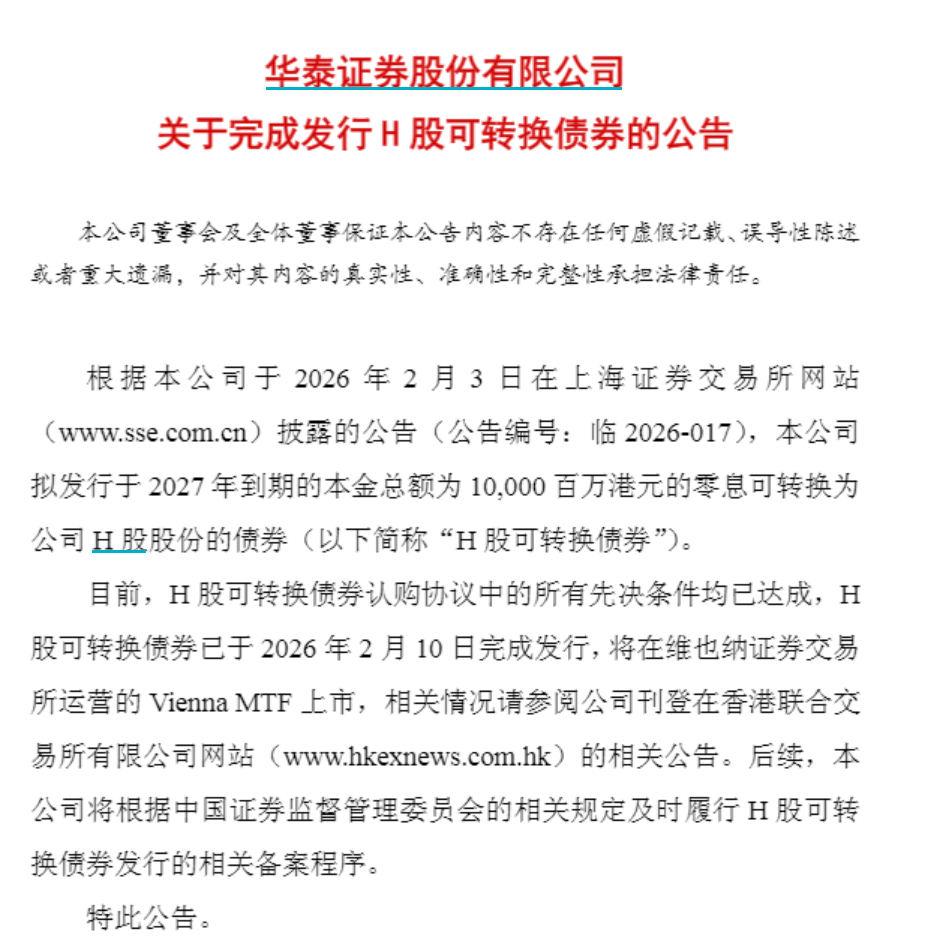
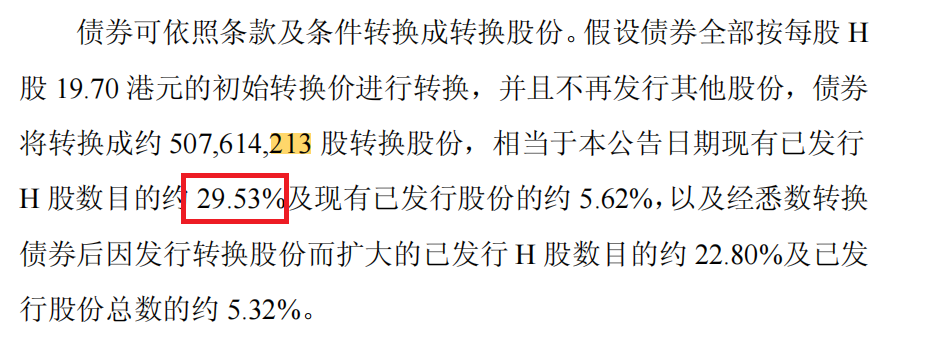
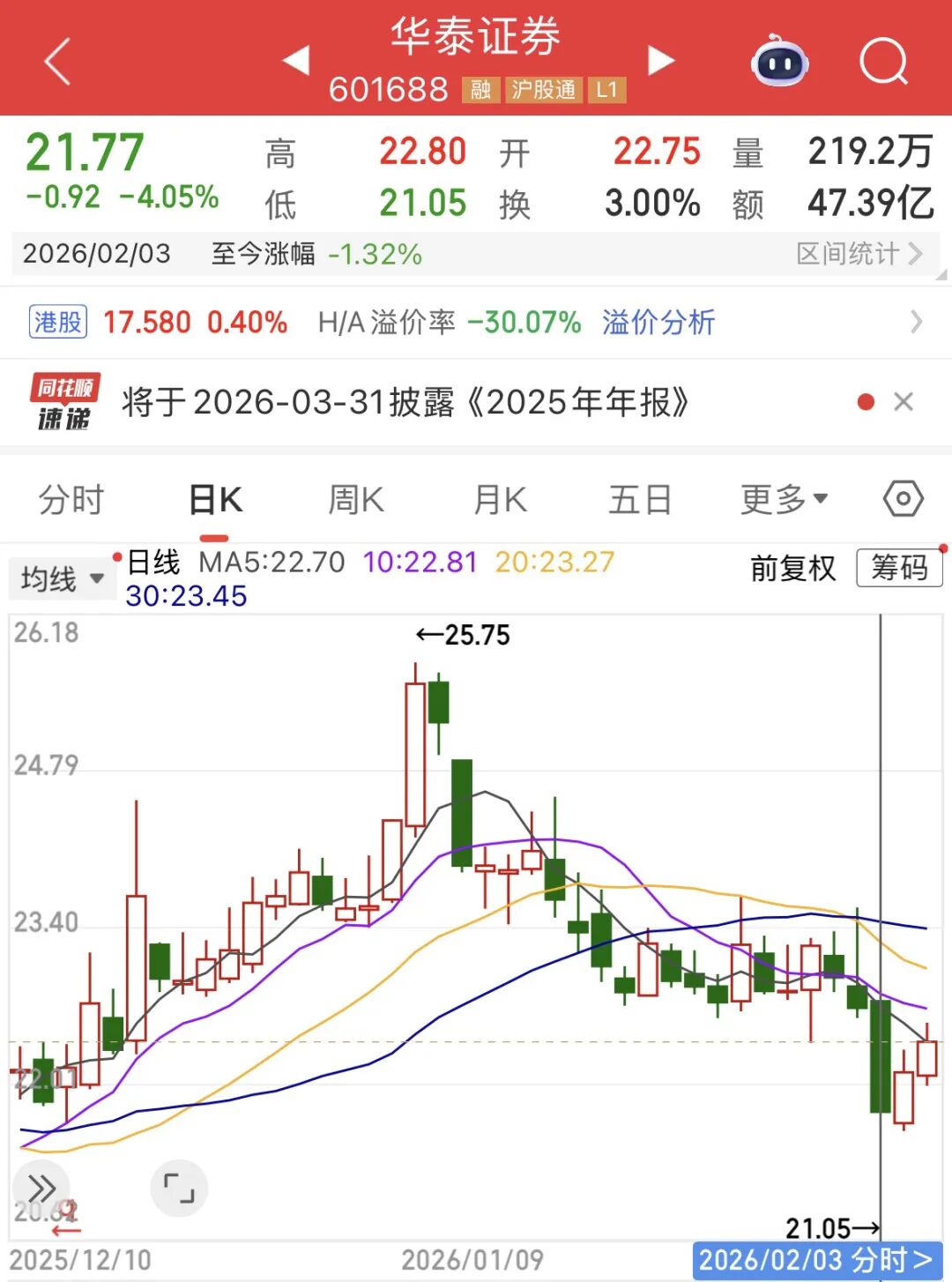
Core Viewpoint - Huatai Securities has successfully issued H-share convertible bonds amounting to HKD 10 billion, which will be listed on the Vienna MTF, indicating a potential alleviation of previous stock price pressures [1][2]. Group 1: Bond Issuance Details - The convertible bonds will mature on February 8, 2027, with an initial conversion price set at HKD 19.70 per H-share, representing a premium of approximately 6.78% over the last trading day's closing price [1]. - If fully converted, the bonds will increase the number of H-shares by 507 million, accounting for about 29.53% of the existing H-shares and approximately 5.62% of the total issued shares [1]. - The net proceeds from the issuance are expected to be around HKD 99.25 billion, aimed at supporting the company's overseas business development and supplementing working capital [1]. Group 2: Market Reaction and Performance - Following the announcement of the refinancing on February 3, both A-shares and H-shares of Huatai Securities experienced significant declines, with A-shares dropping by 4.05% and H-shares by 8.24% [2]. - Despite a slight rebound, the overall performance of Huatai Securities' A-shares and H-shares has been poor this year, with A-shares down over 4% and H-shares down more than 5% since the beginning of 2026 [2]. Group 3: Future Outlook and Analyst Predictions - Analysts suggest that the completion of the refinancing may signal the end of negative market sentiment towards Huatai Securities [2]. - The issuance of convertible bonds is expected to have a limited dilutive effect on the stock, with a projected dilution of only 5.6% [3]. - The financing is anticipated to enhance the company's return on equity (ROE) in the long term, particularly in its overseas operations, which are currently experiencing high growth [3][4]. - Forecasts for net profit for the years 2025-2027 have been revised upwards, with expected figures of HKD 171 billion, HKD 201 billion, and HKD 210 billion, reflecting growth rates of 11%, 18%, and 4% respectively [4].
一天3家大动作,券商“出海”很积极
Zhong Guo Ji Jin Bao· 2026-02-10 13:20
Group 1 - Huatai Securities has completed the issuance of HKD 10 billion zero-coupon convertible bonds, which will be used to enhance its overseas business development and supplement working capital [2][4] - The bonds will be listed on the Vienna MTF and are set to mature in 2027 [2] - The company plans to increase its wholly-owned subsidiary Huatai International by up to HKD 9 billion to support overseas business growth [4] Group 2 - Northeast Securities has received approval from the China Securities Regulatory Commission (CSRC) to establish Dongzheng International Financial Holdings Limited in Hong Kong with a capital of HKD 5 billion [4][7] - The company is required to comply with local laws and regulations during the establishment of Dongzheng International [7] - This move aims to enhance the company's ability to respond to international market risks and challenges [5] Group 3 - Huawan Securities has also received CSRC approval for a capital increase of HKD 5 billion to its Hong Kong subsidiary, Huawan Securities (Hong Kong) Financial Holdings Limited [7][10] - The increase in capital is intended to strengthen the subsidiary's operations in the Hong Kong market [10]
华泰证券百亿港元可转债潜在摊薄效应明显 一年内有息负债占比近八成 A股IPO储备数量仅为国泰海通三分之一
Xin Lang Cai Jing· 2026-02-10 03:35
Core Viewpoint - Huatai Securities plans to issue HKD 10 billion convertible bonds, which could significantly dilute its H-share equity, with a potential increase of approximately 29.53% in the number of H-shares if fully converted, indicating a substantial dilution effect compared to recent issuances by other firms like GF Securities [1][2][16]. Debt and Financial Pressure - As of September 30, 2025, Huatai Securities had a short-term interest-bearing debt of CNY 333.48 billion, accounting for 78.77% of its total interest-bearing debt, indicating significant short-term repayment pressure [1][7][19]. - The company has been actively issuing bonds, with a total of CNY 950 billion registered and issued in January 2026 alone, reflecting its urgent need for liquidity [6][19]. - Huatai Securities' bond financing accounted for 45.29% of its interest-bearing debt as of the first three quarters of 2025, ranking second in the industry for bond liabilities [20]. IPO Project Reserve - As of February 8, 2026, Huatai's investment banking subsidiary, Huatai United, had 15 A-share IPO projects in reserve, ranking fifth in the industry but significantly behind the top firms, with the leading firm having 44 projects [10][21][24]. - The withdrawal of two A-share IPO projects in January 2026 represented 50% of the total market withdrawals for that month, highlighting challenges in maintaining a robust IPO pipeline [9][21]. International Business and Revenue - Huatai Securities expects to raise approximately HKD 99.25 billion from the convertible bond issuance to support its international business and replenish working capital, despite a significant drop in its overseas revenue contribution from 37.22% to 14.23% year-on-year [4][18]. - The sale of its AssetMark platform for USD 1.793 billion (approximately CNY 12.7 billion) has impacted its international revenue, which was CNY 7.926 billion in 2023, with AssetMark contributing nearly half of that [4][18].

非银金融行业周报(2026/2/1-2026/2/7):华泰证券再融资方案落地,国寿H持续获同业增持-20260208
Hua Yuan Zheng Quan· 2026-02-08 13:49
Investment Rating - The investment rating for the non-bank financial sector is "Positive" (maintained) [1] Core Views - The insurance sector is showing signs of improvement, with increased recognition of the industry's fundamentals by insurance companies, as evidenced by China Ping An's continued stake increase in China Life [4] - The brokerage and margin trading businesses maintain a high level of activity, with significant growth in new account openings and trading volumes in January 2026 [5][32] - The asset management and fund distribution businesses are expected to recover, supported by new regulations that have been implemented [5] - Huatai Securities has announced a plan to issue HKD 10 billion in convertible bonds, which is expected to enhance its operational capabilities [6] - The overall performance of brokerage firms is optimistic, with many firms reporting substantial profit growth [6] Data Tracking Insurance Industry Data - As of December 2025, the insurance industry's original premium income reached CNY 61,194 billion, a year-on-year increase of 7.43% [10] - The life insurance premium income was CNY 46,491 billion, up 9.05% year-on-year, while property insurance premium income was CNY 14,703 billion, an increase of 2.60% [10] Securities Industry Data - In January 2026, the average daily trading volume of A-shares was CNY 36.5 trillion, a year-on-year increase of 156.58% [13] - The margin trading balance at the end of January 2026 was CNY 2.72 trillion, up 53.06% year-on-year [13] - New public fund issuance reached 1,094.51 billion units in January 2026, with stock and mixed funds seeing significant growth [13] Industry Dynamics - Insurance capital is increasingly active in equity markets, participating in cornerstone investments in Hong Kong stocks [27] - China Insurance Group reported premium income exceeding CNY 730 billion for 2025, indicating strong operational performance [28] - China Life Group's consolidated investment income grew by double digits in 2025, reflecting robust financial health [29] - China Ping An increased its stake in China Life by 10.12%, demonstrating confidence in the sector [30] - Several automotive service providers have withdrawn from the insurance agency business, indicating competitive pressures in the market [31]


华泰证券百亿融资重挫股价
Guo Ji Jin Rong Bao· 2026-02-05 12:50
Core Viewpoint - Huatai Securities plans to issue HKD 10 billion convertible bonds, leading to a significant drop in its stock price, reflecting investor concerns over equity dilution and market sentiment [1][3][6] Group 1: Impact of Convertible Bond Issuance - The issuance of HKD 10 billion convertible bonds by Huatai Securities is expected to dilute existing shareholders' equity, with A-shareholders' ownership dropping from 80.96% to 76.65% if fully converted [7][8] - The new H-shares will increase the total H-share float by 29.53%, which is significantly higher than the industry norm, raising concerns about earnings per share dilution and control structure changes [6][7] - The market's negative reaction is exacerbated by weak liquidity in the Hong Kong stock market, leading to increased selling pressure [6][7] Group 2: Market Sentiment and Reactions - Investors are advised to avoid making decisions based solely on emotions, as the market's response to convertible bond issuance is influenced by both equity dilution expectations and broader market dynamics [2][15] - The issuance is perceived as a negative signal, indicating potential cash flow concerns or pessimism about future financial performance, which further heightens investor anxiety [7][15] - Historical context shows that similar convertible bond issuances by other securities firms, such as GF Securities, have also led to stock price declines, indicating a pattern in market reactions [9] Group 3: Long-term Perspectives and Strategies - Despite short-term pressures, the long-term impact of the capital raised through convertible bonds will depend on the efficiency of capital utilization and the success of international business expansion [11][12] - If Huatai Securities can effectively demonstrate growth in overseas operations and high return on equity (ROE) investments, it may lead to a re-evaluation of its long-term value and stock price recovery [12][14] - Investors are encouraged to adopt a strategic approach, focusing on companies with clear capital allocation and high efficiency, rather than reacting impulsively to short-term market fluctuations [14][15]
开源证券晨会-20260203
KAIYUAN SECURITIES· 2026-02-03 15:21
Group 1: Overall Market Insights - Institutional attention has rebounded, particularly in the computer, environmental protection, and transportation sectors, indicating a renewed interest in these areas [6][7][8] - The total number of institutions surveyed in the past week decreased compared to the previous week but remained higher than the same period last year, suggesting a persistent low level of survey activity [7] Group 2: Company-Specific Insights - SpaceX plans to deploy a satellite constellation of up to 1 million satellites to provide AI computing capabilities globally, which could create significant investment opportunities in the space and technology sectors [13][14][15] - Jiangxi Copper, a leading copper smelting company, is expected to achieve net profits of 84.51 billion, 121.47 billion, and 133.6 billion yuan from 2025 to 2027, supported by its integrated industry chain and resource acquisition strategies [47][48][49] - Anta Sports announced the acquisition of a 29.06% stake in PUMA for 1.5 billion euros, aiming to enhance its global competitiveness and brand portfolio [41][43] Group 3: Sector-Specific Insights - The banking sector is projected to stabilize its net interest margin at around 1.4% to support a 6% growth in risk-weighted assets (RWA), with expectations of a slight narrowing of 4 basis points in 2026 [18][20][24] - The automotive sector, particularly SAIC Motor, reported a 23.94% year-on-year increase in vehicle sales in January, with significant growth in both domestic and overseas markets, indicating a successful transformation strategy [37][38][39]
华泰证券(601688):发行H股可转债点评:再融资靴子落地,利好国际业务增长
KAIYUAN SECURITIES· 2026-02-03 11:43
Investment Rating - The investment rating for the company is "Buy" (maintained) [1] Core Views - The issuance of H-share zero-coupon convertible bonds is expected to dilute H-share capital by 29.53% and total capital by 5.6%, with proceeds aimed at overseas business development and working capital supplementation. This is anticipated to have short-term pressure on the stock price, particularly in the Hong Kong market, but is expected to benefit long-term international business growth and enhance overall ROE [4][5][6] - The company maintains its profit forecast, projecting net profit attributable to shareholders of 168 billion, 217 billion, and 251 billion yuan for 2025-2027, representing year-on-year growth of 9%, 29%, and 16% respectively. The corresponding PE ratios are 12.2, 9.4, and 8.2 times, with a current PB of 1.20 times [4][6] Financial Summary - Revenue is projected to reach 37,078 million yuan in 2025, with a year-on-year decrease of 10.6%, followed by a recovery to 43,144 million yuan in 2026 and 48,837 million yuan in 2027, with growth rates of 16.4% and 13.2% respectively [7][10] - Net profit attributable to shareholders is expected to be 16,750 million yuan in 2025, 21,680 million yuan in 2026, and 25,067 million yuan in 2027, with year-on-year growth rates of 9.1%, 29.4%, and 15.6% respectively [7][10] - The company's gross margin is projected to improve from 51.2% in 2025 to 58.5% in 2027, while the net margin is expected to rise from 45.2% to 51.3% over the same period [7][10] Valuation Metrics - The projected PE ratios for the company are 12.2 for 2025, 9.4 for 2026, and 8.2 for 2027, indicating a favorable valuation trend [7][10] - The projected PB ratios are 1.2 for 2025, 1.1 for 2026, and 1.0 for 2027, suggesting a decreasing trend in the price-to-book ratio [7][10]
\t洛阳钼业(603993.SH)拟发行12亿美元H股可转债 初始转换价溢价28.70%
Ge Long Hui· 2026-01-20 12:38
Group 1 - The company plans to issue $1.2 billion of zero-coupon convertible bonds due in 2027 through its indirect subsidiary CMOC Capital Limited, with the company providing guarantees for the issuance [1] - The initial conversion price is set at HKD 28.03 per H share, representing a premium of approximately 28.70% over the last closing price of HKD 21.78 on January 19, 2026, and a premium of about 26.17% over the average closing price of HKD 22.22 for the five trading days prior to the announcement [1] - If fully converted at the initial conversion price, the bonds will convert into approximately 333,739,565 H shares, accounting for about 8.48% of the existing issued H shares and approximately 1.56% of the total issued shares [2] Group 2 - The net proceeds from the bond issuance, estimated to be around $1,187.5 million after deducting commissions and other estimated expenses, will be used to support the expansion, optimization, and ongoing capital expenditures of the company's overseas resource projects, enhance operational flexibility, and for general corporate purposes [2] - The converted shares will rank equally with the existing H shares as of the relevant record date [2]

洛阳钼业(603993.SH)拟发行12亿美元H股可转债 初始转换价溢价28.70%
Ge Long Hui A P P· 2026-01-20 01:01
Group 1 - The company plans to issue $1.2 billion of zero-coupon convertible bonds due in 2027 through its indirect subsidiary CMOC Capital Limited, with the company providing guarantees for the issuance [1] - The initial conversion price is set at HKD 28.03 per H share, representing a premium of approximately 28.70% over the last closing price of HKD 21.78 on January 19, 2026, and a premium of about 26.17% over the average closing price of HKD 22.22 for the five trading days prior to the announcement [1] - If fully converted at the initial conversion price, the bonds will convert into approximately 333,739,565 H shares, accounting for about 8.48% of the existing issued H shares and approximately 1.56% of the total issued shares of the company [2] Group 2 - The net proceeds from the bond issuance, estimated to be around $1,187.5 million after deducting commissions and other estimated expenses, will be used to support the expansion, optimization, and ongoing capital expenditures of the company's overseas resource projects, enhance operational flexibility, and for general corporate purposes [2]