BABA(09988)

Search documents
Alibaba CEO takes helm of new AI-focused business group
Reuters· 2026-03-16 11:24
Group 1 - Alibaba Group has announced the formation of a new AI-focused business group called Alibaba Token Hub (ATH), led by CEO Eddie Wu [1][2] - The new group will include existing units such as Tongyi Laboratory, MaaS Business Line, Qwen Business Unit, Wukong Business Unit, and AI Innovation Business Unit [2] - The mission of the Alibaba Token Hub is to "create, deliver, and apply tokens," with a focus on developing AI-native work platforms for enterprises [2]


阿里成立新事业群
财联社· 2026-03-16 11:08
Core Insights - Alibaba has established the Alibaba Token Hub (ATH) business unit, which will be directly overseen by CEO Wu Yongming, to advance its AI strategy [1] - The previously mysterious "Wukong Business Unit" has been revealed, focusing on creating a B-end AI native work platform, indicating Alibaba's intent to integrate large model capabilities into enterprise workflows and target the B-end AI application market [1]
阿里巴巴成立Alibaba Token Hub
第一财经· 2026-03-16 11:07
Group 1 - Alibaba officially established the Alibaba Token Hub (ATH) business group on March 16, with a core goal of "creating Tokens, delivering Tokens, and applying Tokens" [1] - The Alibaba Token Hub includes several divisions: Tongyi Laboratory, MaaS business line, Qianwen Division, Wukong Division, and AI Innovation Division [2]
独家|阿里再放大招,围绕Token成立事业群,吴泳铭亲自带
虎嗅APP· 2026-03-16 10:50
Core Viewpoint - Alibaba is restructuring its business to embrace the new AI era, establishing the Alibaba Token Hub (ATH) to enhance productivity through AI and integrate various departments around the concept of "Token" as a fundamental resource for AI applications [4][10]. Group 1: Business Structure and Goals - The ATH will operate parallel to Alibaba Cloud and the e-commerce business groups, marking a significant organizational adjustment since the last major restructuring [4][5]. - ATH consists of five main divisions: Tongyi Laboratory, MaaS, Qianwen, Wukong, and an AI Innovation division, forming a 4+N system to support AI development and application [6][9]. - The core objective of ATH is to create, deliver, and apply Tokens, enhancing strategic collaboration across departments to boost productivity through AI [10][11]. Group 2: Token Significance and Market Demand - The recent surge in demand for Tokens, driven by AI applications, indicates a rapid shift in AI's role in productivity, with Alibaba's cloud services seeing record sales of Tokens during the Spring Festival [7][10]. - The concept of Tokens is central to the functioning of AI models, with each model product breaking down user inputs into "minimum semantic processing units," which are essential for AI understanding and generation [7][14]. Group 3: Leadership Insights and Future Directions - Alibaba's CEO, Wu Yongming, highlighted that AI capabilities have crossed a critical threshold, with AI agents expected to become the primary users of cloud computing products, shifting from human engineers to AI-driven solutions [8][13]. - The company anticipates a significant increase in Token demand as AI agents become more prevalent, positioning this as a critical opportunity for growth [10][13]. - The restructuring aims to unify previously fragmented AI business segments into a cohesive industrial production system, enhancing collaboration and efficiency [11][12].

南下资金净买入腾讯、阿里和比亚迪
Ge Long Hui· 2026-03-16 10:34
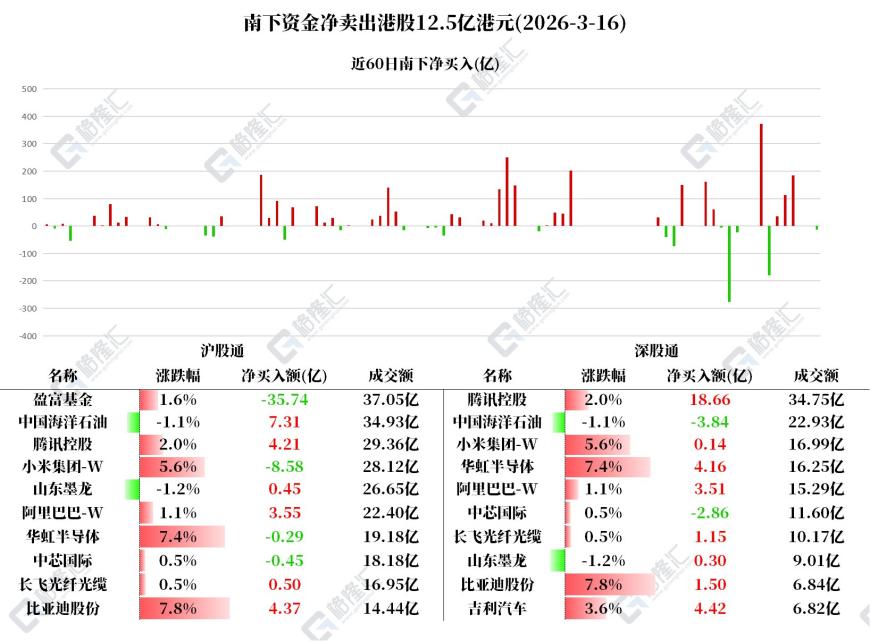
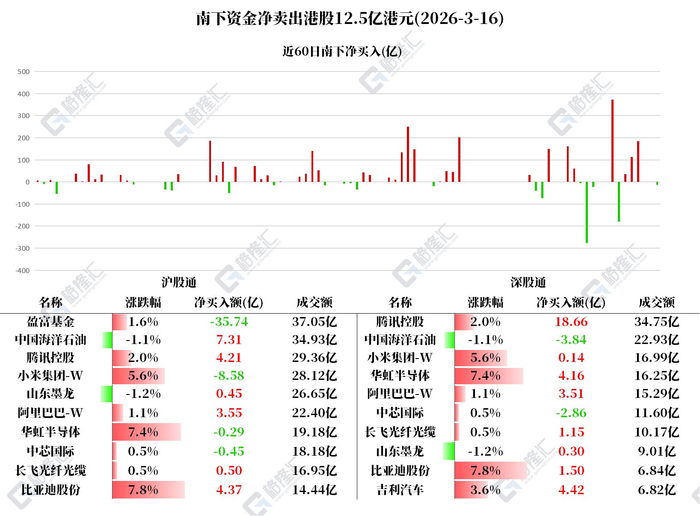
Group 1 - Southbound funds recorded a net sell of HKD 1.25 billion in Hong Kong stocks on March 16, with notable net purchases in Tencent Holdings (HKD 2.287 billion), Alibaba-W (HKD 706 million), BYD Company (HKD 586 million), and Geely Automobile (HKD 442 million) [1] - The net sell was primarily driven by the iShares Asia 50 ETF, which saw a net sell of HKD 3.574 billion, and Xiaomi Group-W with HKD 844 million [1][3] - Southbound funds have consistently net bought China National Offshore Oil Corporation (CNOOC) for four consecutive days, totaling HKD 3.38424 billion [1] Group 2 - Tencent Holdings experienced a price increase of 2.0% with a net buy of HKD 4.21 billion, while Alibaba-W saw a 1.1% increase with a net buy of HKD 3.55 billion [3] - BYD Company had a significant price increase of 7.8% with a net buy of HKD 4.37 billion, and Geely Automobile increased by 3.6% with a net buy of HKD 4.42 billion [3] - The overall trading volume for the stocks mentioned indicates a mixed performance, with some stocks like Xiaomi Group-W and SMIC showing negative net buy figures [3]



图解丨南下资金净买入腾讯、阿里和比亚迪
Ge Long Hui A P P· 2026-03-16 10:01
Group 1 - Southbound funds recorded a net sell of HKD 1.25 billion in Hong Kong stocks today [1] - Notable net purchases included Tencent Holdings at HKD 2.287 billion, Alibaba-W at HKD 706 million, BYD Company at HKD 586 million, Geely Automobile at HKD 442 million, Hua Hong Semiconductor at HKD 387 million, China National Offshore Oil Corporation at HKD 347 million, and Yangtze Optical Fibre and Cable at HKD 165 million [1] - Significant net sells were observed in the Tracker Fund of Hong Kong at HKD 3.574 billion, Xiaomi Group-W at HKD 844 million, and Semiconductor Manufacturing International Corporation at HKD 330 million [1] Group 2 - Southbound funds have continuously net bought China National Offshore Oil Corporation for four consecutive days, totaling HKD 3.38424 billion [2]
OpenClaw掀起全民“龙虾热”,关注AIInfra投资机遇
China Post Securities· 2026-03-16 08:04
Industry Investment Rating - The industry investment rating is "Outperform the Market" and is maintained [1] Core Insights - The report highlights the significant paradigm shift brought by OpenClaw, transitioning from a "dialogue tool" to a "digital employee," enabling autonomous execution of tasks through a four-layer architecture [4] - OpenClaw has sparked a nationwide technological craze, with its GitHub stars surpassing 270,000, leading to widespread adaptation by domestic manufacturers [4] - The demand for AI infrastructure is expected to grow exponentially due to OpenClaw's token consumption model, which has shifted from "human-machine dialogue" to "machine self-circulation" [4] Summary by Relevant Sections Industry Overview - The closing index for the industry is 5311.29, with a 52-week high of 6151.34 and a low of 4080.58 [1] Investment Recommendations - The report suggests focusing on: 1. Large models benefiting from API call surges: MiniMax, Zhipu, etc. 2. Instant Messaging (IM) entry points: Alibaba, Tencent, etc. 3. Cloud services as direct beneficiaries of user growth: UCloud, QingCloud, Wangsu Technology, etc. 4. Computing power leasing/IDC due to rising demand: Dazhi Technology, Dongyangguang, etc. 5. Computing hardware for foundational support: Cambricon, Haiguang Information, etc. [5]


腾讯阿里一起投了家具身智能独角兽丨投融周报
投中网· 2026-03-16 07:13
Key Insights - The article highlights the rapid growth and investment activity in the hard technology sector, particularly in embodied intelligence, with companies like Zhijian Power achieving unicorn status through significant funding rounds [4][12] - The health tech sector remains vibrant, with brain-computer interface companies like Gestala setting records for angel round financing [5][34] - The internet sector continues to thrive, with companies like Guanglun Intelligent securing substantial funding through multiple rounds [6][45] Hard Technology Sector - Zhijian Power completed five rounds of financing in less than six months, raising a total of 2 billion RMB, becoming the youngest unicorn in its field [4][12] - Lingchu Intelligent has raised 2 billion RMB across its angel and Pre-A rounds, with backing from major investors including state-owned funds [4][18] - Shunheng Intelligent announced the completion of three rounds of financing focused on dexterous operations in embodied intelligence [21] Health Tech Sector - Gestala, a company specializing in ultrasound brain-computer interfaces, raised 150 million RMB in its angel round, setting a record in China [5][34] - QiongDome Technology successfully completed nearly 100 million RMB in A+ round financing, with participation from notable investors [5][36] - Aike Biological announced over 100 million RMB in A3 round financing, led by prominent investment firms [30][37] Internet Sector - Guanglun Intelligent secured 1 billion RMB in A++ and A+++ rounds, attracting various industry and financial investors [6][45] - Dify, an AI application development platform, completed a 30 million USD Pre-A round led by Sequoia Capital [6][46] - MetaComp, a fintech company, announced a Pre-A+ round financing exceeding several million USD [46] Other Notable Investments - Zero One Automotive raised 1.2 billion RMB in a new financing round, with participation from multiple investment firms [27] - Magic Atom announced a 500 million RMB A round financing, part of a larger ecosystem fund [17] - Aikemai Medical completed over 100 million RMB in Pre-B round financing, with significant backing from industry investors [37]
中国市场智见 解析中国市场的相对滞后表现0
Morgan Stanley· 2026-03-16 06:30
Investment Rating - The report maintains an overweight rating on materials, industrials, and semiconductors, while adjusting the energy sector from underweight to equal-weight [3][41]. Core Insights - The Chinese market has underperformed compared to broader emerging markets, with the MSCI China Index down 1.2% year-to-date, while the MSCI Emerging Markets Index has risen by 15% [1][9]. - The underperformance of the Chinese market is attributed to unprecedented storage cycles and index composition rules that limit the weight of better-performing sectors [1][2]. - The report suggests a preference for A-shares over Hong Kong/offshore markets due to factors such as reduced selling pressure from state-owned entities and lower sensitivity to global geopolitical uncertainties [3][31]. Summary by Sections Market Performance - The MSCI Emerging Markets Index's gains are primarily driven by three stocks: Samsung, SK Hynix, and TSMC, which have contributed to a 6.5 percentage point upward revision in earnings forecasts [1][10]. - Excluding these three companies, the rest of the MSCI Emerging Markets Index has shown negligible earnings forecast adjustments [10][12]. Sector Analysis - The report highlights that sectors such as materials, energy, and industrials have outperformed, while the internet sector has been a significant drag due to competitive pressures and the "ByteDance effect" [16][20]. - If index composition restrictions were lifted, the combined weight of materials, energy, information technology, and capital goods in the MSCI China Index could increase by 18 percentage points, while the e-commerce sector's weight could decrease by 10 percentage points [2][24]. Stock Selection - The report emphasizes a stock-picking approach rather than relying on index allocations, focusing on sectors less affected by disruptive AI impacts [40][41]. - Specific stocks such as China Petroleum & Chemical Corp. and Zhaoyi Innovation have been added to the focus list, while others have been removed [43][46].



行业点评报告:OpenClaw热潮加速端侧Agent渗透,推理算力需求激增
KAIYUAN SECURITIES· 2026-03-16 06:15
Investment Rating - The industry investment rating is "Positive" (maintained) [1] Core Insights - OpenClaw, an open-source AI agent framework, has gained significant popularity since its release, becoming the most popular open-source project on GitHub as of February 2026. It offers capabilities such as local-first operation, autonomous tool invocation, cross-application execution, and continuous online operation, making it highly appealing to users [4] - The demand for inference computing power is expected to grow exponentially due to the characteristics of Agent AI, which include autonomous task execution and multi-agent concurrency. The daily token consumption in China surged from 100 billion in early 2024 to over 30 trillion by June 2025, reflecting a growth of over 300 times in just one and a half years [5] - OpenClaw is penetrating various devices, including PCs, smartphones, and wearables, transforming the role of AI from a conversational agent to an executor. This shift is expected to create new application scenarios and product categories in the end-side AI market [6] Summary by Sections OpenClaw Development - OpenClaw has seen rapid adoption among major domestic companies, with multiple products and solutions being released based on its code. Notable companies include Tencent, Huawei, Alibaba, and Xiaomi, which are integrating OpenClaw into their cloud services and applications [4] Token Consumption and Inference Demand - The workflow of "plan-execute-feedback-replan" in Agent AI has led to a shift from linear to exponential growth in token consumption. A single task can consume tens of thousands to millions of tokens, indicating a significant increase in demand for inference capabilities [5] End-Side AI Transformation - The modular architecture of OpenClaw allows for comprehensive session management and memory systems, enabling it to autonomously manage various software applications. This evolution is expected to redefine the capabilities of end-side AI and lead to the development of more intelligent personal AI assistants [6] Investment Recommendations - The report suggests focusing on the AI inference computing power supply chain, including segments like chips, complete machines, liquid cooling, and power supplies. Recommended stocks include Haiguang Information, Lingyi Technology, and Dongshan Precision, among others [7]