REMEGEN(09995)

Search documents
智通港股通持股解析|8月22日
智通财经网· 2025-08-22 00:33
Core Insights - The top three companies by Hong Kong Stock Connect holding ratios are China Telecom (00728) at 74.71%, Green Power Environmental (01330) at 69.95%, and China Shenhua (01088) at 68.06% [1] - The largest increases in holdings over the last five trading days were seen in the following companies: Yingfu Fund (02800) with an increase of 134.21 billion, Hang Seng China Enterprises (02828) with an increase of 66.24 billion, and Southern Hang Seng Technology (03033) with an increase of 51.77 billion [1] - The largest decreases in holdings over the last five trading days were recorded for Anta Sports (02020) with a decrease of 10.21 billion, Geely Automobile (00175) with a decrease of 7.70 billion, and HSBC Holdings (00005) with a decrease of 7.40 billion [2] Group 1: Hong Kong Stock Connect Holding Ratios - China Telecom (00728) has a holding of 10.368 billion shares, representing 74.71% [1] - Green Power Environmental (01330) has a holding of 0.283 billion shares, representing 69.95% [1] - China Shenhua (01088) has a holding of 2.299 billion shares, representing 68.06% [1] Group 2: Recent Increases in Holdings - Yingfu Fund (02800) saw an increase of 134.21 billion in holdings, with a change of 52.386 million shares [1] - Hang Seng China Enterprises (02828) experienced an increase of 66.24 billion, with a change of 7.216 million shares [1] - Southern Hang Seng Technology (03033) had an increase of 51.77 billion, with a change of 95.870 million shares [1] Group 3: Recent Decreases in Holdings - Anta Sports (02020) had a decrease of 10.21 billion in holdings, with a change of -10.268 million shares [2] - Geely Automobile (00175) experienced a decrease of 7.70 billion, with a change of -38.819 million shares [2] - HSBC Holdings (00005) saw a decrease of 7.40 billion, with a change of -7.332 million shares [2]




港股创新药概念午后走高,乐普生物涨超9%
Mei Ri Jing Ji Xin Wen· 2025-08-21 05:30
Group 1 - The Hong Kong stock market saw a rise in innovative drug concepts on August 21, with notable increases in stock prices for several companies [1] - Lepu Biopharma (02157.HK) experienced a surge of over 9% [1] - Other companies such as Junshi Biosciences (01877.HK) and Rongchang Biopharma (09995.HK) also saw significant gains, with Junshi rising over 5% [1]
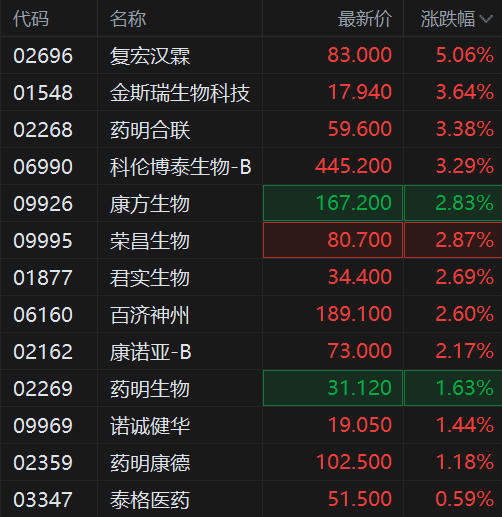
港股异动丨生物医药股普涨 复宏汉霖涨5% 百济神州涨约3%
Ge Long Hui· 2025-08-21 02:03
Core Viewpoint - The Hong Kong biopharmaceutical stocks experienced a general increase, driven by government support for the industry, particularly emphasized by Premier Li Qiang during his recent visit to Beijing [1] Industry Summary - The biopharmaceutical sector in Hong Kong saw significant stock price increases, with notable gains including 5% for Fuhong Hanlin, 3.6% for King’s Ray Biopharmaceutical, and over 3% for WuXi AppTec [1] - Premier Li Qiang highlighted the need for enhanced high-quality technological supply and policy support to promote the development of the biopharmaceutical industry, aiming to produce more high-quality and efficient new drugs [1] - Continuous high-level endorsements from the government signal a strong commitment to supporting the biopharmaceutical industry, especially in the current economic context [1] Company Summary - Fuhong Hanlin (02696) latest price: 83.000, change: +5.06% [1] - King’s Ray Biopharmaceutical (01548) latest price: 17.940, change: +3.64% [1] - WuXi AppTec (02268) latest price: 59.600, change: +3.38% [1] - Other companies with notable increases include: - Keren Biotechnology (06990) +3.29% - Kangfang Biopharmaceutical (09926) +2.83% - Rongchang Biopharmaceutical (09995) +2.87% - Junshi Biosciences (01877) +2.69% - BeiGene (06160) +2.60% [1]


荣昌生物:原研新型双特异性抗体RC148被纳入突破性治疗药物品种,新药上市时间将缩短
Cai Jing Wang· 2025-08-20 21:35
Group 1 - The core viewpoint of the news is that Rongchang Biopharmaceutical has received a breakthrough therapy designation from the China National Medical Products Administration (NMPA) for its innovative bispecific antibody RC148, aimed at treating non-small cell lung cancer (NSCLC) [1][2] - RC148 is specifically indicated for use in combination with docetaxel for patients with locally advanced or metastatic NSCLC who have failed prior treatment with PD-1/PD-L1 inhibitors and platinum-based chemotherapy [1] - The designation is based on a multicenter, open-label Phase I/II clinical study (RC148-C001) conducted in China, which demonstrated superior efficacy and manageable safety of RC148 combined with docetaxel compared to similar drugs or standard treatments in patients with advanced NSCLC [1] Group 2 - Breakthrough therapy drugs are defined as innovative or modified drugs that are used to treat serious life-threatening diseases with no effective treatment options or those that show significant clinical advantages over existing therapies [2] - The inclusion of RC148 in the breakthrough therapy category highlights its substantial clinical value and development potential, which will facilitate faster clinical development and quicker access for patients [2]

荣昌生物:原研的新型双特异性抗体RC148被纳入突破性治疗药物品种,新药上市时间将缩短
Cai Jing Wang· 2025-08-20 21:14
Core Viewpoint - Rongchang Biopharmaceutical has received a breakthrough therapy designation from the China National Medical Products Administration (NMPA) for its innovative bispecific antibody RC148, aimed at treating non-small cell lung cancer (NSCLC) [1][2]. Group 1: Breakthrough Therapy Designation - The bispecific antibody RC148 has been officially included in the list of breakthrough therapies by the NMPA, targeting the indication of RC148 in combination with docetaxel for patients who have previously failed PD-1/PD-L1 inhibitors [2]. - The designation is based on a multicenter, open-label Phase I/II clinical study (RC148-C001) conducted in China, which demonstrated superior efficacy of RC148 combined with docetaxel compared to similar drugs or standard treatments in advanced NSCLC patients who failed prior treatments [2]. Group 2: Clinical Value and Development Potential - The breakthrough therapy designation signifies the significant clinical value and development potential of RC148, which will facilitate accelerated clinical development and resource allocation by the NMPA [2]. - Breakthrough therapies are defined as innovative drugs or modified drugs that provide substantial clinical advantages over existing treatment methods for serious or life-threatening diseases, where no effective treatment options are available [2].
荣昌生物与参天中国达成超12亿元合作 公司连续亏损压力待解
Xin Jing Bao· 2025-08-20 15:44
Core Viewpoint - Rongchang Biopharmaceuticals has signed a licensing agreement with Santen Pharmaceutical's subsidiary, which is expected to generate over 1.2 billion yuan in milestone payments and sales revenue sharing, alleviating the company's financial losses [2][3][4]. Financial Impact - The agreement includes a non-refundable upfront payment of 250 million yuan, potential milestone payments of up to 520 million yuan for development and regulatory achievements, and up to 525 million yuan for sales milestones [3]. - Rongchang Biopharmaceuticals has reported cumulative net losses of approximately 3.95 billion yuan from 2022 to 2024, but showed a revenue increase of 59.17% year-on-year in Q1 2025, reaching 526 million yuan [5]. Product Development - The RC28-E injection is a dual-target fusion protein drug developed by Rongchang Biopharmaceuticals for treating ocular neovascular diseases, with promising results in clinical trials for diabetic macular edema [3][4]. - The company has initiated Phase III clinical trials for RC28-E targeting wet age-related macular degeneration and diabetic macular edema in 2023 [3]. Company Background - Rongchang Biopharmaceuticals focuses on innovative biopharmaceuticals, particularly in antibody-drug conjugates and therapeutic antibodies, with key products including Tai'aisip and Vidisizumab [4]. - The company went public in Hong Kong in 2020 and achieved profitability only in 2021, with a revenue of 1.426 billion yuan and a net profit of 276 million yuan [4]. Challenges and Costs - Sales and management expenses have been rising, with total sales expenses reaching 2.441 billion yuan from 2022 to 2024, contributing to cash flow pressure [6]. - The company faces significant challenges in drug approval processes, market competition, and commercialization capabilities, which could impact future revenue growth [5][6].
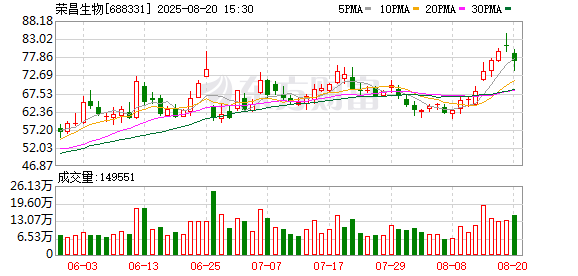
荣昌生物(688331.SH)与日本参天制药达成RC28-E注射液独家许可协议 首付款2.5亿元
Ge Long Hui· 2025-08-20 11:54
Group 1 - Rongchang Biopharma (688331.SH) has entered into an agreement with Santen Pharmaceutical Co., Ltd.'s wholly-owned subsidiary, Santen China, to grant a paid license for its proprietary RC28-E injection [1] - Santen China will obtain exclusive rights for the development, production, and commercialization of RC28-E in Greater China, South Korea, Thailand, Vietnam, Singapore, the Philippines, Indonesia, and Malaysia, while Rongchang Biopharma retains global exclusive rights outside these regions [1] - Rongchang Biopharma will receive a non-refundable and non-offsettable upfront payment of 250 million RMB, with potential milestone payments of up to 520 million RMB for development and regulatory milestones, and up to 525 million RMB for sales milestones [1] Group 2 - Santen China is responsible for the business development of Santen Pharmaceutical in the Chinese market [2] - Santen Pharmaceutical, established over 130 years ago, specializes in ophthalmic pharmaceuticals and is a leader in the global ophthalmic market, focusing on prescription drugs, over-the-counter products, medical devices, and innovative service models [2] - The company's product range includes treatments for glaucoma, dry eye, myopia control, and retinal diseases [2]
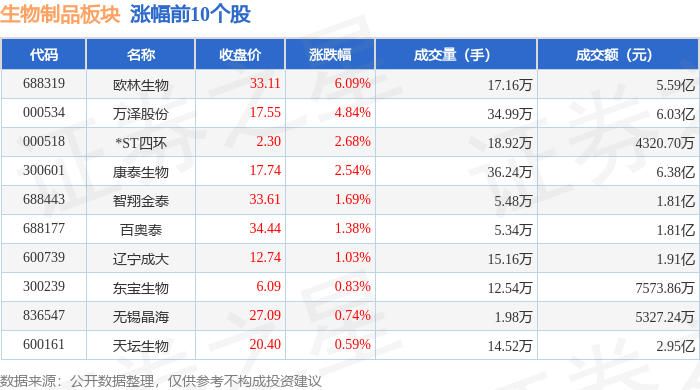
生物制品板块8月20日跌0.42%,荣昌生物领跌,主力资金净流出8.57亿元
Zheng Xing Xing Ye Ri Bao· 2025-08-20 08:41
从资金流向上来看,当日生物制品板块主力资金净流出8.57亿元,游资资金净流入2.95亿元,散户资金净 流入5.62亿元。生物制品板块个股资金流向见下表: 证券之星消息,8月20日生物制品板块较上一交易日下跌0.42%,荣昌生物领跌。当日上证指数报收于 3766.21,上涨1.04%。深证成指报收于11926.74,上涨0.89%。生物制品板块个股涨跌见下表: | 代码 | 名称 | 收盘价 | 涨跌幅 | 成交量(手) | 成交额(元) | | --- | --- | --- | --- | --- | --- | | 688319 | 欧林生物 | 33.11 | 6.09% | 17.16万 | 5.59亿 | | 000534 | 万泽股份 | 17.55 | 4.84% | 34.99万 | 6.03亿 | | 000518 | *ST四环 | 2.30 | 2.68% | 18.92万 | 4320.70万 | | 300601 | 康泰生物 | 17.74 | 2.54% | 1 36.24万 | 6.38亿 | | 688443 | 智翔全泰 | 33.61 | 1.69% | 5.48万 | ...

早盘消息0820| T 链 Gen3 技术路线重塑供应链、DeepSeek 模型升级到V3.1…
Xin Lang Cai Jing· 2025-08-20 05:17
Group 1: Photovoltaic Industry - The Ministry of Industry and Information Technology (MIIT) is actively coordinating between power generation companies and local industries to enhance price transmission from manufacturing to power stations, emphasizing a market-oriented and legal approach to eliminate outdated production capacity [1] - The average bidding price for components from China Resources and China Huadian has increased by 5-8% month-on-month, while silicon material companies have proactively limited production, leading to a 10% decrease in silicon wafer inventory over two weeks [1] - The investment sequence indicates a tight supply of silicon materials in Q3, a premium for BC battery technology in Q4, and a simultaneous increase in both volume and price of auxiliary materials such as glass and adhesive films [1][2] Group 2: Solid-State Battery Technology - A breakthrough in solid-state battery technology has been achieved with the introduction of 5μm vapor-deposited lithium anodes, significantly reducing dendrite risk and achieving over 500 cycles with a capacity retention rate above 90% [3] - The cost of 5μm vapor-deposited lithium is projected to drop to 2 million yuan per GWh, compared to 4 million yuan for 20μm rolled lithium foil, indicating a substantial cost reduction in the industry [3] - The solid-state battery market could reach 50-100 billion yuan by 2030, driven by the demand for 100GWh of global solid-state battery production [3] Group 3: Robotics Industry - The T-Link Gen3 technology is reshaping the supply chain with a focus on lightweight materials, energy efficiency, and sensor integration, leading to a re-tendering of motors, reducers, and lead screws [4] - The use of PEEK materials has reduced costs by 30% compared to imports, and the new harmonic magnetic field motors have achieved a 50% reduction in size while doubling power density [5] - The 3D vision solution from Orbbec has a single machine value of 200 USD, and the company has passed factory audits [6] Group 4: Semiconductor and AI Models - The DeepSeek model has been upgraded to V3.1, expanding the context length from 64K to 128K, which is expected to increase demand for GPU memory and HBM [7] - The need for larger training clusters is anticipated to rise by 30%, benefiting semiconductor and storage manufacturers such as Cambricon, Haiguang, and Lanke [7] Group 5: Pharmaceutical Industry - Rongchang Biotech has licensed its ophthalmic drug RC28-E to Japan's Santen Pharmaceutical, marking a shift in domestic innovative drug licensing from popular fields like oncology to specialized areas with differentiated advantages [8] - This collaboration model provides a clear path for value realization in less popular biotech sectors through upfront payments, milestones, and sales sharing, enhancing cash flow and leveraging established commercialization channels [8] Group 6: High-Speed Rail Industry - The China National Railway Group has initiated its second batch of high-speed train tenders for the year, with 210 sets, marking a recent high and exceeding market expectations [9] - This move reinforces the trend of sustained railway investment recovery, with new construction and maintenance peaks positively impacting the performance certainty of core companies in the industry [9]


智通港股通持股解析|8月20日
智通财经网· 2025-08-20 00:42
Core Insights - The top three companies by Hong Kong Stock Connect holding ratios are China Telecom (00728) at 74.77%, Green Power Environmental (01330) at 69.93%, and China Shenhua (01088) at 68.28% [1][2] - The largest increases in holding amounts over the last five trading days were seen in the following companies: Yingfu Fund (02800) with +6.14 billion, China Life (02628) with +3.52 billion, and Southern Hang Seng Technology (03033) with +2.98 billion [1][2] - The largest decreases in holding amounts over the last five trading days were recorded for Anta Sports (02020) at -1.66 billion, Rongchang Bio (09995) at -635 million, and Kuaishou-W (01024) at -623 million [1][3] Group 1: Holding Ratios - China Telecom (00728) has a holding of 10.377 billion shares, representing 74.77% [2] - Green Power Environmental (01330) has a holding of 283 million shares, representing 69.93% [2] - China Shenhua (01088) has a holding of 2.307 billion shares, representing 68.28% [2] Group 2: Recent Increases in Holdings - Yingfu Fund (02800) saw an increase of +6.14 billion in holding amount, with a change of +23.966 million shares [2][3] - China Life (02628) experienced an increase of +3.52 billion, with a change of +14.502 million shares [2][3] - Southern Hang Seng Technology (03033) had an increase of +2.98 billion, with a change of +54.768 million shares [2][3] Group 3: Recent Decreases in Holdings - Anta Sports (02020) had a decrease of -1.66 billion in holding amount, with a change of -17.008 million shares [3] - Rongchang Bio (09995) saw a decrease of -635 million, with a change of -7.810 million shares [3] - Kuaishou-W (01024) experienced a decrease of -623 million, with a change of -8.424 million shares [3]