BSU(600010)

Search documents
包钢股份涨2.01%,成交额16.84亿元,主力资金净流出7658.06万元
Xin Lang Cai Jing· 2026-01-23 05:17
Group 1 - The core viewpoint of the news is that Baosteel Co., Ltd. has shown a mixed performance in stock price movements and financial results, with a recent increase in stock price but a decline in revenue year-on-year [1][2]. Group 2 - As of January 23, Baosteel's stock price increased by 2.01% to 2.54 CNY per share, with a trading volume of 1.684 billion CNY and a turnover rate of 2.15%, resulting in a total market capitalization of 115.033 billion CNY [1]. - Year-to-date, Baosteel's stock price has risen by 6.72%, with a 1.60% increase over the last five trading days, a 6.72% increase over the last 20 days, and a 3.05% decrease over the last 60 days [2]. - The company's main business revenue composition includes 76.99% from steel products, with specific contributions from plates (50.56%), pipes (10.99%), profiles (8.34%), wires (7.10%), and others (0.65%) [2]. - As of December 19, Baosteel reported a total of 869,100 shareholders, a decrease of 2.65% from the previous period, with an average of 36,105 circulating shares per shareholder, an increase of 2.73% [2]. - For the period from January to September 2025, Baosteel achieved a revenue of 48.08 billion CNY, a year-on-year decrease of 3.58%, while the net profit attributable to shareholders increased by 145.03% to 233 million CNY [2]. - Baosteel has distributed a total of 4.487 billion CNY in dividends since its A-share listing, with 90.577 million CNY distributed in the last three years [3]. - As of September 30, 2025, the second-largest circulating shareholder is China Securities Finance Corporation, holding 767 million shares, while Hong Kong Central Clearing Limited, the third-largest, reduced its holdings by 574 million shares [3].

稀有金属ETF基金(561800)盘中最高涨超2%,成分股西部材料10cm涨停,稀有金属供需格局正加速重构
Xin Lang Cai Jing· 2026-01-23 03:07
Group 1 - The core viewpoint of the articles highlights the strong performance and upward trends in the rare metals market, driven by increasing demand and supply constraints [1][2][3] Group 2 - As of January 23, 2026, the CSI Rare Metals Theme Index (930632) rose by 1.28%, with key stocks like Western Materials hitting the daily limit up and others like Chuaneng Power and Zhuhai Group also showing significant gains [1] - The top ten weighted stocks in the CSI Rare Metals Theme Index accounted for 59.54% of the index, with companies such as Luoyang Molybdenum, Northern Rare Earth, and Ganfeng Lithium leading the list [1] - The rare metals ETF fund (561800) saw a 1.41% increase, with a maximum intraday rise exceeding 2%, and recorded a turnover rate of 6.48% with total transactions of 14.6183 million yuan [1] - The price of battery-grade lithium carbonate increased by 4,000 yuan to 152,500 yuan per ton on January 20, 2026, reflecting a more than 28% rebound from the year's low, driven by surging storage demand and supply constraints [2] - New energy storage technologies are expanding rapidly, with lithium battery shipments in China reaching 430 GWh in the first three quarters of 2025, a year-on-year increase of 99.07% [2] - The supply-demand dynamics for rare metals are undergoing significant changes, with tungsten concentrate prices rising by 4.3% week-on-week to 507,000 yuan per ton, and prices for praseodymium-neodymium oxide and dysprosium oxide also increasing [3] - The CS Rare Metals Index, tracked by the rare metals ETF fund, is one of the highest in energy metal content, particularly lithium and cobalt, and is expected to benefit from ongoing market trends [3]


高某、刘某某、吉某某,散布包钢事故谣言被罚
Bei Jing Ri Bao Ke Hu Duan· 2026-01-22 15:41
Group 1 - An explosion occurred at Baogang Steel Plate Factory on January 18, resulting in 10 fatalities and 84 injuries, with all injured individuals in stable condition [1] - The local police are actively addressing and investigating online rumors related to the explosion, including false claims about the number of casualties [1] - Three specific cases of individuals spreading misinformation have been identified and penalized by law enforcement [2][3] Group 2 - Case one involved an individual named Gao, who falsely claimed during a live stream that the explosion resulted in over 100 deaths, leading to administrative punishment [2] - Case two involved Liu, who posted on a social media platform that the explosion caused 15 deaths and 21 injuries, also resulting in administrative punishment [2] - Case three involved Ji, who spread false information about missile launches on a short video platform, leading to legal consequences [3]
3人散播包钢爆炸事故谣言被处罚
Bei Jing Wan Bao· 2026-01-22 13:40
Core Viewpoint - The article discusses the legal actions taken against individuals spreading false information regarding the Baogang explosion incident, emphasizing the importance of responsible communication in the digital space [1]. Group 1: Incident Overview - The Baogang steel plant explosion incident has led to the spread of various rumors online, including exaggerated casualty figures and fabricated internal communications [1]. - The local police have initiated a crackdown on these rumors, highlighting three specific cases of individuals who disseminated false information for personal gain [1]. Group 2: Legal Actions - Individual Gao was penalized for claiming during a live stream that the explosion resulted in over 100 deaths, despite official reports stating only five were rescued [1]. - Individual Liu was punished for posting on a social media platform that the explosion caused 15 deaths and 21 injuries, which was also unsubstantiated [1]. - Individual Ji faced legal consequences for sharing a video with false claims about missile launches, further illustrating the crackdown on misinformation [1]. Group 3: Public Awareness - The article stresses the need for internet users to critically evaluate information and rely on authoritative sources to avoid spreading rumors [1]. - It calls for public cooperation in reporting any online misinformation to maintain a clear and trustworthy digital environment [1].
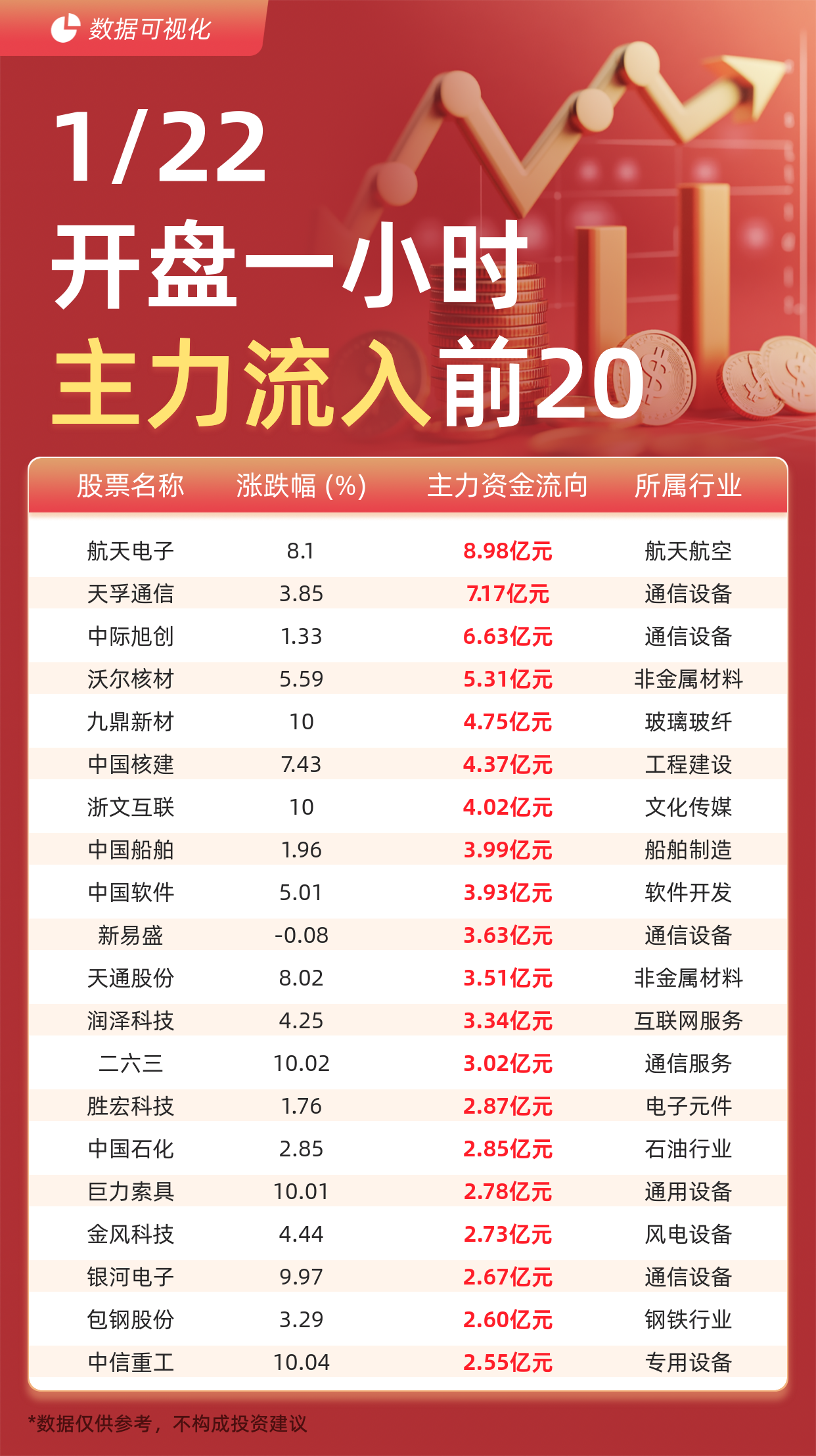
主力资金流入前20:航天电子流入8.98亿元、天孚通信流入7.17亿元
Jin Rong Jie· 2026-01-22 02:43
Group 1 - The top 20 stocks with significant capital inflow include Aerospace Electronics (8.98 billion), Tianfu Communication (7.17 billion), and Zhongji Xuchuang (6.63 billion) [1] - Aerospace Electronics experienced a price increase of 8.1%, while Tianfu Communication and Zhongji Xuchuang saw increases of 3.85% and 1.33% respectively [2] - Other notable stocks with substantial capital inflow include Woer Nuclear Materials (5.31 billion), Jiuding New Materials (4.75 billion), and China Nuclear Engineering (4.37 billion) [1][2] Group 2 - Jiuding New Materials had a significant price increase of 10%, while Zhejiang Wenlian and China Shipbuilding also saw increases of 10% and 1.96% respectively [2][3] - The energy sector is represented by China Petroleum with a capital inflow of 2.85 billion and a price increase of 2.85% [3] - Companies like Jushi Group and Goldwind Technology also showed strong performance with capital inflows of 2.78 billion and 2.73 billion, and price increases of 10.01% and 4.44% respectively [3]


“8名失联人员,已无生命体征”
Xin Lang Cai Jing· 2026-01-21 16:13
央视新闻 本 期 编 辑 邹姗 包钢板材厂爆炸事故应急救援指挥部通报:1月18日15时03分,内蒙古包钢板材厂发生爆炸事故。国 家、自治区、包头市等各级应急救援队伍迅速赶赴现场救援。经救援队伍全力搜救,并由公安、卫健等 部门核实确认,8名失联人员已无生命体征。本次事故造成10人死亡,84人受伤,所有伤员生命体征平 稳。相关善后处置及事故调查正全面推进。 智通财经2026-01-21 19:07:10 ...
包钢板材厂爆炸事故造成10人死亡
中国能源报· 2026-01-21 13:18
出品 | 中国能源报(c n e n e rg y) 包钢板材厂爆炸事故造成1 0人死亡,84人受伤,所有伤员生命体征平稳。 2 1日,包钢板材厂爆炸事故应急救援指挥部发布包钢板材厂爆炸事故人员伤亡情况通报, 经救援队伍全力搜救,并由公安、卫健等部门核实确认,本次事故造成10人死亡,84人 受伤,所有伤员生命体征平稳。 1 8日1 5时3分,包钢板材厂炼钢作业部的一个6 5 0立方米饱和水、蒸汽球罐发生爆炸。事 故发生后,有关部门迅速组织救援力量,超过千人进行现场救援。 据了解,包头已在全市范围内开展安全生产隐患大排查。公安机关已依法对相关企业责任 人采取措施。目前,有关部门正在有序推进事故善后处置工作,事故原因正在调查中。 来源:新华社 End 欢迎分享给你的朋友! 责编丨李慧颖 ...

包钢板材厂爆炸事故造成10人死亡, 84人受伤
Zhong Guo Xin Wen Wang· 2026-01-21 12:46
包钢板材厂爆炸事故造成10人死亡, 84人受伤 广告等商务合作,请点击这里 本文为转载内容,授权事宜请联系原著作权人 中新经纬版权所有,未经书面授权,任何单位及个人不得转载、摘编或以其它方式使用。 关注中新经纬微信公众号(微信搜索"中新经纬"或"jwview"),看更多精彩财经资讯。 官方通报,本次事故造成10人死亡,84人受伤,所有伤员生命体征平稳。相关善后处置及事故调查正全 面推进。(完) 来源:中国新闻网 编辑:董文博 中新网包头1月21日电 (记者 李爱平)包钢板材厂爆炸事故应急救援指挥部21日发布包钢板材厂爆炸事故 人员伤亡情况通报:该次事故造成10人死亡,84人受伤。 据介绍,1月18日15时03分,包钢板材厂发生爆炸事故。国家、内蒙古自治区、包头市等各级应急救援 队伍迅速赶赴现场救援。经救援队伍全力搜救,并由公安、卫健等部门核实确认,8名失联人员已无生 命体征。 ...
包钢板材厂爆炸造成10人死亡
Xin Hua She· 2026-01-21 12:43
【#包钢板材厂爆炸造成10人死亡#】21日,包钢板材厂爆炸事故应急救援指挥部发布包钢板材厂爆炸事 故人员伤亡情况通报,经救援队伍全力搜救,并由公安、卫健等部门核实确认,本次事故造成10人死 亡,84人受伤,所有伤员生命体征平稳。#包钢厂区爆炸已致10死84伤#18日15时3分,包钢板材厂炼钢 作业部的一个650立方米饱和水、蒸汽球罐发生爆炸。事故发生后,有关部门迅速组织救援力量,超过 千人进行现场救援。据了解,包头已在全市范围内开展安全生产隐患大排查。公安机关已依法对相关企 业责任人采取措施。目前,有关部门正在有序推进事故善后处置工作,事故原因正在调查中。(记者: 王靖 贺书琛) ...
包钢板材厂爆炸致10死84伤,救援工作全面展开
2 1 Shi Ji Jing Ji Bao Dao· 2026-01-21 12:08
【#包钢厂区爆炸已致10死84伤#】#包钢板材厂爆炸事故情况通报# 据央视新闻,包钢板材厂爆炸事故 应急救援指挥部通报:1月18日15时03分,内蒙古包头市包钢板材厂发生爆炸事故。国家、自治区、包 头市等各级应急救援队伍迅速赶赴现场救援。经救援队伍全力搜救,并由公安、卫健等部门核实确认, 8名失联人员已无生命体征。本次事故造成10人死亡,84人受伤,所有伤员生命体征平稳。相关善后处 置及事故调查正全面推进。 ...