
CMBC(600016)

Search documents
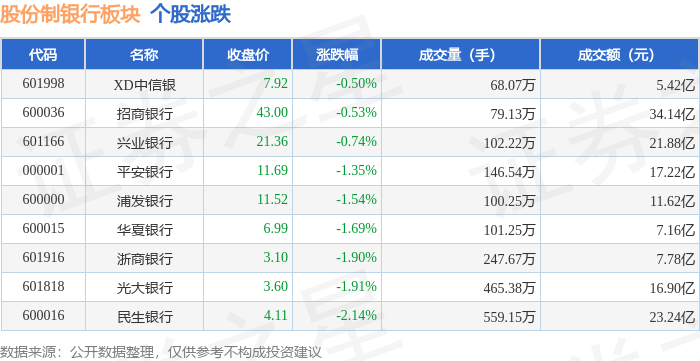
股份制银行板块11月21日跌1.29%,民生银行领跌,主力资金净流出5.23亿元
Zheng Xing Xing Ye Ri Bao· 2025-11-21 09:33
Core Points - The banking sector experienced a decline of 1.29% on November 21, with Minsheng Bank leading the drop [1] - The Shanghai Composite Index closed at 3834.89, down 2.45%, while the Shenzhen Component Index closed at 12538.07, down 3.41% [1] Banking Sector Performance - CITIC Bank (601998) closed at 7.92, down 0.50% with a trading volume of 680,700 shares and a transaction value of 542 million yuan [1] - China Merchants Bank (600036) closed at 43.00, down 0.53% with a trading volume of 791,300 shares and a transaction value of 3.414 billion yuan [1] - Industrial Bank (601166) closed at 21.36, down 0.74% with a trading volume of 1,022,200 shares and a transaction value of 2.188 billion yuan [1] - Ping An Bank (000001) closed at 11.69, down 1.35% with a trading volume of 1,465,400 shares and a transaction value of 1.722 billion yuan [1] - Shanghai Pudong Development Bank (600000) closed at 11.52, down 1.54% with a trading volume of 1,002,500 shares and a transaction value of 1.162 billion yuan [1] - Huaxia Bank (600015) closed at 6.99, down 1.69% with a trading volume of 1,012,500 shares and a transaction value of 716 million yuan [1] - Zhejiang Commercial Bank (601916) closed at 3.10, down 1.90% with a trading volume of 2,476,700 shares and a transaction value of 778 million yuan [1] - China Everbright Bank (601818) closed at 3.60, down 1.91% with a trading volume of 4,653,800 shares and a transaction value of 1.690 billion yuan [1] - Minsheng Bank (600016) closed at 4.11, down 2.14% with a trading volume of 5,591,500 shares and a transaction value of 2.324 billion yuan [1] Capital Flow Analysis - The banking sector saw a net outflow of 523 million yuan from main funds, while speculative funds had a net inflow of 224 million yuan and retail investors had a net inflow of 299 million yuan [1]





逾2000亿“红包雨”来袭,“银伟大”炸裂上涨,中行、工行再创新高!银行10月以来跑赢创业板15%,机构:增配
Xin Lang Ji Jin· 2025-11-20 11:43
Core Viewpoint - The banking sector has shown strong performance, driven by style rotation and significant mid-term dividend distributions, with major state-owned banks leading the gains [3][5]. Group 1: Market Performance - On November 20, major banks experienced a rally, with China Bank rising over 5% and Industrial and Commercial Bank of China increasing by over 2%, both reaching historical highs [1]. - The China Banking Index has accumulated an 8.95% increase since the beginning of October, outperforming the broader market and exceeding the ChiNext Index by 15 percentage points [4]. Group 2: Dividend Distributions - A total of 24 listed banks have announced mid-term dividends, with a combined payout of nearly 263.8 billion yuan, marking a historical high [5]. - The six major state-owned banks are set to distribute a total of approximately 204.66 billion yuan in dividends, with most record dates concentrated in December [5]. Group 3: Investment Appeal - The banking sector is viewed as a defensive investment due to its low valuation and high dividend yield, making it attractive to investors seeking stability [5]. - As of the end of September, the China Banking Index had a price-to-book ratio of 0.67, placing it in the lower 35.69% percentile over the past decade, while the dividend yield reached 4.29%, significantly above the 10-year government bond yield of 1.88% [5]. Group 4: ETF Activity - The largest banking ETF (512800) saw its price rise by 1.9%, reaching a new high for the month, with a total trading volume of 1.491 billion yuan, indicating increased market interest [2]. - The banking ETF has experienced a significant increase in scale, reaching 20.615 billion yuan, reflecting strong investor demand [6].





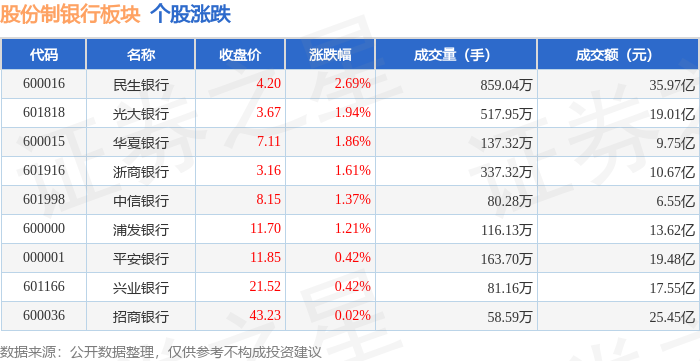
股份制银行板块11月20日涨0.81%,民生银行领涨,主力资金净流入10.74亿元
Zheng Xing Xing Ye Ri Bao· 2025-11-20 09:04
Core Insights - The banking sector saw a rise of 0.81% on November 20, with Minsheng Bank leading the gains [1] - The Shanghai Composite Index closed at 3931.05, down 0.4%, while the Shenzhen Component Index closed at 12980.82, down 0.76% [1] Banking Sector Performance - Minsheng Bank's stock price increased by 2.69% to 4.20, with a trading volume of 8.59 million shares and a transaction value of 3.597 billion [1] - Other notable banks included: - Everbright Bank: closed at 3.67, up 1.94%, with a transaction value of 1.901 billion [1] - Huaxia Bank: closed at 7.11, up 1.86%, with a transaction value of 975 million [1] - Zhejiang Commercial Bank: closed at 3.16, up 1.61%, with a transaction value of 1.067 billion [1] - CITIC Bank: closed at 8.15, up 1.37%, with a transaction value of 655 million [1] Capital Flow Analysis - The banking sector experienced a net inflow of 1.074 billion from main funds, while retail investors saw a net outflow of 451 million [1] - Main fund inflows for specific banks included: - Minsheng Bank: 3.03 billion, with a net outflow from retail investors of 1.10 billion [2] - China Merchants Bank: 2.55 billion, with a net outflow from retail investors of 1.12 billion [2] - Everbright Bank: 1.955 billion from main funds, but a net outflow of 775.33 million from retail investors [2]


21.88亿元主力资金今日抢筹银行板块
Zheng Quan Shi Bao Wang· 2025-11-20 09:01
Market Overview - The Shanghai Composite Index fell by 0.40% on November 20, with 7 industries rising, led by construction materials and comprehensive sectors, which increased by 1.40% and 0.87% respectively [1] - The banking sector ranked third in terms of daily gains, rising by 0.86% [1] Capital Flow - The main capital outflow from both markets totaled 47.655 billion yuan, with 4 industries experiencing net inflows, the banking sector leading with a net inflow of 2.188 billion yuan [1] - The telecommunications sector followed with a daily increase of 0.51% and a net inflow of 1 billion yuan [1] Banking Sector Performance - The banking sector saw a rise of 0.86%, with 41 out of 42 stocks in the sector increasing in value [2] - Among the stocks, Minsheng Bank had the highest net inflow of 366 million yuan, followed by Postal Savings Bank and China Merchants Bank with net inflows of 297 million yuan and 255 million yuan respectively [2] - The sector had 6 stocks with net outflows exceeding 10 million yuan, with Agricultural Bank, Bank of China, and Citic Bank leading in outflows of 181 million yuan, 90.5 million yuan, and 27.1 million yuan respectively [2] Individual Stock Highlights - Minsheng Bank increased by 2.69% with a turnover rate of 2.42% and a main capital flow of 365.51 million yuan [3] - Postal Savings Bank rose by 3.14% with a turnover rate of 0.47% and a main capital flow of 296.74 million yuan [3] - China Merchants Bank had a minimal increase of 0.02% with a turnover rate of 0.28% and a main capital flow of 255.07 million yuan [3]
收盘丨A股三大指数高开低走,银行板块全线走强
Di Yi Cai Jing· 2025-11-20 07:16
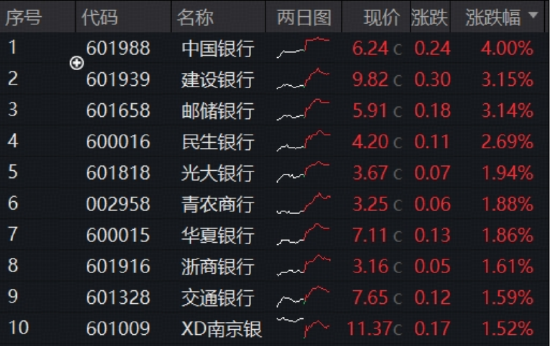
Market Overview - The total trading volume in the Shanghai and Shenzhen markets reached 1.71 trillion, a decrease of 17.7 billion compared to the previous trading day [1][7] - The three major A-share indices closed lower, with the Shanghai Composite Index down 0.40%, the Shenzhen Component Index down 0.76%, and the ChiNext Index down 1.12% [1][2] Sector Performance - The banking sector showed strong performance, with major banks like Bank of China rising by 4%, China Construction Bank and Postal Savings Bank both increasing by over 3%, and Minsheng Bank up by over 2% [3][4] - Conversely, the shipbuilding sector experienced a decline, with all stocks in the sector showing negative performance, notably China Shipbuilding Special Gas down over 5% [5][6] Capital Flow - Main capital inflows were observed in the banking, energy metals, and basic chemicals sectors, while outflows were noted in semiconductors, batteries, and cultural media sectors [10] - Specific stocks that saw significant net inflows included Xinyi Technology, Dazhong Public Utilities, and Tianfu Communication, with inflows of 9.61 billion, 8.12 billion, and 7.06 billion respectively [10] - Stocks that faced substantial net outflows included Molybdenum, Shannon Chip Creation, and CATL, with outflows of 13.77 billion, 13.71 billion, and 8.25 billion respectively [10] Analyst Insights - According to Kaiyuan Securities, the brokerage industry is expected to maintain its favorable outlook, with valuations still at low levels, indicating strategic allocation opportunities in the sector [10] - Huaxin Securities believes that the A-share market is still in the mid-stage of a bull market, with adjustments seen as a consolidation rather than a peak, focusing on low-position rebounds, profit recovery, and technology themes [10] - Dongguan Securities suggests that the current market is in a phase of oscillation and consolidation, with the Shanghai Index likely to stabilize around the 4000-point mark, while a long-term upward trend remains promising [10]



多股创历史新高!大金融崛起,高股息再发力,价值ETF(510030)盘中涨超1%!机构高呼配置价值凸显
Xin Lang Ji Jin· 2025-11-20 05:35
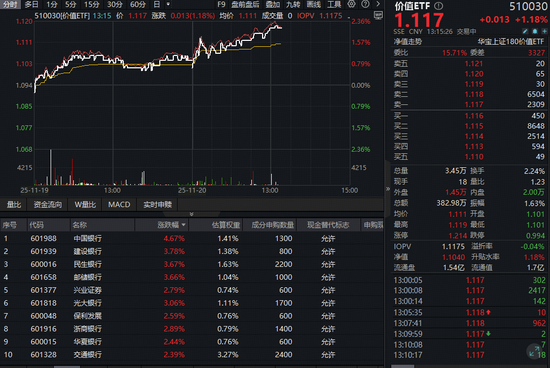
Core Viewpoint - High dividend stocks are experiencing a strong rise, particularly focusing on "high dividend + low valuation" large-cap blue-chip stocks, with the value ETF (510030) showing a 1.18% increase as of the latest report [1] Group 1: Market Performance - The banking sector is seeing significant gains, with major banks like Bank of China rising over 4%, and other banks such as China Construction Bank and Minsheng Bank increasing by over 3% [1] - Both Bank of China and Industrial and Commercial Bank of China reached historical highs during trading [1] Group 2: Institutional Investment Trends - Insurance capital is increasing its holdings in the banking sector, with a reported 27.95% holding position as of Q3 2025, which is a slight decrease in market value but an increase in share quantity by 8.36 billion shares [3] - As of the end of September, insurance capital has invested in 23 banks, with 10 banks receiving increased investments and several new entries from both large and regional banks [3] - Factors such as new premium inflows, increased equity investment ratios, and the implementation of IFRS9 are expected to provide further growth opportunities for insurance capital in the banking sector [3] Group 3: Valuation Insights - The value ETF (510030) is tracking the 180 Value Index, which has a price-to-book ratio of 0.86, indicating a relatively reasonable valuation level, positioned at the 46.38 percentile over the past decade [4] - The index is characterized by a high dividend yield, making it attractive for defensive positioning in volatile markets [5] Group 4: Future Market Outlook - The market is expected to maintain a volatile structure towards the end of the year, with a focus on themes like "anti-involution" and dividends [5] - The A-share market is in a consolidation phase, with rapid rotations between sectors, particularly as technology stocks are currently stabilizing [5] - The value ETF (510030) closely follows the 180 Value Index, which includes 60 stocks with high value factor scores, covering 20 banking stocks [5]
彻底爆了!见证历史
中国基金报· 2025-11-20 04:38
Market Overview - The A-share market opened higher but experienced a decline, with the Shanghai Composite Index rising by 0.38% while the Shenzhen Component and ChiNext fell by 0.05% and 0.52% respectively [3][4]. - The total trading volume in the Shanghai and Shenzhen markets reached 1.11 trillion yuan, an increase of 23 billion yuan compared to the previous trading day [5]. Sector Performance - The banking sector showed strong performance, with all bank stocks rising. Notably, China Bank's stock price surged by 5.17%, reaching a historical high with a market capitalization of 186.78 billion yuan [11][10]. - The lithium mining sector continued its strong momentum, with significant gains in stocks such as Weiling Co. and Dazhong Mining, which recorded a limit-up increase of 10% [16][17]. - Conversely, the retail, soft drink, and tourism sectors experienced noticeable declines, with the water product and lithium battery electrolyte sectors also weakening [5][6]. Specific Stock Movements - Major banks such as Agricultural Bank, Industrial and Commercial Bank, and Construction Bank saw increases of 0.36%, 1.58%, and 4.73% respectively, contributing to a robust banking sector performance [14]. - In the lithium sector, the price of lithium carbonate futures surged past 100,000 yuan per ton, indicating strong demand from downstream manufacturers [18][19]. Brokerage Sector - A wave of mergers among brokerages has sparked market interest, with stocks like Shouchuang Securities rising over 5% following announcements of significant asset restructuring [22][23]. - The overall performance of brokerage stocks was mixed, with some stocks experiencing gains while others saw declines [22]. Fisheries Sector - The fisheries sector, particularly Zhongshui Fisheries, saw its stock price rise by 10.02% amid geopolitical tensions affecting Japanese seafood imports to China [25][26].




港股午盘|恒指涨0.14% 地产股走强
Xin Lang Cai Jing· 2025-11-20 04:20
Core Viewpoint - The Hang Seng Index closed at 25,867.63 points, reflecting a slight increase of 0.14%, while the Hang Seng Tech Index decreased by 1.01% to 5,550.45 points [1] Group 1: Sector Performance - The construction materials, real estate, and banking sectors showed strong performance, with Sunac China rising over 10% and Minsheng Bank increasing by more than 3% [1] - Conversely, the electrical equipment, automotive, and coal sectors experienced declines, with CATL dropping over 8% and Xpeng Motors falling more than 4% [1]

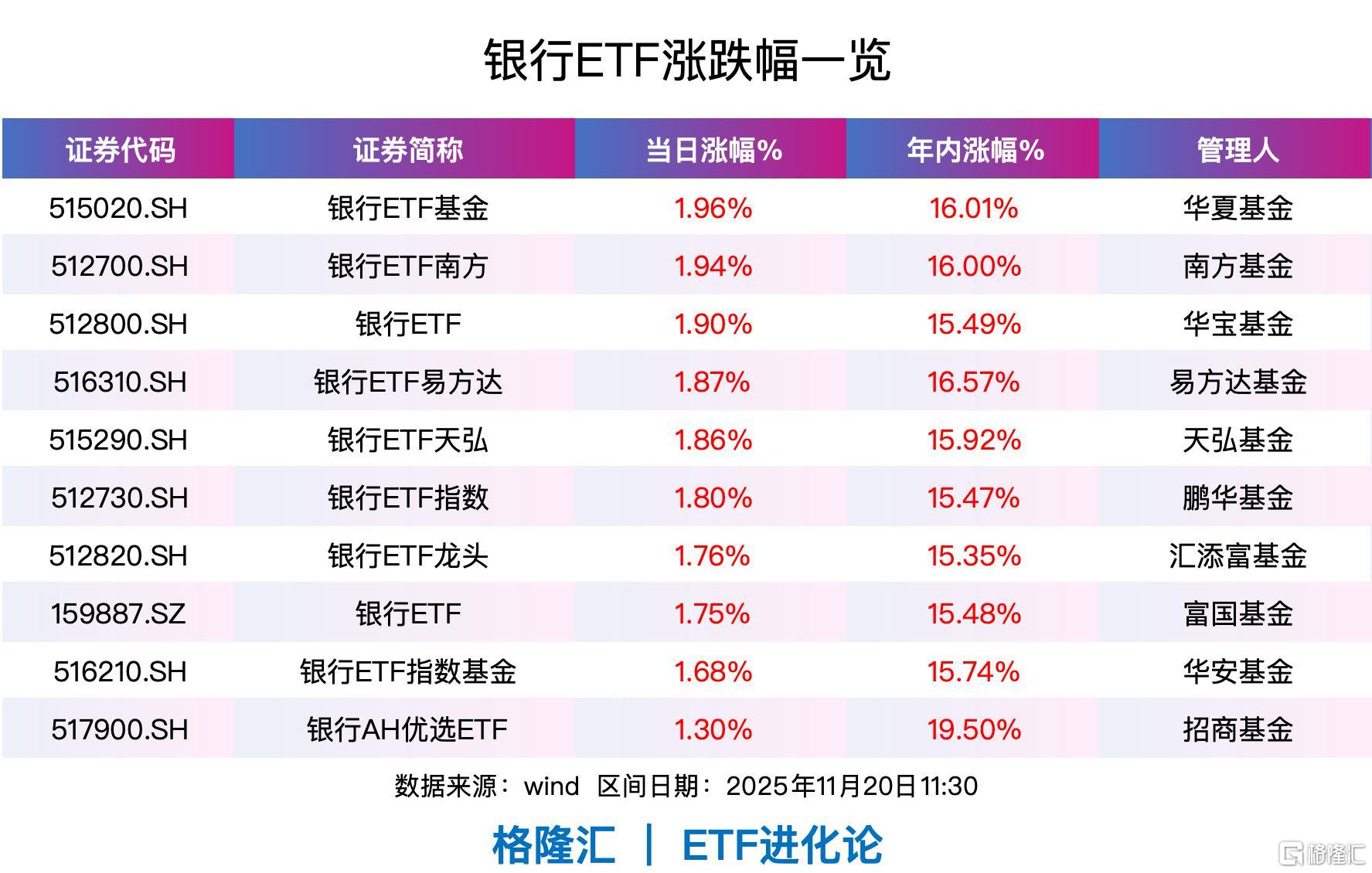
银行ETF基金、银行ETF、银行AH优选ETF上涨,Q3险资加力布局银行板块
Ge Long Hui A P P· 2025-11-20 04:08
Core Viewpoint - The A-share market has seen a significant rise in bank stocks, with notable increases in major banks such as China Bank and Construction Bank, indicating a positive sentiment towards the banking sector [1][4]. Group 1: Stock Performance - China Bank rose over 5%, Construction Bank over 4%, and Postal Savings Bank over 3%, with several other banks also showing gains of over 2% [1]. - Bank ETFs, including various Southern and E-Fund ETFs, have also experienced upward movement, reflecting the overall positive trend in the banking sector [3]. Group 2: ETF Insights - Bank ETFs track the China Securities Bank Index, with nearly 30% of their holdings in major state-owned banks like Industrial and Agricultural Bank, while about 70% focuses on high-growth banks [3]. - The Bank AH Preferred ETF tracks the Bank AH Index, utilizing a monthly security category conversion strategy based on AH prices [4]. Group 3: Institutional Investment Trends - As of Q3 2025, insurance capital has increased its holdings in the banking sector, with a holding ratio of 27.95% and a market value accounting for 3.99% of circulating A-shares [5]. - Insurance capital has increased its positions in 23 banks, with 10 banks seeing increased holdings, indicating a growing interest in the banking sector [6]. Group 4: Market Dynamics - The A-share market is experiencing a style shift, influenced by factors such as the approaching end-of-year assessments for institutions and the central bank's implementation of a moderately loose monetary policy [4]. - The decline in the proportion of bank holdings among public funds suggests a potential opportunity for reallocation towards undervalued financial stocks [4]. Group 5: Future Outlook - The insurance sector is expected to continue increasing its investment in banks, driven by stable dividends and low valuations, with a focus on high ROE small and medium-sized banks [6]. - The ongoing improvement in net profits for banks and the potential for valuation reconstruction through increased capital inflows are seen as positive indicators for the banking sector's future [6].

银行ETF指数(512730)涨超1.6%,银行估值仍处于历史偏低水平
Xin Lang Cai Jing· 2025-11-20 03:43
Group 1 - The core viewpoint indicates a strong performance in the banking sector, with the China Securities Bank Index rising by 1.73% and individual stocks like Bank of China and Construction Bank showing significant gains [1] - The banking sector is experiencing a defensive style resurgence, with the total market capitalization of A-shares surpassing 2.25 trillion [1] - Current credit growth is slowing down, and social financing growth is also retreating from high levels, although policies are in place to support demand recovery [1] Group 2 - The banking sector's retail risk has increased but remains manageable, supported by substantial provisioning and stable dividend policies [1] - The advantages of banks in areas such as gold markets, wealth management, and investment banking contribute to differentiated valuations within the sector [1] - The valuation of banks is still at historically low levels, and there is potential for medium to long-term capital allocation, making increased investment in the banking sector a favorable choice [1] Group 3 - The Bank ETF Index closely tracks the China Securities Bank Index and serves as an analytical tool for investors [2] - As of October 31, 2025, the top ten weighted stocks in the China Securities Bank Index account for 64.87% of the index, highlighting the concentration of investment in major banks [2]

