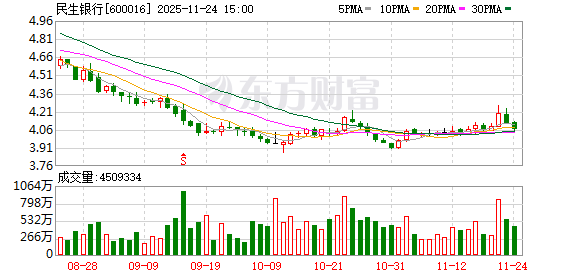
CMBC(600016)

Search documents
多家银行挂牌信用卡不良资产
Zhong Guo Ji Jin Bao· 2025-11-24 16:29
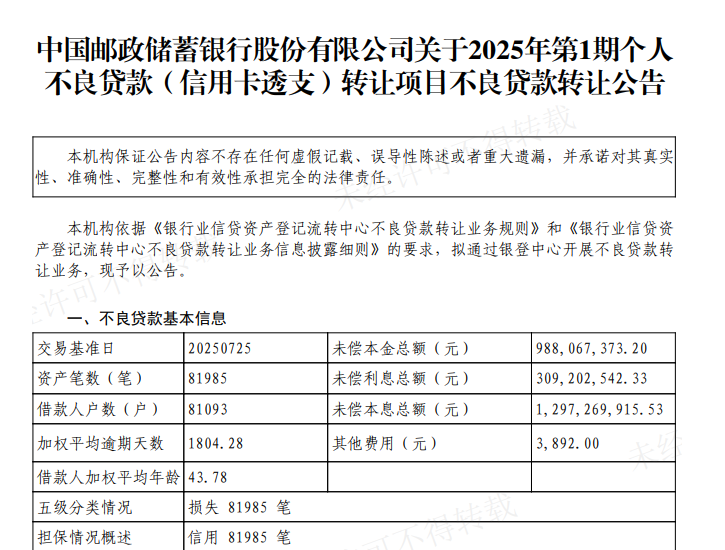
Core Viewpoint - Postal Savings Bank and Ping An Bank are transferring personal non-performing loans totaling 2.1 billion yuan, indicating a trend of accelerated asset clearance in the banking sector as they seek to manage rising non-performing loan ratios and meet regulatory requirements [1][6]. Group 1: Loan Transfer Details - Postal Savings Bank is transferring its first batch of personal non-performing loans for 2025, involving 81,985 loans and 81,093 borrowers, with a total unpaid principal of 988 million yuan and unpaid interest of 309 million yuan, amounting to a total of 1.297 billion yuan [3][5]. - The weighted average overdue days for Postal Savings Bank's non-performing loans is 1,804.28 days (approximately 5 years), with a weighted average borrower age of 43.78 years [5]. - Ping An Bank is transferring two batches of personal non-performing loans, with the first batch involving 33,631 loans and a total unpaid principal and interest of 477 million yuan, and the second batch involving 27,522 loans with a total of 328 million yuan [5]. Group 2: Industry Trends - Since entering the fourth quarter, banks have accelerated the clearance of non-performing assets, with over 20 announcements related to personal non-performing loans in the credit card sector reported this month [6]. - The trend of increasing non-performing loan ratios in retail loans is evident, with credit card loan non-performing rates continuing to rise, although the rate of increase is slowing [6]. - Banks are motivated to transfer non-performing assets to reduce their non-performing loan balances and free up capital tied to inefficient assets, driven by regulatory assessments and the need to optimize financial statements [6].




多家银行挂牌信用卡不良资产
中国基金报· 2025-11-24 16:14
【 导读 】 邮储银行、平安银行挂牌转让个人不良贷款,规模高达21亿元 中国基金报记者 嘉合 11月24日,邮储银行、平安银行相继在银行业信贷资产登记流转中心(以下简称银登中心)发布个人不良贷款转让公告,合计转让不良贷 款规模达21.02亿元。 两家银行挂牌转让个人不良贷款 银登中心公告显示,邮储银行本次转让项目为2025年第1期个人不良贷款(信用卡透支),其中涉及81985笔贷款、81093户借款人,并 全部归类为损失类信用贷款。同时,该项目涉及的未偿本金总额为9.88亿元,未偿利息总额为3.09亿元,未偿本息合计达12.97亿元。 步入四季度以来,各家银行加速对不良资产的出清。据不完全统计,截至目前,本月以来各家银行在银登中心涉及个人不良贷款(信用卡 透支)类的转让公告已经超过20起。 例如,日前,民生银行信用卡中心在银登中心相继挂牌转让第6期和第8期个人不良贷款(信用卡透支)项目,合计本息金额超过了260亿 元。其中,该行第6期不良贷款转让项目,未偿还本息金额为51.42亿元;第8期不良贷款转让项目的未偿还本息金额为216.97亿元。 | 交易基准日 | 20250725 | 未偿本金总额(元) | 9 ...

AI成核心方向 银行启动博士后招聘
Bei Jing Shang Bao· 2025-11-24 15:58
Core Insights - Multiple banks, including Agricultural Bank of China, Minsheng Bank, Bank of China, and others, have initiated recruitment for postdoctoral researchers for 2026, focusing on strategic research and innovation in the financial sector [1][3][4] - The recruitment emphasizes interdisciplinary backgrounds, particularly in artificial intelligence, big data, and financial technology, reflecting a trend towards integrating technology with traditional finance [5][6] Recruitment Conditions - The recruitment criteria are becoming stricter, with banks favoring candidates with interdisciplinary and practical financial experience, typically requiring a PhD obtained within the last three years or expected graduation by mid-2026 [3][4] - Specific banks, such as Nanjing Bank, have set age limits (under 35) and specified fields of study, including economics, finance, statistics, and computer science, with a preference for candidates with financial industry experience [3][4] Research Focus - The research topics reflect banks' strategic priorities, with a strong emphasis on AI, big models, and financial technology applications, particularly in risk management and customer service optimization [6][7] - Each bank has tailored its research topics to align with industry trends and operational needs, such as Nanjing Bank's focus on digital transformation and Agricultural Bank's exploration of AI-driven management models [6][7] Industry Trends - The recruitment surge is driven by the dual pressures of transformation in the banking sector and the opportunities presented by technological advancements, particularly in AI [7] - Experts suggest that the integration of AI in banking operations is crucial for enhancing efficiency and risk management, which are key demands in the current financial landscape [7] Practical Implications - The focus on practical research outcomes distinguishes banking postdoctoral programs from academic institutions, with banks prioritizing research that addresses real-world business challenges [7] - The emphasis on AI and regulatory compliance in research aims to create a balance between innovation speed and risk control, contributing to a safer and more regulated financial technology ecosystem [7]



3.98亿元主力资金今日撤离银行板块
Zheng Quan Shi Bao Wang· 2025-11-24 13:15
Market Overview - The Shanghai Composite Index rose by 0.05% on November 24, with 19 sectors experiencing gains, led by defense and military industry at 4.31% and media at 3.49% [1] - The sectors that saw declines included oil and petrochemicals at 1.21% and coal at 1.09%, with the banking sector also among the top decliners [1] Capital Flow Analysis - The main capital outflow from the two markets totaled 10.192 billion yuan, with 11 sectors seeing net inflows [1] - The defense and military sector had the highest net inflow of 5.466 billion yuan, followed by the media sector with 2.542 billion yuan [1] - The electronics sector experienced the largest net outflow of 6.708 billion yuan, followed by the power equipment sector with 2.087 billion yuan [1] Banking Sector Performance - The banking sector declined by 0.79% with a net capital outflow of 398 million yuan, out of 42 listed banks, only 8 saw gains while 31 experienced losses [2] - Among the banks, the top net inflow was seen in China Communications Bank with 93.848 million yuan, followed by Ping An Bank and Chengdu Bank with 72.672 million yuan and 69.999 million yuan respectively [2] - The banks with the highest net outflows included China Merchants Bank at 197 million yuan, Minsheng Bank at 189 million yuan, and Industrial Bank at 177 million yuan [2][3]


多家银行启动2026年博士后研究人员招聘,AI、金融科技成核心方向
Bei Jing Shang Bao· 2025-11-24 11:10
Core Insights - Several banks, including Agricultural Bank of China, Minsheng Bank, Bank of China, and others, have initiated recruitment for postdoctoral researchers for 2026, focusing on strategic research and innovation in the financial sector [1][3][4] - The recruitment emphasizes interdisciplinary backgrounds, particularly in artificial intelligence, big models, and financial technology, reflecting a trend towards integrating technology with traditional finance [5][6] Recruitment Conditions - The recruitment criteria have become stricter, with banks favoring candidates with interdisciplinary and practical financial experience [3][4] - Specific requirements include a PhD obtained within the last three years or expected graduation by July 2026, with an age limit of 35 years [3][4] - Preferred fields of study include economics, finance, statistics, applied mathematics, computer science, big data, and artificial intelligence, with a strong emphasis on research capability and dedication [3][4] Research Focus - The research topics set by banks highlight their strategic priorities, with a strong focus on AI, big models, and financial technology applications [6][7] - Examples of research topics include "AI Empowering Digital Transformation of Commercial Banks" and "Application of AI and Big Model Technology in Risk Management," indicating a direct response to industry needs [6][7] Industry Trends - The recruitment surge is driven by the dual pressures of transformation in the banking sector and technological opportunities, with banks seeking to enhance core competitiveness through technology [7][8] - AI technologies are seen as crucial for improving operational efficiency and risk management, which are key demands in the current banking landscape [7][8] - The focus on practical research outcomes distinguishes bank postdoctoral programs from academic institutions, emphasizing the need for research that addresses real business challenges [7][8]


民生银行闫新国:以“五纵一横”体系赋能科技金融
2 1 Shi Ji Jing Ji Bao Dao· 2025-11-24 09:41
Core Viewpoint - The journey towards high-level technological self-reliance and strength is significant and requires collective effort, as emphasized by Yan Xinguo, Chief Manager of the Corporate Business Department/Technology Finance Department of Minsheng Bank [1] Group 1: Policy and Strategic Goals - The 20th National Congress report mentions "technology" 10 times and "innovation" 8 times, highlighting the goal of significantly improving the level of technological self-reliance during the 14th Five-Year Plan period [1] - The 14th Five-Year Plan suggests implementing a new type of national system and taking extraordinary measures to achieve breakthroughs in key areas such as integrated circuits, industrial mother machines, high-end instruments, basic software, advanced materials, and biomanufacturing [1] Group 2: Minsheng Bank's Technology Finance Strategy - Minsheng Bank has developed a "Five Vertical and One Horizontal" exclusive service system to address the financial service pain points of technology enterprises, recognizing the unique characteristics of "light asset, high growth" in these companies [2][4] - The "Horizontal" component is the "Firefly Platform," which integrates enterprise evaluation, research support, product services, and investment matching to provide real-time digital portraits of nearly one million technology enterprises [2] Group 3: Service Offerings and Ecosystem Development - The "Five Vertical" system offers services across five dimensions: full cycle, full scene, full ecology, full chain, and full system, providing comprehensive support for enterprises at different growth stages [4] - Minsheng Bank provides various financial products tailored to different stages of enterprise development, including talent loans for startups, R&D loans for growth-stage companies, and merger loans for mature enterprises [4] - The bank has created a service matrix called "Minsheng Easy Creation," offering a one-stop service that combines commercial banking and investment banking, as well as debt and equity financing [4] Group 4: Industry Focus and Support - Minsheng Bank focuses on seven key areas, including advanced materials and new energy, launching the "Minsheng E-Chain" series of products to support the industrial and supply chains [4] - The bank utilizes supply chain transaction data and logistics information for risk assessment, helping small and medium-sized technology enterprises convert data assets into financial assets [4] Group 5: Commitment to Social Responsibility - Minsheng Bank aims to contribute to high-level technological self-reliance and strength by collaborating with various sectors, emphasizing the importance of resilience and vitality in the technology finance service system [5]
股份制银行板块11月24日跌1.05%,中信银行领跌,主力资金净流出4.07亿元
Zheng Xing Xing Ye Ri Bao· 2025-11-24 09:12
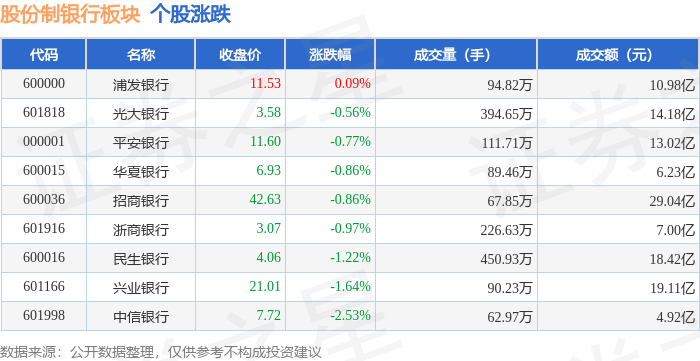
证券之星消息,11月24日股份制银行板块较上一交易日下跌1.05%,中信银行领跌。当日上证指数报收 于3836.77,上涨0.05%。深证成指报收于12585.08,上涨0.37%。股份制银行板块个股涨跌见下表: | 代码 | 名称 | 收盘价 | 涨跌幅 | 成交量(手) | 成交额(元) | | --- | --- | --- | --- | --- | --- | | 600000 | 浦发银行 | 11.53 | 0.09% | 94.82万 | 10.98亿 | | 601818 | 光大银行 | 3.58 | -0.56% | 394.65万 | 14.18 Z | | 000001 | 平安银行 | 11.60 | -0.77% | 111.71万 | 13.02亿 | | 600015 | 华夏银行 | 6.93 | -0.86% | 1 89.46万 | 6.23亿 | | 600036 | 招商银行 | 42.63 | -0.86% | 67.85万 | 29.04亿 | | 601916 | 浙商银行 | 3.07 | -0.97% | 226.63万 | 7.00亿 | | 60001 ...




中国银行业_花旗 2025 中国峰会新动态
花旗· 2025-11-24 01:46
Investment Rating - The report assigns a "Buy" rating to several banks, including ICBC-H, CCB-H, and BOC-H, based on their above-peer dividend yield and attractive valuations [11]. Core Insights - The net interest margin (NIM) is expected to diverge between large banks and regional banks, with regional banks likely to perform better due to higher risk appetite and benefits from time-deposit rate cuts [2]. - Policy-financing instruments are anticipated to support loan growth into 1Q26E, potentially driving new loans of RMB2.5 trillion to RMB5 trillion [3]. - Overall asset quality remains stable, but there is increasing pressure on developer loans and non-mortgage retail loans, with manageable credit risk in mortgage loans [4][7]. - Fee income is improving due to strong agency and custodian fees, although a potential fee rate cut in mutual funds could impact future income [8]. - Big banks maintain flattish earnings growth guidance for 2025E, while regional banks like BOCD and BONJ expect around 5% to 8% earnings growth [9][10]. Summary by Sections Net Interest Margin (NIM) - NIM pressure is expected to moderate into 4Q25E, with large banks anticipating continued year-on-year compression in 2026E [2]. Loan Growth - The distribution of RMB500 billion in policy-financing instruments is expected to enhance loan growth, particularly for banks with higher exposure to infrastructure [3]. Asset Quality - Asset quality is stable overall, but there are rising pressures in developer loans and non-mortgage retail loans, with manageable risks in mortgage loans [4][7]. Fee Income - Fee income has improved, driven by strong performance in asset management, though future fee income may be affected by rate cuts [8]. Earnings Growth - Big banks expect flattish earnings growth in 2025E, while regional banks forecast modest growth, with specific banks like PAB expecting a return to positive year-on-year growth in 2026E [9][10]. Valuation and Equity Raising - The market is focused on potential equity raising, particularly for regional banks trading below 1x book value, which could open financing opportunities for others [10].

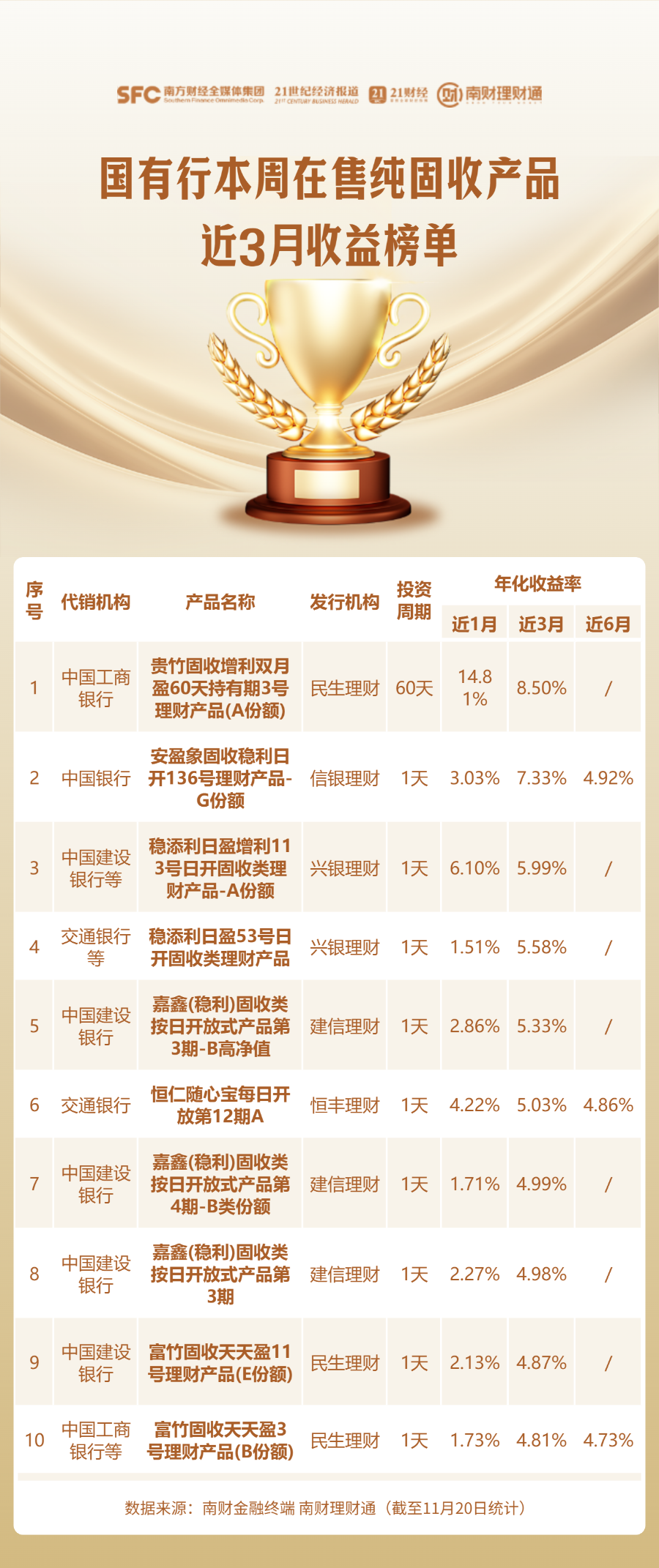
本周在售纯固收理财榜单:互联网银行代销产品收益相对偏低
2 1 Shi Ji Jing Ji Bao Dao· 2025-11-24 01:16
Core Insights - The article emphasizes the abundance of bank wealth management products with similar names and vague characteristics, urging investors to carefully select and differentiate among them [1] - The focus is on pure fixed-income products issued by wealth management companies, providing a performance ranking of these products based on their annualized returns over the past month, three months, and six months [1] Summary by Category Product Performance - The ranking showcases products with outstanding performance, sorted by annualized returns over the past three months to reflect their multidimensional yield performance amid recent market fluctuations [1] - Specific products highlighted include those from Huaxia Bank, which achieved annualized returns of 9.89% over 1 month and 10.92% over 3 months for a 180-day holding period [7] - Other notable products include those from China Bank and China Construction Bank, with varying annualized returns across different holding periods [5][8] Distribution Channels - The article lists 28 distribution institutions, including major banks such as Industrial and Commercial Bank of China, Bank of China, and Agricultural Bank of China, among others [2] - It notes that the availability of products may vary due to factors like sold-out quotas or differences in product listings for different customers, advising investors to refer to the actual displays on bank apps [2] Data Source - The performance data is sourced from the Nanfang Financial Terminal and Nanfang Wealth Management, with statistics as of November 20 [5][12]


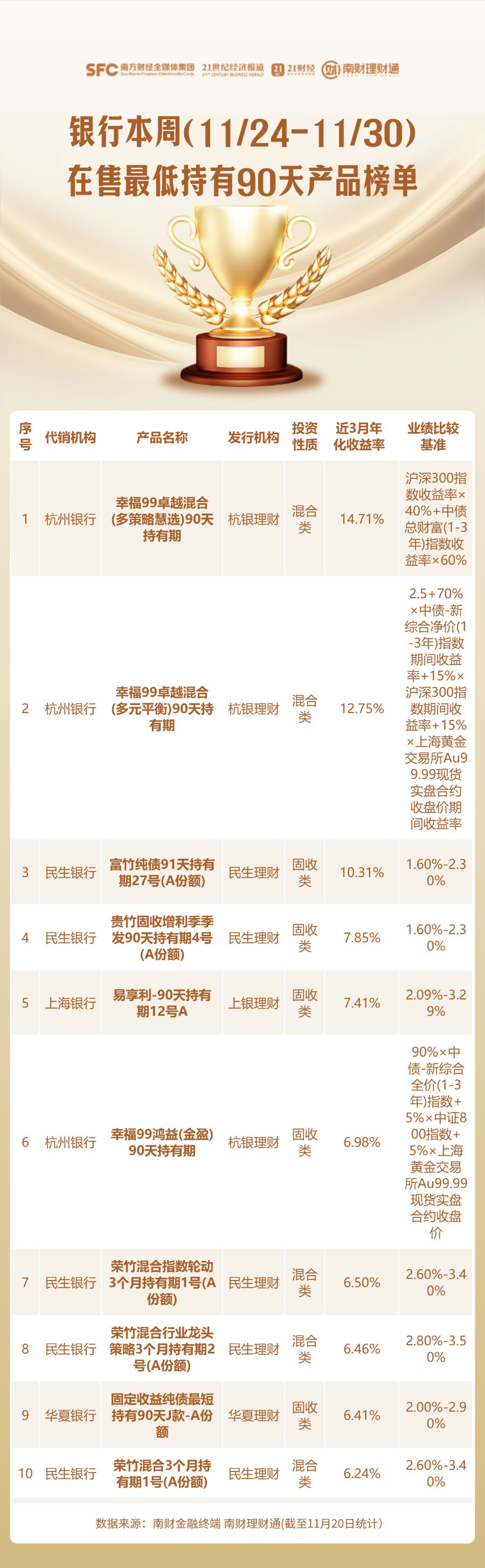
本周在售持有期产品榜单:城商行理财公司强势突围
2 1 Shi Ji Jing Ji Bao Dao· 2025-11-24 01:12
Core Insights - The article emphasizes the importance of distinguishing between various bank wealth management products, which often have similar names and vague characteristics, to help investors make informed choices [1] - The South Finance Wealth Management team focuses on ranking the performance of publicly offered products with minimum holding periods, specifically categorizing them by 90 days, 180 days, and 365 days [1] Group 1: Product Performance Rankings - The article provides a ranking of wealth management products based on their annualized returns for different holding periods, with a focus on those with a minimum holding period of 90 days [1] - For 90-day holding period products, the top performers include: - Hangzhou Bank's "Sunrise 40 Years Tanaka" with a return of 14.71% [4] - Hangzhou Bank's "Happiness 99 Excellence" with a return of 12.75% [4] - Minsheng Bank's "Yuanmen Pure Bond" with a return of 10.31% [4] - The rankings are based on annualized yield calculations corresponding to the holding period, ensuring a fair comparison among similar products [1][4] Group 2: Distribution Institutions - The article lists 28 distribution institutions involved in selling these wealth management products, including major banks such as Industrial and Commercial Bank of China, Bank of China, and Agricultural Bank of China [2] - It highlights that the availability of products may vary due to factors like sold-out quotas or differences in product listings shown to different customers [2] Group 3: Additional Product Insights - The article mentions that the performance rankings are intended to reduce the selection cost for investors by providing a clear overview of the best-performing products in the market [1] - It also notes that the rankings are for reference only and that investors should verify the actual availability of products through the respective bank's app [2]