China Unicom(600050)

Search documents
中国三大电信运营商宣布调整电信服务增值税税率
Zhong Guo Xin Wen Wang· 2026-02-01 13:43
Group 1 - The core point of the news is the adjustment of the value-added tax (VAT) rate for telecommunications services in China, increasing from 6% to 9%, which will impact the revenue and profits of major telecom operators [2][3] - The adjustment is set to take effect on January 1, 2026, and applies to services such as mobile data, SMS, multimedia messaging, and internet broadband access [2] - The change is characterized as a "repositioning" of the tax category rather than an additional tax burden, aiming to clarify the public nature of basic communication services and enhance operational efficiency in the industry [4] Group 2 - The announcement from the Ministry of Finance and the State Taxation Administration specifies the applicable VAT rates and the scope of services, with the current VAT rates in China being 13% for the basic rate, and 9% and 6% for preferential rates [4] - The repositioning is expected to encourage telecom operators to focus more on core activities such as network construction and service assurance, reducing homogeneous marketing competition [4]




宽带、短信等增值税税率由6%提高至9%,会涨价吗?
Di Yi Cai Jing· 2026-02-01 13:42
Core Viewpoint - The adjustment of the VAT tax rate applicable to telecommunications services in China will impact the revenue and profits of the three major telecom operators, China Mobile, China Unicom, and China Telecom, starting from January 1, 2026 [1][2]. Group 1: Tax Rate Changes - The new regulation changes the applicable tax category for mobile data services, SMS, MMS, and internet broadband access from value-added telecommunications services (6% VAT) to basic telecommunications services (9% VAT) [1][2]. - The definition of basic telecommunications services has been expanded to include mobile data services, SMS, MMS, and internet broadband access, which were previously classified under value-added telecommunications services [2]. Group 2: Financial Implications - The increase in VAT from 6% to 9% for certain services may lead to higher costs for consumers, although the extent of this price increase will depend on consumer demand elasticity [2][3]. - The adjustment is expected to increase the tax burden on telecom companies, but given their state-owned status and market position, the impact is considered manageable [2]. - The adjustment in tax rates is anticipated to contribute to increased fiscal revenue, addressing the growing fiscal pressure faced by the government [3]. Group 3: Broader Economic Context - In 2025, the national general public budget revenue is projected to be 21,604.5 billion yuan, a decrease of 1.7% from the previous year, while government fund budget revenue is expected to decline by 7% [3].


宽带、短信等增值税税率由6%提高至9%,会涨价吗?
第一财经· 2026-02-01 13:32
Core Viewpoint - The adjustment of the VAT tax rate applicable to certain telecommunications services in China is expected to impact the revenue and profits of the three major telecom operators: China Mobile, China Unicom, and China Telecom. The VAT rate for these services will increase from 6% to 9% starting January 1, 2026, as per the new regulations issued by the Ministry of Finance and the State Administration of Taxation [3][4]. Summary by Sections VAT Rate Adjustment - The new regulations redefine the scope of basic telecommunications services to include mobile data services, SMS, MMS, and internet broadband access, which were previously classified under value-added telecommunications services with a lower VAT rate of 6% [4]. - The adjustment expands the range of services subject to the 9% VAT rate, thereby increasing the tax burden on the three major telecom operators [4]. Impact on Telecom Operators - The increase in VAT from 6% to 9% for certain services may lead to higher costs for the telecom operators, which could potentially be passed on to consumers depending on demand elasticity [5]. - Voice call services, which were already subject to a 9% VAT rate, will not see a price increase due to this adjustment [5]. Financial Context - The adjustment is part of broader fiscal measures aimed at addressing increasing fiscal revenue challenges, as indicated by the decline in public budget revenues and the increase in budget expenditures in recent years [6].

今日晚间重要公告抢先看——锋龙股份、嘉美包装2月2日起复牌;国内三大电信运营商:电信服务增值税税目适用范围调整将对公司收入及利润产生影响
Jin Rong Jie· 2026-02-01 13:26
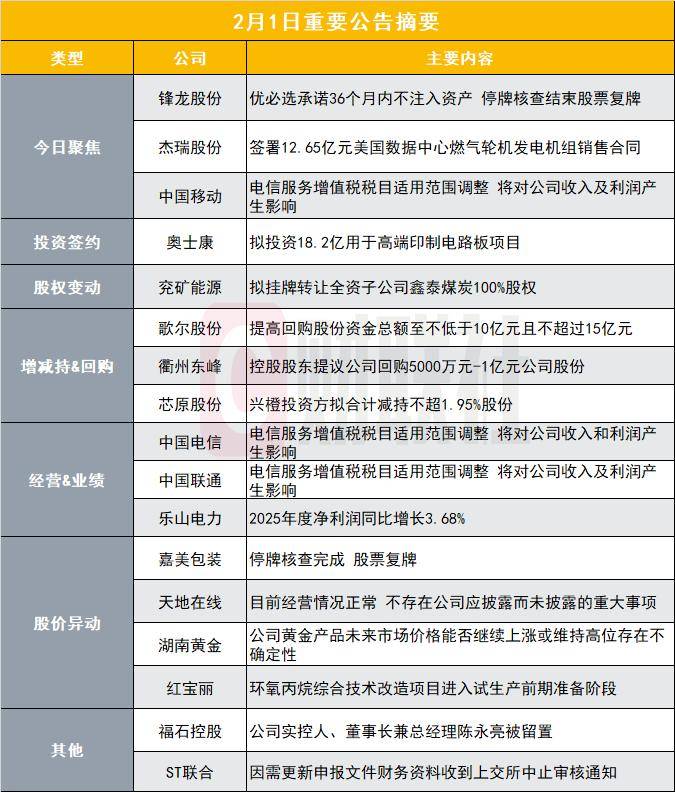
Group 1: Major Announcements - Fenglong Co. and Jiamei Packaging will resume trading on February 2 [21][21] - The three major telecom operators in China, including China Mobile, China Unicom, and China Telecom, announced an adjustment in the applicable scope of value-added tax for telecom services, increasing the tax rate from 6% to 9%, which will impact their revenue and profits [6][7][8] Group 2: Project Wins and Contracts - Chengdi Xiangjiang won a bid for a project worth 1.22 billion yuan, with its subsidiary holding a 52.6% stake in the consortium [2] - Fulongma is expected to win sanitation service projects with a total first-year service fee of 83.54 million yuan, which will positively impact its operating performance in 2026 and beyond [2] Group 3: Corporate Transactions - BGI Genomics plans to acquire assets for 366 million yuan, including 100% equity of two companies, with additional capital increases planned for both [3] - Penghui Energy submitted an application for the issuance and listing of H-shares on the Hong Kong Stock Exchange [4] Group 4: Financial Performance - North Benz Blue Valley reported a January production of 11,169 new energy vehicles, a year-on-year increase of 20.84% [14] - Sailyus achieved January sales of 45,900 vehicles, a year-on-year growth of 104.85% [15] - GAC Group's January sales reached 116,622 vehicles, reflecting an 18.47% year-on-year increase [16] - Leshan Electric reported a net profit of 23.4 million yuan for 2025, a year-on-year increase of 3.68% [17] Group 5: Share Buybacks - Quzhou Dongfeng proposed a share buyback plan with a total amount between 50 million and 100 million yuan [18] - GoerTek increased its share buyback fund to a minimum of 1 billion yuan and a maximum of 1.5 billion yuan [20] Group 6: Stock Trading and Performance - Tiandi Online confirmed that its operations are normal and there are no undisclosed significant matters, despite recent stock price fluctuations [10] - Hongbaoli's epoxy propylene project has entered the pre-production preparation stage, with significant uncertainties remaining [11] - Hunan Gold's stock trading showed abnormal fluctuations, with ongoing asset purchase plans pending approval [12][13]





税率调整!A股三大巨头,突发公告!
券商中国· 2026-02-01 13:12
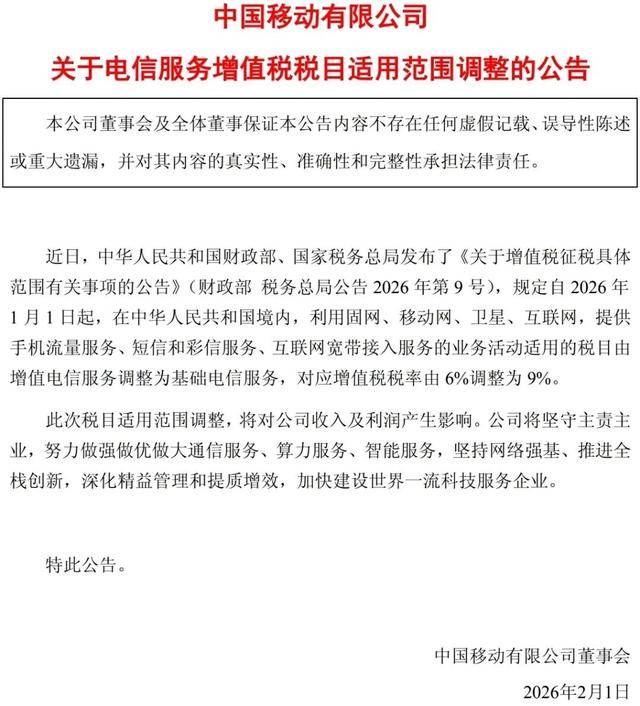
三大运营商公告:增值税率升至9%。 今日,中国移动、中国电信及中国联通三大电信运营商相继发布公告,电信服务增值税税目适用范围调整,税率由6%调整为 9%,将对公司收入及利润产生影响。 在此之前,财政部、税务总局发布《关于增值税征税具体范围有关事项的公告》(以下简称《公告》),明确了适用9%、6% 增值税税率范围,以及销售服务、无形资产、不动产具体范围,这涉及多档税率。该《公告》自2026年1月1日起施行。目前 中国增值税税率主要有三档,其中基本税率是13%,两档优惠税率分别是9%、6%。 三大巨头发布公告 2月1日,中国移动、中国电信、中国联通发布公告称,近日,中华人民共和国财政部、国家税务总局发布了《关于增值税征 税具体范围有关事项的公告》(财政部税务总局公告2026年第9号),规定自2026年1月1日起,在中华人民共和国境内,利用固 网、移动网、卫星、互联网,提供手机流量服务、短信和彩信服务、互联网宽带接入服务的业务活动适用的税目由增值电信 服务调整为基础电信服务,对应增值税税率由6%调整为9%。 中国移动、中国电信、中国联通均在公告中表示,此次税目适用范围调整,将对公司收入及利润产生影响。 中国移动表示 ...

宽带、短信等增值税税率由6%提高至9%,会涨价吗?
Di Yi Cai Jing· 2026-02-01 13:03
Core Viewpoint - The increase in the value-added tax (VAT) rate from 6% to 9% for certain telecom services will negatively impact the revenue and profits of China's three major telecom operators: China Mobile, China Unicom, and China Telecom [1][2]. Group 1: Tax Rate Changes - The new VAT regulations, effective from January 1, 2026, redefine the applicable tax categories for telecom services, shifting mobile data, SMS, and broadband services from the category of value-added telecom services (6% VAT) to basic telecom services (9% VAT) [2][3]. - The adjustment expands the definition of basic telecom services to include mobile data, SMS, and broadband services, which were previously classified under value-added services [3]. Group 2: Impact on Operators - The tax rate increase will lead to a higher tax burden for the three major operators, although their monopolistic position may help mitigate the overall impact [3]. - The potential for price increases in broadband and SMS services exists due to the higher VAT rate, but the extent of this will depend on consumer demand elasticity [4]. Group 3: Financial Context - Recent data indicates a decline in national public budget revenue by 1.7% in 2025, alongside a 7% decrease in government fund budget revenue, highlighting the need for increased tax revenue through such adjustments [5].
三大运营商发布公告,事关增值税税率
Bei Ke Cai Jing· 2026-02-01 13:03
Core Viewpoint - The Ministry of Finance and the State Taxation Administration of the People's Republic of China announced a change in the tax classification for telecommunications services, which will affect the revenue and profits of major telecom companies starting January 1, 2026 [1]. Group 1: Tax Changes - From January 1, 2026, the tax category for services such as mobile data, SMS, MMS, and internet broadband access will change from value-added telecommunications services to basic telecommunications services [1]. - The applicable VAT rate for these services will increase from 6% to 9% [1]. Group 2: Impact on Companies - The adjustment in tax classification is expected to have a significant impact on the revenue and profit margins of companies like China Mobile, China Unicom, and China Telecom [1].
移动、电信、联通同步发布重大公告,影响不一般!
Sou Hu Cai Jing· 2026-02-01 12:45
Core Viewpoint - The recent announcement by the Ministry of Finance and the State Taxation Administration of China regarding the adjustment of the VAT tax category for telecommunications services will lead to a 50% increase in the VAT rate from 6% to 9%, effective January 1, 2026, impacting the revenue and profits of major telecom operators in China [1][5]. Group 1 - The VAT tax category for services such as mobile data, SMS, MMS, and internet broadband access will change from value-added telecommunications services to basic telecommunications services [1][5]. - The adjustment in VAT rate is expected to reduce the profits of major telecom operators, including China Mobile, China Telecom, and China Unicom, necessitating strategies to maintain performance levels [1][9]. - Companies are encouraged to implement strategies focused on cloud transformation and AI integration to enhance efficiency and drive quality development in response to the tax changes [5].
港股公告掘金 | 中国移动、中国联通、中国电信集体公告:电信服务增值税税目适用范围将调整
Zhi Tong Cai Jing· 2026-02-01 12:45
Major Events - Lanke Technology (06809) will conduct an IPO from January 30 to February 4, with an expected listing on February 9 [1] - Aixin Yuanzhi (00600) will conduct an IPO from January 30 to February 5, with an expected listing on February 10 [1] - Lexin Outdoor (02720) will conduct an IPO from January 31 to February 5, raising HKD 130 million from Horizon Capital and Huangshan Dejun [1] - Dongpeng Beverage (09980) sets the offer price at HKD 248 per share [1] - Zhonghui Biotech-B (02627) received approval from the National Medical Products Administration for a trivalent influenza virus subunit vaccine [1] - Kangzheng Pharmaceutical (00867) received approval for the first and only targeted drug for vitiligo treatment in China [1] - Shishi Pharmaceutical Group (02005) received production registration for Propafenone Hydrochloride Injection from the National Medical Products Administration [1] - China Aluminum (02600) plans to jointly acquire 68.6% of Brazilian Aluminum from Rio Tinto and will initiate a mandatory offer [1] - Yanzhou Coal Mining (01171) plans to transfer 100% equity of Inner Mongolia Xintai Coal [1] - Botai Car Union (02889) plans to collaborate with Ping An Property & Casualty to reconstruct the smart travel insurance ecosystem [1] - Jin Jing New Energy (01783) signed a strategic framework agreement with Tianqi Grand for lithium battery recycling and precious metal extraction [1] - Guangdong-Hong Kong-Macau Holdings (01396) subsidiary Hongce Data introduces Fudian Capital as a strategic investor for 40% equity [1] - China Mobile (00941), China Unicom (00762), and China Telecom (00728) will adjust the applicable scope of value-added tax for telecom services [1] Operating Performance - BYD Company (01211) sold approximately 210,000 new energy vehicles in January [2] - Geely Automobile (00175) reported total vehicle sales of 270,200 units in January, a year-on-year increase of about 1% [2] - Chery Automobile (09973) saw total sales of 191,500 vehicles in January, a year-on-year decrease of about 10.7% [2] - Seres (09927) reported total vehicle sales of 45,900 units in January, a year-on-year increase of 104.85% [2] - Great Wall Motors (02333) sold approximately 90,300 vehicles in January, a year-on-year increase of 11.59% [2] - Li Auto-W (02015) delivered 27,668 new vehicles in January, a year-on-year decrease of 7.5% [2] - NIO-SW (09866) delivered 27,182 vehicles in January, a year-on-year increase of 96.1% [2] - GAC Group (02238) reported vehicle sales of 116,600 units in January, a year-on-year increase of 18.47% [2] - Great Wall Motors (02333) released a preliminary report indicating a net profit attributable to shareholders of 9.912 billion yuan for 2025, a year-on-year decrease of 21.71% [2] - Shandong Gold (01787) expects a net profit attributable to shareholders of approximately 4.6 billion to 4.9 billion yuan for 2025, a year-on-year increase of 56% to 66% [2] Earnings Forecast - SF Express (09699) expects a year-on-year profit increase of no less than 80% for 2025 [3] - China International Capital Corporation (03908) anticipates a net profit attributable to shareholders of 8.542 billion to 10.535 billion yuan for 2025, a year-on-year increase of 50% to 85% [3] - China Shenhua (01088) expects a year-on-year decline in net profit for 2025 [3] - Datang Power (00991) anticipates a net profit of approximately 6.8 billion to 7.8 billion yuan for 2025, a year-on-year increase of about 51% to 73% [3] - China Southern Airlines (01055) expects a net profit attributable to shareholders of 800 million to 1 billion yuan for 2025, turning a profit [3] - Air China (00753) warns of a net loss attributable to shareholders of approximately 1.3 billion to 1.9 billion yuan for 2025 [3] - China Eastern Airlines (00670) warns of a net loss attributable to shareholders of approximately 1.3 billion to 1.8 billion yuan for 2025 [3] - GAC Group (02238) expects a net loss attributable to shareholders of 8 billion to 9 billion yuan for 2025 [3] - Ansteel (00347) warns of a net loss attributable to shareholders of approximately 4.077 billion yuan for 2025, a year-on-year narrowing of 42.75% [3] - Junshi Biosciences (01877) warns of a net loss attributable to shareholders of approximately 873 million yuan for 2025, a year-on-year decrease of about 31.85% [3]
机器人概念牛股停牌核查结束 明日复牌|盘后公告集锦
Sou Hu Cai Jing· 2026-02-01 12:43
Company Announcements - Fenglong Co., Ltd. received a commitment from UBTECH not to inject assets into the company within 36 months after the acquisition, and the stock will resume trading on February 2 after the completion of a trading suspension investigation [2] - Jerry Holdings signed a sales contract for gas turbine generator sets with a total amount of 1.82 billion USD (approximately 12.65 billion RMB) for a data center application, marking the fourth such contract with a U.S. client since November 2025 [3] - Aoxin plans to invest 1.82 billion RMB in a high-end printed circuit board project, which aims to enhance product competitiveness and meet the growing demand in various sectors [3] Shareholder Changes - Yanzhou Coal Mining Company intends to transfer 100% equity of its wholly-owned subsidiary Xintai Coal [4] - GoerTek increased its share repurchase fund from a minimum of 5 billion RMB to a minimum of 10 billion RMB, with a maximum of 15 billion RMB [4][5] Business Performance - China Mobile and China Telecom will be affected by the adjustment of the VAT tax category for telecom services, which will impact their revenue and profits [3][5] - Leshan Electric Power reported a year-on-year net profit growth of 3.68% for 2025 [5] Stock Price Movements - Jiamei Packaging's stock price surged by 408.11% from December 17, 2025, to January 23, 2026, leading to a trading suspension for investigation, with the stock resuming trading on February 2 [5] - Hunan Gold's stock experienced significant trading fluctuations, with uncertainty regarding the future market price of its gold products [7] - Hongbaoli's epoxy propylene comprehensive technology transformation project has entered the pre-production preparation stage, although there is uncertainty regarding the timeline for producing qualified products [8] Other News - Fushi Holdings' actual controller and chairman Chen Yongliang has been detained [9] - ST United received a notice from the Shanghai Stock Exchange to suspend the review of its application due to the need to update financial documents [9]