China Unicom(600050)

Search documents
独家:中国电信审计部原总经理黄旭丹动态曝光 任这家央企外部董事
Xin Lang Cai Jing· 2026-01-11 03:47
运营商财经网 吴碧慧/文 其实,黄旭丹这样的职业经历业内还有好几位。比如上海联通原总经理沈洪波2025年初改任央企专职外 部董事,如今也兼任香 港中旅(集团)外部董事; 中国移动投资公司原董事长范冰也同样2025年中转任央企专职外部董事,后来也兼任国家开发投资集团 有限公司外部董事。 运营商财经网副总编刘平表示,他们的受重用,也意味着运营商行业的人才越来越受到其他央企的重 视。 据官方消息,黄旭丹出任中国机械工业集团院外部董事。这也是黄旭丹自2025年11月从中国电信调走后 的又一新动态。 黄旭丹此前是运营商知名的财务女干将,曾先后担任中国联通集团财务部副总经理、中国电信集团财务 部副总经理、天翼融资租赁公司总经理、中国电信财务公司总经理、集团审计部总经理等职。 2025年11月,黄旭丹调离行业,出任央企专职外部董事。该职务与央企外部董事有所区别,是有实职 的,通常享有与央企副总经理同等的待遇。 (责任编辑:吴碧慧) ...




中国联通取得英文缩写字符串特征获取方法专利
Sou Hu Cai Jing· 2026-01-09 11:24
Group 1 - China United Network Communications Group Co., Ltd. has obtained a patent for a method, device, equipment, and storage medium for acquiring features of English abbreviation strings, with authorization announcement number CN117131375B, and application date of August 2023 [1] - China United Network Communications Group Co., Ltd. was established in 1994, located in Beijing, primarily engaged in telecommunications, broadcasting, television, and satellite transmission services, with a registered capital of approximately 10.57 billion RMB [1] - The company has invested in 35 enterprises, participated in 3,339 bidding projects, holds 3,734 trademark records, and has 5,000 patent records, along with 11 administrative licenses [1] Group 2 - Unicom Digital Technology Co., Ltd. was established in 2006, located in Beijing, primarily engaged in software and information technology services, with a registered capital of approximately 988.98 million RMB [1] - The company has invested in 54 enterprises, participated in 5,000 bidding projects, holds 24 trademark records, and has 1,969 patent records, along with 42 administrative licenses [1] Group 3 - Unicom Data Intelligence Co., Ltd. was established in 2024, located in Hangzhou, primarily engaged in other service industries, with a registered capital of 150 million RMB [2] - The company has invested in 1 enterprise, participated in 282 bidding projects, and holds 281 patent records [2]
港股中国联通短线拉升涨超4%
Mei Ri Jing Ji Xin Wen· 2026-01-09 02:32
Group 1 - The stock of China Unicom in the Hong Kong market experienced a short-term surge, rising over 4% [1] - The trading volume exceeded 2.4 million hands, indicating significant market activity [1]
高盛:下调中国电信及中国联通评级至“中性” 创新业务增长短期受压
智通财经网· 2026-01-08 09:41
Group 1 - The core viewpoint of the article is that Goldman Sachs has a positive outlook on the shift of capital expenditure from traditional telecom networks to AI computing infrastructure and new business expansions in Chinese telecom companies, but notes that short-term growth in service and innovative businesses is under pressure [2][3] Group 2 - In terms of telecom services, future growth is expected to stagnate due to the slowdown in 5G applications affecting both paying users and average revenue per user (ARPU) growth, although there is a positive outlook on value-added services [3] - The expansion of ARPU is believed to depend on breakthroughs in AI applications and functionalities to drive user traffic [3] - For innovative businesses, there is a long-term positive view on the revenue contribution from AI-related solutions and growth in computing capital expenditure, but macroeconomic uncertainties may lead enterprises to prioritize quality projects, potentially impacting short-term growth [3] Group 3 - Goldman Sachs has downgraded the investment ratings for China Telecom (00728) and China Unicom (00762) from "Buy" to "Neutral" due to stagnation in telecom service growth and the need for a longer time frame for innovative business acceleration [3] - The target price for China Telecom has been reduced from HKD 7.9 to HKD 6, while the target price for China Unicom has been lowered from HKD 11.5 to HKD 8.8 [3] - The firm has also cut its earnings forecasts for both companies for the next two years by 6% to 7% [3]



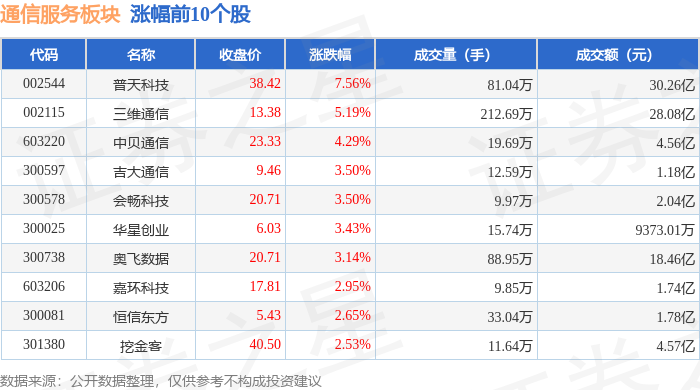
通信服务板块1月8日涨0.75%,普天科技领涨,主力资金净流出2.87亿元
Zheng Xing Xing Ye Ri Bao· 2026-01-08 08:58
Group 1 - The communication services sector increased by 0.75% on January 8, with Putian Technology leading the gains [1] - The Shanghai Composite Index closed at 4082.98, down 0.07%, while the Shenzhen Component Index closed at 13959.48, down 0.51% [1] - Putian Technology's stock price rose by 7.56% to 38.42, with a trading volume of 810,400 shares and a transaction value of 3.026 billion yuan [1] Group 2 - The communication services sector experienced a net outflow of 287 million yuan from institutional investors and 390 million yuan from retail investors, while retail investors saw a net inflow of 677 million yuan [2] - Major stocks in the sector showed varied performance, with China Unicom experiencing a net inflow of 3.25 billion yuan from institutional investors, while retail investors had a net outflow of 1.49 billion yuan [3] - The stock of Sanwei Communication saw a net inflow of 271 million yuan from institutional investors but a net outflow of 201 million yuan from retail investors [3]



68.20亿元主力资金今日撤离通信板块
Zheng Quan Shi Bao Wang· 2026-01-08 08:52
Market Overview - The Shanghai Composite Index fell by 0.07% on January 8, with 20 industries experiencing gains, led by defense and military industry with a rise of 4.18% and media with a rise of 2.00% [1] - The non-bank financial and non-ferrous metals industries saw the largest declines, with drops of 2.81% and 1.56% respectively [1] Capital Flow Analysis - The net outflow of capital from the two markets reached 45.304 billion yuan, with 9 industries experiencing net inflows [1] - The defense and military industry had the highest net inflow of capital at 6.773 billion yuan, followed by the computer industry with a net inflow of 3.917 billion yuan and a daily increase of 1.27% [1] Communication Industry Performance - The communication industry declined by 0.95%, with a total net outflow of 6.820 billion yuan [2] - Out of 124 stocks in the communication sector, 95 stocks rose, including 2 that hit the daily limit, while 28 stocks fell [2] - The top three stocks with the highest net inflow in the communication sector were ZTE Corporation with 561 million yuan, China Unicom with 362 million yuan, and FiberHome Technologies with 303 million yuan [2] Communication Industry Capital Outflow - The communication industry saw significant capital outflows, with the top three stocks being Zhongji Xuchuang with a net outflow of 3.156 billion yuan, Newray Technology with 1.205 billion yuan, and Tianfu Communication with 1.090 billion yuan [4] - Other notable stocks with capital outflows included Nanjing Panda Electronics and China Mobile, with outflows of 434 million yuan and 326 million yuan respectively [4]



大行评级|高盛:下调中国电信及联通评级至“中性” 创新业务增长短期受压
Ge Long Hui· 2026-01-08 06:53
Core Viewpoint - Goldman Sachs expresses a positive outlook on the shift of Chinese telecom operators' capital expenditure from traditional telecom networks to artificial intelligence computing infrastructure and new business expansions, but notes that the growth of service and innovative businesses in the domestic telecom industry is under short-term pressure [1] Telecom Services - Future growth in telecom services is expected to stagnate due to a slowdown in 5G applications affecting both paying users and average revenue per user (ARPU) growth [1] - There is a positive outlook on the increase of value-added services, but the expansion of ARPU will depend on breakthroughs in artificial intelligence applications and functionalities to drive user traffic [1] Innovative Businesses - A long-term positive view is maintained regarding the revenue contribution from AI-related solutions and the growth of computing capital expenditure [1] - However, macroeconomic uncertainties are expected to lead companies to prioritize quality projects, which may impact short-term growth [1] Price Target Adjustments - Goldman Sachs has lowered the target price for China Telecom from HKD 7.9 to HKD 6 and for China Unicom from HKD 11.5 to HKD 8.8, with both ratings downgraded from "Buy" to "Neutral" [1] - The earnings forecasts for both companies for the next two years have been reduced by 6% to 7% [1]
移动联通重押雷鸟创新背后:智能眼镜发出“独立宣言”,欲告别“手机附属品”标签
Hua Xia Shi Bao· 2026-01-07 14:17
Core Viewpoint - The investment by Chinese telecom operators in Thunderbird Innovation marks a strategic move to position themselves in the next generation of personal communication terminals, particularly in the AR smart glasses market, which is expected to reach a significant milestone akin to the "iPhone moment" in the coming years [2][3][4]. Group 1: Investment and Financing - Thunderbird Innovation has completed a new financing round exceeding 1 billion yuan, led by China Mobile's Chain Long Fund and CITIC Jinshi, with participation from China Unicom's Lianchuang Innovation Fund [3]. - Since its establishment in 2021, Thunderbird Innovation has attracted significant capital, with its previous financing round occurring just two months prior, setting a record for the largest single financing amount in the domestic AI+AR glasses sector for 2025 [3]. - The strategic investment from China Mobile and China Unicom signifies the formal entry of AR terminals into the strategic vision of national communication infrastructure [3]. Group 2: Market Position and Growth - According to Counterpoint Research, Thunderbird Innovation held a 24% global market share in AR glasses by Q3 2025, achieving the highest shipment volume globally for two consecutive quarters [4]. - The company has established a strong presence in international retail channels, with its products available in over 25 countries and regions, and a cumulative user base exceeding 500,000, with overseas sales increasing by 3.8 times year-on-year [4]. Group 3: Strategic Collaboration - The partnership with telecom operators will facilitate comprehensive collaboration in market channel development, business model innovation, and core technology ecosystems, leveraging the operators' extensive offline service networks and user bases [5]. - The introduction of the first AR smart glasses with eSIM technology, "Thunderbird X3 Pro Project eSIM," exemplifies the collaborative efforts between Thunderbird Innovation and telecom operators, enabling independent communication capabilities [5][6]. Group 4: Future Outlook - The integration of eSIM technology is expected to transform AR smart glasses into a complete personal computing center, capable of independent communication, computation, display, and interaction [6]. - The operators' involvement is anticipated to catalyze the growth of AR glasses sales in China, potentially reaching millions in volume by 2026-2027, thus accelerating their adoption as mainstream consumer devices [7].

年终奖真相:为什么总感觉像在补发工资?
Xin Lang Cai Jing· 2026-01-07 10:07
Core Viewpoint - The year-end bonus system in state-owned enterprises (SOEs) creates a perception of "back pay" due to the fixed salary cap established at the beginning of the year, which is linked to the company's economic performance and profit targets [2][4][20]. Salary Cap Management - The total salary budget is predetermined annually, encompassing all forms of employee compensation, including salaries, bonuses, and allowances [2][18]. - The salary budget is linked to the company's economic performance; if profits decline, the salary budget must also decrease [4][20]. - This budgetary constraint leads to conservative monthly payouts, with significant adjustments made at year-end based on confirmed performance metrics [5][20]. Performance Pressure in 2025 - The major telecom operators are facing significant performance pressures, with emerging business revenue growth slowing down from 22.2% in 2023 to 9.9% in 2024, and further stagnation expected in 2025 [6][22]. - EBITDA for China Mobile and China Unicom has shown rare negative growth, while China Telecom's growth rate has also declined, indicating reduced profitability [6][22]. - Management salaries have been cut, with China Mobile's key management compensation decreasing from 10.1 million yuan in 2022 to 9.29 million yuan in 2024, a reduction of approximately 8% [6][22]. Year-End Bonus Disparities - There is a significant disparity in year-end bonuses among employees, with reported bonuses ranging from 6,000 yuan to 150,000 yuan depending on position and location [7][23]. - For example, a graduate from Hunan Mobile received a total of 100,000 yuan, while a master's degree holder from Anhui received around 30,000 yuan [7][23]. - The differences reflect the complex internal distribution logic within the operators [9][25]. Hierarchical Influence on Compensation - The fixed salary cap means that higher-ranking employees receive a larger share of the total compensation pool, leading to substantial differences in bonuses based on job level [10][26]. - For instance, an employee in a lower position may receive only a fraction of what a higher-ranking colleague earns for similar contributions [10][26]. Departmental Impact on Bonuses - Not all departments within the telecom operators are equally valued; R&D departments are prioritized, with significant increases in R&D budgets for AI and cloud computing [12][28]. - Conversely, traditional communication roles are under pressure, with bonuses likely to decrease as these services decline [12][28]. Year-End Bonus as a Management Tool - Year-end bonuses serve as a management tool rather than just a reward, with a portion of the total salary budget allocated to performance-based bonuses linked to company performance metrics [29][34]. - This system allows for differentiated bonuses to incentivize and manage employee performance effectively [29][34]. Future Trends in Year-End Bonuses - The trend of bonus disparities is expected to continue, with traditional communication roles facing further reductions while positions in AI and computing may see increases [15][31]. - The success of the operators' transformation into digital service providers will directly influence the potential for year-end bonuses to become genuine incentives rather than mere compensatory payments [33].

中国联通原部门总经理宗新华受贿200多万 包括一款12.9万的名表
Xin Lang Cai Jing· 2026-01-07 07:56
Core Viewpoint - The article outlines the rise and fall of Zong Xinhua, a key figure in China Unicom's e-commerce and information technology sectors, detailing his contributions and subsequent legal troubles due to corruption allegations [1][3]. Group 1: Background and Contributions - Zong Xinhua played a pivotal role in establishing China Unicom's electronic channel center, e-commerce department, and information technology and e-commerce division, significantly contributing to the company's e-commerce business, which generated revenue of 23 billion yuan in 2011 [3]. - His leadership was instrumental in developing China Unicom's e-commerce model from inception to a successful business unit [3]. Group 2: Legal Troubles - On December 19, 2014, China Unicom announced Zong's dismissal due to serious disciplinary violations, coinciding with the investigation of another senior executive just days prior [5][6]. - Zong was placed under residential surveillance in January 2015, formally arrested in February, and faced a lengthy legal process, culminating in a conviction for bribery in November 2016, resulting in a prison sentence of five years and six months, along with a fine of 800,000 yuan [6]. - The court also confiscated over 1.8 million yuan, 11,000 USD, and a luxury watch valued at 129,000 yuan, although allegations of personal misconduct were not included in the final judgment [6]. Group 3: Industry Impact - The case serves as a cautionary tale for the industry, highlighting the importance of integrity in professional conduct, as noted by industry experts reflecting on Zong's capabilities overshadowed by his ethical failures [6].