FOSUNPHARMA(600196)

Search documents
复星医药:复宏汉霖两款地舒单抗注射液获美国FDA批准
Xin Lang Cai Jing· 2025-09-01 11:11
Core Viewpoint - Fosun Pharma's subsidiary, Hanhui, received FDA approval for its self-developed denosumab injection (HLX14) in two specifications, which includes five indications for osteoporosis treatment [1] Group 1: Product Approval - The FDA approved the biologics license application (BLA) for denosumab injection in two concentrations: 60mg/mL and 120mg/1.7mL [1] - The approved indications include treatment for osteoporosis in postmenopausal women, osteoporosis in male patients, glucocorticoid-induced osteoporosis, non-metastatic prostate cancer in male patients undergoing androgen deprivation therapy, and breast cancer in women receiving aromatase inhibitor therapy [1] Group 2: Market Potential - The global sales revenue for denosumab injection is approximately $7.462 billion [1]
复星医药(600196) - 复星医药H股公告-证券变动月报表
2025-09-01 09:30
FF301 致:香港交易及結算所有限公司 公司名稱: 上海復星醫藥(集團)股份有限公司 ( 於中華人民共和國註冊成立的股份有限公司) 呈交日期: 2025年9月1日 I. 法定/註冊股本變動 股份發行人及根據《上市規則》第十九B章上市的香港預託證券發行人的證券變動月報表 截至月份: 2025年8月31日 狀態: 新提交 | 1. 股份分類 | 普通股 | 股份類別 | H | | 於香港聯交所上市 (註1) | | 是 | | | --- | --- | --- | --- | --- | --- | --- | --- | --- | | 證券代號 (如上市) | 02196 | 說明 | | | | | | | | | | 法定/註冊股份數目 | | | 面值 | | 法定/註冊股本 | | | 上月底結存 | | | 551,940,500 | RMB | | 1 RMB | | 551,940,500 | | 增加 / 減少 (-) | | | 0 | | | RMB | | 0 | | 本月底結存 | | | 551,940,500 | RMB | | 1 RMB | | 551,940,500 | ...
复星国际徐晓亮:在具备长期价值的领域不断突破
Zhong Zheng Wang· 2025-09-01 09:29
Core Insights - The core viewpoint emphasizes that Fosun International is effectively mitigating market uncertainties through its global operational capabilities, while also experiencing signs of economic recovery in China [1] Financial Performance - In the first half of the year, Fosun reported total revenue of 87.28 billion yuan, operating profit of 3.15 billion yuan, and net profit attributable to shareholders of 660 million yuan [1] - Fosun Pharma's net profit increased by 37.6% year-on-year, and Fosun Tourism's revenue reached a historical high [1] Strategic Focus - Fosun is shifting from blind expansion to a strategy of "slimming down and strengthening," focusing on core businesses and long-term value creation [1][2] - The company has been divesting non-core assets, including the sale of German private bank HAL for 670 million euros and the complete exit from Homelike [2] Operational Strategy - Fosun has developed a "red-yellow-green light" mechanism to evaluate assets based on their alignment with core family consumption sectors, profitability, and sustainability [3] - The company aims for a "double hundred billion" target, seeking to achieve 10 billion yuan in operating profit and self-owned cash flow, with 7 billion yuan expected from four core subsidiaries [3] Asset Management - The strategy of "embracing light and combining heavy" focuses on enhancing cooperation with various capital sources to improve light asset operations [4] - The Taicang Alps International Resort project is highlighted as a significant example of this light asset capability [4][5] Tourism Sector - Fosun Tourism is concentrating on vacation strategies, leveraging the Club Med brand to cater to the evolving preferences of Chinese consumers for "light vacations" [6] - The company is exiting unrelated businesses, such as scenic area construction and management services, to focus solely on vacation-related operations [6] AI Integration - Fosun is committed to an "All in AI" approach, emphasizing the importance of AI applications in enhancing business processes rather than merely investing in AI technology [8] - The company is currently in the "business + AI" phase, aiming to transition to "AI + business" to fundamentally restructure its core business processes [8][9] Pharmaceutical Innovation - Fosun Pharma recognizes the potential of AI in drug development, launching the PharmAID platform to provide quantifiable decision-making support in research and clinical trials [9]


CRO概念涨2.88%,主力资金净流入这些股
Zheng Quan Shi Bao Wang· 2025-09-01 09:21
Group 1 - The CRO concept index increased by 2.88%, ranking 8th among concept sectors, with 56 stocks rising, including Baohua Pharmaceutical, Dezhan Health, and ST Weiming hitting the daily limit [1][2] - Notable gainers in the CRO sector included Yiqiao Shenzhou, Puris, and Baicheng Pharmaceutical, which rose by 10.65%, 8.59%, and 8.46% respectively [1][2] - The sector saw a net inflow of 1.876 billion yuan, with 39 stocks receiving net inflows, and 7 stocks attracting over 50 million yuan [2][3] Group 2 - The leading stock in terms of net inflow was WuXi AppTec, with a net inflow of 1.04 billion yuan, followed by Fosun Pharma, Dezhan Health, and Chengdu Xian Dao with net inflows of 233 million yuan, 126 million yuan, and 93.8 million yuan respectively [2][3] - The highest net inflow ratios were observed in Dezhan Health, ST Weiming, and Baohua Pharmaceutical, with ratios of 26.23%, 17.45%, and 16.34% respectively [3][4] - The trading volume and turnover rates for key stocks in the CRO sector showed significant activity, with WuXi AppTec having a turnover rate of 4.09% and a price increase of 8.02% [3][4]


CRO概念涨2.88% 主力资金净流入这些股
Zheng Quan Shi Bao Wang· 2025-09-01 09:19
Group 1 - The CRO concept sector increased by 2.88%, ranking 8th among concept sectors, with 56 stocks rising, including Baohua Pharmaceutical, Dezhan Health, and ST Unimed hitting the daily limit [1] - Notable gainers in the CRO sector included Yiqiao Shenzhou, Puris, and Baicheng Pharmaceutical, which rose by 10.65%, 8.59%, and 8.46% respectively [1] - The sector saw a net inflow of 1.876 billion yuan, with 39 stocks receiving net inflows, and 7 stocks exceeding 50 million yuan in net inflow, led by WuXi AppTec with 1.04 billion yuan [2][3] Group 2 - The top stocks by net inflow ratio included Dezhan Health, ST Unimed, and Baohua Pharmaceutical, with net inflow ratios of 26.23%, 17.45%, and 16.34% respectively [3] - The top stocks in the CRO concept by net inflow included WuXi AppTec, Fosun Pharma, and Dezhan Health, with net inflows of 1.04 billion yuan, 233.4 million yuan, and 126.1 million yuan respectively [3][4] - Stocks with significant declines included Sichuan Shuangma, ST Biology, and Hitec Biotech, which fell by 3.73%, 3.03%, and 2.67% respectively [1][6]


15.28亿主力资金净流入 减肥药概念涨2.99%
Zheng Quan Shi Bao Wang· 2025-09-01 09:17
Core Viewpoint - The weight loss drug sector has shown a significant increase, with a rise of 2.99% as of September 1, ranking it seventh among concept sectors, driven by strong performances from several stocks [1][2]. Group 1: Sector Performance - The weight loss drug sector saw 48 stocks increase in value, with notable gainers including Baihua Pharmaceutical (up 10.91%), Dezhan Health (up 10.00%), and Health元 (up 9.98%) [1][2]. - Conversely, stocks such as Sichuan Shuangma, Nawei Technology, and Deyuan Pharmaceutical experienced declines, with drops of 3.73%, 3.61%, and 1.64% respectively [1][2]. Group 2: Capital Flow - The weight loss drug sector attracted a net inflow of 1.528 billion yuan, with 35 stocks receiving net inflows, and 6 stocks exceeding 100 million yuan in net inflows [2][3]. - Leading the net inflow was Heng Rui Pharmaceutical, which saw a net inflow of 524 million yuan, followed by Fosun Pharmaceutical (233 million yuan), Health元 (213 million yuan), and Yi Pin Hong (128 million yuan) [2][3]. Group 3: Stock Specifics - Health元, Dezhan Health, and Baihua Pharmaceutical had the highest net inflow ratios at 28.67%, 26.23%, and 16.34% respectively [3]. - Specific stock performances included Heng Rui Pharmaceutical (up 3.20% with a turnover rate of 1.37%), Fosun Pharmaceutical (up 6.38% with a turnover rate of 4.71%), and Health元 (up 9.98% with a turnover rate of 3.05%) [3][4].



化学制药板块9月1日涨3.54%,迈威生物领涨,主力资金净流入12.45亿元
Zheng Xing Xing Ye Ri Bao· 2025-09-01 08:44
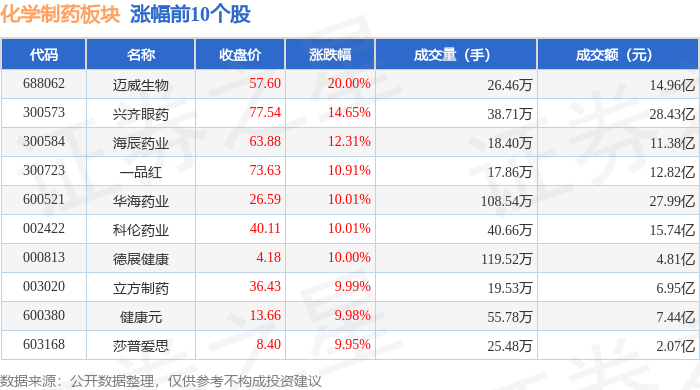
Group 1 - The chemical pharmaceutical sector increased by 3.54% on September 1, with Maiwei Biotech leading the gains [1] - The Shanghai Composite Index closed at 3875.53, up 0.46%, while the Shenzhen Component Index closed at 12828.95, up 1.05% [1] - Notable gainers in the chemical pharmaceutical sector included Maiwei Biotech, which rose by 20.00% to a closing price of 57.60, and Xingqi Eye Medicine, which increased by 14.65% to 77.54 [1] Group 2 - The chemical pharmaceutical sector saw a net inflow of 1.245 billion yuan from main funds, while retail funds experienced a net outflow of 41.1167 million yuan [2] - The top stocks by main fund inflow included Heng Rui Medicine with 474 million yuan and Fuxing Medicine with 256 million yuan [3] - Conversely, stocks like Duorui Medicine and ST Suwu experienced significant declines, with Duorui Medicine down 9.36% to 41.17 [2][3]




复星医药(02196) - 截至2025年8月31日之股份发行人的证券变动月报表
2025-09-01 08:28
截至月份: 2025年8月31日 狀態: 新提交 致:香港交易及結算所有限公司 FF301 股份發行人及根據《上市規則》第十九B章上市的香港預託證券發行人的證券變動月報表 公司名稱: 上海復星醫藥(集團)股份有限公司 ( 於中華人民共和國註冊成立的股份有限公司) 呈交日期: 2025年9月1日 I. 法定/註冊股本變動 | 1. 股份分類 | 普通股 | 股份類別 | H | | 於香港聯交所上市 (註1) | | 是 | | | --- | --- | --- | --- | --- | --- | --- | --- | --- | | 證券代號 (如上市) | 02196 | 說明 | | | | | | | | | | 法定/註冊股份數目 | | | 面值 | | 法定/註冊股本 | | | 上月底結存 | | | 551,940,500 | RMB | | 1 RMB | | 551,940,500 | | 增加 / 減少 (-) | | | 0 | | | RMB | | 0 | | 本月底結存 | | | 551,940,500 | RMB | | 1 RMB | | 551,940,500 | ...
医药生物行业周报(8月第5周):MASH无创诊断有望加速新药研发-20250901
Century Securities· 2025-09-01 00:40
Investment Rating - The report provides a positive outlook on the MASH non-invasive diagnosis technology, suggesting it could accelerate new drug development in the pharmaceutical and biotechnology sector [2]. Core Insights - The pharmaceutical and biotechnology sector experienced a decline of 0.65% from August 25 to August 29, underperforming compared to the Wind All A index (1.9%) and the CSI 300 index (2.71%). Only the medical research outsourcing (4.9%) and other biological products (0.14%) sectors saw gains, while in vitro diagnostics (-4.12%), raw materials (-3.34%), and vaccines (-0.59%) faced significant declines [2][7]. - The FDA has accepted the proposal for using VCTE-LSM as a reasonable alternative endpoint for clinical trials in adults with MASH and moderate to advanced fibrosis. This non-invasive method is expected to enhance patient compliance and could lead to a surge in drug development in the MASH area within the next two to three years [2][13]. - The report emphasizes the potential for domestic companies in China to leverage their cost advantages and forward-looking strategies in the field of non-invasive companion diagnostics, particularly in the MASH drug development competition [2]. Market Weekly Review - The pharmaceutical and biotechnology sector's performance was notably weaker than the broader market indices, with specific sub-sectors like medical research outsourcing and other biological products showing resilience [7][8]. - Individual stocks such as Tianchen Medical (30.1%), Ailis (25.6%), and Maiwei Biotech-U (22.4%) performed well, while stocks like Lifang Pharmaceutical (-13.9%), Yuekang Pharmaceutical (-11.9%), and Kanghua Biotech (-11.1%) faced significant losses [10][12]. Industry News and Key Company Announcements - On August 28, Kangfang Biotech announced that its drug AK112 received approval for treating advanced non-squamous non-small cell lung cancer, with promising clinical trial results expected to be presented at an international conference [12]. - The report highlights various companies' financial performances, with notable revenue changes and profit margins, indicating a mixed outlook across the sector [16][17].


多家创新药企业绩大涨
2 1 Shi Ji Jing Ji Bao Dao· 2025-08-31 00:44
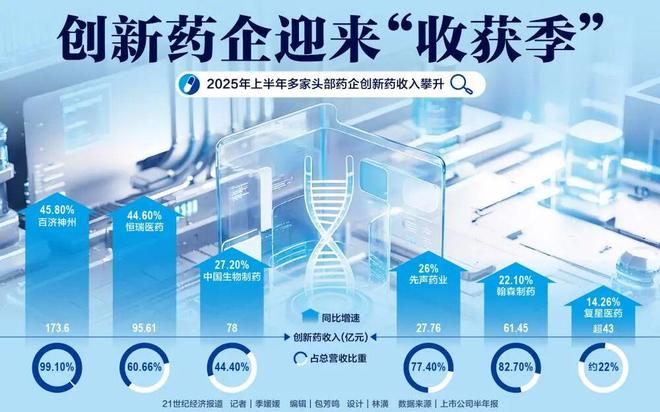
Core Viewpoint - The performance of innovative pharmaceutical companies in China for the first half of 2025 has been impressive, with significant revenue and profit growth driven by innovative drug sales, indicating a potential recovery in the pharmaceutical industry [1][6][15]. Group 1: Company Performance - Heng Rui Pharmaceutical achieved a revenue of 15.76 billion yuan, a year-on-year increase of 15.88%, with a net profit of 4.45 billion yuan, up 29.67%. Innovative drug sales accounted for 60.66% of total revenue [3][9]. - BeiGene reported total revenue of 17.52 billion yuan, a 46.0% increase year-on-year, with a net profit of 450 million yuan, marking a turnaround from losses [3][6]. - China Biopharmaceutical's revenue reached 17.57 billion yuan, a 10.7% increase, with innovative product revenue of 7.8 billion yuan, up 27.2%, representing 44.4% of total revenue [3][6]. - XinDa Biopharmaceutical achieved revenue of 5.95 billion yuan, a 50.6% increase, and a net profit of 1.21 billion yuan, turning a loss from the previous year [7][8]. - Xiansheng Pharmaceutical reported a revenue increase of 15.1% to 3.58 billion yuan, with innovative drug revenue surpassing 75% of total revenue [8]. Group 2: Market Trends - The rising proportion of innovative drug revenue among multiple pharmaceutical companies suggests a shift towards innovation-driven strategies, indicating a growing market for innovative drugs in China [6][8][15]. - The second-tier market is experiencing a prosperous phase, leading to speculation about a potential "spring" for the pharmaceutical industry, although the primary market remains challenging [4][15]. - The demand for high-quality products that can compete globally is increasing, with a focus on "best-in-class" products [4][15]. Group 3: Business Development (BD) Contributions - Business development (BD) activities are becoming crucial for the growth of innovative pharmaceutical companies, with significant deals contributing to revenue [9][10]. - Heng Rui Pharmaceutical's BD activities included a $1.97 billion contract with Merck and a partnership with GSK, highlighting the increasing global engagement of Chinese innovative drug companies [10][11]. - The first half of 2025 saw over 50 BD transactions in China's innovative drug sector, with a total disclosed cooperation amount exceeding $48.44 billion, marking a significant increase compared to the previous year [10][11]. Group 4: Challenges and Outlook - Despite the positive trends, companies face challenges such as intense market competition, high project uncertainty, and increasing accounts receivable [13][14]. - Some companies, like BeiDa TianHeng, reported significant revenue declines due to high R&D investments and previous income recognition from collaborations [13][14]. - Overall, the industry is transitioning from an "investment phase" to a "harvest phase," indicating a recovery in profitability and a moderate expansion phase [14][15].