
SHRC(600392)

Search documents
有色金属周报:铜现货愈发紧张,看好有色春季躁动-20251207
SINOLINK SECURITIES· 2025-12-07 09:35
Investment Ratings - The report maintains a positive outlook on copper, aluminum, and rare earths, indicating high market activity and potential for growth [12][33][34]. Core Insights - Copper prices increased by 4.38% to $11,665.00 per ton on LME, with domestic prices rising by 6.12% to 92,800 yuan per ton, driven by supply constraints and high demand [1][13]. - Aluminum prices rose by 1.24% to $2,900.50 per ton on LME, with domestic prices up 3.4% to 22,300 yuan per ton, reflecting stable demand despite seasonal fluctuations [2][14]. - Gold prices decreased by 0.87% to $4,227.7 per ounce, influenced by geopolitical risks and market volatility, while SPDR gold holdings increased [3][15]. - Rare earth prices, particularly praseodymium-neodymium oxide, rose by 2.79%, with expectations of increased demand due to supply constraints and favorable export conditions [4][34]. - Antimony prices decreased by 1.79%, but the outlook remains positive due to anticipated recovery in exports [4][35]. - Tin prices increased by 4.70%, supported by low inventory levels and supply disruptions in Indonesia and Myanmar [4][36]. Summary by Sections Copper - LME copper price increased by 4.38% to $11,665.00 per ton, with domestic prices at 92,800 yuan per ton [1][13]. - Supply constraints are evident with a decrease in copper inventory and processing fees [1][13]. - Downstream demand is weakening due to high prices, leading to a decline in new orders [1][13]. Aluminum - LME aluminum price rose by 1.24% to $2,900.50 per ton, with domestic prices at 22,300 yuan per ton [2][14]. - Inventory levels remain stable, but processing rates have decreased slightly [2][14]. - Demand is cautious due to high prices affecting transaction volumes [2][14]. Precious Metals - Gold prices fell by 0.87% to $4,227.7 per ounce, with geopolitical factors influencing market dynamics [3][15]. - SPDR gold holdings increased, indicating a slight uptick in investor interest [3][15]. Rare Earths - Praseodymium-neodymium oxide prices increased by 2.79%, with expectations of higher demand due to supply constraints [4][34]. - Export conditions are improving, contributing to a positive outlook for the sector [4][34]. Antimony - Antimony prices decreased by 1.79%, but the long-term outlook remains optimistic due to potential export recovery [4][35]. Tin - Tin prices increased by 4.70%, driven by low inventory levels and supply disruptions [4][36].


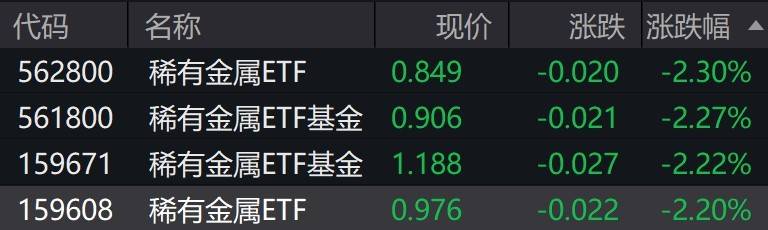
稀有金属概念股走弱,稀有金属ETF跌超2%
Sou Hu Cai Jing· 2025-12-02 06:02
Group 1 - The rare metal concept stocks have weakened, with companies like China Rare Earth, Shenghe Resources dropping over 3%, and Northern Rare Earth, Huayou Cobalt, Salt Lake Industry, and Ganfeng Lithium falling over 2% [1] - The Rare Metal ETF has also declined by more than 2% [1] - Analysts believe that the limited reserves of strategic minor metals, high extraction difficulty, and insufficient supply elasticity, combined with rapid growth in downstream demand from sectors like new energy, semiconductors, and military industry, are exacerbating supply-demand conflicts [2] Group 2 - The scarcity of resources is becoming increasingly prominent, and with the upgrading of demand structure and policy regulation, rare metal prices are expected to continue an upward trend [2] - Companies with resource reserve advantages, technical barriers, and compliant export channels are likely to benefit continuously [2]




稀土概念股走低,稀土相关ETF跌约2%
Mei Ri Jing Ji Xin Wen· 2025-12-02 03:31
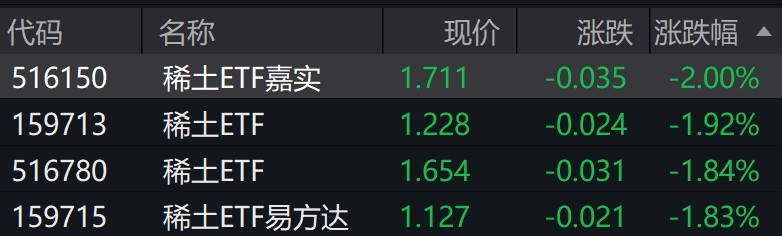
Group 1 - The core viewpoint of the article indicates a decline in rare earth stocks, with Chinese rare earths dropping over 3%, and companies like Northern Rare Earth, Wolong Electric Drive, Shenghe Resources, and Baotou Steel falling more than 2% [1] - The related rare earth ETFs also experienced a decline, with an approximate drop of 2% [1] Group 2 - Specific ETF performance includes: - Jiashi Rare Earth ETF (516150) at 1.711, down 0.035 or 2.00% - Rare Earth ETF (159713) at 1.228, down 0.024 or 1.92% - Rare Earth ETF (516780) at 1.654, down 0.031 or 1.84% [2] - Analysts suggest that rare earths, as core resources for high-end manufacturing and strategic emerging industries, are showing a resonance in both supply and demand [2] - The strategic position of the rare earth industry chain is expected to be further solidified against the backdrop of increased supply concentration and upgraded demand structure, providing long-term driving force for high-end manufacturing development [2]


稀土指数盘中跌2%,成分股多数走低
Mei Ri Jing Ji Xin Wen· 2025-12-02 03:31
Group 1 - The rare earth index experienced a decline of 2% during intraday trading, with most constituent stocks showing a downward trend [1] - China Rare Earth fell by 2.96%, Huahong Technology decreased by 2.28%, Shenghe Resources dropped by 2.19%, Baotou Steel fell by 2.01%, and Northern Rare Earth declined by 1.96% [1]

澳洲稀土供应商表态,美媒:西方“稀土替代”破灭
Sou Hu Cai Jing· 2025-12-01 16:24
Core Viewpoint - The global race for rare earth resources is intensifying as countries seek to establish a supply chain independent of China, highlighting the strategic importance of these materials in modern industry and defense [1][3]. Group 1: Importance of Rare Earths - Rare earths are essential for high-end manufacturing and defense, with significant quantities required for electric vehicles, wind turbines, and military technology [5][12]. - China's dominance in the rare earth supply chain is not solely based on reserves but also on its advanced purification technology, achieving levels of purity that many Western countries cannot match [7][10]. Group 2: Western Response and Initiatives - Following China's export restrictions and price surges, Western nations initiated various strategies to reduce dependence on Chinese rare earths, including the U.S. Rare Earths Act and the EU's Critical Raw Materials Alliance [14][27]. - Australia’s Peak Rare Earths discovered a significant deposit in Tanzania, which was initially seen as a potential solution for Western supply needs [16][29]. Group 3: Challenges Faced by Western Companies - Peak Rare Earths faced significant challenges, including political resistance in Tanzania and a lack of sustained investment, which hindered its ability to develop the mine [19][21]. - The company struggled financially and ultimately had to accept Chinese investment, which led to a complete acquisition by a Chinese firm, highlighting the difficulties faced by Western companies in establishing a reliable supply chain [25][29]. Group 4: Strategic Implications - The acquisition of Peak by a Chinese company underscores the shifting dynamics in the global rare earth market, where Western efforts to secure independence have faltered due to financial and operational challenges [27][31]. - The situation illustrates the need for long-term investment and technological support in the rare earth sector, areas where Western companies have been lacking compared to their Chinese counterparts [31].

工业金属板块多股高开,白银有色涨超7%
Mei Ri Jing Ji Xin Wen· 2025-12-01 01:40
Group 1 - The industrial metal sector saw multiple stocks open higher on December 1, with silver rising over 7% [1] - Shenghe Resources increased by more than 6%, while Jiangxi Copper and Shengton Mining also experienced gains [1]


澳洲稀土供应商正式表态,美媒:西方稀土替代破灭,认命吧
Sou Hu Cai Jing· 2025-11-30 13:42
Group 1 - The acquisition of Peak Rare Earths by China's Shenghe Resources for AUD 158 million allows China to control a resource that produces 37,000 tons of neodymium and praseodymium annually, highlighting a strategic victory in the global resource competition [1][3] - The Ngualla project, containing 887,000 tons of high-grade rare earth minerals, was initially identified by Peak in 2010, but development faced challenges due to high costs and complex extraction processes, leading to a decade-long delay [3][5] - Despite holding only 34% of global rare earth reserves, China is projected to dominate the rare earth permanent magnet materials market with a 91.62% share by 2025, emphasizing the importance of refining and processing capabilities beyond mere resource ownership [5][12] Group 2 - Western countries, including the EU and the US, have struggled to establish independent rare earth supply chains due to funding issues and stringent environmental regulations, which have hindered their ability to compete effectively [7][10] - The strategic missteps of Western nations are evident as they failed to respond timely to the acquisition, with the US only expressing concern after the deal was nearly finalized, indicating a lack of long-term strategic planning [7][10] - The Ngualla acquisition is seen as a precursor to further Chinese investments in resource-rich countries, with a systematic approach of gradual share acquisition and strategic partnerships, posing a challenge to Western interests [10][12]

澳洲稀土巨头突然倒戈!拒美2.4亿投向中国,美媒:稀土替代梦碎
Sou Hu Cai Jing· 2025-11-29 10:40
Core Viewpoint - The acquisition of the Ngualla rare earth mine in Tanzania by China's Shenghe Resources marks a significant shift in the global rare earth landscape, undermining Western aspirations for self-sufficiency in this strategic resource [1][3]. Group 1: Acquisition Details - Shenghe Resources completed the acquisition of Australian Peak Rare Earths for AUD 195 million, securing control over a world-class rare earth mine [1]. - The Peak board rejected a higher offer of AUD 240 million from another investment firm, indicating a strategic preference for Shenghe Resources [3]. Group 2: Importance of Ngualla Mine - The Ngualla mine contains 887,000 tons of high-quality neodymium-praseodymium ore, representing 15% of the world's proven high-quality rare earth resources [5]. - Neodymium-praseodymium is essential for manufacturing permanent magnets, which are critical components in electric vehicles and wind turbines [5]. Group 3: Western Challenges - The former CEO of Peak stated that while they possess resources, they struggle to convert them into products, highlighting a broader issue within the Western rare earth sector [6]. - The lack of a complete industrial chain is a fundamental reason why the West has failed to maintain control over this strategic resource [5]. Group 4: China's Dominance in Rare Earths - China dominates the global rare earth industry, accounting for 58.6% of mining, 85.4% of refining, and 91.6% of permanent magnet production [8]. - This dominance means that 9 out of every 10 permanent magnet motors in electric vehicles rely on Chinese rare earth materials [8]. Group 5: Strategic Insights - China's advantage in the rare earth permanent magnet sector is estimated to be 8-10 years ahead of the West, according to a report by the State Council Development Research Center [10]. - The technical barriers and high costs associated with establishing a complete rare earth supply chain pose significant challenges for Western investors [12]. Group 6: Future Outlook - Short-term reliance on China for rare earths is expected to continue, with predictions indicating that by 2030, 91% of the West's heavy rare earth demand will depend on China [19]. - Establishing a non-Chinese rare earth supply chain could require an investment of USD 120 billion, with product costs potentially increasing by 3-5 times [19]. - Long-term cooperation is suggested as a viable solution, with the potential for rare earths to serve as a bridge for collaboration rather than a tool for competition [21].
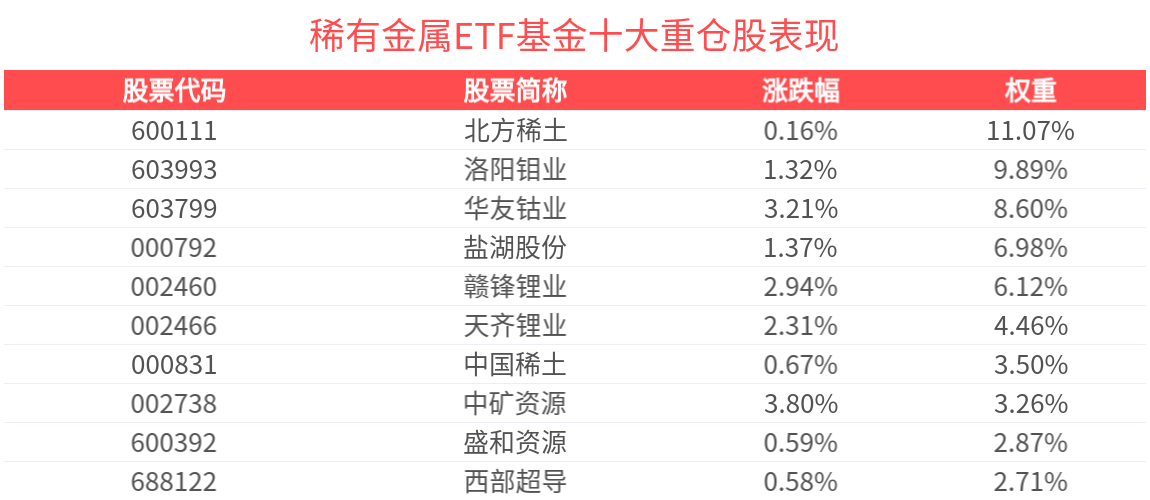
稀有金属概念股盘中大涨,稀有金属ETF基金(561800)最高涨超2%,成分股盛新锂能、天华新能等涨幅居前
Sou Hu Cai Jing· 2025-11-28 03:10
Group 1 - The core viewpoint highlights the significant rise in rare metal stocks driven by the dual forces of new energy transition and high-end manufacturing upgrades, with the rare metal theme index showing a strong performance [1][2] - As of November 27, 2025, the rare metal ETF fund has accumulated a 15.14% increase over the past three months, indicating strong investor interest and market momentum [1] - The liquidity of the rare metal ETF fund is notable, with a turnover rate of 5.29% and a total transaction volume of 975.95 million yuan, reflecting active trading [1] Group 2 - The strategic value of rare metals is emphasized, with traditional demand remaining stable while emerging fields like humanoid robots and low-altitude economy are becoming significant growth drivers [2] - The industry is experiencing increased concentration due to tighter domestic supply controls and enhanced export regulations, which are expected to support rising rare metal prices and improve corporate profitability [2] - The top ten weighted stocks in the rare metal theme index account for 60% of the index, with companies like Northern Rare Earth and Luoyang Molybdenum leading the way [2][4]




澳洲稀土供应商正式表态,美媒:西方“稀土替代”破灭,认命吧
Sou Hu Cai Jing· 2025-11-26 22:30
Core Insights - The global rush for rare earth mining resources is driven by the desire to establish a supply chain independent of China, but recent acquisitions show that China continues to dominate this sector [1][3][4] - Australia’s Peak Rare Earths failed to create a non-Chinese supply chain, highlighting the challenges faced by Western companies in breaking free from reliance on Chinese rare earths [3][5] - China's control over the rare earth supply chain is significant, with 91.62% of global production of rare earth permanent magnet materials coming from China as of 2025 [3][12] Industry Overview - Western countries, including the US, France, and Germany, are actively seeking key mineral deposits to establish rare earth production lines, but many promising sites have already been acquired by Chinese companies [4][5] - The acquisition of Peak by a Chinese rare earth giant signifies a strategic loss for Western nations, enhancing China's market power in the rare earth sector [5][11] - The Ngualla mine in Tanzania, discovered by Peak, contains high-quality rare earth deposits, but the project faced funding challenges and was ultimately acquired by Chinese interests [5][9] Market Dynamics - China's dominance in rare earths is not solely based on resource quantity; it also controls critical processing stages, making it difficult for other countries to compete [3][12] - The trade war initiated by the US has allowed China to leverage its rare earth resources, leading to increased export revenues despite stable export volumes [3][12] - The acquisition of Peak by a Chinese firm reflects a broader trend where Western companies struggle to secure funding and support for rare earth projects, while Chinese companies benefit from state backing [11][12] Strategic Implications - The failure of Peak to secure Western funding and support underscores the difficulties in establishing a self-sufficient rare earth supply chain outside of China [9][11] - The high acquisition premium paid by the Chinese company for Peak's shares indicates a strategic long-term vision, contrasting with the short-term profit focus of Western investors [12] - The ongoing acquisitions by Chinese firms in the rare earth sector suggest that the global landscape for these critical materials will remain heavily influenced by China for the foreseeable future [11][12]
