
WINGTECH(600745)

Search documents
早报|俞敏洪长文再回应并道歉;钟睒睒向一中学捐款一亿元;多地否认试点“老头乐”C7驾照;小米汽车未交车却催尾款,法院判返双倍定金
虎嗅APP· 2025-11-23 23:56
Group 1 - The founder of Nongfu Spring, Zhong Shanshan, donated 100 million yuan to establish the Zhong Ziyi Education Fund at Zhuji Middle School in Zhejiang Province, which has a history dating back to 1912 and has produced over 40,000 outstanding students [2][3] - The fund aims to support educational initiatives and is recognized as a 5A-level foundation by the Hangzhou Civil Affairs Bureau [3] Group 2 - Trump criticized the Ukrainian leadership for showing no gratitude towards the U.S. efforts, while Europe continues to purchase oil from Russia [4] Group 3 - Wentech Technology urged Nexperia Netherlands to respond constructively to resolve control issues, emphasizing the importance of global supply chain stability [5][6] Group 4 - In the first three quarters of this year, marriage registrations in China increased by 405,000 pairs compared to the same period last year, totaling 5.152 million pairs [7] - 29 provinces have extended marriage leave, with Shanxi and Gansu offering the longest at 30 days [7] Group 5 - A collaborative research team from Heilongjiang University, Tsinghua University, and the National University of Singapore published a breakthrough in the field of rare earth materials, addressing the challenge of efficient electroluminescence in insulating rare earth nanocrystals [8] Group 6 - Xibei restaurant chain has reduced prices on nearly 40 menu items by 5% to 20% as part of a nationwide adjustment [9] Group 7 - A fire incident occurred at Xiaomi's battery production line due to operational errors during equipment debugging, but it was quickly extinguished without affecting personnel safety [23][24][25] Group 8 - The German government will impose a 23% VAT on cross-border packages from China starting November 24, significantly increasing costs for cross-border e-commerce [34]




【财经早报】6连板!渔业龙头再发声
Zhong Guo Zheng Quan Bao· 2025-11-23 23:35
Industry Insights - The low-altitude economy market in China is expected to reach 1.5 trillion yuan by 2025, with potential to exceed 2 trillion yuan by 2030, indicating strong growth in the industry [1] - As of now, the annual box office for Chinese films in 2025 has surpassed 46 billion yuan, with over 50 new films expected to be released in November [1] Company News - Zhongshui Fishery has experienced a stock price increase with a cumulative deviation of over 20% in closing prices over two trading days, indicating potential irrational trading behavior and risks of price correction [3] - Jiahua Technology is planning to acquire a controlling stake in Shudun Technology, which may constitute a major asset restructuring, leading to a suspension of trading for up to five days [3] - CITIC Bank has received approval for its subsidiary to commence operations, focusing on market-oriented debt-to-equity swaps and equity investments in strategic emerging industries [3] - Jinfu Technology is planning to acquire at least 51% of Guangdong Lanyuan Technology, which is expected to enhance the company's profitability and risk resistance [4] - Zhongding Co. is entering a strategic cooperation with Shanghai Fourier Intelligent Technology to develop humanoid robot components [4] - JinkoSolar has announced the mass production of its Tiger Neo 3.0 solar module, achieving a production efficiency of over 24.8% and a power output of up to 670W [4] - Zhongjin Lingnan plans to acquire stakes in Zhongjin Copper and Zhongjin Rongsheng for a total consideration of 742 million yuan [5] - Qingmu Technology's subsidiary is set to acquire a 65.83% stake in Vitalis, becoming its controlling shareholder [5]




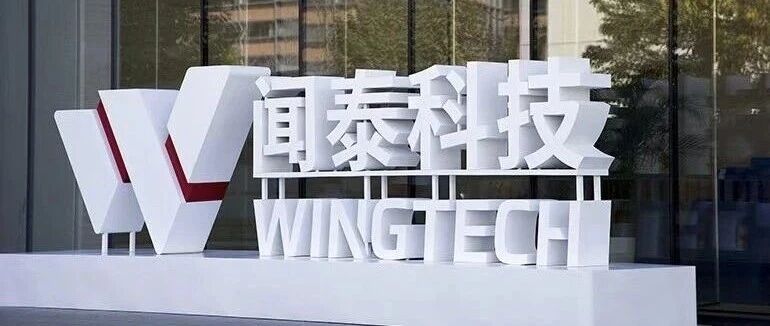
三天二次!闻泰科技再发声明
是说芯语· 2025-11-23 23:25
Core Viewpoint - The recent developments regarding the freezing of assets and control limitations of Anshi Semiconductor, a subsidiary of Wentai Technology, pose potential threats to the stability of the global semiconductor supply chain, prompting Wentai to urge Anshi Netherlands to respond constructively to restore control rights [2][3]. Group 1: Company Statements and Actions - Wentai Technology issued a statement on November 23, emphasizing the lack of substantial response from Anshi Netherlands despite Wentai's efforts to communicate and resolve control issues [2]. - The company highlighted that the Dutch Minister of Economic Affairs' suspension of the administrative order on November 19 reflects a recognition of the current issues, marking a step towards resolution [3]. - Wentai reiterated the need for the Dutch Ministry to comprehensively address the Anshi Semiconductor situation to restore Wentai's complete shareholder rights and legal control [3]. Group 2: Legal and Regulatory Context - The administrative order from the Dutch Ministry, issued in late September, restricted Anshi and its global subsidiaries from making any adjustments to assets, intellectual property, and personnel for one year [3]. - Despite the suspension of the administrative order, the emergency measures imposed by the Amsterdam court remain in effect, limiting Wentai's control over Anshi Semiconductor [4]. - The emergency measures include the suspension of Zhang Xuezheng from his role as an executive director and the management of Wentai's shares in Anshi by an independent third party [4]. Group 3: Financial Implications - Anshi Semiconductor reported revenue of approximately 14.7 billion yuan last year [4]. - Wentai Technology indicated that if control over Anshi is not restored by the end of 2025, the company may face risks of revenue, profit, and cash flow adjustments [4]. - Wentai criticized the Dutch government's actions as excessive intervention based on geopolitical biases, citing "national security" as the rationale for the operational freeze on Anshi Semiconductor [4].
泽连斯基就日内瓦会谈发表声明;王毅:日本现职领导人越了不应碰的红线;多地否认试点“老头乐”C7驾照;钟睒睒,捐赠1亿元丨每经早参
Mei Ri Jing Ji Xin Wen· 2025-11-23 21:44
Group 1 - MSCI announced index adjustments on November 6, effective after the market close on November 24 [3] - The 2025 China Automotive Supply Chain Conference will be held on November 24 [3] - The 2025 RISC-V Industry Development Conference will take place from November 24 to 25 in Zhuhai and Macau [3] Group 2 - As of November 23, the annual box office for Chinese films in 2025 has exceeded 46 billion RMB [9] Group 3 - Longxin Storage officially launched its latest DDR5 product series on November 23, featuring speeds up to 8000 Mbps and capacities up to 24 Gb, marking a significant advancement in domestic storage technology [15][16] - Xiaomi clarified rumors regarding a fire incident at its automotive factory, stating it was a minor issue during equipment debugging and did not cause injuries [20][21] Group 4 - The first domestic GPU stock, Moore Threads, is set to open for subscription on November 24, with an issuance price of 114.28 RMB per share, aiming to raise 8 billion RMB [23][24] - JD Industrial passed the hearing at the Hong Kong Stock Exchange, potentially becoming the sixth listed company under JD Group [25][26]


闻泰科技再发声
2 1 Shi Ji Jing Ji Bao Dao· 2025-11-23 14:48
Core Viewpoint - The company expresses concern over unilateral actions by Nexperia Netherlands that threaten the stability of the global semiconductor supply chain and calls for constructive dialogue to resolve control issues [1][3]. Group 1: Company Actions and Statements - The company has proactively shown goodwill and expressed willingness to engage in constructive communication with Nexperia Netherlands to restore its legitimate control and resolve the current dispute [3]. - Despite the company's efforts to initiate dialogue, Nexperia Netherlands has not provided any substantive response to the communication proposals [3]. Group 2: Industry Implications - The stability of the global semiconductor industry is crucial for the overall development of the sector, and the company urges all parties to act rationally and responsibly to maintain the stability and prosperity of the semiconductor industry [3].
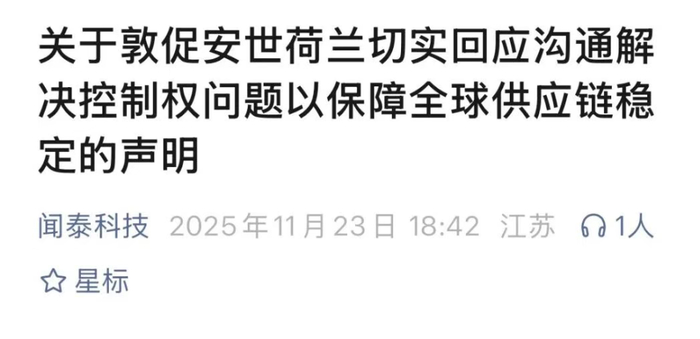
闻泰科技再发声
21世纪经济报道· 2025-11-23 14:31
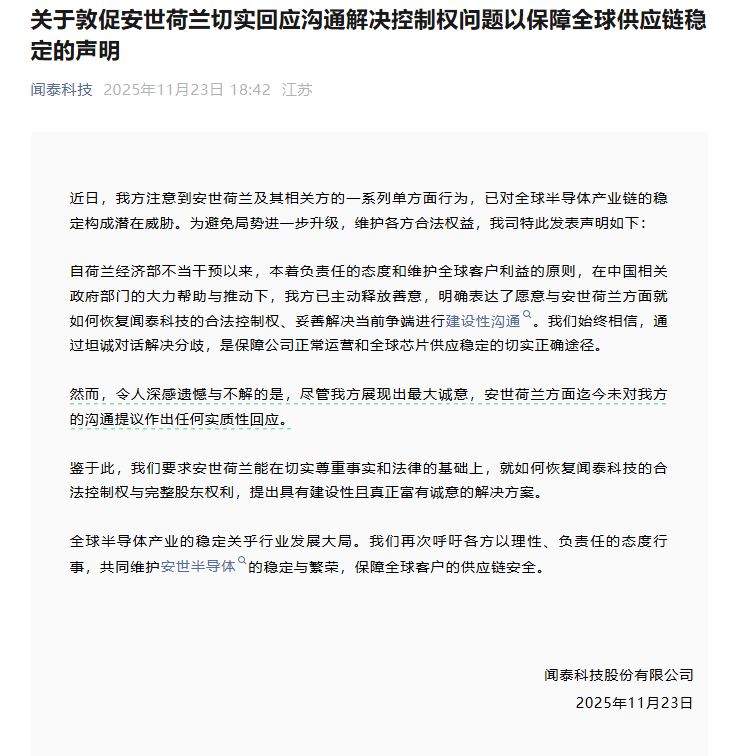
23日晚间,闻泰科技发布《关于敦促安世荷兰切实回应沟通解决控制权问题以保障全球供应链稳定的声明》。 声明全文如下: 自荷兰经济部不当干预以来,本着负责任的态度和维护全球客户利益的原则,在中国相关政府部门的大力帮助与推动下,我方已 主动释放善意,明确表达了愿意与安世荷兰方面就如何恢复闻泰科技的合法控制权、妥善解决当前争端进行建设性沟通。我们始 终相信,通过坦诚对话解决分歧,是保障公司正常运营和全球芯片供应稳定的切实正确途径。 鉴于此,我们要求安世荷兰能在切实尊重事实和法律的基础上,就如何恢复闻泰科技的合法控制权与完整股东权利,提出具有建 设性且真正富有诚意的解决方案。 全球半导体产业的稳定关乎行业发展大局。我们再次呼吁各方以理性、负责任的态度行事,共同维护安世半导体的稳定与繁荣, 保障全球客户的供应链安全。 来源丨闻泰科技微信公众号 编辑丨黎雨桐 商务部再选10城:深圳、杭州、西安、成都均入选,信号很大 8元米线卖48元,有人排队3小时!人均上百的云贵川bistro为何让年轻人上头 热搜第一,西贝店长称近40道产品降价 SFC 21君荐读 21 悦 读 · 智能 权 威 . o 凸》 扫码点击下载 近日,我方注 ...
半导体龙头,重要声明
Zhong Guo Zheng Quan Bao· 2025-11-23 14:28
Core Viewpoint - The statement from the company emphasizes the need for constructive communication with ASML to resolve control issues and ensure the stability of the global semiconductor supply chain [1][3]. Group 1: Company Actions and Statements - The company has expressed a willingness to engage in constructive dialogue with ASML regarding the restoration of its legitimate control and resolution of the current dispute [1]. - Despite the company's efforts to communicate, ASML has not provided any substantial response to the proposals made by the company [1]. - The company calls for ASML to propose a constructive and sincere solution based on respect for facts and laws to restore its legitimate control and shareholder rights [1]. Group 2: Industry Context and Government Involvement - Recent discussions between the Chinese and Dutch governments regarding ASML have taken place, with the Dutch side proposing to suspend an administrative order issued by the Dutch Minister of Economic Affairs [3]. - The Chinese Ministry of Commerce welcomed the Dutch government's suspension of the administrative order, viewing it as a step towards resolving the underlying issues affecting the global semiconductor supply chain [3]. - The erroneous ruling by the Dutch corporate court that stripped the company of its control over ASML is identified as a key obstacle to resolving the issue [3]. Group 3: Company Profile - The company is recognized as a leading ODM manufacturer and semiconductor enterprise in China, actively transitioning from product integration to semiconductor business [4].
控制权僵局待解 闻泰科技再发声明敦促安世荷兰“实质性”对话
Zhong Guo Jing Ying Bao· 2025-11-23 14:25
Core Viewpoint - The company, Wintech Technology, has issued a statement urging its Dutch subsidiary, Nexperia, to address control issues to ensure the stability of the global semiconductor supply chain [1][2]. Group 1 - Wintech Technology has expressed concern over unilateral actions by Nexperia and related parties, which pose a potential threat to the stability of the global semiconductor industry [1]. - The company reiterated its constructive stance, emphasizing a willingness to engage in dialogue to restore its legitimate control over Nexperia and resolve the current dispute [1]. - Despite Wintech's efforts to communicate, Nexperia has not provided any substantial response to the proposals made by Wintech [1]. Group 2 - This is the second statement issued by Wintech Technology within three days, following the announcement by the Dutch Minister of Economic Affairs to suspend an administrative order regarding Nexperia [2]. - Wintech highlighted that while the administrative order was suspended, the emergency measures imposed by the Amsterdam Court of Appeal remain in effect, continuing to infringe upon the rights of Chinese shareholders and personnel [2]. - The company called for the Dutch Ministry of Economic Affairs to recognize the essence of the situation and to permanently withdraw the administrative order, ensuring the restoration of Chinese shareholders' legitimate control rights [2].
半导体龙头,重要声明!
Zhong Guo Zheng Quan Bao· 2025-11-23 14:11
Core Viewpoint - The company emphasizes the need for constructive communication with ASML to resolve control issues and ensure global supply chain stability, expressing disappointment over ASML's lack of substantial response to their proposals [1][2]. Group 1: Company Position - The company has taken a responsible approach to address the control issues with ASML, highlighting the potential threat to the global semiconductor supply chain due to ASML's unilateral actions [1]. - The company has expressed a willingness to engage in constructive dialogue to restore its legitimate control and shareholder rights, believing that open communication is essential for normal operations and supply chain stability [1][2]. Group 2: Government Involvement - Recent face-to-face consultations between the Chinese and Dutch governments have taken place regarding the ASML issue, with the Dutch side proposing to suspend an administrative order related to the Goods Availability Act [2]. - The Chinese government welcomes the Dutch's decision to suspend the administrative order but notes that further steps are needed to address the root causes of the disruptions in the global semiconductor supply chain [2]. Group 3: Industry Context - The company is recognized as a leading ODM manufacturer and semiconductor enterprise in China, actively transitioning from product integration to semiconductor business [3].
闻泰科技喊话安世荷兰解决问题
Bei Jing Wan Bao· 2025-11-23 14:07
【#闻泰科技喊话安世荷兰解决问题#】#闻泰科技要求恢复合法控制权#闻泰科技11月23日发表声明:近 日,我方注意到安世荷兰及其相关方的一系列单方面行为,已对全球半导体产业链的稳定构成潜在威 胁。为避免局势进一步升级,维护各方合法权益,我司特此发表声明如下:自荷兰经济部不当干预以 来,本着负责任的态度和维护全球客户利益的原则,在中国相关政府部门的大力帮助与推动下,我方已 主动释放善意,明确表达了愿意与安世荷兰方面就如何恢复闻泰科技的合法控制权、妥善解决当前争端 进行建设性沟通。我们始终相信,通过坦诚对话解决分歧,是保障公司正常运营和全球芯片供应稳定的 切实正确途径。然而,令人深感遗憾与不解的是,尽管我方展现出最大诚意,安世荷兰方面迄今未对我 方的沟通提议作出任何实质性回应。鉴于此,我们要求安世荷兰能在切实尊重事实和法律的基础上,就 如何恢复闻泰科技的合法控制权与完整股东权利,提出具有建设性且真正富有诚意的解决方案。全球半 导体产业的稳定关乎行业发展大局。我们再次呼吁各方以理性、负责任的态度行事,共同维护安世半导 体的稳定与繁荣,保障全球客户的供应链安全。 闻泰科技股份有限公司 2025年11月23日 转自:京报 ...