
Huaan Securities(600909)

Search documents
券商板块月报:券商板块2026年1月回顾及2月前瞻-20260224
Zhongyuan Securities· 2026-02-24 08:18
Investment Rating - The report maintains a "Market Perform" rating for the brokerage sector, indicating a synchronized performance with the market [1]. Core Insights - The brokerage index attempted to strengthen in January 2026 but ultimately failed, resulting in a decline of 1.49%, underperforming the CSI 300 index, which rose by 1.65% [5][8]. - The brokerage sector experienced increased differentiation, with a notable number of stocks outperforming the brokerage index, leading to a higher average P/B ratio fluctuating between 1.426 and 1.541 times [5][11][14]. - The overall market conditions for January 2026 were characterized by a significant increase in trading volumes and a record high in margin financing balances, indicating a robust trading environment despite the sector's overall weakness [7][30]. Summary by Sections 1. January 2026 Brokerage Market Review - The brokerage index's performance was weak, with a 1.49% decline, ranking 28th among 30 industry indices [5][8]. - The average P/B ratio for the brokerage sector fluctuated between 1.426 and 1.541 times, reflecting a slight increase in valuation [14]. - A total trading volume of 1.03 trillion yuan was recorded, marking a 40.1% increase month-on-month [9]. 2. Key Market Factors Impacting January 2026 Performance - The equity market faced resistance after an initial rise, while the fixed income market showed signs of mild recovery, contributing to a rebound in proprietary trading [7][18]. - The average daily trading volume reached a historical high of 3.05 trillion yuan, with a total monthly trading volume of 60.90 trillion yuan, indicating a strong recovery in brokerage activity [26]. - Margin financing balances reached 27,153 billion yuan, reflecting a 6.9% month-on-month increase and a 53.1% year-on-year increase [30]. 3. February 2026 Performance Outlook for Listed Brokerages - Proprietary trading is expected to decline due to a cooling equity market, while brokerage activity may experience a seasonal drop in performance [7][40]. - The brokerage index is anticipated to face continued weakness, with a potential drop in overall monthly performance expected to return to relative lows seen in the previous 12 months [7][45]. - The report suggests that if the brokerage sector's valuation drops to 1.3x P/B, it may present a good opportunity for re-entry, particularly for leading firms with strong wealth management capabilities [7].




再融资结构性松绑,银行业盈利改善
HTSC· 2026-02-24 05:10
Investment Rating - The report maintains an "Overweight" rating for the securities and banking sectors [9]. Core Insights - The report highlights the structural relaxation of refinancing policies, which is expected to improve profitability in the banking sector. The central bank's Q4 monetary policy report emphasizes the implementation of personal credit repair measures, supporting micro-entities [1][28]. - The report identifies investment opportunities in the order of securities > insurance > banking, with a focus on the potential for marginal improvements in the brokerage business due to the recent refinancing policy adjustments [12][24]. Summary by Sections Securities Sector - The optimization of refinancing measures announced by the exchanges is expected to lead to marginal improvements in the brokerage business, with leading firms likely to solidify their advantages through professional capabilities. The Chinese brokerage index performed better than the Hang Seng index during the holiday period, increasing by 0.20% [2][13]. - Recommended stocks include leading brokerages such as CITIC Securities, Guotai Junan, and GF Securities, as well as quality regional firms like Guoyuan Securities [3][12]. Insurance Sector - The report notes a mixed performance in the insurance sector, with property insurance companies showing gains while life insurance companies mostly declined. China Property & Casualty Insurance rose by 5%, while China Taiping fell by 4% [24][25]. - Investors are advised to focus on quality leaders in the insurance sector, with a preference for defensive stocks like China Ping An and China Life Insurance for conservative investors [24][25]. Banking Sector - The banking sector is experiencing a recovery in performance, with Q4 profits improving and net interest margins stabilizing. The report indicates a year-on-year increase in social financing, primarily due to the pre-positioning of government bonds and a rebound in off-balance-sheet financing [28][37]. - Recommended stocks include quality regional banks such as Nanjing Bank and Chengdu Bank, which are expected to perform well due to their strong fundamentals [3][28].





数据揭示“春节效应”:券商提示节后市场上涨概率高 成长与红利风格有望共舞
Xi Niu Cai Jing· 2026-02-23 01:24
作者:柳白 中信建投表示,考虑到春节前避险情绪升温,情绪指数回落的季节性效应,预计市场短期面临情绪降温和指数回调压力。综合考虑当前市场增量资金和情绪 指数各分项指标,预计全A指数调整空间有限,且有望在春节前企稳,春节前后迎来新一轮上行行情。 招商证券指出,春节之后,由于临近两会召开,政策催化将会加速出现,春节之后指数有望有更好的表现。基本面层面,1-2月是数据真空期,从目前来 看,产业端的边际变化带来的业绩改善趋势仍然是市场关注的方向。顺周期涨价品种,以半导体光模块为代表的AI链依然是景气趋势之所在。 对于今年的春节行情,天风证券表示,不论是"十五五"开局之年的政策预期,全球流动性宽松前景,还是居民资金向权益资产配置的趋势,都可能强化节后 市场上涨的规律,今年"春节躁动"行情或更持续。另外,今年受"史上超长九天春节假期"的影响,消费需求释放明显早于往年,出行与消费规模有望再突 破,市场对"经济开门红"的预期或更稳定。 粤开证券则对当前市场行情提示了相关风险。粤开证券指出,2月行情并非毫无风险,短期仍需警惕三大扰动因素:一是海外市场的波动传导,美国加征关 税的政策落地、美股科技股的调整,或对A股相关板块形成短期 ...




春节券商研究服务“不打烊” 超百场路演折射行业新态势
Huan Qiu Wang· 2026-02-15 01:00
Group 1 - Western Securities launched an online service from February 16 to 23, featuring 15 conference calls, with a focus on the AI industry, which gained significant attention during the holiday period [1] - Over 100 brokerage roadshows were scheduled during the Spring Festival, with more than 20 online roadshows from February 16 to 18 and over 80 roadshows from February 19 to 23, indicating a strong demand for research services [3] - Smaller brokerages have become the main players in holiday roadshows, using differentiated competition strategies to effectively reach target clients and meet the research needs of institutions holding stocks during the holiday [3] Group 2 - The surge in holiday roadshows is attributed to increased competition in the sell-side research industry amid a backdrop of reduced fees for public funds, with brokerage commission income declining significantly [4] - In the first half of 2025, total brokerage commission income fell by 33.98% year-on-year, with Western Securities experiencing a decline of over 20% and other firms like Open Source Securities seeing declines exceeding 40% [4] - Future industry developments suggest that large comprehensive brokerages will continue strategic investments in research, while medium-sized brokerages will intensify competition to offset the impact of declining fees [4]




增资、发债、新设、担保......开年中金、广发、华泰等多家券商为出海筹措“弹药”
Xin Lang Cai Jing· 2026-02-14 10:35
Core Viewpoint - Chinese securities firms are increasingly expanding their overseas operations, with multiple major and mid-sized firms announcing initiatives for international capital operations at the beginning of the year [1][2]. Group 1: Recent Developments - On February 13, major firms including CITIC Securities, CICC, and Zhongtai Securities announced guarantees for their overseas subsidiaries [2]. - GF Securities reported a change in registered capital from 7.606 billion RMB to 7.825 billion RMB due to a completed H-share placement, with funds aimed at enhancing overseas subsidiary capital [2]. - GF Securities plans to list its zero-interest convertible bonds on the Vienna MTF [3]. Group 2: Industry Trends - GF Securities is not the first to pursue overseas financing; Huatai Securities recently issued 10 billion HKD in zero-interest convertible bonds for international business support [5]. - Since 2025, over ten securities firms have made significant strides in international business, with firms like Western Securities and Dongwu Securities establishing wholly-owned subsidiaries in Hong Kong [6]. - The push into overseas markets represents a shift for Chinese securities firms from local intermediaries to global traders, driven by the need for risk hedging and capital flow [6]. Group 3: Performance Metrics - As of mid-2025, 13 out of 16 comparable A-share listed securities firms reported over 10% year-on-year growth in overseas business revenue [7]. - Notable revenue figures include CITIC Securities at 6.912 billion RMB (up 13.57%), CICC at 4.024 billion RMB (up 75.66%), and Haitong Securities at 2.459 billion RMB (up 76.21%) [8]. Group 4: Future Outlook - Experts predict that a significant number of quality domestic enterprises will connect with global markets through Hong Kong, creating opportunities for IPOs and cross-border capital services [9]. - The competitive edge in overseas business will increasingly focus on cross-border derivatives and FICC (Fixed Income, Currency, and Commodity) operations [10]. - Chinese securities firms are expanding beyond Hong Kong to Southeast Asia and the Middle East, establishing a comprehensive international business landscape [10]. Group 5: Strategic Considerations - The future growth potential for Chinese securities firms lies in cross-border wealth management, offshore RMB-related businesses, and investment banking in emerging markets [11]. - Firms are advised to build a composite team that understands both international rules and Chinese industries, while also enhancing cross-cultural integration [12].



券商出海持续提速,差异化路径成中小机构关键考题
Di Yi Cai Jing· 2026-02-12 14:57
Core Viewpoint - The competition in the overseas market for Chinese securities firms is intensifying, with leading players dominating the Hong Kong IPO market, while many smaller firms struggle to establish a foothold. Group 1: Overseas Expansion Efforts - As of February 11, 2026, four securities firms have disclosed their latest progress in overseas business, including Huatai Securities and GF Securities, which are issuing zero-coupon convertible bonds to support their international operations [2][4] - Northeast Securities and Huawan Securities have received approval to establish and increase capital in their Hong Kong subsidiaries, with each committing HKD 500 million [3][4] Group 2: Competitive Landscape - The "Matthew Effect" is evident in the overseas competition, with leading firms like CITIC Securities and CICC capturing a significant share of the Hong Kong IPO market, accounting for 53.96% of the total fundraising, while smaller firms have less than 1% [5][6] - Head firms have expanded into derivatives and broader international markets, establishing a 24-hour global trading system, while smaller firms face higher barriers to entry and slower internationalization processes [6][7] Group 3: Strategic Differentiation - The industry consensus is that while the pace of overseas expansion varies, it is essential for firms to explore differentiated development paths. Leading firms should leverage their capital strength and extensive client networks, while smaller firms should focus on niche markets or specialized financial products [8][9] - Smaller firms are exploring opportunities in cross-border services, wealth management, and Southeast Asian markets, capitalizing on their understanding of domestic policies and established trust with local enterprises [9]


三天内四家中国券商公告“出海”新布局
Zhong Guo Xin Wen Wang· 2026-02-12 13:56
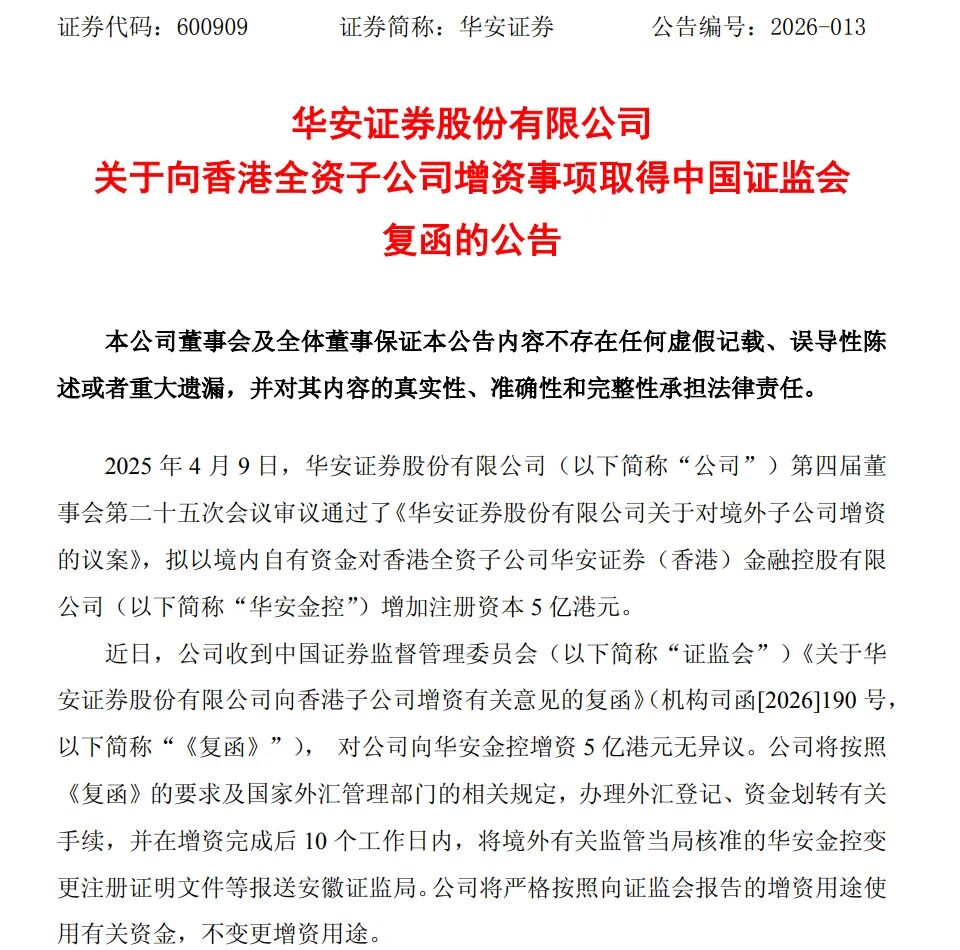
Core Viewpoint - Chinese listed securities firms are increasingly expanding their overseas operations, with four companies announcing new international business strategies within three days [1][2]. Group 1: Company Announcements - Dongwu Securities announced a capital increase of HKD 2 billion to its Hong Kong subsidiary, receiving no objections from the China Securities Regulatory Commission (CSRC) [1]. - Huatai Securities successfully issued HKD 10 billion in H-share convertible bonds, with net proceeds aimed at supporting overseas business development and supplementing operational funds [2]. - Hua'an Securities received CSRC approval for a capital increase of HKD 500 million to its wholly-owned subsidiary in Hong Kong [2]. - Northeast Securities also received CSRC approval for establishing Dongzheng International Financial Holdings Limited in Hong Kong with its own funds amounting to HKD 500 million [2]. Group 2: Industry Insights - The concentrated overseas expansion by Chinese securities firms is seen as a proactive strategic choice to address industry homogenization and explore new growth points [2]. - The issuance of H-share convertible bonds and other financial instruments is viewed as an effective means to support business expansion [2]. - Hong Kong is recognized as a preferred location for these firms' international strategies, fostering collaboration among leading and mid-sized securities firms and indicating a shift from scale expansion to quality enhancement in the internationalization of Chinese securities firms [2].

券商加速“出海”,在下一盘什么棋?
Guo Ji Jin Rong Bao· 2026-02-12 11:53
Core Viewpoint - Domestic securities firms are accelerating their internationalization efforts in response to industry homogenization and to explore new growth points, driven by policy encouragement and recovering market demand [1][10]. Group 1: Recent Developments - Huatai Securities has completed the issuance of HKD 10 billion H-share convertible bonds, providing funding for overseas business development [6][8]. - Huazhong Securities and Northeast Securities have both received approval from the China Securities Regulatory Commission (CSRC) for capital increases in their Hong Kong subsidiaries, with each firm planning to inject HKD 5 million [2][4]. Group 2: Industry Trends - The recent actions of multiple securities firms reflect a broader industry consensus on the importance of expanding overseas markets and enhancing international business [9][10]. - In January, GF Securities announced the successful placement of 219 million new H-shares, raising approximately HKD 39.59 billion, with plans to allocate 70% of the funds to support international business development [9]. Group 3: Opportunities and Challenges - Opportunities include the increasing demand for cross-border financing as Chinese enterprises expand internationally, supported by favorable policies and Hong Kong's status as a global financial hub [10]. - Challenges faced by domestic securities firms include gaps in brand influence, global pricing capabilities, and regulatory complexities in foreign markets, which increase compliance costs and operational difficulties [11].
华安证券:截至2026年2月10日公司股东人数为111514户
Zheng Quan Ri Bao Wang· 2026-02-12 11:39
证券日报网讯 2月12日,华安证券(600909)在互动平台回答投资者提问时表示,截至2026年2月10 日,公司股东人数为111514户。 ...
“学海拾珠”系列之二百六十六:基金持股的偏态特征
Huaan Securities· 2026-02-12 07:20
Investment Rating - The report does not explicitly provide an investment rating for the industry or funds analyzed Core Insights - The report introduces a new metric, portfolio skewness, to measure fund manager skill by analyzing the return distribution of U.S. mutual fund holdings, suggesting that higher skewness indicates better future performance [2][5] - The study finds that high-skewness funds significantly outperform low-skewness funds, with an annualized Fama-French-Carhart alpha difference of 2.88% before fees, translating to approximately $7.35 million annually [5][18] - The research indicates that portfolio skewness is a distinct predictor of fund performance, independent of existing skill metrics like active share and R² [5][39] Summary by Sections Introduction - The report discusses the importance of understanding mutual fund portfolio characteristics as they reflect fund manager skills and behaviors [15][21] Portfolio Skewness - Two skewness metrics are constructed: standard skewness (Pskew) and Pearson's second skewness coefficient (Pskew2), with the latter being more robust against extreme values [4][23] - The average portfolio skewness across the sample is positive, indicating a tendency for funds to hold more winning stocks [29][31] Sample Selection and Data Sources - The sample includes all U.S. actively managed equity funds from March 1980 to December 2023, with a total of 895,487 fund-month observations [27][28] Empirical Results Descriptive Statistics and Persistence of Skewness - The average Pskew is 0.265, with significant variability among funds, indicating that portfolio skewness is not randomly generated but reflects managerial behavior [29][32] Skewness and Future Fund Performance - High-skewness funds show a consistent performance advantage, with annualized alpha increasing by 0.444% for each quartile increase in skewness [40][43] - The report confirms a positive correlation between portfolio skewness and future fund performance, independent of common fund characteristics [42][44] Skewness and Other Skill Metrics - Portfolio skewness shows limited overlap with existing skill measures, suggesting it captures unique information about fund managers [46][48]