CHINA MOBILE(600941)

Search documents
0元!两大央企巨头,重磅动作!
证券时报· 2025-11-03 12:11
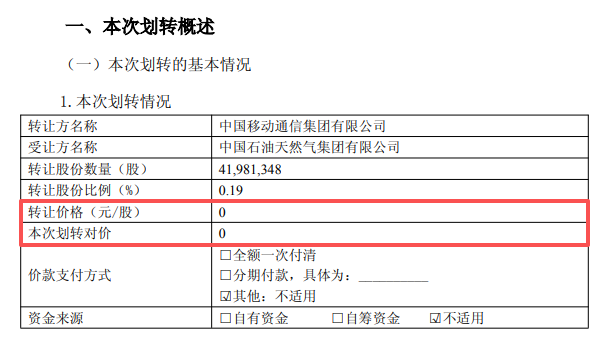
两大央企巨头,新动作。 中国移动11月3日晚间公告称,中国移动集团拟通过国有股份划转方式将其持有的中国移动4198.13万股 A股股份(占公司总股数的0.19%)划转给中国石油集团,本次划转对价为0元。 | 转让方名称 | 中国移动通信集团有限公司 | | | | --- | --- | --- | --- | | 受让方名称 | 中国石油天然气集团有限公司 | | | | 转让股份数量(股) | 41,981,348 | | | | 转让股份比例(%) | 0.19 | | | | 转让价格(元/股) | 0 | | | | 本次划转对价 | 0 | | | | 价款支付方式 | □全额一次付清 | | | | | □分期付款,具体为: | | | | | ☑其他:不适用 | | | | 资金来源 | □自有资金 | □自筹资金 | ☑不适用 | 根据中国移动近期披露的三季报,今年前三季度,中国移动全面实施"三大计划",全面推进"三个深化", 经营业绩稳健增长。前三季度,公司实现营业收入7947亿元,同比增长0.4%;净利润1154亿元,同比 增长4.0%。 近年来,包括中国移动在内的电信运营商加快数智化转 ...



巨头宣布:4198.13万股,0元划转!
Shang Hai Zheng Quan Bao· 2025-11-03 11:21
Group 1 - China Mobile announced the transfer of 41,981,348 A-shares (0.19% of total shares) to China National Petroleum Corporation (CNPC) through state-owned share transfer [1][2] - The purpose of the share transfer is to enhance strategic collaboration between China Mobile and CNPC, promoting cooperation in information technology and smart energy sectors [2][3] - Following the transfer, China Mobile's shareholding will decrease from 69.05% to 68.85%, with no significant impact on its normal operations or changes in controlling shareholders [2][3] Group 2 - On October 28, China Mobile appointed a new chairman, Chen Zhongyue, who previously served as the chairman of China Unicom [3] - In September, CNPC announced a similar share transfer of 541 million A-shares (0.30% of total shares) to China Mobile, aimed at deepening strategic cooperation and optimizing shareholding structure [3] - A strategic cooperation agreement was signed in January 2024, focusing on the integration of new-generation information technology with the energy industry, covering areas such as basic communication services and digital transformation [3][4] Group 3 - In May, China Mobile supported CNPC in launching the 300 billion parameter Kunlun model, showcasing their collaboration in artificial intelligence [4] - China Mobile is the main integrator for the Kunlun model project, establishing 14 specialized working groups to ensure high-quality project delivery [4] - The collaboration aims to explore innovative applications of AI in the energy and chemical sectors, contributing to the "Smart China National Petroleum" initiative [4]
中国移动(00941):中国移动集团拟将公司0.19%股权划转给中国石油集团
智通财经网· 2025-11-03 10:49
Core Viewpoint - China Mobile Group plans to transfer 41,981,348 A-shares (0.19% of total shares) to China National Petroleum Corporation to enhance strategic collaboration in information technology and smart energy sectors, aiming to unlock new potential in digital and physical integration [1] Group 1 - The share transfer will result in China Mobile Group holding a total of 14,890,502,494 shares, approximately 68.85% of the company's total issued shares [1] - After the transfer, China National Petroleum Corporation will directly hold 41,981,348 A-shares, representing 0.19% of the total issued shares [1] - China Mobile Group's direct holdings include 385,652 A-shares, while it indirectly holds 14,890,116,842 shares of Hong Kong ordinary shares through China Mobile Hong Kong (BVI) Limited [1]
中国移动:中国移动集团拟将公司0.19%股权划转给中国石油集团
智通财经网· 2025-11-03 10:49
Core Viewpoint - China Mobile Group plans to transfer 41,981,348 A-shares (0.19% of total shares) to China National Petroleum Corporation to enhance strategic collaboration in information technology and smart energy sectors, aiming to unlock new potential in digital and physical integration [1] Group 1 - The share transfer will result in China Mobile Group holding a total of 14,890,502,494 shares, approximately 68.85% of the company's total issued shares [1] - After the transfer, China National Petroleum Corporation will directly hold 41,981,348 A-shares, representing 0.19% of the total issued shares [1] - China Mobile Group's direct holdings include 385,652 A-shares, while it indirectly holds 14,890,116,842 shares of Hong Kong ordinary shares through China Mobile Hong Kong (BVI) Limited [1]
“YYDS”的反击 | 谈股论金
水皮More· 2025-11-03 10:46
Market Overview - The three major A-share indices collectively rose slightly today, with the Shanghai Composite Index up 0.55% closing at 3976.52 points, the Shenzhen Component Index up 0.19% at 13404.06 points, and the ChiNext Index up 0.29% at 3196.87 points [3] - The total trading volume in the Shanghai and Shenzhen markets reached 2.1071 trillion yuan, a decrease of 210.7 billion yuan compared to the previous trading day [3] Private Fund Insights - Notable private fund managers, including Yang Dong and Chen Guangming, have announced fund closures, which should be taken seriously by investors. Chen Guangming, a former president of Dongfang Securities, has stated that his firm, Ruiyuan Fund, will no longer accept new subscriptions [4] - The key difference between private and public funds lies in their scale management, with private funds often making timely decisions to reduce size when indices reach certain highs [4] Market Dynamics - The Shanghai Composite Index showed resilience with minimal declines at the opening, primarily driven by major players like the "three oil giants" (PetroChina, CNOOC, Sinopec) and the banking sector, particularly Industrial and Commercial Bank of China [5] - The Shenzhen market experienced a maximum drop of 1.65% during the day but rebounded in the afternoon, largely due to the performance of four stocks, leading to a final increase of approximately 0.20% in the Shenzhen Component Index [6] Trading Sentiment - The market is currently in a phase of uncertainty regarding whether the recent small gains represent a continuation of a downtrend or a potential bottoming out, with further validation needed in upcoming sessions [6] - Approximately 3,479 stocks rose while about 1,500 fell today, with a median increase of around 0.6%. However, there was a net outflow of approximately 27 billion yuan from major funds, with northbound trading also seeing an outflow of about 25 billion yuan [6] Sector Performance - Strong performing sectors included AI applications (gaming, cultural media), military shipbuilding, photovoltaic, and coal, while underperforming sectors were primarily semiconductors, securities, insurance, and lithium batteries [6] - The current market sentiment and trading intensity are significantly lower compared to previous trends, indicating a lack of clear direction as mainstream funds have retreated [7]


中国移动(00941) - 海外监管公告国有股份划转
2025-11-03 10:39
香港交易及結算所有限公司及香港聯合交易所有限公司對本公告之內容概不 負 責,對 其 準 確 性 或 完 整 性 亦 不 發 表 任 何 聲 明,並 明 確 表 示 概 不 就 因 本 公 告 全 部或任何部分內容而產生或因倚賴該等內容而引致之任何損失承擔任何責任。 CHINA MOBILE LIMITED 中國移動有限公司 (根據公司條例在香港註冊成立之有限公司) 股份代號:941(港幣櫃台)及 80941(人民幣櫃台) 海外監管公告 國有股份劃轉 本公告乃中國移動有限公司(「本公司」)根 據《香 港 聯 合 交 易 所 有 限 公 司 證 券 上 市 規 則》第13.10B條 而 作 出。 茲提述本公司在上海證券交易所網站刊登的《中 國 移 動 有 限 公 司 關 於 國 有 股 份 劃 轉 的 提 示 性 公 告》,僅 供 參 考。 承董事會命 中國移動有限公司 黃蕙蘭 公司秘書 香 港,2025年11月3日 前瞻性陳述 中国移动有限公司 关于国有股份划转的提示性公告 中国移动通信集团有限公司保证向本公司提供的信息真实、准确、完整,没 有虚假记载、误导性陈述或重大遗漏。 本公司董事会及全体董事保证公告内容 ...
资金动向 | 北水连续4日扫货小米,抛售中芯国际13.81亿港元
Ge Long Hui· 2025-11-03 10:10
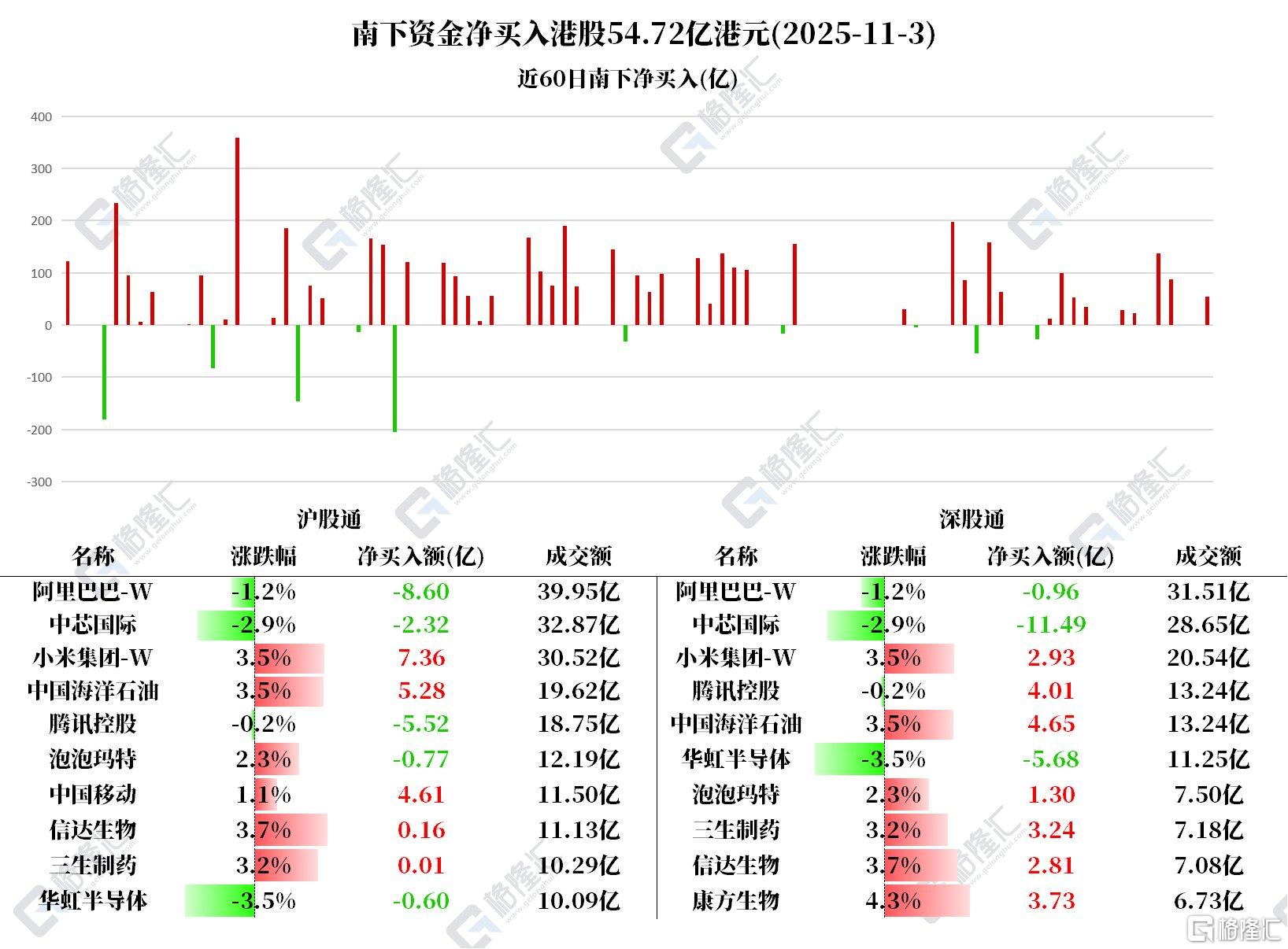
Group 1 - Xiaomi Group has seen a net buy of HKD 1.029 billion, with a total of HKD 19.1269 billion net bought over four consecutive days [1] - CNOOC reported a net buy of HKD 0.993 billion, totaling HKD 16.0304 billion net bought over three consecutive days [1] - Tencent Holdings experienced a net sell of HKD 1.51 billion, with a total of HKD 19.9056 billion net sold over four consecutive days [1] Group 2 - Xiaomi's automotive division announced that it will deliver over 40,000 vehicles by October 2025, with a significant reduction in delivery times due to increased production capacity [3] - CNOOC's Q3 revenue reached CNY 104.895 billion, a year-on-year increase of 5.7%, while net profit decreased by 12.2% [3] - China Mobile, along with China Unicom and China Telecom, has received approval to conduct commercial trials for eSIM mobile services, which are expected to enhance user communication needs and provide opportunities for domestic software and systems [4]


中国移动:中国移动集团拟向中国石油集团划转4198.13万股公司股份
Zhi Tong Cai Jing· 2025-11-03 10:05
Core Viewpoint - China Mobile (600941.SH) announced the transfer of 41.9813 million A-shares, representing 0.19% of the total shares, from China Mobile Group to China National Petroleum Corporation. This transfer will not change the controlling shareholder or actual controller of the company [1]. Summary by Relevant Sections - **Share Transfer Details** - China Mobile Group plans to transfer 41.9813 million A-shares to China National Petroleum Corporation [1]. - The shares represent 0.19% of the total shares of China Mobile [1]. - **Impact on Control** - The share transfer will not result in any change to the controlling shareholder or actual controller of China Mobile [1].
中国移动(600941) - 中国移动:关于国有股份划转的提示性公告
2025-11-03 10:00
证券代码:600941 证券简称:中国移动 公告编号:2025-027 中国移动有限公司 一、本次划转概述 (一)本次划转的基本情况 | 转让方名称 | 中国移动通信集团有限公司 | | | | --- | --- | --- | --- | | 受让方名称 | 中国石油天然气集团有限公司 | | | | 转让股份数量(股) | 41,981,348 | | | | 转让股份比例(%) | 0.19 | | | | 转让价格(元/股) | 0 | | | | 本次划转对价 | 0 | | | | 价款支付方式 | □全额一次付清 | | | | | □分期付款,具体为:__________ | | | | | □√其他:不适用 | | | | 资金来源 | □自有资金 | □自筹资金 | □√不适用 | 1.本次划转情况 关于国有股份划转的提示性公告 中国移动通信集团有限公司保证向本公司提供的信息真实、准确、完整,没 有虚假记载、误导性陈述或重大遗漏。 本公司董事会及全体董事保证公告内容与信息披露义务人提供的信息一致。 重要内容提示: 中国移动通信集团有限公司(以下简称"中国移动集团")拟通过国有股 份划转方 ...
国家体育总局体育科学研究所联合半月谈文化传媒中心与中国移动咪咕出品微短剧杀青!
Huan Qiu Wang· 2025-11-03 09:59
Core Viewpoint - The micro short drama "Holding the Fat Loss Secret, Ancient People Crying Because of Me" has officially wrapped up, marking a significant innovation in promoting scientific fitness knowledge through entertainment, responding to national calls for sports consumption and high-quality development in the sports industry [1][3][11]. Group 1: Production and Collaboration - The production is a collaboration between the National Sports Administration, the Sports Science Research Institute, Ban Yue Tan Cultural Media Center, and Migu Digital Media, showcasing a commitment to enhancing public engagement in fitness [3][11]. - The project received special support from Zhejiang Sports Science Research Institute, Dongyang Cultural and Broadcasting Tourism Sports Bureau, and Zhejiang Hengdian Film and Television City [4]. Group 2: Content and Themes - The drama centers on "scientific fitness," featuring a modern fitness coach who, after time travel, challenges societal norms about beauty and health, promoting a shift in perceptions towards body image and self-acceptance [4][9]. - It creatively integrates modern scientific fitness knowledge with ancient exercise tools, aiming to engage audiences in a fun and educational manner [7][9]. Group 3: Cast and Audience Engagement - The participation of Olympic gymnastics champion Guan Chenchen and world martial arts champion Mao Yaqi adds star power, with their characters involved in a murder mystery that intertwines fitness and romance [7]. - The drama aims to advocate for a healthy lifestyle, breaking misconceptions about fitness being painful or dieting being necessary, and emphasizes a scientific, sustainable, and personalized approach to health [9][11]. Group 4: Industry Impact - This micro short drama represents a bold exploration in the "micro short drama + sports" integration, potentially setting a new trend in the industry and contributing positively to the dissemination of sports culture [11]. - The unique narrative style and engaging plot are expected to resonate with audiences, creating a wave of interest in scientific fitness [11].