
BOB(601169)

Search documents
深圳多家银行披露信贷业务第三方合作机构,催收代理成看点
Nan Fang Du Shi Bao· 2025-09-16 13:47
Core Viewpoint - Shenzhen has taken action to enhance financial consumer rights by publicly disclosing the list of third-party cooperation institutions involved in credit business among eight major banks during the "Shenzhen 2025 Financial Education Promotion Week" [2][3]. Group 1: Third-Party Cooperation Institutions - Eight banks, including Industrial and Commercial Bank of China and Agricultural Bank of China, have announced their third-party cooperation institutions, focusing on marketing, guarantee enhancement, and collection services [2][3]. - For example, Shenzhen's Bank of China has nearly 80 third-party cooperation institutions, with over 70% involved in credit card auto installment and home decoration installment services [3]. - The list includes 49 auto installment companies, 9 home decoration installment companies, and 9 personal housing loan institutions, indicating a significant reliance on third-party services for credit management [3]. Group 2: Consumer Rights Protection - The Shenzhen Banking Association stated that the public disclosure of third-party cooperation institutions is a positive step towards protecting financial consumer rights and regulating banking practices [3]. - This initiative aims to combat illegal loan intermediaries and promote fair competition within the financial sector [3][4]. Group 3: Issues with Illegal Loan Intermediaries - Illegal loan intermediaries have been a persistent issue, prompting banks in Shenzhen to issue "anti-intermediary" statements against a specific consulting service named Xin Xin Hui Lin [4]. - These intermediaries often mislead consumers with false claims of partnerships with banks and charge excessive fees, leading to significant consumer rights violations [4][5]. - Regulatory authorities have highlighted various deceptive tactics used by these intermediaries, such as posing as bank employees and promoting unrealistic loan conditions [5].






银行行业9月16日资金流向日报
Zheng Quan Shi Bao Wang· 2025-09-16 09:22
银行行业资金流向排名 | 代码 | 简称 | 今日涨跌幅(%) | 今日换手率(%) | 主力资金流量(万元) | | --- | --- | --- | --- | --- | | 600016 | 民生银行 | -1.43 | 2.79 | -124908.82 | | 600036 | 招商银行 | -1.11 | 0.42 | -96548.52 | | 601169 | 北京银行 | -1.87 | 2.29 | -76484.34 | | 601166 | 兴业银行 | -1.76 | 0.52 | -56186.70 | | 601328 | 交通银行 | -1.27 | 1.15 | -51101.59 | | 601818 | 光大银行 | -1.66 | 1.23 | -47138.82 | | 601288 | 农业银行 | -1.68 | 0.13 | -44072.33 | | 601988 | 中国银行 | -0.92 | 0.15 | -31174.70 | | 002142 | 宁波银行 | -1.90 | 0.71 | -25716.69 | | 600015 | 华夏银行 ...



深圳8家金融机构集体“官宣”:披露信贷业务第三方合作机构
2 1 Shi Ji Jing Ji Bao Dao· 2025-09-16 08:54
Group 1 - The first batch of 8 banking financial institutions in Shenzhen has publicly announced a list of third-party cooperation agencies for credit business, which includes major banks such as Industrial and Commercial Bank of China, Agricultural Bank of China, and China Bank [1] - The third-party agencies primarily cover three categories: marketing and customer acquisition, guarantee and credit enhancement, and collection services [1] - Financial institutions will continuously update the list based on business developments and encourage customers to verify the legitimacy of any third-party claims [1] Group 2 - The public disclosure of the third-party cooperation agency list is an effort to implement regulatory requirements, protect financial consumers' rights, and combat illegal loan intermediaries [2] - Illegal loan intermediaries have been a significant issue in the financial sector, with instances of companies falsely claiming partnerships with banks to attract customers [2] - Common tactics used by illegal loan intermediaries include impersonating legitimate financial institutions, offering low-interest rates, and making false service promises, which can lead to consumer financial losses and data breaches [2] Group 3 - Regulatory authorities have intensified efforts to combat financial "black and gray industries," focusing on illegal loan intermediaries and related financial crimes [3] - A new regulation from the National Financial Supervision Administration mandates that commercial banks manage and disclose lists of platform operators and credit enhancement service providers, effective October 1 [3] - The regulation prohibits banks from collaborating with institutions not on the approved list for internet lending services [3]

北京银行跌2.04%,成交额24.89亿元,主力资金净流出6.15亿元
Xin Lang Cai Jing· 2025-09-16 06:53
Core Points - Beijing Bank's stock price decreased by 2.04% on September 16, reaching 5.76 CNY per share, with a total market capitalization of 121.78 billion CNY [1] - The bank's main business segments include corporate banking (40.68%), personal banking (35.70%), and funding business (23.24%) [1] - As of June 30, 2025, Beijing Bank reported a net profit of 15.05 billion CNY, a year-on-year increase of 3.25% [2] Financial Performance - Year-to-date, Beijing Bank's stock price has declined by 1.20%, with a 4.16% drop over the last five trading days and a 14.29% decline over the last 60 days [1] - Cumulative cash dividends since the bank's A-share listing amount to 71.53 billion CNY, with 20.09 billion CNY distributed in the last three years [3] Shareholder Information - As of June 30, 2025, the number of shareholders decreased by 3.17% to 135,800, while the average number of circulating shares per person increased by 3.28% to 155,651 shares [2] - The top ten circulating shareholders include Hong Kong Central Clearing Limited, holding 943 million shares, and China Securities Finance Corporation, holding 324 million shares [3]
北京银行股份有限公司石家庄分行与中国信达资产管理股份有限公司河北省分公司债权转让暨债务催收联合公告
Jing Ji Ri Bao· 2025-09-15 22:19
Core Points - Beijing Bank's Shijiazhuang Branch has transferred its creditor's rights to China Cinda Asset Management Co., Ltd. Hebei Branch, which includes all rights under the loan and guarantee contracts with the listed borrowers and guarantors [1] - The announcement requires the listed debtors and guarantors to fulfill their repayment obligations immediately to China Cinda Asset Management Co., Ltd. Hebei Branch [1] Summary by Categories Debt Transfer - The creditor's rights have been transferred from Beijing Bank's Shijiazhuang Branch to China Cinda Asset Management Co., Ltd. Hebei Branch [1] - The transfer includes all rights related to the main debt and guarantee contracts [1] Borrowers and Outstanding Balances - Tangshan Aoyuan Animal Husbandry Co., Ltd. has an outstanding principal balance of 479,843.08 yuan [1] - Shijiazhuang Judeyuan Trading Co., Ltd. has an outstanding principal balance of 2,174,709.95 yuan [1] - Guoyu Hot Spring Resort Co., Ltd. has an outstanding principal balance of 62,160,000.00 yuan [1]
北京上市公司协会举办上市公司走进北京银行活动
Zhong Zheng Wang· 2025-09-15 11:03
Core Viewpoint - The event organized by the Beijing Listed Companies Association focuses on "high-quality financial development and the five key articles," emphasizing the importance of financial institutions in supporting national economic growth and innovation [1][2][3] Group 1: Financial High-Quality Development - The recent policies and regulations on financial high-quality development outline a clear implementation path, including targeted support for key economic areas, internal mechanism improvements within financial institutions, and the development of specialized bonds [1] - The five key articles serve as crucial tools for promoting financial high-quality development, with listed companies playing a vital role in this process [3] Group 2: Role of Financial Institutions - Financial institutions are encouraged to innovate financial products and service models to better meet the financing needs of listed companies in technology innovation and industrial upgrading [2] - There is a call for improved communication and information sharing mechanisms between financial institutions and listed companies to provide more precise financial services [2] Group 3: Collaboration and Interaction - Listed companies are urged to leverage financial market resources and enhance their capabilities to actively participate in financial innovation, contributing to high-quality financial development [3] - Financial institutions should continuously improve their service levels and strengthen cooperation with listed companies to foster a positive interaction between finance and the real economy [3]
当规模光环褪色,价值银行时代来临
Xi Niu Cai Jing· 2025-09-15 09:09
Core Insights - The banking industry is facing common pressures such as narrowing net interest margins, weak asset growth, and rising credit costs, leading to a shift from scale expansion to quality and efficiency-focused growth [1][2] - Beijing Bank exemplifies this trend by focusing on differentiated and specialized business development, transitioning from scale expansion to quality dividends [1][2] Industry Overview - The banking sector is maintaining a stable operation with key indicators such as non-performing loan ratios, provision coverage ratios, and capital adequacy ratios showing overall stability and improvement [2] - Regulatory requirements emphasize the need for banks to maintain sound operations, making high-quality development the future focus of the industry [2] Beijing Bank's Transformation - Beijing Bank is transitioning its business structure from a company-centric model to a balanced approach between corporate and retail banking, aiming to establish a "second growth curve" [2] - As of mid-2025, Beijing Bank's retail revenue reached 11.081 billion yuan, with retail funds exceeding 1.3 trillion yuan, growing at a rate of 7.28% since the beginning of the year [2] Asset Quality Management - Beijing Bank emphasizes a balanced approach to credit management, optimizing credit structure and enhancing the quality of non-performing loan resolution [3] - As of mid-2025, the non-performing loan ratio stood at 1.30%, a decrease of 0.01 percentage points since the beginning of the year, indicating strong asset quality [3] Strategic Focus Areas - The bank is pursuing a strategy of "five distinctive banks," integrating stable management principles into specialized areas such as children's finance, elderly finance, and technology finance [4] - This strategy aims to create competitive barriers while injecting new momentum into stable operations, achieving a balance between stability and innovation [4] Innovative Financial Services - Beijing Bank is developing a comprehensive financial service system for children, hosting 30,000 events in the first half of 2025 and collaborating with local organizations to enhance child-friendly city initiatives [5] - The bank offers a full spectrum of services for individuals and enterprises, including tailored financial solutions for different life stages and business needs [5] Talent and AI Integration - The bank is building an integrated talent financial service system, providing services to governments and educational institutions, with over 24,000 "Talent Cards" issued and nearly 1.6 billion yuan in loans disbursed [6] - Beijing Bank is also advancing its AI strategy, establishing a robust AI framework to drive digital transformation and enhance financial services [6] Dividend Policy - Beijing Bank has a strong track record of dividend payments, with a total cash dividend of 71.533 billion yuan since its listing in 2007, reflecting management's confidence in the company's future [6] Conclusion - The banking industry is undergoing significant transformation, with differentiation and specialization being key to high-quality development [7] - Beijing Bank's focus on the "five distinctive banks" strategy, along with its commitment to asset quality and risk control, positions it well for future growth and serves as a model for industry transformation [7]
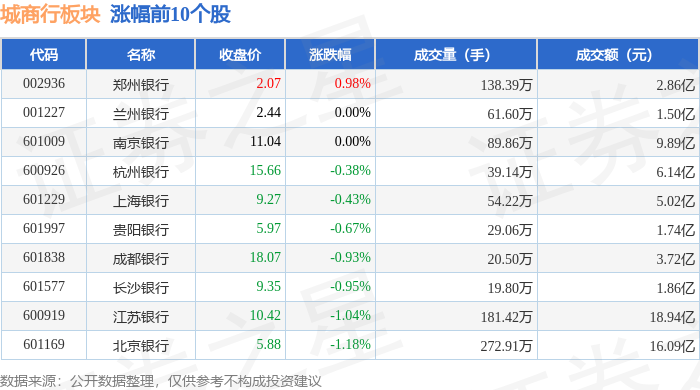
城商行板块9月15日跌0.85%,西安银行领跌,主力资金净流出7.97亿元
Zheng Xing Xing Ye Ri Bao· 2025-09-15 08:43
Market Overview - On September 15, the city commercial bank sector declined by 0.85% compared to the previous trading day, with Xi'an Bank leading the decline [1] - The Shanghai Composite Index closed at 3860.5, down 0.26%, while the Shenzhen Component Index closed at 13005.77, up 0.63% [1] Individual Bank Performance - Zhengzhou Bank closed at 2.07, up 0.98% with a trading volume of 1.38 million shares and a transaction value of 286 million yuan [1] - Xi'an Bank closed at 4.19, down 1.87% with a trading volume of 438,000 shares and a transaction value of 184 million yuan [2] - The highest decline was observed in Chengdu Bank, which closed at 18.07, down 0.93% [1] Capital Flow Analysis - The city commercial bank sector experienced a net outflow of 797 million yuan from institutional investors, while retail investors saw a net inflow of 348 million yuan [2] - The main capital inflow and outflow for individual banks varied, with Hangzhou Bank seeing a net inflow of 61.64 million yuan from institutional investors [3] - Conversely, Suzhou Bank experienced a net outflow of 11.76 million yuan from institutional investors [3]



北京银行跌2.02%,成交额13.91亿元,主力资金净流出3.30亿元
Xin Lang Cai Jing· 2025-09-15 06:34
Core Viewpoint - Beijing Bank's stock price has shown a decline recently, with a current trading price of 5.83 yuan per share and a total market capitalization of 123.26 billion yuan, indicating a challenging market environment for the bank [1]. Financial Performance - As of June 30, Beijing Bank reported a net profit attributable to shareholders of 15.05 billion yuan, reflecting a year-on-year growth of 3.25% [2]. - The bank's cumulative cash dividends since its A-share listing amount to 71.53 billion yuan, with 20.09 billion yuan distributed over the past three years [3]. Stock Market Activity - On September 15, the stock experienced a decline of 2.02%, with a trading volume of 1.39 billion yuan and a turnover rate of 1.11% [1]. - The stock has remained flat year-to-date, with a 5-day decline of 2.51%, a 20-day decline of 6.57%, and a 60-day decline of 13.50% [1]. Shareholder Structure - As of June 30, the number of shareholders decreased to 135,800, while the average circulating shares per person increased by 3.28% to 155,651 shares [2]. - The top ten circulating shareholders include Hong Kong Central Clearing Limited, holding 943 million shares, and China Securities Finance Corporation, holding 324 million shares, with the latter's holdings remaining unchanged [3].
北京银行霍学文:三轮驱动赋能新质生产力
2 1 Shi Ji Jing Ji Bao Dao· 2025-09-15 04:37
Core Viewpoint - The internationalization of enterprises is a crucial engine for the high-quality development of China's economy, with financial support being key for companies to "go global" [1] Group 1: Financial Support for Internationalization - Beijing Bank emphasizes high-level openness as a strong driving force for high-quality development and efficient financial services [1] - The bank focuses on a collaborative model of "big ship guiding, small ship following, and financial escort" to support enterprise internationalization [1] - New financial products and services, including "AI+" service plans and strategic cooperation agreements with various companies, have been launched to enhance financial service efficiency for global expansion [1] Group 2: Emphasis on Technological Innovation - Beijing Bank has identified serving new quality productivity as a key development direction, enhancing AI applications in the fintech sector [2] - The bank has launched the "Science and Technology Radar" evaluation system to quantify the innovation capabilities of enterprises [2] - A comprehensive approach integrating commercial banking, investment banking, and private banking resources is being adopted to support convenient financing for enterprises [2] Group 3: Strategic Initiatives for New Quality Productivity - The bank proposes three major initiatives: prioritizing technology finance, focusing on industry-specific strategies, and fostering an ecosystem for resource and service integration [3] - It aims to enhance collaboration across various sectors, including government and investment institutions, to strengthen the ecosystem supporting new quality productivity [3] - The bank is committed to creating a unified service model that integrates technology finance with other financial services [3]