Bank Of Shanghai(601229)

Search documents
上海银行(601229) - 上海银行董事会2025年第十次会议决议公告
2025-11-28 10:15
上海银行股份有限公司(以下简称"公司")董事会及全体董事保证本公告 内容不存在任何虚假记载、误导性陈述或者重大遗漏,并对其内容的真实性、准 确性和完整性承担法律责任。 公司董事会 2025 年第十次会议于 2025 年 11 月 28 日以书面传签方式召开, 会议通知已于 2025 年 11 月 28 日以电子邮件方式发出。本次会议应参加表决董 事 17 人,实际参加表决董事 17 人。本次会议的召开符合《中华人民共和国公司 法》《上海银行股份有限公司章程》《上海银行股份有限公司董事会议事规则》 的规定。 会议经审议并通过以下议案: | 证券代码:601229 | 证券简称:上海银行 | 公告编号:临2025-065 | | --- | --- | --- | | 优先股代码:360029 | | 优先股简称:上银优1 | | 可转债代码:113042 | | 可转债简称:上银转债 | 上海银行股份有限公司 董事会 2025 年第十次会议决议公告 关于向香港白玉兰慈善基金会捐赠的议案 表决情况:同意 17 票,反对 0 票,弃权 0 票。 2025 年 11 月 29 日 1 会议批准向香港白玉兰慈善基金会捐 ...

城商行板块11月28日跌0.62%,上海银行领跌,主力资金净流出3.79亿元
Zheng Xing Xing Ye Ri Bao· 2025-11-28 09:05
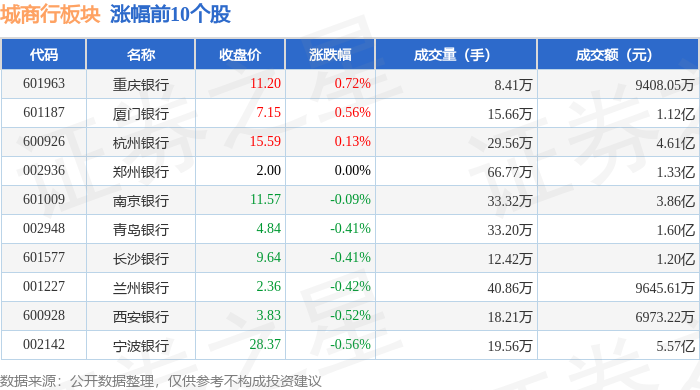
Core Viewpoint - The city commercial bank sector experienced a decline of 0.62% on November 28, with Shanghai Bank leading the drop, while the overall stock market showed slight gains [1][2]. Market Performance - The Shanghai Composite Index closed at 3888.6, up 0.34% - The Shenzhen Component Index closed at 12984.08, up 0.85% [1]. Individual Stock Performance - Chongqing Bank: Closed at 11.20, up 0.72%, with a trading volume of 84,100 shares and a turnover of 94.08 million yuan - Xiamen Bank: Closed at 7.15, up 0.56%, with a trading volume of 156,600 shares and a turnover of 112 million yuan - Hangzhou Bank: Closed at 15.59, up 0.13%, with a trading volume of 295,600 shares and a turnover of 461 million yuan - Zhengzhou Bank: Closed at 2.00, unchanged, with a trading volume of 667,700 shares and a turnover of 13.3 million yuan - Nanjing Bank: Closed at 11.57, down 0.09%, with a trading volume of 333,200 shares and a turnover of 38.6 million yuan - Qingdao Bank: Closed at 4.84, down 0.41%, with a trading volume of 332,000 shares and a turnover of 16 million yuan - Changsha Bank: Closed at 9.64, down 0.41%, with a trading volume of 124,200 shares and a turnover of 12 million yuan - Lanzhou Bank: Closed at 2.36, down 0.42%, with a trading volume of 408,600 shares and a turnover of 96.46 million yuan - Xi'an Bank: Closed at 3.83, down 0.52%, with a trading volume of 182,100 shares and a turnover of 6.97 million yuan - Ningbo Bank: Closed at 28.37, down 0.56%, with a trading volume of 195,600 shares and a turnover of 557 million yuan [1][2]. Capital Flow Analysis - The city commercial bank sector saw a net outflow of 379 million yuan from institutional investors, while retail investors contributed a net inflow of 86.74 million yuan [2][3]. - The following stocks had notable capital flows: - Hangzhou Bank: Net inflow of 9.48 million yuan from institutional investors - Qilu Bank: Net inflow of 6.55 million yuan from institutional investors - Suzhou Bank: Net inflow of 6.07 million yuan from institutional investors - Qingdao Bank: Net inflow of 3.22 million yuan from institutional investors - Lanzhou Bank: Net inflow of 2.34 million yuan from institutional investors - Zhengzhou Bank: Net outflow of 0.96 million yuan from institutional investors - Guizhou Bank: Net outflow of 1.41 million yuan from institutional investors - Xi'an Bank: Net outflow of 2.69 million yuan from institutional investors - Nanjing Bank: Net outflow of 9.30 million yuan from institutional investors - Chongqing Bank: Net outflow of 9.87 million yuan from institutional investors [3].




上海银行将在11月28日晚上至次日凌晨部分时段进行业务系统维护
Jin Tou Wang· 2025-11-28 02:54
Group 1 - The core point of the announcement is that Shanghai Bank will conduct system maintenance on November 28, 2025, from 22:00 to 00:00, which will temporarily suspend services related to "dynamic verification code" for transactions and agreements [1] Group 2 - Customers are advised to prepare in advance for the service interruption [1] - The bank apologizes for any inconvenience caused by this maintenance [1]
上海银行将在12月3日晚上进行储蓄国债业务系统维护
Jin Tou Wang· 2025-11-28 02:54
Core Points - Shanghai Bank (601229) announced a scheduled maintenance for its savings bond business system on December 3, 2025, from 19:00 to 21:00 [1] - During this maintenance period, personal mobile banking services for savings bonds will be temporarily suspended [1] - Customers are advised to prepare in advance for this service interruption [1]
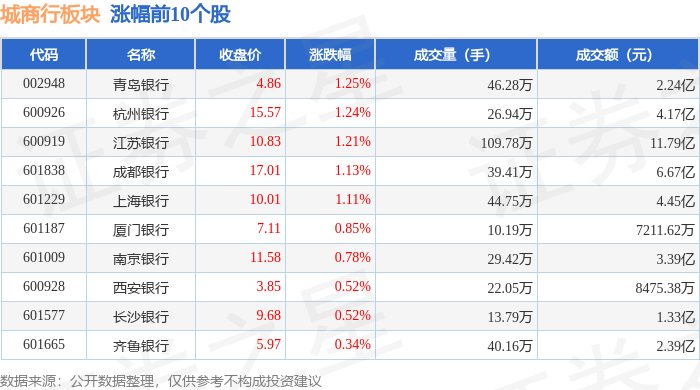
城商行板块11月27日涨0.69%,青岛银行领涨,主力资金净流入7276.85万元
Zheng Xing Xing Ye Ri Bao· 2025-11-27 09:07
Core Insights - The city commercial bank sector experienced a rise of 0.69% on November 27, with Qingdao Bank leading the gains [1] - The Shanghai Composite Index closed at 3875.26, up 0.29%, while the Shenzhen Component Index closed at 12875.19, down 0.25% [1] Stock Performance Summary - Qingdao Bank (002948) closed at 4.86, up 1.25% with a trading volume of 462,800 shares and a transaction value of 224 million [1] - Hangzhou Bank (600926) closed at 15.57, up 1.24% with a trading volume of 269,400 shares and a transaction value of 417 million [1] - Jiangsu Bank (616009) closed at 10.83, up 1.21% with a trading volume of 1,097,800 shares and a transaction value of 1.179 billion [1] - Chengdu Bank (601838) closed at 17.01, up 1.13% with a trading volume of 394,100 shares and a transaction value of 667 million [1] - Shanghai Bank (601229) closed at 10.01, up 1.11% with a trading volume of 447,500 shares and a transaction value of 445 million [1] - Xiamen Bank (601187) closed at 7.11, up 0.85% with a trading volume of 101,900 shares and a transaction value of 72.116 million [1] - Nanjing Bank (6000009) closed at 11.58, up 0.78% with a trading volume of 294,200 shares and a transaction value of 339 million [1] - Xi'an Bank (600928) closed at 3.85, up 0.52% with a trading volume of 220,500 shares and a transaction value of 84.754 million [1] - Changsha Bank (601577) closed at 9.68, up 0.52% with a trading volume of 137,900 shares and a transaction value of 133 million [1] - Qilu Bank (601665) closed at 5.97, up 0.34% with a trading volume of 401,600 shares and a transaction value of 239 million [1] Capital Flow Analysis - The city commercial bank sector saw a net inflow of 72.7685 million from institutional investors, while retail investors experienced a net inflow of 16.4028 million [2] - The sector faced a net outflow of 89.1713 million from speculative funds [2] Individual Stock Capital Flow - Jiangsu Bank (600919) had a net inflow of 75.1851 million from institutional investors, while it faced a net outflow of 38.3807 million from speculative funds [3] - Shanghai Bank (601229) saw a net inflow of 33.6962 million from institutional investors, with a net outflow of 37.6450 million from speculative funds [3] - Qilu Bank (601665) had a net inflow of 23.2129 million from institutional investors, while it faced a net outflow of 7.1943 million from speculative funds [3] - Chengdu Bank (601838) experienced a net inflow of 21.6104 million from institutional investors, with a significant net outflow of 68.9418 million from speculative funds [3] - Hangzhou Bank (600926) had a net inflow of 17.6667 million from institutional investors, while it faced a net outflow of 41.0399 million from speculative funds [3]
上海银行AI手机银行:“可触可感”,颠覆性交互重构金融体验
Cai Jing Wang· 2025-11-27 02:55
Core Insights - The integration of AI technology in the banking sector has shifted from exploration to a critical path for future competitiveness, exemplified by Shanghai Bank's launch of AI mobile banking services that enhance customer interaction and service delivery [1][4]. Group 1: AI Mobile Banking Features - Shanghai Bank's AI mobile banking introduces a "dialogue-as-a-service" model, allowing users to perform over ten high-frequency services such as fund transfers and retirement fund management through voice or text input, significantly improving user experience [2][3]. - The AI system utilizes a voice model to recognize customer intent and provides personalized financial advice based on various data points, enhancing wealth management services [2][3]. Group 2: User Experience and Engagement - The AI mobile banking service proactively identifies customer needs by analyzing historical behavior and preferences, offering timely notifications and support in local dialects to bridge communication gaps [3]. - The bank has established over 300 "Beautiful Life Studios" in collaboration with communities to extend online services to offline activities, addressing the comprehensive needs of elderly customers [3]. Group 3: Operational Efficiency and Performance - The implementation of AI technology has led to a 10% increase in business transaction conversion rates, reduced reliance on human customer service, and improved online problem-solving capabilities [5][6]. - Shanghai Bank's digital transformation strategy includes building a robust AI infrastructure, enhancing computational resources, and deploying various AI models to improve operational efficiency across multiple business functions [4][6]. Group 4: Future Directions - The bank plans to deepen its digital transformation by enhancing the language user interface (LUI) and expanding AI applications beyond financial services to include government, healthcare, and education, aiming to position the AI mobile banking as a comprehensive financial advisor for customers [6].

商业银行共绘未来五年发展新蓝图
Jin Rong Shi Bao· 2025-11-27 02:22
Core Viewpoint - Agricultural Bank of China is inviting employees and the public to contribute ideas for its 15th Five-Year Plan, aligning with the national economic and social development strategy outlined by the Communist Party [1] Group 1: National Strategy Alignment - State-owned banks are prioritizing national strategies, focusing on supporting the real economy, expanding domestic demand, and facilitating foreign trade during the 15th Five-Year Plan [2] - Agricultural Bank will enhance rural financial services and support agricultural modernization while promoting domestic consumption and effective investment [2] - China Bank aims to improve its global competitiveness and service capabilities, supporting the internationalization of the Renminbi and the Belt and Road Initiative [2] - Construction Bank will support infrastructure development and modern industrial systems, focusing on new industrialization and productivity [2] Group 2: Strategic Planning and Implementation - Transportation Bank emphasizes a seamless transition between the 14th and 15th Five-Year Plans, refining strategic focus and priorities [3] - Postal Savings Bank is committed to implementing its unique financial strategies and responding to the evolving financial needs of the public [3] Group 3: Differentiated Transformation - Joint-stock and local banks are identifying their unique positions and competitive advantages to create a multi-tiered financial service structure during the 15th Five-Year Plan [4] - Industrial Bank, as a leader in green finance, will enhance its services to support carbon reduction goals and promote green operations [4] - Citic Bank is focusing on technology finance, providing comprehensive financial services to support industrial upgrades and innovation [4] Group 4: Future Development Planning - The 15th Five-Year Plan is guided by the goal of building a strong financial nation, with banks actively developing their strategic plans [6] - Construction Bank is engaging with grassroots feedback to address high-priority issues and enhance operational efficiency [6] - Transportation Bank is incorporating public and expert opinions into its planning process for the 15th Five-Year Plan [6] - Regional banks are also developing their plans, focusing on key performance indicators like ROE and adjusting their business structures to enhance revenue [7]





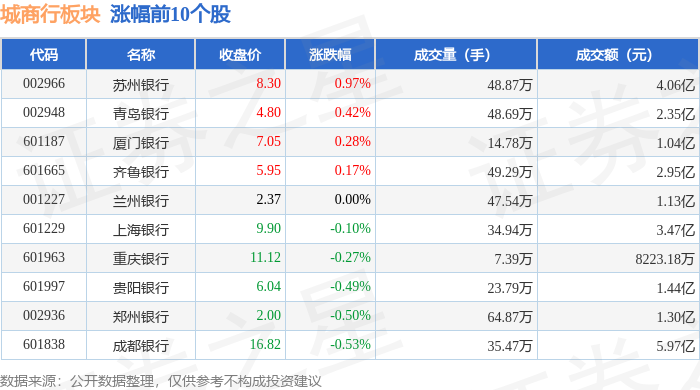
城商行板块11月26日跌0.59%,南京银行领跌,主力资金净流出1.47亿元
Zheng Xing Xing Ye Ri Bao· 2025-11-26 09:05
Market Performance - The city commercial bank sector declined by 0.59% on November 26, with Nanjing Bank leading the drop [1] - The Shanghai Composite Index closed at 3864.18, down 0.15%, while the Shenzhen Component Index rose by 1.02% to 12907.83 [1] Individual Stock Performance - Suzhou Bank closed at 8.30, up 0.97% with a trading volume of 488,700 shares and a transaction value of 406 million yuan [1] - Nanjing Bank closed at 11.49, down 1.29% with a trading volume of 514,300 shares and a transaction value of 592 million yuan [2] - Chengdu Bank closed at 16.82, down 0.53% with a trading volume of 354,700 shares and a transaction value of 597 million yuan [2] Capital Flow Analysis - The city commercial bank sector experienced a net outflow of 147 million yuan from institutional investors, while retail investors saw a net inflow of 152 million yuan [2] - Among individual stocks, Suzhou Bank had a net outflow of 31.27 million yuan from institutional investors, while Nanjing Bank saw a net inflow of 27.56 million yuan [3]


高息优先股密集退场 银行优先股投资逻辑生变
Zhong Guo Jing Ying Bao· 2025-11-25 13:12
Core Viewpoint - Recent announcements from multiple commercial banks regarding the redemption of preferred shares indicate a shift in capital management strategies within the banking sector [1][2]. Group 1: Redemption of Preferred Shares - Several banks, including Ping An Bank and Nanjing Bank, have announced plans to redeem preferred shares issued over five years ago, with Ping An Bank set to redeem 200 million shares worth 20 billion yuan by March 2026 and Nanjing Bank planning to redeem 49 million shares worth 4.9 billion yuan by December 2025 [1]. - Since July, at least nine banks, including Industrial and Commercial Bank of China and Bank of Beijing, have disclosed similar redemption plans, creating a notable trend in the market [1]. Group 2: Reasons for Redemption - The high dividend rates set at the time of issuance, combined with declining market interest rates, incentivize banks to redeem high-cost preferred shares and replace them with lower-cost perpetual bonds [2]. - Regulatory changes and the need for banks to optimize their capital structures are also significant factors driving the decision to redeem high-cost preferred shares [2]. Group 3: Capital Management Strategies - The banking sector is transitioning from a focus on scale expansion to a cost-efficiency-centered model, emphasizing the need for banks to balance the redemption of high-interest preferred shares with the issuance of low-cost capital tools [3]. - Banks are adopting more diversified and flexible capital supplement tools, allowing them to respond to market conditions effectively, such as redeeming high-interest preferred shares when interest rates are low [3].

城商行板块11月25日涨0.99%,南京银行领涨,主力资金净流入3.66亿元
Zheng Xing Xing Ye Ri Bao· 2025-11-25 09:09
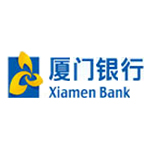
Core Insights - The city commercial bank sector experienced a rise of 0.99% on November 25, with Nanjing Bank leading the gains [1] - The Shanghai Composite Index closed at 3870.02, up 0.87%, while the Shenzhen Component Index closed at 12777.31, up 1.53% [1] Stock Performance - Nanjing Bank (600T009) closed at 11.64, with a gain of 2.65% and a trading volume of 457,300 shares, amounting to a transaction value of 526 million [1] - Beijing Bank (601169) closed at 5.78, up 1.76%, with a trading volume of 2,510,400 shares [1] - Xiamen Bank (601187) closed at 7.03, up 1.59%, with a trading volume of 156,300 shares [1] - Hangzhou Bank (600926) closed at 15.49, up 1.37%, with a trading volume of 128,080 shares [1] - Guiyang Bank (601997) closed at 6.07, up 1.17%, with a trading volume of 335,800 shares [1] - Other notable performances include Changsha Bank (601577) at 69.6 (+1.04%), Suzhou Bank (002966) at 8.22 (+0.98%), and Qingdao Bank (002948) at 4.78 (+0.84%) [1] Capital Flow - The city commercial bank sector saw a net inflow of 366 million in main funds, while retail funds experienced a net outflow of 305 million [2] - The main funds' net inflow for Hangzhou Bank was 97.67 million, while retail funds saw a net outflow of 48.86 million [3] - Qilu Bank (601665) had a main fund net inflow of 67.32 million, with retail funds experiencing a net outflow of 50.62 million [3] - Jiangsu Bank (601009) reported a main fund net inflow of 38.10 million, while retail funds had a net outflow of 45.88 million [3]