AGRICULTURAL BANK OF CHINA(601288)

Search documents
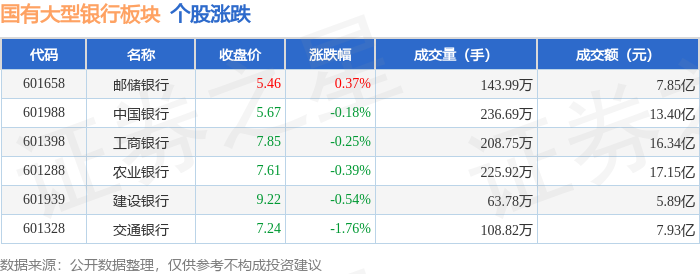
国有大型银行板块12月30日跌0.31%,交通银行领跌,主力资金净流出1.43亿元
Zheng Xing Xing Ye Ri Bao· 2025-12-30 09:08
Group 1 - The core viewpoint of the news is that the state-owned large bank sector experienced a slight decline of 0.31% on December 30, with the Bank of Communications leading the drop [1] - The Shanghai Composite Index closed at 3965.12, showing no change, while the Shenzhen Component Index rose by 0.49% to 13604.07 [1] - The trading performance of individual state-owned banks varied, with Postal Savings Bank gaining 0.37% and Bank of Communications falling by 1.76% [1] Group 2 - The net outflow of main funds from the state-owned large bank sector was 143 million yuan, while retail investors saw a net inflow of 180 million yuan [1] - The detailed fund flow for individual banks showed that Agricultural Bank and Bank of Communications had significant net outflows from main funds, while retail investors contributed positively to their inflows [2] - The data indicates that the main funds were predominantly negative for most banks, with the exception of Industrial and Commercial Bank, which had a net inflow of approximately 533 million yuan from speculative funds [2]





农行陕西省分行授信150亿助力千亿级煤化工项目绿色转型
Zhong Guo Jin Rong Xin Xi Wang· 2025-12-30 08:35
Group 1 - The core project of Shaanxi Coal Group's Yulin Chemical is the construction of a 15 million tons/year coal quality clean and efficient conversion demonstration project, which is part of the first batch of four trillion-level chemical projects in Shaanxi Province for 2024 [1] - Agricultural Bank of China (ABC) Shaanxi Branch provided a significant financial support of 15 billion yuan, marking the largest financial backing since its establishment [1] - The project aims to utilize coal quality conversion technology to produce high-value-added materials and biodegradable products through coal-to-olefins and coal-to-aromatics pathways, thereby extending the industrial chain [1] Group 2 - Upon completion, the Yulin Chemical Phase II project is expected to form a trillion-level industrial cluster, providing crucial support for the construction of a trillion-level modern energy industrial cluster in Shaanxi [2] - The project will lead the upgrade direction of the coal chemical industry and explore the coupling development of "coal chemical + new energy," contributing to the high-end, diversified, and low-carbon development of the industry [2] - Since 2023, ABC Shaanxi has approved over 10 green energy chemical projects, with a total approval amount reaching 50 billion yuan, providing solid financial support for the construction of the Yulin National Energy Revolution Innovation Demonstration Zone [2]

强化主动合规、突出源头预防 农业银行持续加强全链条合规治理
Zhong Guo Xin Wen Wang· 2025-12-30 07:04
Group 1 - The core viewpoint of the articles emphasizes the commitment of Agricultural Bank to enhance its compliance management system and risk prevention mechanisms to support high-quality development [1][3] - Agricultural Bank is actively implementing regulatory requirements by revising its compliance management basic system and optimizing its compliance management processes, aiming to establish a clear and effective compliance governance structure [1][2] - The bank is focusing on cultivating a strong compliance culture through a series of initiatives, including education and the promotion of compliance best practices, to foster a legal and disciplined environment [2] Group 2 - Agricultural Bank is prioritizing proactive compliance management by establishing differentiated internal control standards and enhancing its internal control prevention system to address key risk points [2] - The bank is committed to integrating compliance into all decision-making and operational processes, aligning with the directives from the 20th Central Committee and the Central Economic Work Conference [3]
农行陕西省分行推动农户贷款助力乡村振兴
Zheng Quan Ri Bao Wang· 2025-12-30 06:48
Group 1 - The product "Huayang Guoba" has gained significant popularity on Douyin, with consumers reportedly waiting 1.5 hours to purchase it [1] - The product is produced by Huayang Food Factory in Xi'an, which has been operating for 17 years and relies heavily on financial support for its operations [1] - The factory's daily cash flow requirement is at least 150,000 yuan, highlighting the financial pressures faced by small businesses in the food industry [1] Group 2 - Agricultural Bank of China Shaanxi Branch has prioritized rural revitalization, focusing on industrial development as a key aspect of this initiative [2] - By December 20, 2025, the bank's agricultural loan balance is projected to exceed 50 billion yuan, with a current balance of 54.2 billion yuan, reflecting a year-on-year increase of 13 billion yuan [2] - The bank has implemented four marketing strategies for agricultural loans, resulting in a customer base increase of 27,000 households in the past year [2] Group 3 - The bank has established a strong presence in rural financial services, with 127 branches having agricultural loan balances exceeding 100 million yuan [3] - There are 40 branches with loan balances over 500 million yuan, and 54 branches have seen an annual increase of over 100 million yuan in loan balances [3] - The bank aims to enhance its services to support rural industries, improve farmers' livelihoods, and promote sustainable rural development [3]
精准滴灌外贸企业 助力稳住外贸基本盘——农行青岛分行“优汇服务惠千家”专项行动成效显著
Xin Lang Cai Jing· 2025-12-30 06:19
Group 1 - The core viewpoint of the articles emphasizes the efforts of Agricultural Bank of China (ABC) Qingdao Branch in implementing the "优汇服务惠千家" initiative to support foreign trade enterprises through enhanced financial services and policy promotion [1][2][3] Group 2 - ABC Qingdao Branch has adopted a customer-centric approach, focusing on demand-driven services and leveraging technology to provide precise support in key areas such as policy dissemination, exchange rate risk management, international settlement, and financing support [1] - The branch has increased its outreach through various channels, including online platforms and offline activities, to promote foreign exchange policies and facilitate trade [1] - A significant achievement includes the processing of cross-border RMB facilitation business amounting to 138 billion yuan, representing a 23% year-on-year increase, and trade foreign exchange receipts and payments facilitation business of 5 billion USD, with a 25% year-on-year growth [1] - The bank has launched digital services for capital project business, including online capital project services and applications for cross-border financial service platforms, enhancing customer remittance efficiency [2] - The focus on small and micro foreign trade enterprises has led to the promotion of credit insurance financing, with 900 million yuan in short-term credit insurance financing processed, marking a 25% increase [2] - ABC Qingdao Branch aims to provide high-quality, efficient, and convenient financial services to foreign trade enterprises, contributing to the economic development of Qingdao [3]
强化主动合规 突出源头预防 农业银行持续加强全链条合规治理
Xin Hua Wang· 2025-12-30 05:10
Core Viewpoint - Agricultural Bank is committed to enhancing its compliance management system and risk prevention mechanisms to support high-quality development and ensure safety in operations [1][3]. Group 1: Compliance Governance - The bank is actively implementing regulatory requirements by revising its compliance management basic system and optimizing its organizational structure and operational processes [1]. - A comprehensive compliance governance mechanism has been established, focusing on cultural leadership, institutional norms, compliance review, dynamic assessment, and root cause management [1]. Group 2: Compliance Culture - Agricultural Bank emphasizes a proactive compliance culture through a series of activities that promote the "Five Musts and Five Must Nots" of Chinese financial culture [2]. - The bank is advancing compliance quality by recognizing benchmark units and sharing best practices to foster a strong legal compliance atmosphere [2]. Group 3: Risk Management - The bank has introduced differentiated internal control standards for its five-level institutions to enhance internal control construction [2]. - A closed-loop deterrent mechanism, rigid constraint mechanism, and intrinsic motivation mechanism have been established to address key risk points and improve compliance risk management levels [2].
回归本源,服务实体——盘点2025年银行业全貌
Xin Hua Cai Jing· 2025-12-30 04:00
Core Viewpoint - The banking industry in 2025 is characterized by "breaking the situation and establishing new value," focusing on "stabilizing capital, managing risks, promoting transformation, and strengthening governance," achieving resilient growth supported by policy backing, deepening reforms, and innovation [1] Group 1: Special Bonds and Capital Support - In March, the government proposed to issue special bonds worth 500 billion yuan to support state-owned commercial banks in capital replenishment [2] - Major banks collectively announced plans to raise 520 billion yuan through targeted issuance, with the Ministry of Finance investing 500 billion yuan to acquire new shares [2] Group 2: Consumer Loan Subsidies - In July, the State Council introduced personal consumption loan interest subsidies, with implementation details released in August [3] - By December, several regional banks began accepting applications for these subsidies, marking their entry into the previously restricted "national subsidy" program [3] Group 3: Innovation Bonds - In May, the People's Bank of China and the China Securities Regulatory Commission announced the launch of a "technology board" for innovation bonds, expanding issuance to financial institutions and tech companies [4] - By December, the issuance scale of innovation bonds exceeded 1.5 trillion yuan within seven months [4] Group 4: Corporate Governance Transformation - In April, several major banks announced the abolition of supervisory boards, transitioning to a "one-tier" governance model with employee directors representing grassroots voices [5] - By December, 42 A-share listed banks had announced the removal or non-establishment of supervisory boards, indicating a significant shift in corporate governance [5] Group 5: Interest Margin and Competition - Early in the year, consumer loan rates dropped to around 2.6%, with a subsequent rise to above 3% by April [6] - By July, net interest margins narrowed to a historical low of 1.43%, highlighting intensified competition and "involution" within the banking sector [6] Group 6: Gold Investment Thresholds - As international gold prices rose, domestic financial institutions increased the minimum investment thresholds for gold accumulation products, with some banks raising the minimum to 1,500 yuan by November [7][8] Group 7: Restructuring of Small and Medium Banks - In 2025, a significant number of small and medium banks, including village and rural banks, are undergoing mergers and closures, with 368 banks having been dissolved or merged by December [9] Group 8: Record Dividends from Listed Banks - By December 9, 2025, 26 A-share listed banks announced dividend plans totaling over 260 billion yuan, with an average dividend payout ratio of 24.9%, marking a 2.55% increase from 2024 [10] Group 9: Stock Performance of Listed Banks - As of December 29, 2025, A-share listed banks saw an average stock price increase of 9.94%, with 35 out of 42 banks experiencing price rises, and Agricultural Bank leading with a 51.59% increase [11]

数字人民币余额有利息收?新政发布,消费者如何办理
Nan Fang Du Shi Bao· 2025-12-30 03:25
Core Viewpoint - The People's Bank of China has introduced an action plan to enhance the management and service system of the digital renminbi, which will take effect from January 1, 2026, allowing banks to pay interest on customers' real-name digital renminbi wallet balances [2][3] Group 1: Digital Renminbi Overview - The digital renminbi, a legal digital currency issued by the People's Bank of China, can be used in various scenarios such as transportation, dining, shopping, and utility payments [3] - The action plan establishes a framework for measuring digital renminbi and incorporates it into the reserve requirement system, marking a transition from a cash-like version to a deposit currency version [3] Group 2: Interest Payment Mechanism - Banks will pay interest on customers' real-name digital renminbi wallet balances, adhering to self-regulatory pricing agreements for deposit interest rates [3] - The digital renminbi will transition from being considered "electronic change" to "digital deposits" that earn interest [3] Group 3: Wallet Types and Management - Digital renminbi personal wallets can be opened through designated operating institutions, which currently include 10 banks [4] - Wallets are categorized into four types based on identity verification strength, with varying levels of anonymity and balance limits [4][6] - The first two wallet types require bank account binding, while the third and fourth types have additional operational requirements for recharging or returning funds to banks [4] Group 4: Interest Accrual and Limits - Different wallet types have specific balance limits, with the first type having no upper limit and the second to fourth types capped at 500,000, 20,000, and 10,000 respectively [6] - Not all wallet types will earn interest; only real-name wallets (first, second, and third types) will receive interest based on the People's Bank of China's rules for current deposit interest [6] - The digital renminbi is included in the deposit insurance scheme, providing the same level of security as bank deposits [6] Group 5: Transaction Statistics - As of November 2025, the digital renminbi has processed 3.48 billion transactions, with a total transaction amount of 16.7 trillion yuan, and 230 million personal wallets have been opened [7]


“大象起舞”背后,15.6万亿银行股板块的价值重估之路
Bei Jing Shang Bao· 2025-12-30 02:46
Core Viewpoint - The A-share banking sector experienced a significant value reassessment throughout 2025, culminating in a total market capitalization exceeding 15.65 trillion yuan, marking a notable recovery and growth in the sector [1][2]. Group 1: Market Performance - The banking index increased by 12.06% over the year, with 42 listed banks achieving a combined market value growth of 15.37% compared to the end of 2024 [2]. - Agricultural Bank of China emerged as the standout performer with a 51.86% increase in stock price, surpassing Industrial and Commercial Bank of China in total market value [1][2]. - 35 out of 42 listed banks saw their stock prices rise, with several regional banks like Xiamen Bank and Chongqing Bank also showing strong performance, each exceeding a 20% increase [2]. Group 2: Valuation and Market Dynamics - The banking sector's price-to-book ratio showed signs of improvement, with some banks briefly exceeding a ratio of 1, indicating a shift away from the "broken net" situation that had persisted [4]. - The market's transition from valuation repair to value reassessment is attributed to improved investor confidence in banks' long-term profitability and asset quality [3][4]. Group 3: Policy and Economic Environment - The supportive policy environment, including interest rate cuts and liquidity injections, has created a favorable operating climate for banks, enhancing their appeal to long-term investors [8]. - The influx of long-term capital from insurance and pension funds into the banking sector has been driven by regulatory changes and a focus on stable returns [8]. Group 4: Future Outlook - The continuation of the value reassessment in 2026 will depend on macroeconomic stability, ongoing supportive policies, and confirmation of profit growth [9][10]. - The market is expected to experience a more structured performance, with large banks favored for their stability and certain regional banks potentially offering greater growth opportunities [10][11].
洞察2025|“大象起舞”背后,15.6万亿银行股板块的价值重估之路
Bei Jing Shang Bao· 2025-12-30 02:45
Core Viewpoint - The A-share banking sector experienced a significant value reassessment throughout 2025, culminating in a total market capitalization exceeding 15.65 trillion yuan, marking a notable recovery and growth phase for the industry [1][3]. Market Performance - The Wind Banking Index recorded a cumulative increase of 12.06% for the year, with 42 listed banks achieving a total market value growth of 15.37% compared to the end of 2024 [3][8]. - Agricultural Bank of China emerged as the standout performer with a remarkable stock price increase of 51.86%, surpassing Industrial and Commercial Bank of China in total market value [1][3]. - 35 out of 42 listed banks saw their stock prices rise, with several regional banks like Xiamen Bank and Chongqing Bank also posting gains exceeding 20% [3][8]. Valuation Dynamics - The banking sector's average price-to-book ratio improved from a range of 0.33-0.99 at the end of 2024 to some banks briefly exceeding 1.0 in October 2025, indicating a reduction in the "broken net" phenomenon [5][9]. - Despite the average price-to-book ratio remaining at 0.62, the trend shows significant improvement, although concerns about long-term profitability and credit cost pressures persist [5][10]. Policy and Economic Environment - The central bank's monetary policies, including interest rate cuts and structural loans, provided a supportive environment for banks, enhancing market confidence in asset quality [9][10]. - Regulatory adjustments facilitated increased inflows of long-term capital from insurance and pension funds into the banking sector, further supporting the value reassessment [9][10]. Future Outlook - The banking sector's value reassessment is expected to continue into 2026, driven by macroeconomic stabilization, ongoing supportive policies, and confirmation of profit growth [11][12]. - The market may see a shift from broad-based gains to a more differentiated performance, with large banks and high-quality regional banks attracting investor interest due to their stable dividends and solid fundamentals [12].