
AGRICULTURAL BANK OF CHINA(601288)

Search documents
工行、农行、建行、交行、邮储银行发布公告
Xin Jing Bao· 2025-12-31 06:49
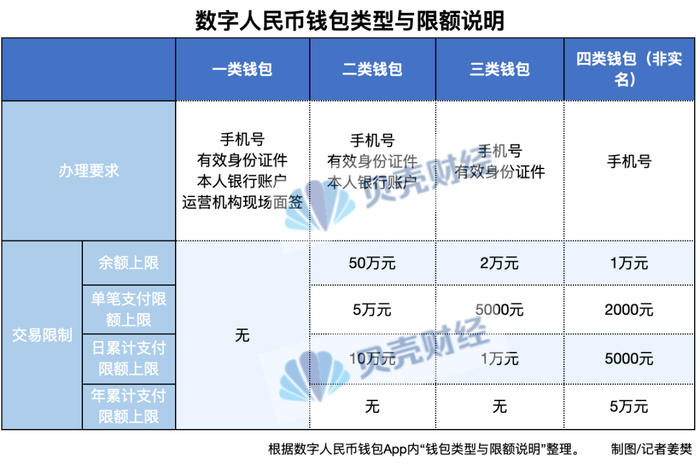
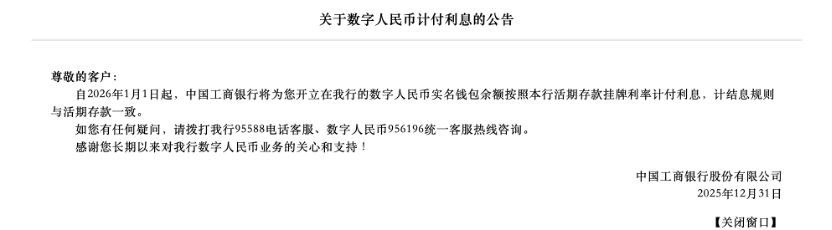
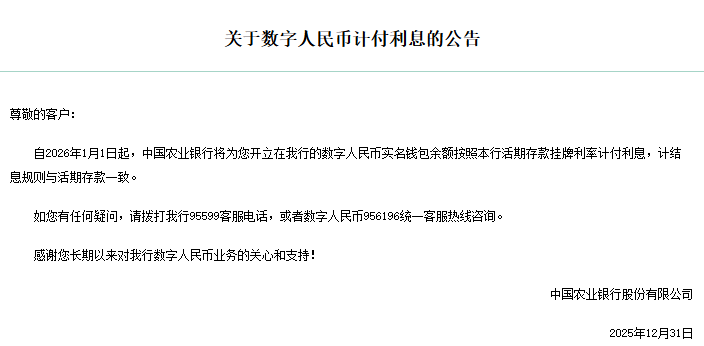
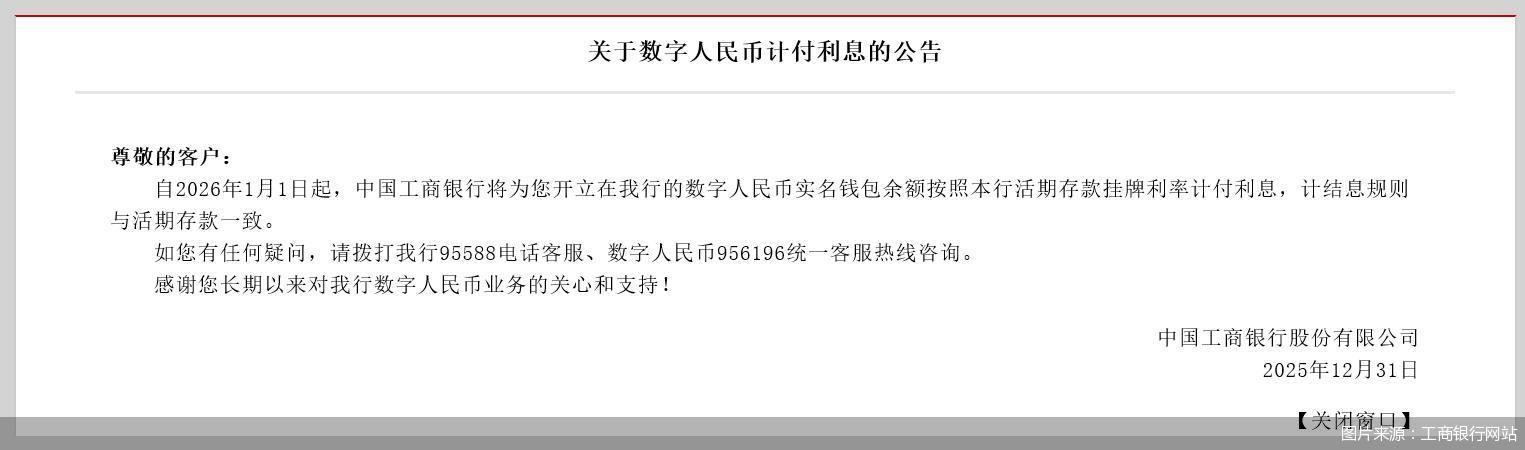
新京报贝壳财经记者 姜樊 编辑 陈莉 校对 杨利 本周一(12月29日),人民银行出台的《关于进一步加强数字人民币管理服务体系和相关金融基础设施 建设的行动方案》(以下简称《行动方案》)明确,从明年起,数字人民币钱包余额将计付利息。 明日起,数字人民币实名钱包余额将开始计息。12月31日,工行、农行、建行、交行、邮储银行等国有 银行公布了数字人民币钱包余额计息的规则。 工行、农行、建行、交行、邮储银行均发布公告称,自2026年1月1日起,银行将为客户开立的数字人民 币实名钱包余额按照本行活期存款挂牌利率计付利息,计结息规则与活期存款一致。 值得注意的是,数字人民币钱包分为四类钱包。其中,一类、二类、三类钱包未实名钱包,四类钱包为 非实名钱包。因此四类钱包不属于各家银行计息的"实名钱包"范畴。交行在公告中明确,如客户开立的 数字人民币钱包为四类个人钱包,则钱包内的余额不计付利息。 数字人民币是指人民银行发行的法定数字货币和相关支付体系,采用双层运营架构,由中国人民银行向 数字人民币业务运营机构发行,再由数字人民币业务运营机构兑换给公众。 ...






三大行集体公告数字钱包生息机制,数字人民币告别“无息时代”
2 1 Shi Ji Jing Ji Bao Dao· 2025-12-31 06:42
Core Viewpoint - The digital renminbi will officially end its "interest-free era" as of January 1, 2026, with major banks announcing that interest will be paid on the balances of real-name digital renminbi wallets based on the current deposit rates [1][6][10]. Group 1: Interest Payment Policy - Starting January 1, 2026, the balance in real-name digital renminbi wallets will earn interest according to the People's Bank of China's current deposit interest rate [6][7]. - The interest calculation will follow the same rules as regular savings accounts, with interest credited on the 21st of each quarter [6][10]. - Balances in anonymous wallets will not earn interest, maintaining a distinction between different wallet types [6][10]. Group 2: Transition to Digital Deposit Currency - The implementation of the interest payment policy marks the transition from "digital cash" to "digital deposit currency," indicating a significant evolution in the digital renminbi's role [7][10]. - The digital renminbi will now be considered a liability of commercial banks, allowing it to earn interest and be subject to deposit insurance, similar to traditional bank deposits [10]. - This change enhances the monetary elasticity of the digital renminbi, enabling it to support credit activities and deposit expansion mechanisms [10]. Group 3: Background and Development - The policy change is part of a broader initiative by the People's Bank of China to strengthen the management and service system for digital renminbi [7]. - The digital renminbi has been in development for over ten years, expanding its pilot programs from select cities to entire provinces [8]. - As of November 2025, the digital renminbi has processed 3.48 billion transactions, amounting to 16.7 trillion yuan, indicating significant adoption and usage [9].

多家银行宣布:2026年起数字人民币钱包余额可计付利息
Sou Hu Cai Jing· 2025-12-31 05:40
Group 1 - The core announcement is that starting from January 1, 2026, major Chinese banks including Agricultural Bank of China, Postal Savings Bank, and others will pay interest on digital RMB wallet balances according to the same rates as regular demand deposits [1][4][8] - The interest calculation rules for digital RMB wallets will align with those of demand deposits, indicating a significant shift in how digital currency is treated [1][8] - This transition marks the evolution of digital RMB from a "digital cash era" to a "digital deposit currency era," following a decade of research and pilot programs [8] Group 2 - The People's Bank of China has introduced a plan to enhance the management and service system for digital RMB, which will officially launch on January 1, 2026 [8] - The new framework will include a measurement system, management structure, operational mechanism, and ecosystem for digital RMB [8]
多家银行官宣:2026年1月1日起,为数字人民币实名钱包余额计付利息
Bei Jing Shang Bao· 2025-12-31 05:25
Core Viewpoint - Major Chinese banks including Industrial and Commercial Bank of China, Agricultural Bank of China, Postal Savings Bank of China, Bank of Communications, and China Construction Bank will start paying interest on digital RMB wallet balances at the same rate as current deposit rates from January 1, 2026, marking a significant transition in the digital currency landscape in China [1][4][5] Group 1: Bank Announcements - Industrial and Commercial Bank of China, Agricultural Bank of China, and Postal Savings Bank of China will apply interest to digital RMB wallet balances according to the current deposit rate, with interest calculation rules consistent with those for current deposits [4] - Bank of Communications will also apply the current deposit rate to digital RMB wallet balances, including various types of personal and corporate wallets, while balances in type four wallets will not earn interest [4] - China Construction Bank will revise its customer service agreement to reflect that digital RMB wallet balances will earn interest based on the current deposit rate starting January 1, 2026 [4] Group 2: Digital RMB Framework - The People's Bank of China has introduced a plan to enhance the management and service system for digital RMB, which will officially implement a new measurement framework and operational mechanism on January 1, 2026 [5] - This transition signifies a shift from the "digital cash era" to the "digital deposit currency era" after a decade of research and pilot programs [5]
数说A股2025: 十大亮点绘制市场新图景
Zheng Quan Shi Bao Wang· 2025-12-31 05:00
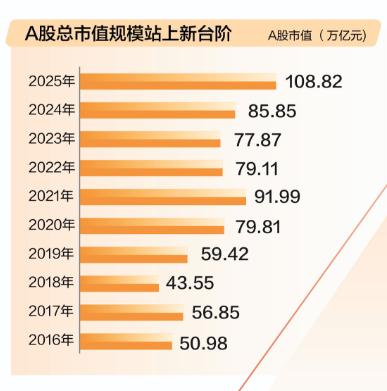
2025年A股注定载入中国资本市场发展史册:总市值首破百万亿元大关,实现历史性体量跨越;科技板 块强势回归重塑市场主线,成为行情核心引擎。从规模跃升的"量"的突破,到结构优化的 "质" 的飞 跃,资本市场以全方位的进阶,清晰映射出中国经济高质量发展新格局。 2025年A股市场今日收官。回顾这一年,市场在经济复苏、产业政策深化与投资者结构变迁的共同驱动 下,演绎了一场深刻而又充满活力的结构性行情。这一年,A股不仅实现了规模的跨越式增长,更在产 业结构、资金流向与投资生态上,呈现出标志性的新特征。本文将从十大角度逐一展开,解读数据背后 的趋势与信号。 亮点一 A股总市值突破100万亿元 市场体量迈入新纪元 2025年以来,A股市场体量迈向新台阶。据证券时报·数据宝统计,截至12月30日收盘,A股总市值达到 108.82万亿元,创历年来新高。8月18日,A股总市值首次突破100万亿元。南开大学金融发展研究院院 长田利辉接受证券时报记者采访时表示:"A股总市值突破100万亿元,标志着中国资本市场迈入高质量 发展新阶段。这不仅是规模扩张的体现,更是市场结构优化、服务实体经济能力提升的标志。" 1990年,上交所正式开业 ...




中国农业银行董事长谷澍:提升AI应用普惠性的若干思考
Zhong Guo Jin Rong Xin Xi Wang· 2025-12-31 03:11
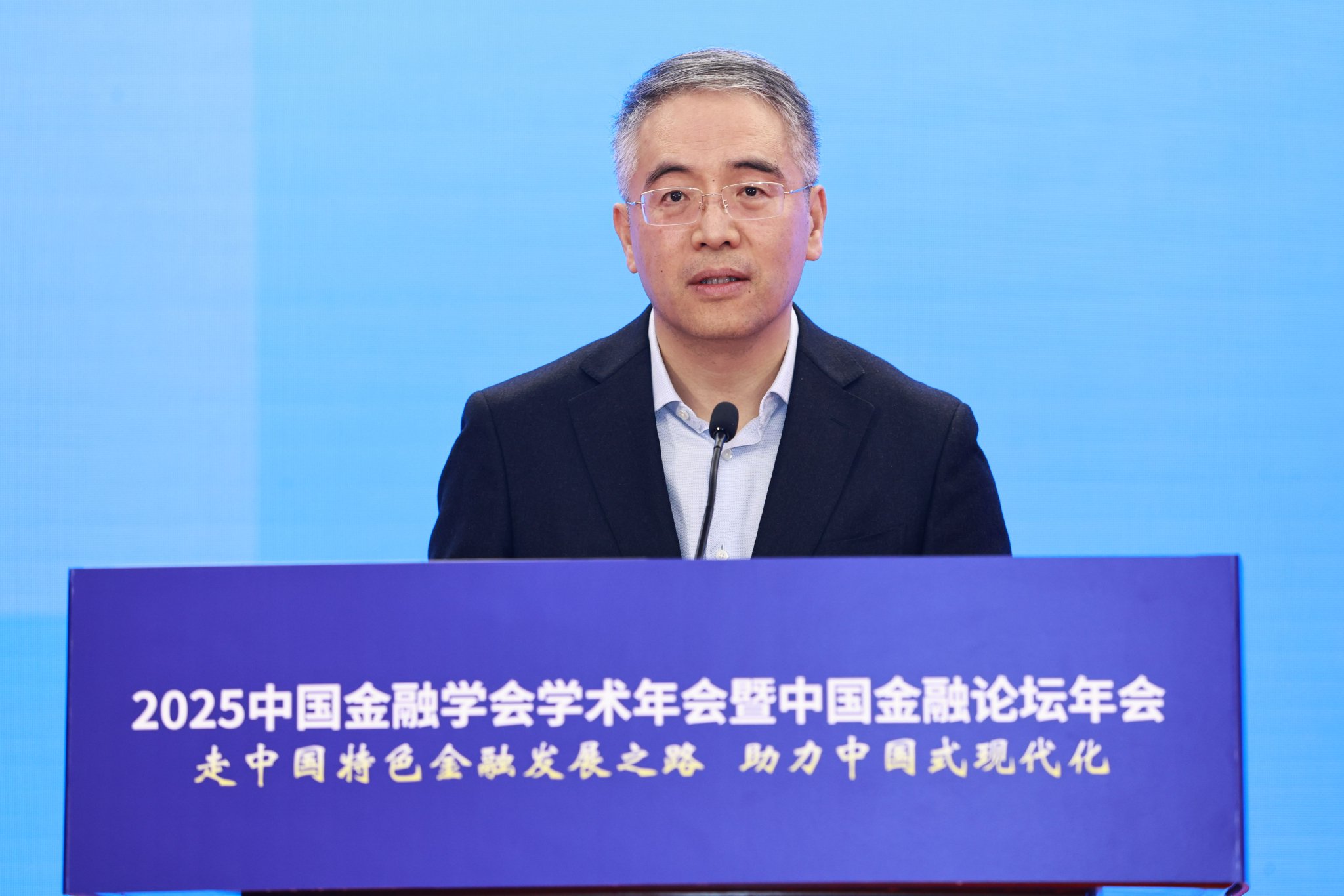
转自:新华财经 谷澍 (2025年12月6日) 谢谢晓慧副会长的介绍。 尊敬的各位来宾,首先借这个机会,感谢各位领导、各位同仁对农业银行的帮助和支持! 党的二十届四中全会审议通过的"十五五"规划建议,8次提及"人工智能",指出要全面实施"人工智能+"行动,全方位赋能千行百业。今年8月,国务院印发 的《关于深入实施"人工智能+"行动的意见》明确要通过"三步走",不断提升新一代智能终端、智能体等应用普及率。金融业应主动融入"人工智能+"发展进 程,当好提升AI应用普惠性的践行者,推动技术创新与业务应用深度融合。当前,人工智能技术迭代演进速度非常快,下一步往哪个方向发展、发展成什 么样,难以形成统一的共识。但普惠是人类始终应当坚持的价值取向。今天我想就提升AI应用的普惠性,谈几点体会。 提升AI应用普惠性的路径,我认为有四方面问题需要考虑。 在12月6日举行的2025中国金融学会学术年会暨中国金融论坛年会上,中国金融学会理事会副会长,中国农业银行董事长谷澍发表"提升AI应用普惠性的若干 思考"主题演讲。 全文如下: 提升AI应用普惠性的若干思考 —在中国金融学会学术年会暨中国金融论坛年会上的发言 从发展趋势看,随着 ...
双融日报-20251231
Huaxin Securities· 2025-12-31 01:24
Market Sentiment - The current market sentiment score is 70, indicating a "relatively hot" market condition, which suggests investor confidence is strong [5][9]. - Historical trends show that when the sentiment score is below or close to 30, the market tends to find support, while scores above 70 may indicate resistance [9]. Hot Themes Tracking - **Robotics Theme**: The establishment of a national standard organization for humanoid robots and embodied intelligence marks a transition from "technical exploration" to "industrial collaboration" and "scale deployment," which is expected to accelerate technology application and ecosystem formation. Related stocks include Sanhua Intelligent Control (002050) and Wolong Electric Drive (600580) [5]. - **Banking Theme**: Bank stocks are characterized by high dividend yields, with the CSI Bank Index yielding 6.02%, significantly higher than the 10-year government bond yield. This makes bank stocks attractive for long-term funds during economic slowdowns. Relevant stocks include Agricultural Bank of China (601288) and Ningbo Bank (002142) [5]. - **Brokerage Theme**: The China Securities Regulatory Commission (CSRC) is focusing on strengthening classified regulation and optimizing risk control indicators for quality institutions. This shift aims to enhance capital utilization efficiency and promote high-quality development in the securities industry. Related stocks include CITIC Securities (600030) and Guotai Junan Securities (601211) [5]. Capital Flow Analysis - The top ten stocks with the highest net inflow include Sanhua Intelligent Control (002050) with a net inflow of approximately 279.98 million, and Shanzhi Gaoke (000981) with about 153.53 million [10]. - The top ten stocks with the highest net buy in financing include C Qiangyi (688809) with 54.91 million and Sanhua Intelligent Control (002050) with 37.68 million [13]. - The top ten industries with the highest net inflow include SW Machinery Equipment and SW Automotive, indicating strong investor interest in these sectors [17]. Industry Insights - The banking sector is highlighted for its stability and high dividend yields, making it a key focus for long-term investors amid economic uncertainties [5]. - The robotics industry is poised for growth due to new standards that facilitate collaboration and reduce development costs, indicating a shift towards more scalable applications [5]. - The brokerage industry is undergoing a transformation towards quality over quantity, with a focus on differentiated services and professional strength [5].





2025年度NEWS品牌样本发布
Xin Jing Bao· 2025-12-31 00:17
Core Insights - The article emphasizes the critical role of enterprises in driving economic stability, technological innovation, industrial upgrades, and improving people's livelihoods, positioning them as the "ballast stone" of economic operation and the "main force" of technological innovation [1][2]. Group 1: NEWS Brand Sample Evaluation - The 2025 NEWS Brand Sample focuses on "new consumption, new scenarios, and new applications," assessing companies based on three key dimensions: AI+, green development, and brand social responsibility [2][3]. - The acronym "NEWS" represents four dimensions: - "N" for Innovation (New) evaluates brands on their innovation capabilities and outcomes - "E" for Energy (Energetic) assesses brands' market responsiveness and activity - "W" for Wisdom (Wise) measures strategic planning and decision-making abilities - "S" for Sustainability (Sustainable) looks at social responsibility and long-term development plans [2]. Group 2: Key Brand Highlights - The 2025 NEWS Brand Sample includes 39 companies recognized for their market leadership, innovation, sustainability, and AI+ application capabilities [6]. - Notable brands include: - China Agricultural Bank, which has significantly increased its county loan scale, surpassing 1 trillion yuan, and has seen rapid growth in various financial services [9]. - BYD Group, which achieved the production of its 15 millionth new energy vehicle and expanded its overseas sales significantly, covering over 110 countries [10]. - Tencent, which has seen international market revenue exceed 20 billion yuan and has actively engaged in social responsibility initiatives [11]. - Haidilao, which has innovated its service offerings to enhance customer experience and expand its brand portfolio [16]. - Aier Eye Hospital, which has integrated AI into its services and focused on social responsibility projects [17]. Group 3: Brand Categories - The brands are categorized into different groups based on their strengths: - 9 brands recognized for their influence include China Agricultural Bank, BYD, Tencent, and others [6]. - 9 brands noted for their responsibility include Abbott, Xifeng Wine, and others, focusing on compliance and ESG governance [19]. - 8 brands leading in innovation include Perfect China and Zebra Language, which have made significant market breakthroughs [20]. - 6 brands identified as AI+ pioneers include Xueersi and Squirrel AI, showcasing the application of AI in transforming business models [22]. - 7 brands recognized for industry breakthroughs include Nu Skin and Mousse Group, which have disrupted traditional industry paths [22].




“消失”的银行监事长
Shang Hai Zheng Quan Bao· 2025-12-30 19:26
Core Viewpoint - The bank supervisory board system, in operation for nearly 30 years, is approaching its end as banks begin to abolish this structure in favor of audit committees, following new regulations from the China Securities Regulatory Commission (CSRC) and the Financial Regulatory Bureau [2][3][4]. Regulatory Framework for Reform - The new Company Law, effective from July 2024, allows financial institutions to replace supervisory boards with audit committees, fundamentally changing the requirement for supervisory boards as mandatory entities [3][4]. - The Financial Regulatory Bureau has issued policies that support the transition, allowing financial institutions to choose between retaining supervisory boards or establishing audit committees to perform supervisory functions [3][4]. Differences in Implementation - There is a differentiation in the approach to abolishing supervisory boards between listed and non-listed banks, with listed banks required to eliminate supervisory boards by 2026, while non-listed banks have the option to retain them [4][5]. - Major state-owned banks have already initiated the process of abolishing supervisory boards, with the five largest banks voting to remove them in April 2025 [5]. Effectiveness and Challenges of Supervisory Boards - The supervisory board has been criticized for its lack of independence, professionalism, and efficiency, often leading to overlapping functions and ineffective oversight [6][7]. - The costs associated with maintaining a supervisory board are significant, with estimates suggesting that listed banks could save millions annually by abolishing this structure [7]. Transition Paths for Supervisory Board Members - Former supervisory board members may transition to roles within the audit committee, take on positions in other financial institutions, or retire from the industry [8]. - The governance mechanism is expected to become more efficient, with fewer decision-making layers and a more direct oversight structure through audit committees [8].




农行陕西省分行:542亿金融活水“贷”动美丽乡村建设
Zhong Guo Jin Rong Xin Xi Wang· 2025-12-30 10:10
Core Insights - The article highlights the transformation of rural areas in Xi'an's Huoyi District, showcasing the impact of financial support from Agricultural Bank of China (ABC) on local businesses and the overall rural revitalization effort [1][2]. Group 1: Financial Support and Impact - ABC has introduced various financial tools to support rural revitalization, significantly aiding small and micro enterprises like "Huayang Guoba" [1]. - The price of palm oil used by "Huayang Guoba" surged from over 8,000 yuan/ton to 19,000 yuan/ton, creating financial strain, which was alleviated by a loan from ABC [1]. - ABC's "Huinong e-loan" program has been pivotal in helping small businesses navigate financial challenges, thereby enhancing local living standards [1]. Group 2: Growth of Local Industries - The hospitality sector, particularly homestays, has seen significant growth, with operators like Geng Shusen investing over 2 million yuan in renovations [2]. - ABC's "no principal renewal loan" policy has extended loan terms from one year to three years, providing essential flexibility for business adjustments [2]. - As of December 20, the loan balance for farmers from ABC in Shaanxi Province reached 54.2 billion yuan, with an annual increase of 13 billion yuan, reflecting strong support for local industries [2].