PING AN OF CHINA(601318)

Search documents
平安人寿快速应对广东汕头火灾
Xin Lang Cai Jing· 2025-12-10 10:33
(1)主动排查客户出险信息:开展理赔主动服务工作,多渠道获取事件死伤人员名单,排查客户出险 信息;(2)简化理赔手续:因此次重大突发事件导致身故的客户,可按相关部门公布名单先行申请身 故理赔;(3)理赔绿色通道:及时启动理赔应急处理机制,成立理赔应急处理小组,开启理赔绿色通 道;(4)提供上门理赔服务:对此次重大突发事件的理赔客户,公司可以提供上门收取理赔资料等主 动服务;(5)开通特案预赔服务:根据事故进展,结合客户伤情启动特案预赔流程,预付赔款;(6) 取消定点医院和自费限制; (7)启动急难救援服务。 责任编辑:曹睿潼 来源:平安随行 据新华社报道,12月9日21时20分,广东省汕头市潮南区峡山街道丹凤路一住宅突发火灾,遇难人数已 升至12人。经初步勘查,起火建筑为一栋四层钢筋混凝土结构自建房,过火面积约150平方米,起火原 因调查中。 平安人寿启动重大突发事故应急预案,总/分公司成立应急处理小组,第一时间应对本次事故。广东分 公司高度重视快速响应,密切关注媒体报道,经排查暂无我司客户出险。 平安人寿将持续跟进本次事故进展,同时推出7项服务举措,第一时间启动绿色通道,为客户及家属提 供温暖便捷的服务。 ...

从“有”到“优”,拆解平安“五星级”居家养老管家
2 1 Shi Ji Jing Ji Bao Dao· 2025-12-10 10:23
Core Insights - The rise of "outsourced children" services reflects the emotional needs of elderly individuals living alone in an increasingly aging society in China [1] - The demand for home care services is growing due to the increasing number of elderly individuals, with 14.2% of seniors living alone and a significant shortage of professional caregivers [2][3] - The establishment of a standardized system for home care services is crucial for improving service quality and meeting the needs of the elderly [4][5] Group 1: Industry Challenges - The demand for elderly caregivers in China has reached 6 million, while only about 500,000 are currently available, leading to a significant gap in service provision [2] - Many elderly individuals face difficulties in accessing services due to limited digital skills and a fragmented market, which complicates the process of obtaining care [2][3] - The lack of a unified standard for service content and personnel qualifications results in unclear service boundaries and responsibilities, leading to inconsistent service quality [3][4] Group 2: Standardization and Quality Assurance - The absence of mandatory national standards for home care services has led to the gradual inclusion of relevant requirements in various standard systems, such as the "Basic Norms for Home Care Services" implemented in 2023 [4] - The China Quality Certification Center (CQC) has developed an evaluation system for home care services based on four core dimensions: basic assurance capabilities, service process standardization, professional service capabilities, and user satisfaction [5][6] - Companies like Ping An have successfully implemented these standards, achieving a five-star rating for their home care services, highlighting the importance of resource coordination and professional qualifications [6][7] Group 3: Service Innovations - Ping An's home care service integrates smart technology and professional care, providing a comprehensive solution that includes insurance and personalized care plans [7] - The service has expanded to cover 100 cities, with nearly 240,000 clients receiving home care services, demonstrating significant market penetration [7] - Future service models are expected to shift from standardized offerings to personalized solutions tailored to individual health conditions and preferences, enhancing the overall care experience for the elderly [7]
25Q3企业年金基金及养老金产品业务数据点评:权益类收益跳涨带动业绩走强
Hua Yuan Zheng Quan· 2025-12-10 09:48
1. Report Industry Investment Rating No information provided in this report. 2. Core View of the Report In Q3 2025, enterprise annuities showed the characteristics of "scale expansion, high - growth investment income, and market pattern differentiation". The overall performance was significantly improved driven by the jump in equity investment income while the coverage and fund scale continued to expand. In the trustee market, insurance funds still dominated, and bank - affiliated institutions were growing, with different institutional competition strategies. The head - effect in the investment end was strengthened, and equity products became the core driving force for performance. The market conditions and product structure adjustment jointly drove the outstanding performance this quarter [2]. 3. Summary by Relevant Catalogs 3.1 Enterprise Annuity Scale and Yield - **Scale Expansion**: In Q3 2025, the number of enterprises with enterprise annuities increased by 2,770 to 175,000, the number of participating employees increased by 275,200 to 33.32 million, and the accumulated funds increased by 0.24 trillion yuan to 4.09 trillion yuan. The number of established plans only increased by 8 for single plans (corporate entrustment), and other types remained stable. The investment asset net value increased by 248.7 billion yuan, and the number of portfolios increased by 70. The cumulative yield rate in the past three years increased significantly from 6.27% to 12.08% [2]. - **Yield Growth**: The investment income growth was the core highlight. The number of recipients decreased slightly by 7,700 to 2.8538 million, the amount of benefits received decreased by 898 million yuan to 27.998 billion yuan, and the per - capita benefit received decreased from 10,098 yuan to 9,811 yuan [2]. 3.2 Enterprise Annuity Trustee Market - **Overall Pattern**: Insurance funds continued to dominate, and bank - affiliated institutions rose rapidly. The market had a significant head - gathering effect, and the competition strategy might be biased towards small and medium - sized enterprises. As of Q3 2025, China Life Pension and Ping An Pension almost occupied half of the market in terms of the number of managed enterprises, employees, and asset amounts, with the combined proportions being 44.3%, 49.4%, and 49.5% respectively, compared with - 1.38pct, - 0.11pct, and + 0.03pct in Q2 2025 [2]. - **Trustee Management Asset Amount**: The overall scale continued to rise, with a Q3 2025 quarter - on - quarter increase of 6.3% to 3.1 trillion yuan. Institutions with relatively smaller trustee scales expanded relatively faster. China Life Pension (934.5 billion yuan), Ping An Pension (598.7 billion yuan), and Industrial and Commercial Bank of China (369.7 billion yuan) ranked in the top three in terms of trustee scale. The trustee asset scales of China Construction Bank Pension, PICC Pension, and China Merchants Bank increased by 8.9%, 8.3%, and 8.1% quarter - on - quarter in Q3 2025. The proportion of bank - affiliated institutions in the trustee management asset amount increased from 24.8% in Q2 2025 to 25.0% in Q3 2025 [2]. - **Number of Managed Enterprises**: The total number of enterprises managed by enterprise annuity trustee institutions continued to grow, increasing by 6,826 to about 160,000 from Q2 2025 to Q3 2025, a quarter - on - quarter increase of 4.5%. Insurance institutions continued to dominate the market. In Q3 2025, the proportion of enterprises managed by insurance institutions was 73.9%, an increase of 3.3pct compared with Q2 2025. China Life Pension led with 43,000 managed enterprises, accounting for 27.1% of the whole market. In terms of quarter - on - quarter growth, the number of enterprises managed by Industrial and Commercial Bank of China increased by 16.6% to 20,000 in Q3 2025, leading the industry in both growth rate and increment. The number of enterprises managed by China Construction Bank Pension increased by 12.7% to 8,000 in Q3 2025, with relatively fast business growth [2]. - **Number of Managed Employees**: The head - gathering effect was obvious, and the overall pattern still showed insurance - fund dominance. The number of employees increased only slightly by 0.6% quarter - on - quarter to 27.44 million in Q3 2025, which might reflect that the enterprise annuity participation structure was tilted towards small and medium - sized enterprises. Among them, the number of employees managed by the trustee institution of China Merchants Bank increased by 6.1% quarter - on - quarter to 390,000, with a growth rate much higher than that of its peers. Although the number of enterprises managed by Industrial and Commercial Bank of China and China Construction Bank Pension increased significantly, the number of their managed employees increased only by 1.6% and 0.7% quarter - on - quarter respectively, which might indicate that their new enterprise customers were mostly scattered small and medium - sized customers [2]. 3.3 Investment Management Institutions of Enterprise Annuity - **Head - effect Strengthened**: In Q3 2025, the list of the top ten institutions in terms of portfolio asset amount was relatively stable. Three insurance - fund institutions, Taikang Asset, China Life Pension, and Ping An Pension, still ranked in the top three in terms of management scale with 693.3 billion yuan, 517.3 billion yuan, and 381.6 billion yuan respectively. The average managed asset amount of public - offering fund companies (149.5 billion yuan, an increase of 9.2 billion yuan compared with Q2 2025, a quarter - on - quarter increase of 6.54%) was less than that of insurance - fund institutions (an average of 283.1 billion yuan, an increase of 17.2 billion yuan compared with Q2 2025, a quarter - on - quarter increase of 6.48%). In terms of scale change, Taikang Asset, ICBC Credit Suisse, and Ping An Pension had the top three increments, with increases of 44.9 billion yuan, 37.9 billion yuan, and 26.0 billion yuan respectively compared with Q2 2025. Xinhua Pension, Guotai Fund, and Yin Hua Fund had the top three growth rates, with quarter - on - quarter increases of 25.9%, 17.1%, and 14.5% respectively. Guotai Fund entered the top 10 in terms of management scale (a rise of 4 places compared with Q2 2025) [3]. - **Performance**: The high - growth yield of equity - containing portfolios drove the overall investment yield to strengthen, while the investment yield of fixed - income portfolios fluctuated slightly and remained relatively stable. In Q3 2025, the investment yield of fixed - income portfolios decreased slightly by 0.03pct (from 0.93% to 0.90%), mainly affected by the decline in the income of single plans. The investment yield of equity - containing portfolios "jumped", with the single - quarter yield increasing significantly from 1.02% to 4.82%, and each plan type recorded an increase of about 3pct. This also drove the overall yield to increase from 1.00% to 4.26%, and single - plan and collective - plan types all achieved significant growth. From the yields in the first three quarters of this year, the yields of fixed - income, equity - containing, and overall were 2.37%, 6.24%, and 5.72% respectively [3]. 3.4 Changes in Annuity Pension Products - **Equity Products**: Compared with Q2 2025, in Q3 2025, the scale and yield of equity products increased significantly. As of Q3 2025, the number of actually operating products was 568, a decrease of 2 compared with Q2 2025. The net value of equity products at the end of the period increased by 42.8% quarter - on - quarter to 223.6 billion yuan, and the investment yield in this period increased from 2.3% in Q2 2025 to 22.9% in Q3 2025. Among them, the single - quarter yields of ordinary stock - type and Hong Kong - stock - type products reached 22.6% and 25.4% respectively, and the cumulative yield of Hong Kong - stock products since their establishment also improved from - 23.8% in Q2 2025 to - 7.3% in Q3 2025 [3]. - **Fixed - Income Products**: The net value of fixed - income products at the end of Q3 2025 decreased by 5.95% quarter - on - quarter to 1,596.1 billion yuan, and the yield in this period slightly decreased to 0.68% [3]. - **Overall Situation**: The total net value of pension products at the end of the period increased slightly by 0.58% quarter - on - quarter to 2,464.8 billion yuan, and the quarterly investment yield increased from 1.09% in Q2 2025 to 3.11% in Q3 2025. This change might be due to the inflow of funds into equity products driven by the equity market conditions in the third quarter, while the fixed - income products experienced capital outflows [3].

平安产险江苏分公司:彰显服务温度 百万赔款为二级伤残客户点亮希望之光
Jiang Nan Shi Bao· 2025-12-10 09:33
Core Viewpoint - Ping An Property & Casualty Insurance Jiangsu Branch actively fulfills social responsibility by adhering to a "people-centered" service philosophy, integrating warmth into every case handling process [1] Group 1: Service Philosophy - The company emphasizes a service philosophy of "worry-free, time-saving, and cost-effective," aiming to provide professional and efficient claims support while actively demonstrating care and warmth in the insurance industry [1] - In a traffic accident case in Xuzhou, the company quickly initiated an emergency response plan, demonstrating its commitment to social responsibility by visiting the injured party's family [1] Group 2: Professional Dispute Resolution - The company utilized its professional legal and claims teams to conduct precise assessments regarding disputes over nursing fees and assistive devices, laying a foundation for efficient and proper resolution [2] - By implementing a solution that balances legal principles and human emotions, the company alleviated the anxiety of the injured party's family during the dispute resolution process [2] Group 3: Timely Financial Support - Adhering to the principle of "life first," the company pre-paid 1 million yuan to the injured party's account within three working days, preventing a financial crisis for the family [3] - The swift action received high praise from the court, with a judge noting that the company's proactive approach brought hope before legal proceedings were finalized [3] Group 4: Cost-Effective Claims Management - In the final stages of the case, the company optimized the nursing plan and carefully determined the standards for assistive devices, achieving precise and reasonable allocation of claims resources [3] - This approach not only saved the injured party's legal costs but also preserved social trust resources, demonstrating the company's commitment to effective claims management [3] Group 5: Commitment to Social Harmony - The handling of this major case exemplifies the company's "three savings" service philosophy, transforming insurance protection from mere economic compensation into a tool for stabilizing social expectations and promoting social harmony [4] - The company plans to continue its commitment to "finance for the people," leveraging technology to enhance service quality and fulfill its role as a stabilizer for society and a booster for economic development in Jiangsu [4]

中国平安起诉华夏幸福及其董事长王文学
Feng Huang Wang Cai Jing· 2025-12-10 08:52
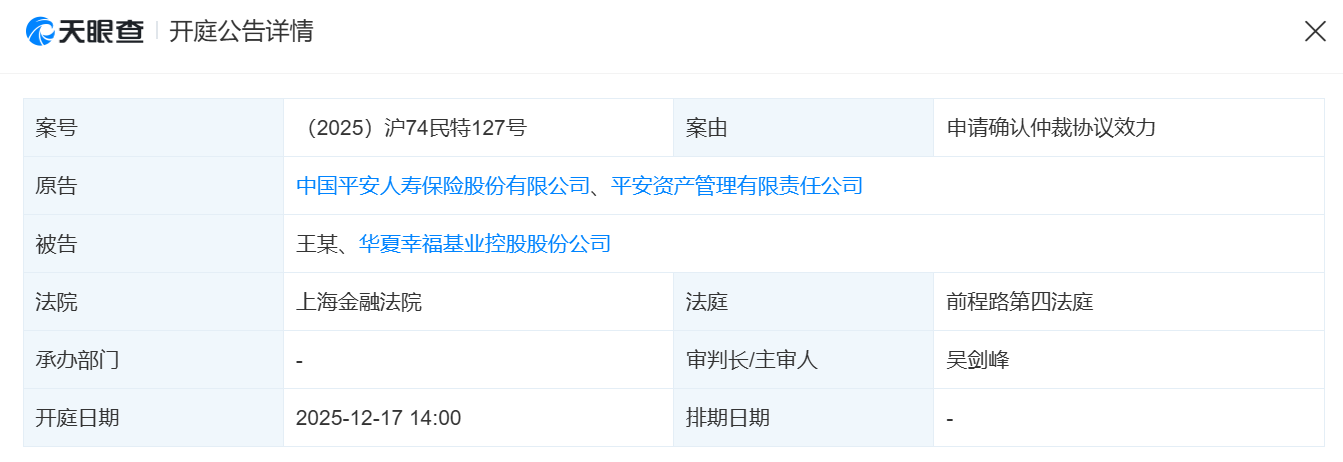
Group 1 - The core issue involves a lawsuit filed by China Ping An Life Insurance Co., Ltd. and Ping An Asset Management Co., Ltd. against Huaxia Happiness Holdings Co., Ltd. and its chairman Wang Wenxue, with the aim of confirming the validity of an arbitration agreement [1][2] - The case is set to be heard at the Shanghai Financial Court on December 17, 2025 [1][2] - Between 2018 and 2020, Ping An invested heavily in Huaxia Happiness through equity and debt, but faced challenges when Huaxia Happiness's debt crisis emerged in February 2021, leading to Ping An becoming the largest shareholder after the forced disposal of shares by the original controlling shareholder [2] Group 2 - Ping An is currently in the process of reducing its stake in Huaxia Happiness, with a plan to sell up to 117.4 million shares, representing 3% of Huaxia Happiness's total share capital, between September 1 and November 30, 2025 [2]


中国平安起诉华夏幸福及其董事长王文学
凤凰网财经· 2025-12-10 08:50
凤凰网财经讯 2025年12月10日,天眼查信息显示:中国平安人寿保险股份有限公司及平安资产管理有限责任公司起诉华夏幸福基业控股股份公司及"王 某"。据知情人士透露,"王某"即华夏幸福董事长王文学。 华夏幸福董事长王文学 根据开庭公告详情,本案案由为"申请确认仲裁协议效力",上诉法院为上海金融法院,开庭日期为12月17日。 | 案号 | (2025) 沪74民特127号 | 案由 | 申请确认仲裁协议效力 | | --- | --- | --- | --- | | 原告 | 中国平安人寿保险股份有限公司、平安资产管理有限责任公司 | | | | 被告 | 王某、华夏幸福基业控股股份公司 | | | | 法院 | 上海金融法院 | 法庭 | 前程路第四法庭 | | 承办部门 | | 审判长/主审人 | 吴剑峰 | | 开庭日期 | 2025-12-17 14:00 | 排期日期 | | 2018- 2020年期间,平安方面通过股权、债权等形式,斥重金投资华夏幸福。2021年2月,华夏幸福债务危机爆发;同年9月,因原控股股东华夏控股所持 股份被强制处置,平安方面被动成为华夏幸福第一大股东。 值得一提的是,目前平安 ...

中国平安起诉华夏幸福及其董事长王文学
YOUNG财经 漾财经· 2025-12-10 08:49
资料图。本文来源 :凤凰网财经 2018- 2020年期间,平安方面通过股权、债权等形式,斥重金投资华夏幸福。2021年2月,华夏 幸福债务危机爆发;同年9月,因原控股股东华夏控股所持股份被强制处置,平安方面被动成为 华夏幸福第一大股东。 值得一提的是,目前平安方面正在减持华夏幸福股份。今年8月8日,华夏幸福发布公告,称收 到股东平安资管送达的《股份减持计划告知函》。根据公告,平安人寿及其一致行动人平安资 管计划自2025年9月1日—11月30日期间,通过大宗交易或集中竞价方式减持公司股份不超过 1.174亿股,占华夏幸福总股本的3%。 ■ 中国平安起诉华夏幸福及其董事长王文学 凤凰网财经讯 2025年12月10日,天眼查信息显示:中国平安人寿保险股份有限公司及平安资产 管理有限责任公司起诉华夏幸福基业控股股份公司及"王某"。据知情人士透露,"王某"即华夏 幸福董事长王文学。 根据开庭公告详情,本案案由为"申请确认仲裁协议效力",上诉法院为上海金融法院,开庭日 期为12月17日。 | 案号 | (2025) 沪74民特127号 | 案由 | 申请确认仲裁协议效力 | | --- | --- | --- | - ...
中国平安涨0.16%,成交额28.09亿元,近3日主力净流入-6946.13万
Xin Lang Cai Jing· 2025-12-10 07:17
Core Viewpoint - China Ping An's stock performance shows a slight increase of 0.16% with a trading volume of 28.09 billion yuan and a market capitalization of 1,132.633 billion yuan [1] Dividend Analysis - The dividend yields for China Ping An over the past three years are 5.15%, 6.03%, and 4.84% respectively [2] - The top ten circulating shareholders include Central Huijin Asset Management Co., Ltd. and China Securities Finance Corporation [2] - The company owns Fintech subsidiary OneConnect, providing electronic banking, account services, credit reporting, loans, and interbank transactions to small and medium-sized banks [2] - China Ping An has stakes in several unicorn companies, including Lufax, Ping An Good Doctor, and a health insurance company, with Lufax valued at 39.4 billion USD as of March 2019 [2] Fund Flow Analysis - Today's main capital net inflow is -1.08 million yuan, accounting for 0.05%, with a ranking of 5 out of 5 in the industry, indicating a reduction in main capital positions for two consecutive days [3] - The industry has seen a net inflow of -58.263 million yuan, with a reduction in main capital positions for three consecutive days [3] Technical Analysis - The average trading cost of the stock is 52.96 yuan, with recent accumulation activity noted, although the strength of accumulation is weak [5] - The current stock price is near a resistance level of 63.80 yuan, suggesting caution against potential pullbacks unless the resistance is broken, which could lead to an upward trend [5] Company Overview - China Ping An Insurance (Group) Co., Ltd. is headquartered in Shenzhen, Guangdong, and was established on March 21, 1988, with its listing date on March 1, 2007 [6] - The company offers diversified financial services centered around insurance, including banking, securities, and trust services, with revenue breakdowns of 45.76% from life and health insurance, 34.46% from property insurance, 13.87% from banking, 5.27% from asset management, and 3.85% from financial empowerment [6] - As of September 30, 2025, the company reported a revenue of 832.94 billion yuan, a year-on-year increase of 7.42%, and a net profit attributable to shareholders of 132.856 billion yuan, a year-on-year increase of 11.47% [6] Dividend Distribution - Since its A-share listing, China Ping An has distributed a total of 391.904 billion yuan in dividends, with 134.54 billion yuan distributed over the past three years [7] - As of September 30, 2025, the sixth largest circulating shareholder is Hong Kong Central Clearing Limited, holding 456 million shares, a decrease of 182 million shares from the previous period [7]
金融品牌如何突破传统营销桎梏? 中国平安连载短剧《霞客行》值得借鉴
Xin Lang Cai Jing· 2025-12-10 06:57
Core Viewpoint - China Ping An has launched its first brand-customized serialized short drama "Xia Ke Xing," creatively combining modern insurance services with the adventurous spirit of the ancient traveler Xu Xiake, allowing viewers to learn about his life while experiencing the premium services of the Ping An Travel Protection insurance product [3][17]. Content Breakthrough - The "Xia Ke Xing" series represents a new direction in content creativity for the financial industry, moving beyond rigid product introductions to weave insurance services naturally into well-crafted storylines [3][17]. Plot Setting - The storyline features Xu Xiake, the "Saint of Travel" from the Ming Dynasty, unexpectedly arriving in 2025, where he encounters a stark contrast to his time, leading to humorous situations. His journey across China showcases his enduring spirit of exploration, with Ping An's services providing comprehensive travel protection [4][18]. Scene Integration - The success of "Xia Ke Xing" lies in its ability to deeply integrate product functions with user scenarios. Instead of direct product promotion, the series uses Xu Xiake's travel stories to naturally demonstrate the various protections offered by Ping An during travel, breaking traditional financial advertising frameworks [7][21]. Effectiveness and Efficiency - The marketing approach in the financial industry must balance innovation with caution. Ping An's attempt in "Xia Ke Xing" illustrates how to achieve creative breakthroughs within safe boundaries. The short drama format enhances brand exposure and customer engagement, leading to exponential growth in brand communication [10][24]. Conclusion - The series not only entertains but also illustrates how Ping An disassembles its insurance services into relatable life scenarios, proving that insurance can be engaging and warm [13][27].

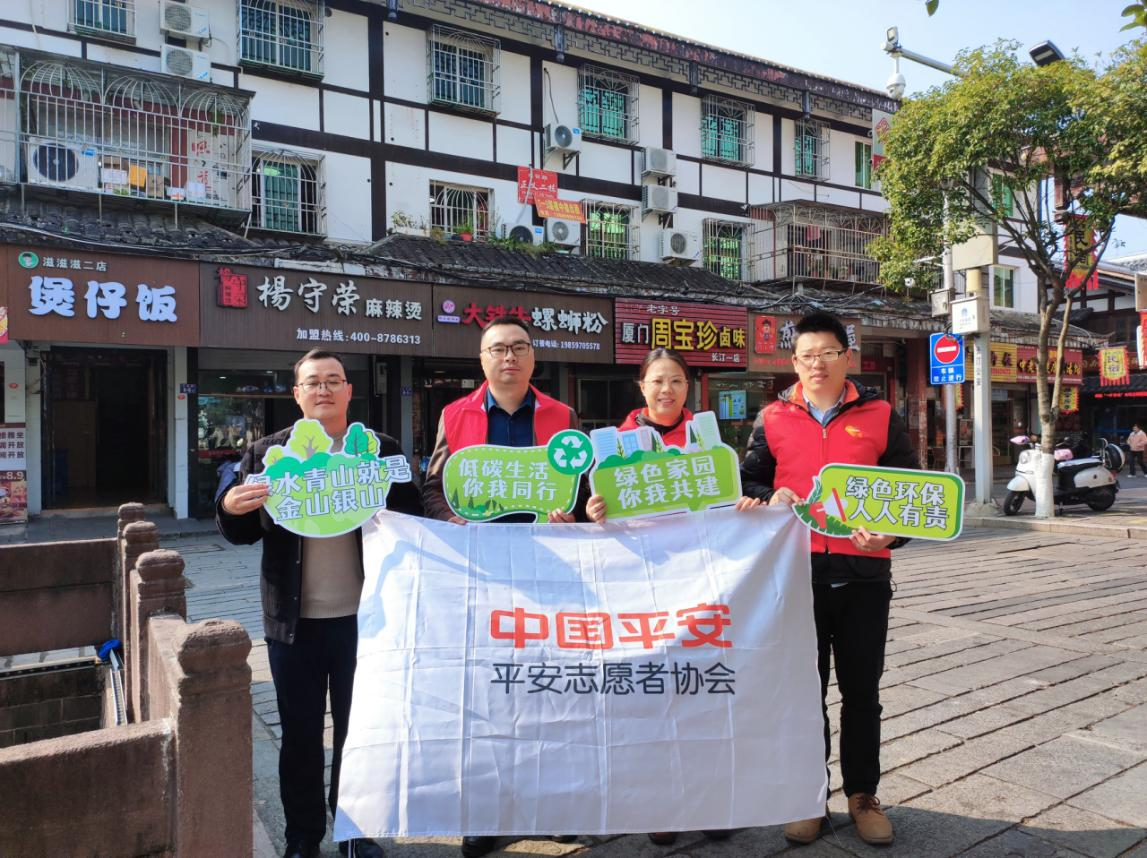
平安产险龙岩中心支公司:“筷”护低碳,共筑绿色餐饮
Zhong Jin Zai Xian· 2025-12-10 04:59
Core Viewpoint - The initiative by Ping An Property & Casualty aims to reduce waste in the restaurant industry by promoting the use of stainless steel chopsticks as a sustainable alternative to disposable utensils, thereby contributing to low-carbon transformation in dining [1][3]. Group 1: Environmental Impact - A medium-traffic restaurant consumes over 8,000 pairs of disposable chopsticks annually, leading to significant wood resource waste and non-biodegradable garbage generation [3]. - The donated stainless steel chopsticks have a lifespan of 5-10 years, potentially reducing the use of disposable chopsticks by approximately 80,000 pairs per year for the initial 10 restaurants, equivalent to saving 10 mature trees and reducing carbon emissions by over 150 kilograms annually [3]. Group 2: Economic Benefits - By switching to stainless steel chopsticks, a restaurant can save around 600 yuan annually on the cost of disposable chopsticks, assuming a monthly expenditure of 50 yuan on disposables [5]. - The initiative not only promotes environmental sustainability but also offers financial savings for restaurant owners [5]. Group 3: Community Engagement - Volunteers provided practical advice to restaurant owners on how to encourage customers to accept eco-friendly chopsticks, including displaying informational cards on tables [7]. - The initiative has received positive feedback from restaurant owners, with many expressing willingness to adopt the new practices and promote environmental awareness among customers [7]. Group 4: Future Plans - Ping An Property & Casualty plans to continue monitoring the use of eco-friendly chopsticks in participating restaurants and aims to collaborate with the community to establish an "Eco-Friendly Restaurant" evaluation, encouraging broader participation in waste reduction efforts [9].