BANK COMM(601328)

Search documents
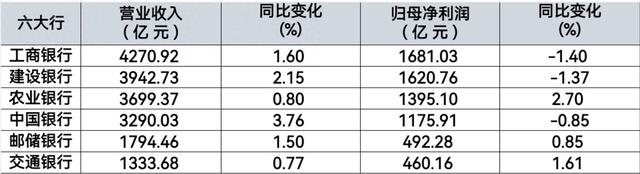
国有六大行拟中期分红超2000亿元
Zhong Guo Zheng Quan Bao· 2025-08-31 01:20
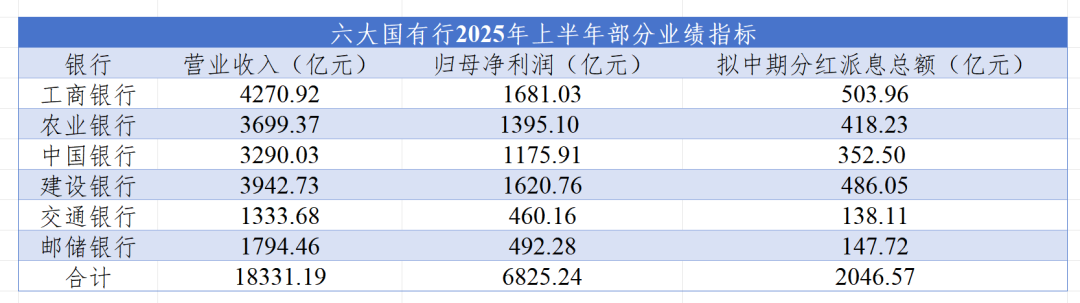
截至8月29日晚,工商银行、农业银行、中国银行、建设银行、交通银行、邮储银行六家国有大行2025年上半年"成绩单"揭晓。 2025年上半年,六家国有大行归母净利润合计超6800亿元,资产质量稳中向好,且六家银行均宣布推出中期分红计划。 同时,如何应对净息差挑战也是国有大行管理层在中期业绩说明会上重点提及的话题。 | | | 六大国有行2025年上半年部分业绩指标 | | | --- | --- | --- | --- | | 银行 | | 营业收入(亿元) | 拟中期分红派息总额(亿元) | | 工商银行 | 4270.92 | 1681.03 | 503.96 | | 农业银行 | 3699.37 | 1395.10 | 418.23 | | 中国银行 | 3290.03 | 1175.91 | 352.50 | | 建设银行 | 3942.73 | 1620.76 | 486.05 | | 交通银行 | 1333.68 | 460.16 | 138.11 | | 邮储银行 | 1794.46 | 492.28 | 147.72 | | 合计 | 18331.19 | 6825.24 | 2046.57 | ...







上海多家银行宣布调整房贷利率
Zhong Guo Zheng Quan Bao· 2025-08-31 01:13
Core Viewpoint - The recent adjustments in Shanghai's housing policies aim to optimize the personal housing loan interest rate mechanism, impacting both new and existing loans, which is expected to enhance banks' flexibility in pricing and risk management [1][2]. Group 1: Policy Changes - On August 25, Shanghai's housing authorities issued a notice to adjust real estate policies, including reducing housing purchase restrictions and optimizing housing provident fund and personal housing credit policies, effective from August 26 [1]. - Multiple banks in Shanghai have announced adjustments to their commercial personal housing loan interest rate pricing mechanisms following the new policies [1]. Group 2: New Loan Interest Rate Mechanism - The new interest rate mechanism for commercial personal housing loans in Shanghai will no longer differentiate between first and second homes, with rates determined based on market conditions and individual bank assessments [2]. - The average interest rate for newly issued commercial personal housing loans in China was reported at 3.09% for Q2 2025, with the latest 5-year LPR at 3.5% [2]. Group 3: Existing Loan Adjustments - Existing loans can be adjusted based on the new rules, allowing for potential reductions in interest rates for second home loans, with specific conditions for applying for rate adjustments [3]. - Banks will offer two methods for customers to adjust their loan rates: self-application and proactive adjustments by the banks starting from September 1 [3].

突发!胡塞武装行政机构负责人被以军打死;上海多家银行新增房贷利率不再区分首套、二套;刘强东现身“苏超”现场观赛丨每经早参
Mei Ri Jing Ji Xin Wen· 2025-08-31 01:10
Group 1 - The Houthis announced the death of their administrative head, Ahmed Rahawi, due to an Israeli airstrike in Sana'a, Yemen on August 28 [2][9] - Israeli Defense Minister confirmed the airstrike targeting Houthi officials [2][9] - The airstrike is part of ongoing military actions in the region, with Israel also targeting Hamas personnel in Gaza [9] Group 2 - Multiple banks in Shanghai have adjusted their housing loan interest rate mechanisms following the "825 New Policy," no longer distinguishing between first and second homes [7] - The specific interest rates for housing loans will now be determined based on the Shanghai market interest rate pricing self-discipline mechanism and other factors [7] Group 3 - The Chinese Ministry of Commerce held discussions with U.S. officials regarding U.S.-China trade relations and emphasized the need for mutual respect and cooperation [4] - The Ministry expressed opposition to the U.S. decision to revoke the "validated end-user" status of three semiconductor companies in China, citing potential negative impacts on the global semiconductor supply chain [5] Group 4 - Central Huijin increased its holdings in 12 ETF products, spending over 210 billion yuan, indicating strong confidence in the market [10] - The six major state-owned banks in China announced a total cash dividend of approximately 204.66 billion yuan for the first half of 2025, reflecting their robust financial health [11] Group 5 - Huawei's executive revealed details about its collaboration with SAIC Motor, emphasizing trust and commitment despite resource constraints [12] - Huawei's rotating chairman discussed the current state of the HarmonyOS ecosystem, highlighting its ongoing development and the need for broader participation from developers and manufacturers [14] Group 6 - Ping An Life has increased its stake in Agricultural Bank of China, marking its third acquisition of shares within a year, indicating confidence in the bank's future [15]

每周股票复盘:交通银行(601328)交行2025年中报净利增1.61%
Sou Hu Cai Jing· 2025-08-30 17:17
Core Viewpoint - The recent performance of Bank of Communications shows a slight decline in stock price, with a total market capitalization of 642.05 billion yuan, ranking 6th among state-owned large banks and 21st among A-shares [1] Trading Information Summary - On August 27, Bank of Communications recorded a block trade worth 34.2788 million yuan [2] Shareholder Changes - As of June 30, 2025, the number of shareholders decreased to 234,400, a reduction of 14,700 or 5.89% compared to March 31, 2025. The average shareholding increased from 157,600 shares to 227,600 shares, with an average market value of 1.8212 million yuan per shareholder [3] Financial Report Highlights - The mid-year report for 2025 indicates that the company's main revenue reached 133.368 billion yuan, a year-on-year increase of 0.77%. The net profit attributable to shareholders was 46.016 billion yuan, up 1.61% year-on-year. The second quarter alone saw a main revenue of 66.994 billion yuan, a 2.61% increase year-on-year [4] Company Announcements Summary - The profit distribution plan for the first half of 2025 proposes a cash dividend of 1.563 yuan per 10 shares (including tax), totaling 13.811 billion yuan. There are no plans for stock dividends or capital reserve transfers [5][7] - The announcement regarding the distribution of cash dividends for domestic preferred shares states a payout of 4.07 yuan per share, totaling 1.8315 billion yuan [6] - The board meeting approved the mid-year report, profit distribution plan, and preferred share dividend plan, with a total dividend of 1.8315 billion yuan to be distributed on September 8, 2025 [8]
六大行半年赚6825亿,分红超2000亿
2 1 Shi Ji Jing Ji Bao Dao· 2025-08-30 14:16
Core Viewpoint - The six major banks reported a total operating income of 1.81 trillion yuan for the first half of 2025, reflecting a year-on-year growth of 2.05%, while the net profit attributable to shareholders decreased by 0.13% to 682.52 billion yuan [1][3]. Financial Performance - All six banks achieved positive growth in operating income, but net profit showed a mixed trend with three banks experiencing declines [1][3]. - The operating income of the six banks was 1.81 trillion yuan, with a year-on-year increase of 2.05%, while the net profit totaled 682.52 billion yuan, down 0.13% from the previous year [3][6]. - China Bank led in revenue growth with an increase of 3.76%, reaching 329 billion yuan, driven by a significant rise of 26.43% in non-interest income [3][6]. Revenue Structure - The revenue structure of the six banks has shifted, with non-interest income increasing its share [3][6]. - The non-interest income of China Bank reached 114.19 billion yuan, accounting for 34.71% of total revenue, up 6.23 percentage points year-on-year [3][6]. Profitability - Industrial and Commercial Bank of China (ICBC) reported a net profit of 168.10 billion yuan, a decrease of 1.40%, while Agricultural Bank of China saw a profit increase of 2.66% to 139.51 billion yuan [6][7]. - The net profit of the six banks showed a decline for ICBC, China Construction Bank, and China Bank, while Agricultural Bank, Postal Savings Bank, and Bank of Communications reported slight increases [6][7]. Asset Quality - The asset quality of the six banks remained stable, with non-performing loan ratios at low levels [16][17]. - Postal Savings Bank had the lowest non-performing loan ratio at 0.92%, despite a slight increase [17]. Net Interest Margin - The net interest margin for the six banks decreased, with Postal Savings Bank at 1.70%, down 21 basis points year-on-year [19][20]. - The net interest margin for China Bank was 1.26%, reflecting an 18 basis point decline, attributed to factors such as the continuous decline in LPR and adjustments in mortgage rates [19][20].

六大行半年赚6825亿,分红超2000亿
21世纪经济报道· 2025-08-30 13:55
Core Viewpoint - The six major banks reported a total operating income of 1.81 trillion yuan for the first half of 2025, with a year-on-year growth rate of 2.05%. However, the net profit attributable to shareholders decreased by 0.13% to 682.52 billion yuan, indicating a mixed performance among the banks [1][3]. Revenue Summary - All six banks achieved positive growth in operating income, with China Bank leading at 329 billion yuan, a 3.76% increase year-on-year. Non-interest income significantly contributed to this growth, rising by 26.43% [3][4]. - The operating income for each bank is as follows: - Industrial and Commercial Bank: 409.08 billion yuan (1.80% growth) - China Construction Bank: 385.91 billion yuan (2.95% growth) - Agricultural Bank: 369.79 billion yuan (0.70% growth) - China Bank: 329.00 billion yuan (3.76% growth) - Postal Savings Bank: 179.45 billion yuan (1.50% growth) - Bank of Communications: 133.50 billion yuan (0.72% growth) [4][5]. Net Profit Summary - The net profit attributable to shareholders showed a "three increase, three decrease" pattern: - Industrial and Commercial Bank: 168.10 billion yuan (-1.40%) - China Construction Bank: 162.08 billion yuan (-1.37%) - Agricultural Bank: 139.51 billion yuan (+2.66%) - China Bank: 117.59 billion yuan (-0.85%) - Postal Savings Bank: 49.23 billion yuan (+0.85%) - Bank of Communications: 46.02 billion yuan (+1.61%) [6][7]. Asset and Loan Growth - The total assets of the six major banks continued to expand, with Industrial and Commercial Bank leading at 52.32 trillion yuan. The growth rates for total assets were as follows: - China Construction Bank: 9.52% - Agricultural Bank: 8.37% - Industrial and Commercial Bank: 7.16% - Postal Savings Bank: 6.47% [10][11]. - The loan growth rates for the six banks were: - Industrial and Commercial Bank: 6.40% - Agricultural Bank: 7.30% - China Bank: 7.72% - China Construction Bank: 6.20% - Postal Savings Bank: 6.99% - Bank of Communications: 5.18% [15]. Asset Quality - The non-performing loan (NPL) ratios remained low across the banks, with the following figures: - Industrial and Commercial Bank: 1.33% - China Construction Bank: 1.33% - Agricultural Bank: 1.28% - China Bank: 1.24% - Postal Savings Bank: 0.92% (lowest among the six banks) [16]. Net Interest Margin - The net interest margin for the six banks showed a decline, with Postal Savings Bank at 1.70% (down 21 basis points), China Bank at 1.26% (down 18 basis points), and Industrial and Commercial Bank at 1.30% (down 13 basis points) [18][19].
六大行中报出炉!合计分红超2000亿,“宇宙行”资产破50万亿
Sou Hu Cai Jing· 2025-08-30 12:49
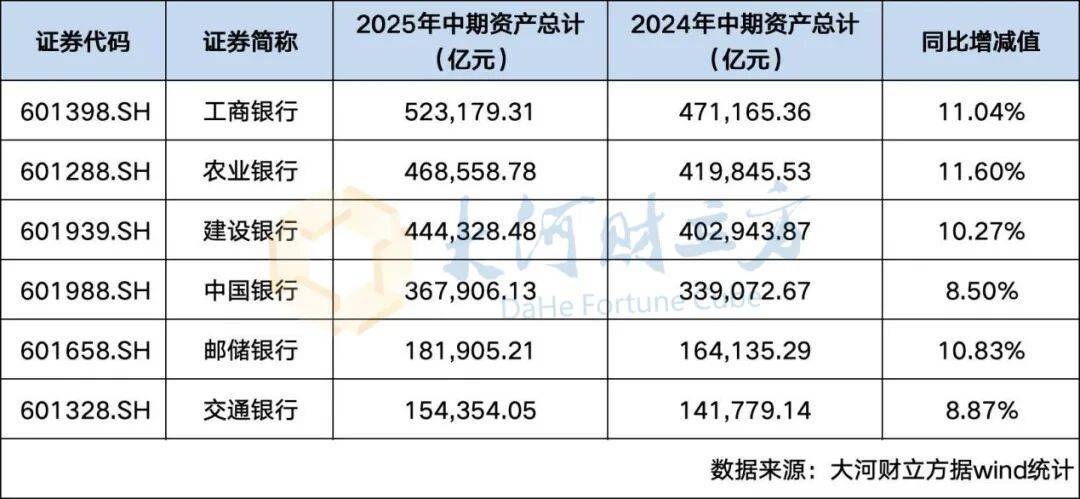
Core Insights - The six major state-owned banks in China reported steady improvement in asset quality and strong profitability in the first half of the year, with a total asset scale reaching 214.02 trillion yuan, marking a significant year-on-year growth [1][4] - The banks announced a total cash dividend of over 204.6 billion yuan for the mid-2025 period, reflecting their robust financial performance [1][16] Asset Quality and Growth - All six banks achieved year-on-year growth in total assets, with Industrial and Commercial Bank of China (ICBC) surpassing 50 trillion yuan in total assets for the first time, while Agricultural Bank of China and China Construction Bank followed with 46.86 trillion yuan and 44.43 trillion yuan respectively [2][4] - The average non-performing loan (NPL) ratio for the six banks was 1.23%, which is 0.26 percentage points lower than the industry average, indicating a strong role in financial stability [5][6] Revenue and Profitability - The total operating income for the six banks reached 1.83 trillion yuan, with all banks reporting year-on-year growth in revenue, reversing the declining trend from the previous year [7][8] - The net profit attributable to shareholders for the six banks totaled 682.52 billion yuan, averaging 37.71 billion yuan per day, with ICBC, China Construction Bank, and Agricultural Bank of China each exceeding 100 billion yuan in net profit [9][10] Net Interest Margin - The net interest margin (NIM) continued to narrow across the banks, but the pace of decline has slowed, with expectations for stabilization in the second half of the year [11][14] - Postal Savings Bank had the highest NIM at 1.70%, despite experiencing the largest decline of 0.21 percentage points [12][15] Dividend Distribution - The dividend distribution plans for the six banks included significant payouts, with ICBC proposing a cash dividend of 503.96 billion yuan, followed by Agricultural Bank with 418.23 billion yuan [16]
260万银行人,半年平均薪酬“曝光”,5家月薪超4.5万
中国基金报· 2025-08-30 12:39
Core Viewpoint - The average salary of bank employees in China has slightly increased in the first half of 2025 compared to the same period in 2024, with a notable number of banks experiencing salary increases while others saw declines [2][4]. Salary Overview - The average salary for 2.6 million bank employees in the first half of 2025 is approximately 181,000 yuan, translating to an average monthly salary of 30,200 yuan, which is an increase of about 1,300 yuan from the previous year [5]. - The average salary for the first half of 2024 was lower, with a decrease of over 5,000 yuan compared to the first half of 2023 [4]. Leading Banks in Salary - Joint-stock banks and city commercial banks lead in average salary levels, with several banks reporting average monthly salaries exceeding 45,000 yuan in the first half of 2025 [3]. - Specific banks with high average monthly salaries include: - China Merchants Bank: 50,500 yuan - Nanjing Bank: 48,200 yuan - Ningbo Bank: 45,400 yuan - Industrial Bank: 45,400 yuan - Beijing Bank: 45,200 yuan [5][6]. State-Owned Banks Salary Comparison - Among the six major state-owned banks, the average monthly salaries are significantly lower, with: - Bank of China: 28,200 yuan - Bank of Communications: 27,500 yuan - Industrial and Commercial Bank of China: 26,300 yuan - China Construction Bank: 26,200 yuan - Agricultural Bank of China: 25,200 yuan - Postal Savings Bank: 24,900 yuan [7][8]. Salary Policy Trends - Major state-owned banks are focusing on salary policies that favor grassroots employees, aiming to enhance talent development in county-level branches and improve employee engagement [10][11].



国有大行“期中考”答卷: 扩规模、稳息差、向中间收入要效益
经济观察报· 2025-08-30 12:17
Core Viewpoint - The six major state-owned banks in China reported growth in asset scale but showed a divergence in operational indicators, with three banks experiencing a decline in net profit [2][7]. Group 1: Asset Scale Growth - All six major state-owned banks demonstrated growth in asset scale, with specific figures indicating significant increases: - Industrial and Commercial Bank of China (ICBC) reached total assets of 52.32 trillion yuan, up 7.2% from the previous year [5]. - Agricultural Bank of China (ABC) reported total assets of 46.86 trillion yuan, an increase of 8.37% [5]. - China Construction Bank (CCB) had total assets of 44.43 trillion yuan, growing by 9.52% [5]. - Bank of China (BOC) reached total assets of 36.79 trillion yuan, up 4.93% [6]. - Postal Savings Bank of China (PSBC) reported total assets of 18.19 trillion yuan, increasing by 6.47% [6]. - Bank of Communications (BoCom) had total assets of 15.44 trillion yuan, a growth of 3.59% [6]. Group 2: Operational Performance Divergence - The operational performance of the six banks varied, with ABC, BoCom, and PSBC achieving positive growth in both operating income and net profit: - ABC's operating income was 3699.37 billion yuan, up 0.85%, with a net profit of 1399.43 billion yuan, growing by 2.53% [9]. - BoCom's operating income reached 1333.68 billion yuan, increasing by 0.77%, and net profit was 460.16 billion yuan, up 1.61% [10]. - PSBC reported operating income of 1794.46 billion yuan, a 1.50% increase, and net profit of 494.15 billion yuan, growing by 1.08% [11]. - In contrast, ICBC, BOC, and CCB saw declines in net profit despite positive growth in operating income: - ICBC's operating income was 4270.92 billion yuan, up 1.6%, but net profit fell by 1.5% to 1688.03 billion yuan [12]. - CCB reported operating income of 3942.73 billion yuan, a 2.15% increase, while net profit decreased by 1.45% to 1626.38 billion yuan [12]. - BOC's operating income was 3290.03 billion yuan, up 3.76%, but net profit declined by 0.31% to 1261.38 billion yuan [12]. Group 3: Net Interest Margin Pressure - The net interest margin (NIM) for the major banks remained under pressure, with specific figures indicating declines: - ICBC's NIM was 1.30%, down 13 basis points year-on-year [15]. - CCB's NIM was 1.40%, down 14 basis points [15]. - ABC's NIM was 1.32%, down 13 basis points [15]. - BOC's NIM was 1.26%, down 18 basis points [15]. - PSBC's NIM was 1.70%, down 21 basis points [15]. - BoCom's NIM was 1.21%, down 8 basis points [15]. Group 4: Non-Interest Income Growth - In response to the pressure on interest income, several banks have shifted focus to non-interest income: - BOC's non-interest income accounted for over one-third of its operating income, with a growth of over 70% in non-interest income from overseas institutions [19]. - BOC's non-interest income was 1141.87 billion yuan, up 26.43%, increasing its share of operating income from 28.48% to 34.71% [20]. - ICBC's non-interest income was 1135.16 billion yuan, growing by 6.5%, with its share of operating income rising from 25.34% to 26.58% [21]. - ABC's non-interest income totaled 874.64 billion yuan, up 15.1%, increasing its share from 20.71% to 23.64% [22]. - CCB's non-interest income was 1075.64 billion yuan, a 19.64% increase, raising its share to 27.28% [22]. - PSBC's non-interest income reached 403.88 billion yuan, growing by 19.09%, with its share increasing from 19.18% to 22.51% [23].

国有六大行上半年净利润合计6825亿元,资产质量稳中向好
Guan Cha Zhe Wang· 2025-08-30 11:41
Core Viewpoint - The six major state-owned banks in China reported a total net profit of 682.52 billion yuan for the first half of 2025, with asset quality showing improvement and a decrease in non-performing loan ratios for five banks compared to the end of 2024 [1][5]. Financial Performance - Industrial and Commercial Bank of China (ICBC) led with a net profit of 168.10 billion yuan, a year-on-year decrease of 1.4% [2][3]. - China Construction Bank (CCB) followed with a net profit of 162.08 billion yuan, down 1.37% year-on-year [2][3]. - Agricultural Bank of China (ABC) achieved a net profit of 139.51 billion yuan, marking a 2.70% increase, the highest growth among the six banks [2][3]. - Bank of China (BOC) reported a net profit of 117.59 billion yuan, down 0.85% year-on-year [2][3]. - Postal Savings Bank of China (PSBC) and Bank of Communications (BoCom) recorded net profits of 49.23 billion yuan and 46.02 billion yuan, with increases of 0.85% and 1.61% respectively [2][3]. Revenue and Asset Growth - ICBC also led in revenue with 427.09 billion yuan, a 1.6% year-on-year increase [2][3]. - CCB's revenue was 394.27 billion yuan, up 2.15% year-on-year [2][3]. - ABC's revenue slightly increased by 0.8% to 369.94 billion yuan [2][3]. - BOC's revenue reached 329.00 billion yuan, a 3.76% increase [2][3]. - The asset scale of ICBC grew by 7.20% to 52.32 trillion yuan, maintaining its top position [4]. Non-Interest Income and Net Interest Margin - The banks faced a common challenge of narrowing net interest margins, with CCB's net interest income decreasing by 3.16% [4]. - To counteract margin pressure, banks increased non-interest income through fees and commissions, with ICBC's non-interest income growing by 6.5% [4]. Asset Quality - The overall asset quality of the six banks showed improvement, with five banks reporting a decrease in non-performing loan ratios compared to the end of 2024 [5]. - Agricultural Bank and PSBC had high provision coverage ratios of 295.00% and 260.35% respectively, indicating strong risk resistance capabilities [5]. Dividend Plans - All six banks plan to implement mid-term cash dividends, with a total payout exceeding 200 billion yuan [6]. Strategic Focus - The banks are focusing on five key areas: technology finance, green finance, inclusive finance, pension finance, and digital finance, enhancing their service to the real economy [7][10]. - ICBC's technology loan balance exceeded 6 trillion yuan, with significant growth in green and inclusive loans [7][8].