BANK COMM(601328)

Search documents
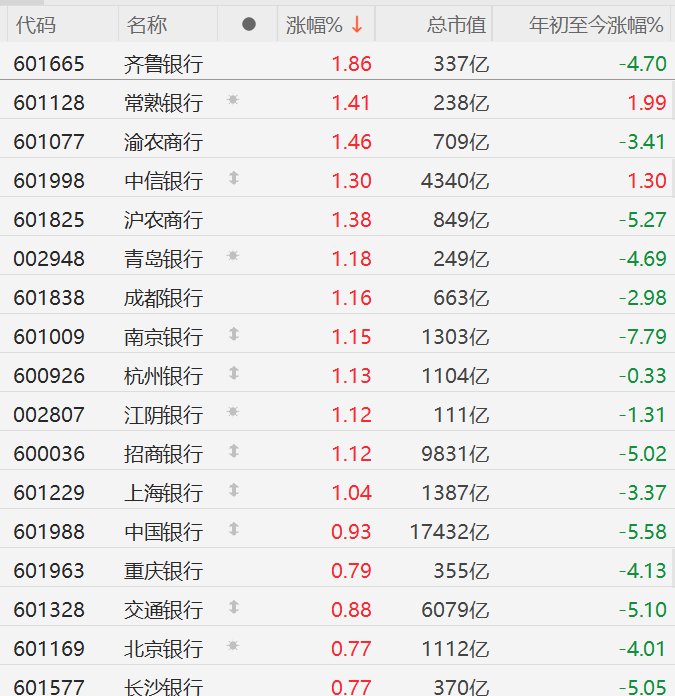
银行股逆势普涨,齐鲁银行涨近2%
Ge Long Hui· 2026-01-20 03:06
Group 1 - The A-share market saw a significant increase in bank stocks, with Qilu Bank rising nearly 2% and several other banks, including Changshu Bank and Chongqing Rural Commercial Bank, increasing by over 1% [1] - The total market capitalization of Qilu Bank is 33.7 billion, while Changshu Bank has a market cap of 23.8 billion [2] - Year-to-date performance shows that Qilu Bank has decreased by 4.70%, while Changshu Bank has increased by 1.99% [2] Group 2 - Other banks that experienced gains include Yunnan Rural Commercial Bank (1.46%), CITIC Bank (1.30%), and Shanghai Bank (1.04%) [2] - The total market capitalization of CITIC Bank is 434 billion, and it has a year-to-date performance of 1.30% [2] - Despite the gains, many banks still show negative year-to-date performance, such as Shanghai Bank (-3.37%) and China Bank (-5.58%) [2]



金融赋能助推养老产业发展
Jin Rong Shi Bao· 2026-01-20 02:12
Core Insights - The high-quality development of pension finance has become a focal point due to the aging population trend, with Luoyang's population aged 60 and above reaching 1.471 million and an aging rate of 20.8% by the end of 2024 [1] Group 1: Policy Guidance - The People's Bank of China Luoyang Branch is actively formulating guiding opinions for the development of pension finance, enhancing communication with local government and financial institutions to improve policy awareness and coverage [2] - A project library of 30 key quality projects in the pension service sector has been established, facilitating targeted support from banks to eligible enterprises [2] Group 2: Financial Product Innovation - The first "pension loan" of 760,000 yuan was issued to a healthcare service company, showcasing the innovation in pension finance products and providing a model for the province [3] - Financial institutions are encouraged to develop a comprehensive financial product system tailored to the needs of pension enterprises, ensuring timely and effective funding [3] Group 3: Warm Financial Services - Financial institutions are creating a warm pension finance service system, including the establishment of demonstration outlets and various convenient services for the elderly [5] - Over 100 bank outlets have completed renovations to cater to the elderly, enhancing their service experience [6] Group 4: Overall Progress - Significant progress has been made in building the pension finance service system in Luoyang, with various banks conducting over 200 promotional activities benefiting more than 100,000 people [6]



村镇银行重组提速 “村改支”密集落地
Zhong Guo Zheng Quan Bao· 2026-01-19 21:25
Core Viewpoint - The reform of rural banks is accelerating in 2026, with a focus on improving the quality of rural financial supply rather than merely reducing the number of institutions [1][4]. Group 1: Mergers and Acquisitions - SuNong Bank announced the absorption and merger of Jiangsu Zhangjiagang Yunnong Commercial Rural Bank, planning to acquire 100% of its shares and convert it into a branch [2]. - The acquisition of Zhejiang Anji Jiaoyin Rural Bank by Bank of Communications has been approved, with plans to establish multiple branches [2]. - Since the beginning of 2026, 53 rural banks have been listed for exit, indicating a trend of consolidation in the sector [3]. Group 2: Policy and Industry Demand - The acceleration of rural bank reforms is driven by both policy guidance and the inherent needs of the industry [3]. - The 2020 notice from the former CBIRC encouraged the orderly merger and restructuring of rural banks, allowing larger banks to absorb high-risk rural banks [3]. - The 2025 Central Document No. 1 emphasized the need for innovative financing mechanisms for rural revitalization and the importance of small banks in supporting agriculture and small enterprises [3]. Group 3: Quality Improvement - The primary goal of rural bank reform is to enhance the quality of financial services provided to agriculture and rural economies [4]. - Mergers and restructuring are seen as effective methods to resolve operational risks and improve competitiveness through resource integration [4]. - Experts suggest that the focus should be on quality improvement rather than just reducing the number of institutions, aiming for more efficient and higher-quality development [4]. Group 4: Challenges in Restructuring - The process of mergers and restructuring involves complex stakeholder interests and requires careful balancing of various demands [5]. - Some rural banks face challenges with historical non-performing assets, complicating the restructuring process [5]. - Recommendations include developing reasonable disposal plans for shareholder rights and creating specialized plans for addressing non-performing assets [5].
村镇银行重组提速“村改支”密集落地
Zhong Guo Zheng Quan Bao· 2026-01-19 21:11
Core Viewpoint - The reform of rural banks is accelerating in 2026, with a focus on improving the quality of rural financial supply rather than merely reducing the number of institutions [1][2][3] Group 1: Mergers and Acquisitions - SuNong Bank has announced the absorption and merger of Jiangsu Zhangjiagang Yunnong Commercial Rural Bank, planning to acquire 100% of its shares and convert it into a branch [1] - The acquisition of Zhejiang Anji Jiaoyin Rural Bank by Bank of Communications has been approved, allowing the establishment of multiple branches [2] - Since the beginning of 2026, 53 rural banks have been listed for exit, indicating a trend of consolidation in the sector [3] Group 2: Policy and Industry Demand - The acceleration of rural bank reform is driven by both policy guidance and the inherent needs of the industry [2] - The 2020 notice from the former CBIRC encourages the orderly merger and restructuring of rural banks, allowing larger banks to convert high-risk rural banks into branches [2] - The 2025 Central Document No. 1 emphasizes the need for innovative financing mechanisms for rural revitalization and supports the reform of rural credit cooperatives [2] Group 3: Quality Improvement in Rural Financial Supply - The primary goal of rural bank reform is to enhance the quality of financial services for agriculture, rural areas, and small enterprises [3] - Mergers and restructuring are seen as essential for resolving operational risks and integrating resources, leading to improved competitiveness [3] - Experts suggest that addressing shareholder rights and managing historical bad assets are critical for successful restructuring [3]
8.04亿元主力资金今日撤离银行板块
Zheng Quan Shi Bao Wang· 2026-01-19 09:34
Market Overview - The Shanghai Composite Index rose by 0.29% on January 19, with 23 out of the 28 sectors experiencing gains. The top-performing sectors were basic chemicals and petroleum & petrochemicals, with increases of 2.70% and 2.08% respectively. Conversely, the computer and communication sectors saw declines of 1.55% and 0.96% respectively [1] - The net outflow of capital from the two markets was 35.714 billion yuan, with 13 sectors experiencing net inflows. The power equipment sector led with a net inflow of 7.597 billion yuan and a daily increase of 1.84%, followed by the basic chemicals sector with a net inflow of 1.331 billion yuan [1] Banking Sector Performance - The banking sector declined by 0.60% with a net outflow of 804 million yuan. Among the 42 stocks in this sector, 7 stocks increased while 28 stocks decreased. Notably, 15 stocks had net inflows, with the highest being Shanghai Pudong Development Bank, which saw a net inflow of 133 million yuan [2] - Major banks with significant net outflows included China Merchants Bank, Agricultural Bank of China, and Chengdu Bank, with outflows of 384 million yuan, 312 million yuan, and 146 million yuan respectively [2] Capital Flow in Banking Stocks - The top banking stocks by capital flow included: - Shanghai Pudong Development Bank: +0.72%, net inflow of 1.334 billion yuan - Industrial Bank: +0.00%, net inflow of 1.082 billion yuan - China Communications Bank: -0.73%, net inflow of 1.046 billion yuan - China Merchants Bank: -0.44%, net outflow of 384 million yuan - Agricultural Bank of China: -1.53%, net outflow of 312 million yuan [3]



固定收益专题报告:绿色债券浅析
BOHAI SECURITIES· 2026-01-19 09:26
Report Industry Investment Rating The provided content does not mention the report industry investment rating. Core Viewpoints - Green bonds are securities raised for green industries, projects, or economic activities, and have become an important financing tool. As of the end of 2025, the cumulative issuance scale in China reached 5.32 trillion yuan [2]. - The development of China's green bond market can be divided into three stages: the exploration and launch stage (2015), the standardization development stage (2016 - 2020), and the system improvement stage (2021 - present) [2][16]. - By the end of 2025, the annual issuance scale increased from 207.231 billion yuan in 2016 to 1.079283 trillion yuan, and the number of issuances rose from 89 to 834. The stock of green bonds was 2,014, with a market size of 2.464521 trillion yuan. Green bonds are suitable for long - term investment [3][109]. - Green bonds generally have a "green spread" over non - green bonds, which has weakened in the past three years but still supports pricing. They are more suitable as a stable portfolio base rather than a source of significant excess returns [4]. Summary by Directory 1. Green Bond Development 1.1 Green Bond Concept - Green bonds are securities that raise funds for green industries, projects, or economic activities. They are divided into four types according to the "China Green Bond Principles (2022)" and play an important role in global green finance [13]. 1.2 Policy Context - China's green bond market has established a relatively complete system. The development is divided into three stages: - Exploration and launch stage (2015): The People's Bank of China and the National Development and Reform Commission issued relevant documents, marking the official start of the green bond market [16][17]. - Standardization development stage (2016 - 2020): Multiple departments issued a series of policies to improve the regulatory mechanism, project catalog, and evaluation and certification mechanism [16][18]. - System improvement stage (2021 - present): Policies continued to be refined, the standard system was integrated with international standards, and cross - border green financing advanced steadily [16][25]. 2. Green Bond Value 2.1 Value to Issuers - Green bonds generally have a lower issuance interest rate than non - green bonds, showing a "green spread," which has weakened in the past three years. They can also access overseas ESG funds [34]. 2.2 Value to Investors - Green bonds are fixed - income tools. Their credit risk is mainly determined by the issuer's quality and credit enhancement. They are suitable as a stable portfolio base and can meet institutional ESG and sustainable investment goals. Their tradability has also improved [46]. 3. Green Bond Issuance Statistics 3.1 Green Asset - Backed Securities - Their issuance rhythm has different stages. From 2016 - 2018, it was in the start - up phase; 2019 - 2020 saw market expansion; 2021 entered the accelerated development stage; 2022 - 2023 maintained a high - level operation; 2024 - 2025 had a decline in scale. They are mainly short - term and ultra - long - term products, with concentrated underlying assets [48][49]. 3.2 Non - Asset - Backed Green Bonds - The issuance showed phased characteristics. It expanded steadily from 2016 - 2020, jumped significantly in 2021, reached a high in 2022, declined in 2023, and significantly increased in 2025. State - owned enterprises are the main issuers, and bank - to - bank market is the main trading platform. Their issuance interest rate has been declining, and the term is mainly medium - short term [59][61][71]. 4. Green Bond Stock and Transaction Analysis 4.1 Green Bond Stock Analysis - As of the end of 2025, the stock of green bonds was 2,014, with a market size of 2.464521 trillion yuan. Financial bonds accounted for nearly half of the stock, followed by medium - term notes and asset - backed securities. The stock was concentrated in short - and medium - term bonds, a few industries, and regions such as Beijing, Shanghai, and Guangdong [83][90][95]. 4.2 Green Bond Transaction Analysis - The secondary - market trading volume of green bonds has been rising with fluctuations, and the turnover rate has shown a trend of "falling from a high level, fluctuating in the central range, and weakening again in recent years." Compared with credit bonds and financial bonds, the turnover rate of green bonds is relatively low, but it has stable trading and periodic surges. The valuation of green bonds shows a clear stratification [100][101][105]. 5. Investment Viewpoint - Similar to the core viewpoints, green bonds have good development prospects, supply - side expansion, and are suitable for long - term investment and portfolio optimization [108][109][110].


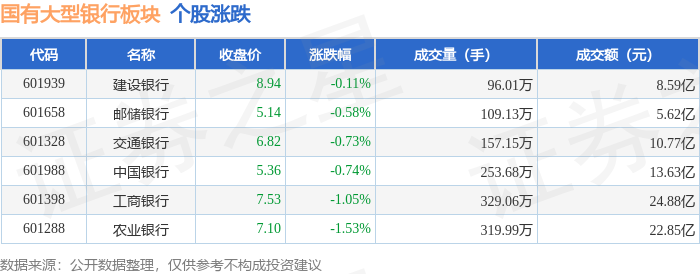
国有大型银行板块1月19日跌1.12%,农业银行领跌,主力资金净流出4.07亿元
Zheng Xing Xing Ye Ri Bao· 2026-01-19 08:58
Group 1 - The core viewpoint of the news is that the state-owned large bank sector experienced a decline of 1.12% on January 19, with Agricultural Bank leading the drop [1] - The Shanghai Composite Index closed at 4114.0, up 0.29%, while the Shenzhen Component Index closed at 14294.05, up 0.09% [1] - The trading performance of individual stocks in the state-owned large bank sector showed varied results, with Agricultural Bank down 1.53% and Industrial and Commercial Bank down 1.05% [1] Group 2 - The net outflow of main funds from the state-owned large bank sector was 407 million yuan, while retail investors saw a net inflow of 539 million yuan [1] - The detailed fund flow data indicates that the Agricultural Bank had a significant net outflow of 35.37 million yuan from main funds, but a net inflow of 73.72 million yuan from retail investors [2] - The overall trend shows that while main and speculative funds are withdrawing, retail investors are increasing their positions in certain banks [2]


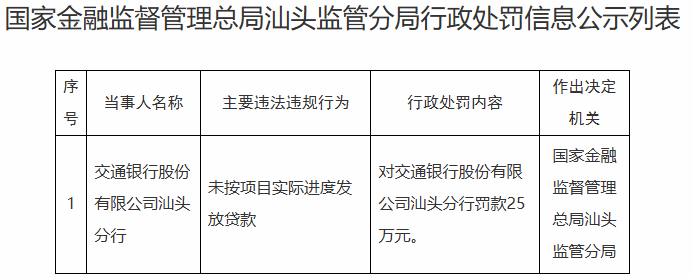
交通银行汕头分行违规被罚 未按项目实际进度发放贷款
Zhong Guo Jing Ji Wang· 2026-01-19 07:29
Group 1 - The core viewpoint of the article highlights that the Shantou branch of Bank of Communications was fined for not disbursing loans according to the actual project progress [1] - The fine imposed on the Shantou branch amounts to 250,000 yuan [1]
今年仅半月减少超70家银行 “减量提质”持续推进
Xin Jing Bao· 2026-01-19 06:20
Core Viewpoint - The banking industry is undergoing a significant structural adjustment, with many rural banks being acquired and transformed into branches of larger state-owned banks, reflecting a trend towards consolidation and quality improvement in the financial sector [1][2][5]. Group 1: Bank Acquisitions - Several rural banks are being acquired by major state-owned banks, such as Chang'an Bank acquiring Shaanxi Taibai Changyin Rural Bank and Bank of Communications acquiring Zhejiang Anji Jiaoyin Rural Bank [1][3]. - In just the first half of this year, over 70 banks are set to be integrated, a stark increase from only 8 during the same period last year [1]. - The acquisitions are part of a broader strategy to enhance the quality of financial institutions by eliminating weaker competitors and optimizing regional financial supply [1][5]. Group 2: Structural Reforms - The central economic work conference has emphasized the need to "deeply promote the reduction and quality improvement of small and medium-sized financial institutions," indicating a shift towards a more efficient banking structure [11]. - The consolidation of smaller banks into larger entities is seen as a necessary step to mitigate regional financial risks and improve the management and operational standards of these institutions [5][11]. - The approach of merging smaller banks into larger ones is being recognized as a new model for enhancing the quality of financial services in rural areas [5]. Group 3: Governance and Quality Improvement - The focus on "reduction" is aimed at achieving "rebirth," with the ultimate goal being quality enhancement rather than merely reducing the number of institutions [10][11]. - The ongoing reforms are expected to lead to a decrease in the number of high-risk institutions, thereby laying a foundation for deeper reforms and risk management [11]. - The success of these reforms hinges on improving governance and ensuring that financial institutions can effectively meet the diverse financial needs of the real economy [11][12]. Group 4: Customer Impact - Bank customers' deposits will remain unaffected during the transition, as the assets and liabilities are typically assumed by the acquiring bank or newly established institution [12]. - The consolidation is expected to enhance the overall competitiveness of banks, thereby providing greater security for customer deposits [12].
银行资负跟踪20260119:降准降息还有空间
GF SECURITIES· 2026-01-19 04:26
Investment Rating - The industry investment rating is "Buy" [3] Core Viewpoints - The report indicates that there is still room for further cuts in reserve requirement ratios and interest rates, with a focus on structural monetary policy support for high-quality economic development [15][19] - The central bank has implemented a reduction of 0.25 percentage points in various structural monetary policy tool rates, signaling a supportive monetary policy stance [15][19] - The report emphasizes the importance of timing for future policy implementations, particularly in relation to government bond issuance peaks and the maturity schedule of high-interest bank deposits [15] Summary by Sections 1. Monetary Policy Adjustments - The report notes a reduction of 0.25 percentage points in structural monetary policy tool rates, with a focus on supporting key areas through increased re-lending [15] - Future attention is directed towards December economic data and January LPR [22] 2. Central Bank Dynamics and Market Rates - The central bank conducted a total of 9,515 billion yuan in 7-day reverse repos at an interest rate of 1.40%, with a net injection of 9,741 billion yuan [16] - The report highlights that the funding rates remained stable, with expectations of slight increases due to tax payments and government bond net repayments [16] 3. Bank Financing Tracking - The report indicates that the total outstanding amount of interbank certificates of deposit (CDs) is 19.09 trillion yuan, with an average issuance rate of 1.65% [20] - The report also notes that there were no commercial bank bond issuances during the period, with a total outstanding commercial bank bond size of 3.38 trillion yuan [20]