BANK COMM(601328)

Search documents
多家国有银行发布公告,数字人民币余额按0.05%付息
Xin Lang Cai Jing· 2026-01-01 06:24
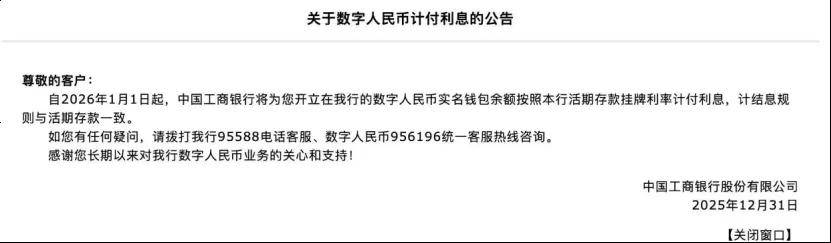
Core Viewpoint - The People's Bank of China (PBOC) announces the transition of digital RMB from the "digital cash era" to the "digital deposit currency era" after ten years of research and pilot programs [1] Group 1: Digital RMB Development - The PBOC's new action plan will officially implement on January 1, 2026, introducing a new measurement framework, management system, operational mechanism, and ecosystem for digital RMB [1] - Major banks including Industrial and Commercial Bank of China, Agricultural Bank of China, China Construction Bank, Bank of Communications, and Postal Savings Bank will start paying interest on digital RMB wallet balances at the same rate as current deposit rates from January 1, 2026 [1] Group 2: Interest Mechanism - The introduction of an interest mechanism for digital RMB wallet balances is a significant highlight of the new action plan, aligning it with traditional savings accounts [1]






六大国有银行,集体宣布
Sou Hu Cai Jing· 2026-01-01 05:16
Core Viewpoint - Starting from January 1, 2026, the six major state-owned banks in China will begin to pay interest on the balances in customers' real-name digital RMB wallets at the same rate as current deposit rates, which is currently set at 0.05% [1][2]. Group 1: Digital RMB Overview - Digital RMB is a legal digital currency issued by the People's Bank of China, applicable in various scenarios such as transportation, dining, shopping, and bill payments [3]. - The pilot program for digital RMB has expanded from select cities to provincial levels, including major municipalities and several provinces [3]. Group 2: Implementation Details - The People's Bank of China has released an action plan to enhance the management and service system for digital RMB, effective from January 1, 2026, which includes interest payments on wallet balances [3]. - Digital RMB will be included in the deposit insurance scheme, providing the same security guarantees as traditional deposits [3]. Group 3: Wallet Classification - Digital RMB wallets are classified into four categories based on the level of real-name verification, with categories one to three requiring more stringent identity verification than category four [4]. - The balance limits for different wallet categories are as follows: category one has no limit, category two is capped at 500,000 yuan, category three at 20,000 yuan, and category four at 10,000 yuan [4][5]. Group 4: Banking Institutions - Currently, ten commercial banks are authorized to open digital RMB wallets, including the six major state-owned banks and four other banks [6].


六大国有银行公告:数字人民币实名钱包余额明起计付利息
Sou Hu Cai Jing· 2026-01-01 04:42
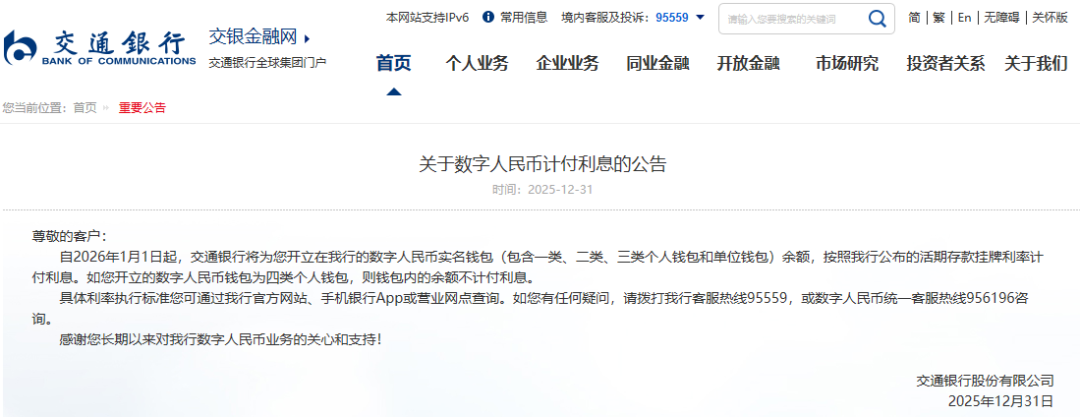
Core Viewpoint - Starting January 1, 2026, several major banks in China, including Industrial and Commercial Bank of China, Agricultural Bank of China, Bank of China, China Construction Bank, Bank of Communications, and Postal Savings Bank, will offer interest on the balances of digital RMB real-name wallets at the same rate as current deposit rates [1] Group 1 - The interest calculation rules for digital RMB wallets will align with those of current deposits [1] - China Construction Bank's announcement specifies that four types of wallets are excluded from this interest policy [1] - Bank of Communications states that if a customer opens a type four personal digital RMB wallet, the balance will not earn interest [1]
多家国有大行,集体公告
Sou Hu Cai Jing· 2026-01-01 03:32
Core Viewpoint - Digital Renminbi will start accruing interest from January 1, 2026, as major banks in China announce plans to pay interest on the balances of digital Renminbi wallets at the same rates as regular savings accounts [1] Group 1: Bank Announcements - Industrial and Commercial Bank of China, Agricultural Bank of China, and China Construction Bank will begin paying interest on digital Renminbi wallet balances according to the current savings deposit rates starting January 1, 2026 [1] - Bank of Communications will also pay interest on digital Renminbi wallet balances, including various types of personal and corporate wallets, based on its announced savings deposit rates, while balances in certain wallet types will not earn interest [1] Group 2: Regulatory Framework - The People's Bank of China has introduced an action plan to enhance the management and service system for digital Renminbi, which will officially launch on January 1, 2026 [1] - The action plan specifies that banks must comply with self-discipline agreements regarding deposit interest rate pricing for customer digital Renminbi wallet balances [1]
银行“抢滩”年终奖 跨年理财高收益获投资者青睐
2 1 Shi Ji Jing Ji Bao Dao· 2026-01-01 03:18
Core Insights - The article discusses the increasing demand for wealth management products as year-end bonuses are being distributed, highlighting a competitive marketing environment among banks to attract customers [1][2][4] Group 1: Bank Marketing Strategies - Banks are launching exclusive wealth management activities and products to capture the influx of year-end bonuses, with a focus on flexible redemption and low entry thresholds [2][8] - For example, Bank of Communications has introduced a series of wealth management products with an annualized return of 4.68%, allowing daily purchases and redemptions starting from 1 yuan [2][8] - Industrial and Commercial Bank of China is promoting three wealth management products, with one offering a near-month annualized return of 3.09% and a minimum investment of 1 yuan [2][8] Group 2: Product Design Trends - Mid to low-risk products are becoming mainstream for year-end bonus investments, balancing risk control with potential returns to meet the demand for stable investments [3][9] - The trend of lowering investment thresholds, such as allowing purchases from 1 yuan, is expanding the customer base to include ordinary investors with small amounts of idle funds [3][9] - Traditional deposit products are also being enhanced, with Tianjin Bank offering a three-year deposit with a higher annual interest rate of 1.85%, appealing to conservative investors [3][9] Group 3: Investor Preferences - Investors are showing a preference for stable wealth management options, with many prioritizing safety over high returns when managing their year-end bonuses [4][10] - A common strategy among investors is to allocate funds based on purpose, with approximately 10% for emergency cash, 30-40% for liquidity, and over 50% for medium to long-term investments [5][11] - The trend towards "cross-year wealth management" is noted, where investors seek flexible products that do not interfere with holiday spending while still providing higher returns than regular products [6][12]
2025年度A股股权承销排行榜
Wind万得· 2025-12-31 22:50
Core Viewpoint - In 2025, the A-share equity financing market experienced a significant rebound, with a total of 315 fundraising events, raising over 1 trillion yuan, marking a year-on-year increase of 226.10% [2][4]. Group 1: Financing Overview - The total amount raised through equity financing in 2025 reached 10,222.68 billion yuan, an increase of 226.10% compared to the previous year [4]. - The IPO market saw 112 issuances, raising 1,308.35 billion yuan, a year-on-year increase of 97.40% [4][22]. - The private placement market expanded significantly with 157 issuances, raising 8,267.20 billion yuan, a growth of 300.05% [4][40]. Group 2: Financing Method Distribution - In 2025, the distribution of financing methods showed that IPOs accounted for 12.80% of the total amount raised, while private placements dominated with 80.87% [8][11]. - Convertible bonds represented 6.33% of the total financing, with 46 issuances raising 647.13 billion yuan [8][11]. Group 3: Industry Distribution of Financing Entities - The banking sector led the fundraising efforts with 5,200 billion yuan, followed by the semiconductor industry with 714.53 billion yuan, and the public utilities sector with 555.05 billion yuan [13][48]. Group 4: Regional Distribution of Financing - Beijing ranked first in fundraising with 4,451.82 billion yuan from 24 projects, followed by Shanghai with 1,875.94 billion yuan from 34 projects, and Guangdong with 964.76 billion yuan from 49 projects [16][19]. Group 5: IPO Trends - The quarterly breakdown of IPOs showed a significant recovery in the third and fourth quarters, with total issuances of 27, 21, 28, and 36 respectively [22]. - The main boards and the innovation board contributed significantly to the total fundraising, with the innovation board raising 378.45 billion yuan, accounting for 28.93% of the total [25]. Group 6: Underwriting Rankings - CITIC Securities topped the underwriting rankings with a total amount of 2,416.68 billion yuan, followed by Guotai Junan with 1,506.59 billion yuan, and CICC with 1,374.87 billion yuan [60][61]. - In terms of the number of underwriting projects, CITIC Securities also led with 61 projects, while Guotai Junan followed with 47 projects [64].



银行业十五五展望系列专题(上篇):回眸十四五,监管引导和主动求变下的银行经营理念重构
Shenwan Hongyuan Securities· 2025-12-31 14:14
Investment Rating - The report indicates a positive outlook for the banking industry, suggesting a return to a price-to-book (PB) ratio of 1x during the "15th Five-Year Plan" period, focusing on stable profitability and high-quality development [3][4]. Core Insights - The banking sector is transitioning from a focus on scale to quality, with an emphasis on risk management and structural optimization. The "15th Five-Year Plan" includes the goal of building a strong financial nation, highlighting the importance of high-quality development [3][16]. - The report identifies key changes in the banking industry during the "14th Five-Year Plan," including a shift in credit structure, a focus on profitability, and the need for banks to balance risk and efficiency [2][4]. - Regulatory support is expected to stabilize net interest margins, which have reached record lows, with a projected recovery in the coming years [5][19]. Summary by Sections 1. From Quantity to Quality - The banking industry has evolved through three five-year plans, with a shift from rapid expansion to a focus on quality and risk management. The current phase emphasizes high-quality development and financial support for key sectors [2][10]. 2. Developments During the "14th Five-Year Plan" 2.1 ROE: Resilience of State-Owned Banks and Advantages of City Commercial Banks - The return on equity (ROE) for listed banks has remained around 10%, with city commercial banks showing a slight advantage due to higher leverage and better provisioning [19][20]. 2.2 Credit: Moving Away from Scale to Balance Capital and Efficiency - Banks are prioritizing structural transformation over sheer volume, focusing on supporting key sectors and optimizing credit distribution [4][12]. 2.3 Interest Margin: Recovery from Continuous Decline - The report anticipates a stabilization of net interest margins, which have been under pressure, with regulatory measures aimed at supporting banks [5][19]. 2.4 Risk: Provisioning to Support Stability - The banking sector is expected to manage risks more effectively, with a focus on maintaining adequate provisions to support profitability during challenging economic conditions [4][19]. 2.5 Financial Markets: An Alternative Revenue Stream - The report highlights the increasing importance of financial market activities as a means to smooth revenue amid declining interest income, with banks diversifying their investment strategies [4][19]. 3. Investment Analysis Opinion - The report suggests a dual strategy of focusing on leading banks and undervalued city commercial banks, anticipating a recovery in valuations for state-owned banks that have been lagging [3][4].
又一国有大行浙江省分行原行长落马
第一财经· 2025-12-31 13:18
Core Viewpoint - The article discusses the ongoing anti-corruption efforts within China's financial sector, highlighting the recent investigation of Cheng Jun, the president of Bank of China Zhejiang Branch, for serious violations of discipline and law, marking a significant trend in the scrutiny of high-ranking officials in state-owned banks [3][4]. Group 1: Investigations and Trends - Cheng Jun is the 211th central-level official investigated in 2025, a decrease from 257 in 2024, indicating a tightening of scrutiny on high-ranking officials [3]. - Cheng is the fifth former president of a state-owned bank's Zhejiang branch to be investigated in recent years, following several others who faced similar allegations of serious violations [4]. - In 2025, a total of 65 central management officials were investigated, surpassing the 58 from the previous year, while 722 provincial management officials were also scrutinized [5]. Group 2: Broader Anti-Corruption Efforts - The 20th Central Commission for Discipline Inspection's fourth plenary session emphasized the importance of deepening anti-corruption efforts in 2025, which is seen as a crucial year for the completion of the 14th Five-Year Plan [5]. - In 2024, disciplinary bodies across the country investigated 73 provincial-level and above officials, 4,348 bureau-level officials, 35,000 county-level officials, and 121,000 township-level officials, reflecting a comprehensive approach to tackling corruption [5].

【财闻联播】关于《股票上市规则》,深交所发布!首批国产四价HPV疫苗上市!
券商中国· 2025-12-31 12:29
Macro Dynamics - The Ministry of Commerce announced safeguard measures for imported beef, stating that an investigation was initiated on December 27, 2024, due to domestic industry requests. The measures include country-specific quotas and additional tariffs for three years, with annual quota increases to support the domestic industry [2] Financial Institutions - Major state-owned banks, including ICBC, ABC, CCB, BOC, and Postal Savings Bank, announced that starting January 1, 2026, interest will be paid on the balances of real-name digital RMB wallets at the same rate as current deposits. The announcement emphasizes the distinction between real-name and anonymous wallets, with specific interest rules applying only to real-name wallets [9] Market Data - The A-share market closed on December 31, 2025, with the Shanghai Composite Index rising 0.09% for a total annual increase of 18.41%, marking a ten-year high. The Shenzhen Component Index increased by 29.87% over the year, while the ChiNext Index saw a significant rise of 49.57% [11] - The Hong Kong stock market also reported strong performance, with the Hang Seng Index increasing by 27.77% for the year, the best annual performance since 2017. The Hang Seng Tech Index rose by 23.45%, marking its best annual performance since 2020 [12] Company Dynamics - The first domestically produced quadrivalent HPV vaccine has been launched, developed by China National Pharmaceutical Group. The vaccine covers four HPV types and has shown 100% efficacy in preventing certain precancerous lesions in clinical trials, providing a cost-effective option for women aged 18 to 45 [14] - Tianqi Materials announced an expected net profit increase of 127.31% to 230.63% for 2025, driven by rising demand in the new energy vehicle and energy storage markets, along with improved production efficiency [15] - Platinum Technology is under investigation by the China Securities Regulatory Commission for suspected violations of information disclosure laws, but the company stated that its operations remain normal [16] - Changan Ford announced a recall of 38,473 units of the Ford Focus due to compliance with regulations regarding defective automotive products [17]


六大行集体官宣,事关数字人民币
Zhong Guo Zheng Quan Bao· 2025-12-31 12:28
Core Viewpoint - The announcement by six major banks in China regarding interest payments on digital RMB wallet balances marks a significant transition from "digital cash (M0)" to "digital deposit currency," indicating a shift in the nature of liabilities from the central bank to commercial banks [1][2] Group 1: Announcement Details - Starting from January 1, 2026, the six major banks will pay interest on the balances of real-name digital RMB wallets at the rate of the current deposit interest rate [1] - The current deposit interest rate for the Bank of Communications is set at 0.05% [1] - Balances in type four personal wallets will not earn interest, and specific interest rate standards can be checked through the bank's official website, mobile banking app, or physical branches [1] Group 2: Implications and Effects - This move enhances user willingness to hold digital RMB, promoting its adoption and dissemination [2] - It incorporates banking institutions into the reserve requirement framework, improving monetary statistics and macroeconomic regulation [2] - Establishing this mechanism is a crucial step towards the maturity of digital RMB, maintaining a dual-layer operational structure while achieving functional upgrades [2]