BANK COMM(601328)

Search documents
数字人民币明日起余额可计息!六大国有行齐宣布利率
Sou Hu Cai Jing· 2025-12-31 10:00
Group 1 - The six major state-owned banks in China will start paying interest on the balances in customers' real-name digital RMB wallets at the same rate as current deposit rates, which is currently set at 0.05% [2][4] - Digital RMB, issued by the People's Bank of China, is a legal digital currency that can be used in various scenarios such as transportation, dining, shopping, and utility payments [4] - The pilot program for digital RMB has expanded from select cities to entire provinces, including major municipalities and several provinces like Guangdong, Jiangsu, and Zhejiang [4] Group 2 - The People's Bank of China has introduced an action plan to enhance the management and service system for digital RMB, effective from January 1, 2026, which includes interest payments on wallet balances and inclusion in deposit insurance [4] - Digital RMB wallets are categorized into four types based on the level of identity verification, with varying limits on account balances; the first three types are real-name wallets, while the fourth type is an anonymous wallet [5][6] - Currently, ten commercial banks are authorized to open digital RMB wallets, including the six major state-owned banks and four other banks [7]








工、农、建、交、邮储,国有大行集体官宣→
证券时报· 2025-12-31 09:57
数据显示,截至2025年11月末,数字人民币累计处理交易34.8亿笔,累计交易金额16.7万亿 元。通过数字人民币App开立个人钱包2.3亿个,数字人民币单位钱包已开立1884万个。多边 央行数字货币桥(mBridge)累计处理跨境支付业务4047笔,累计交易金额折合人民币3872 亿元,其中数字人民币在各币种交易额占比约95.3%。 中国邮政储蓄银行研究员娄飞鹏介绍,四类钱包是数字人民币个人非实名钱包,仅需手机号 验证开通,不绑定银行卡,属匿名性质,多用于小额匿名支付场景。实名钱包(一、二、三 类)则需不同程度身份核验。相关公告限定,凸显了对实名制与金融安全的强化要求。娄飞 鹏提示,对消费者而言,需要确定钱包类型,了解计息规则,注意钱包限额与资金安全。 据央视新闻此前报道,中国人民银行已经出台《关于进一步加强数字人民币管理服务体系和 相关金融基础设施建设的行动方案》(简称"《行动方案》"),新一代数字人民币计量框 架、管理体系、运行机制和生态体系将于2026年1月1日正式启动实施。 根据方案部署,从2026年1月1日起,数字人民币钱包余额将按照活期存款计付利息。这也意 味着,经过十年研发试点,数字人民币将从 ...
工、农、建、交、邮储,国有大行集体官宣→
新华网财经· 2025-12-31 09:57
Core Viewpoint - Starting from January 1, 2026, major Chinese banks including Industrial and Commercial Bank of China, Agricultural Bank of China, China Construction Bank, Bank of Communications, and Postal Savings Bank of China will pay interest on the balances of real-name digital RMB wallets at the same rate as current deposit rates, with interest calculation rules aligned with those of current deposits [2] Group 1: Digital RMB Wallets - The announcement specifies that interest will not be paid on balances in four types of personal non-real-name wallets, which are typically used for small anonymous payments and require only mobile phone verification for activation [2] - Real-name wallets (types one, two, and three) require varying degrees of identity verification, highlighting a strengthened emphasis on real-name systems and financial security [2] - Consumers are advised to understand the type of wallet they hold, the interest calculation rules, and the limits and security of their funds [2]

交通银行(601328)披露2025年中期股息派发方案,12月31日股价上涨0.14%
Sou Hu Cai Jing· 2025-12-31 09:54
Core Viewpoint - The recent announcement by Bank of Communications regarding its interim dividend reflects the company's financial health and commitment to returning value to shareholders [1] Group 1: Stock Performance - As of December 31, 2025, the stock price of Bank of Communications closed at 7.25 RMB, marking a 0.14% increase from the previous trading day [1] - The stock opened at 7.25 RMB, reached a high of 7.30 RMB, and a low of 7.23 RMB, with a trading volume of 6.21 billion RMB and a turnover rate of 0.33% [1] Group 2: Dividend Announcement - The company announced a proposed interim dividend of 1.563 RMB per share for the six months ending June 30, 2025, equivalent to 1.729253 HKD based on the exchange rate of 1 RMB to 1.106368 HKD [1] - Key dates include the shareholder approval date on December 12, 2025, the ex-dividend date on December 17, 2025, the record date on December 24, 2025, and the dividend payment date on January 28, 2026 [1] - The tax rate for Hong Kong Stock Connect investors is set at 20%, while the tax rate for non-resident enterprises and non-individual residents is 10% [1]
六大国有行官宣,2026年起数字人民币实名钱包按活期利率计息
第一财经· 2025-12-31 09:49
作者 | 第一财经 杜川 本文字数:913,阅读时长大约2分钟 2025.12. 31 这意味着,四类钱包不属于各家银行计息的"实名钱包"范畴。 对社会公众来说,自2026年1月1日起,数字人民币实名钱包的余额将享有利息收益。 12月31日,中国银行、工商银行、农业银行、建设银行、交通银行、邮储银行六家国有大行相继发 布公告称,2026年1月1日起,将为开立在该行的数字人民币实名钱包余额按照该行活期存款挂牌利 率计付利息,计结息规则与活期存款一致。 从几家大行官网来看,当前活期存款挂牌利率为0.05%。 从数字人民币钱包分类来看,目前数字人民币分为四类钱包。其中,一类、二类、三类钱包为实名钱 包,四类钱包为匿名钱包。 (注:我们会对线索进行核实。您的隐私将严格保密。) 推荐阅读 湖北一地官宣:生娃"奖房子" 例如,工商银行称,2026年1月1日起,数字人民币实名钱包(一类、二类、三类钱包)中的钱包余 额按照中国人民银行规定的活期存款结息规则计付利息,并由钱包运营机构依法代扣代缴利息税(如 有),钱包运营机构将为客户的钱包余额计付利息,按结息日我行挂牌活期利率计息,每季末月的 20日结息,21日入账。 工商银行 ...

大消息!工行、农行、中行、建行、交行、邮储,国有六大行集体宣布
中国基金报· 2025-12-31 08:42
Core Viewpoint - The six major state-owned banks in China announced that starting January 1, 2026, the balance in digital RMB wallets will earn interest based on the current deposit rate, marking the end of the "interest-free era" for digital RMB [2][5]. Group 1: Interest Payment Mechanism - The digital RMB wallets (including personal and corporate wallets) will earn interest according to the bank's published current deposit rates, while balances in certain wallet types (fourth category personal wallets) will not earn interest [5]. - Currently, the current deposit rate across these banks is set at 0.05% [6]. Group 2: Future Development and Regulatory Framework - The People's Bank of China (PBOC) has outlined a new action plan to enhance the management and service system for digital RMB, which will officially launch on January 1, 2026 [6][7]. - The future digital RMB will be a modern digital payment and circulation method, supported by the central bank and possessing characteristics of commercial bank liabilities, with functionalities including value measurement, value storage, and cross-border payments [7]. Group 3: Adoption and Usage Statistics - As of November 2025, digital RMB has processed 3.48 billion transactions, amounting to 16.7 trillion yuan, with 230 million personal wallets and 18.84 million corporate wallets opened [8]. - The mBridge initiative has processed 4,047 cross-border payment transactions, with a total transaction amount equivalent to 387.2 billion yuan, where digital RMB accounted for approximately 95.3% of the transaction volume [8].


大消息!工行、农行、中行、建行、交行、邮储,国有六大行集体宣布
Zhong Guo Ji Jin Bao· 2025-12-31 08:36
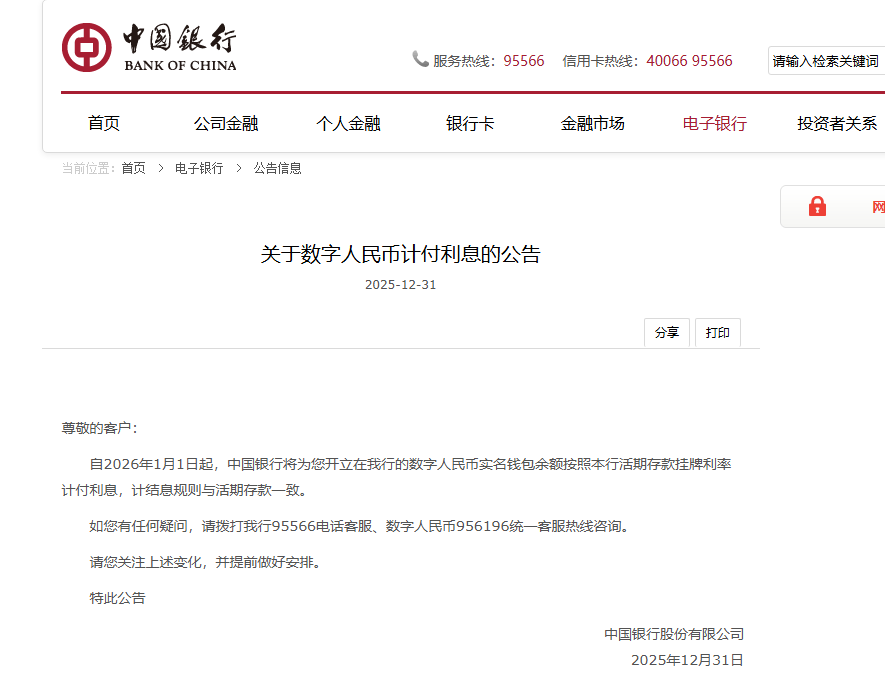
【导读】数字人民币告别"无息时代"!六家国有大行集体官宣并公布计息方式 同时,《行动方案》也明确提及,银行机构为客户实名数字人民币钱包余额计付利息,遵守存款利率定价自律约定。由此,银行可以对数字人民币钱包余 额自主开展资产负债经营管理,由存款保险依法提供与存款同等的安全保障。 | 父 直 张 行 | 交银金融网 ▶ | | 本网站支持IPv6 ● ♥ 常用信息 境内客服及投诉: 95559 ▼ | 油输入您要搜索的关键词 | ○ 简 繁 En 无障碍 关怀版 | | | --- | --- | --- | --- | --- | --- | --- | | 个人业务 企业务 同业金融 开放金融 市场研究 投资者关系 关于我们 | S 交通银行全球集团门户 | 前页 | | | | | | ▲ | | | | | | | | 您当前位置:首页 » 里要公告 | | | | | | | | 关于数字人民币计付利息的公告 | | | | | | | | 时间:2025-12-31 | | | | | | | | 尊敬的客户: | | | | | | | | 自2026年1月1日起,交通银行将为您开立在我行的数字人民 ...
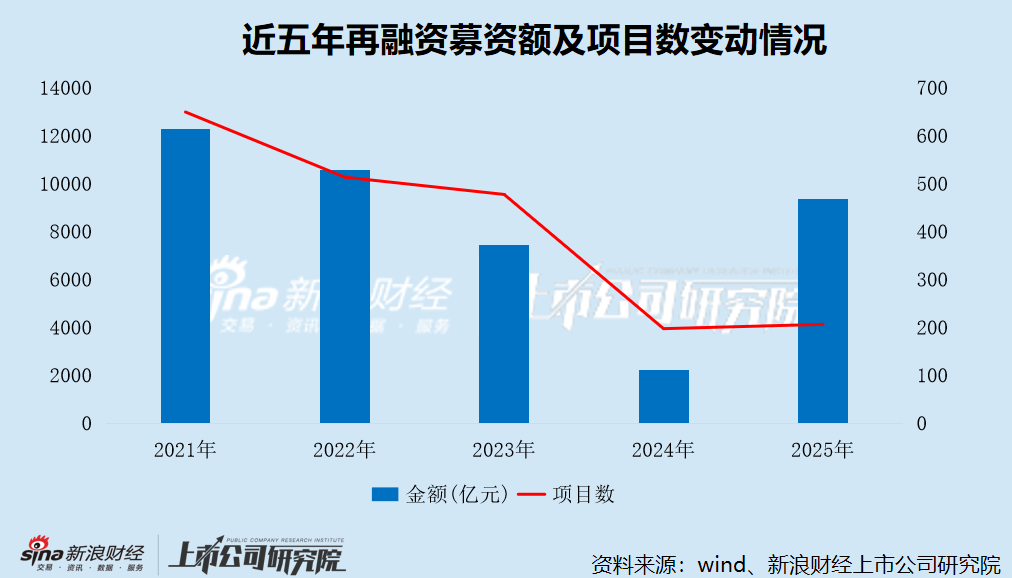
2025年A股再融资数据盘点:电子行业项目数量位列全行业第一(40个) 银行业募资额高居榜首(5200亿元)
Xin Lang Cai Jing· 2025-12-31 08:01
Core Insights - The A-share market in 2025 marked a significant milestone with the index crossing a decade threshold, market capitalization exceeding one trillion, and record trading volumes, driven by policy incentives and liquidity [1][8] Group 1: Overall Market Performance - The total refinancing scale reached 950.865 billion, a year-on-year increase of 326.17% [3][10] - The majority of the refinancing growth came from private placements, which totaled 887.732 billion, reflecting a 412.99% increase year-on-year [3][10] - The number of refinancing applications accepted was 251, with a 100% approval rate across all listed sectors [3][10] Group 2: Specific Financing Types - The total amount raised through convertible bonds was 63.133 billion, marking a 30.77% increase year-on-year [7][14] - No funds were raised through rights issues or preferred shares during the year [3][10] Group 3: Industry Breakdown - The banking sector led in fundraising through private placements, raising 520 billion, accounting for 58.58% of the total [5][12] - The electronics industry had the highest number of private placement projects at 30 [5][12] - The top five industries in terms of total fundraising included banking, electronics, non-bank financials, public utilities, and defense, collectively raising 708.618 billion, which is 79.82% of the total [5][12] Group 4: Convertible Bonds Industry Breakdown - The electronics sector also led in the number of convertible bond projects with 10 [7][14] - The real estate sector raised 13.3 billion through convertible bonds, representing 21.07% of the total [7][14] - The top five industries for convertible bond fundraising included public utilities, power equipment, electronics, and machinery, raising a total of 475.72 billion, which is 75.35% of the total [7][14]
2025年A股再融资数据盘点:中行、邮储、交行、建行位列前四大增发项目 募资额均超千亿
Xin Lang Cai Jing· 2025-12-31 08:01
Core Insights - The A-share market in 2025 marked a significant milestone with indices crossing a decade threshold, market capitalization exceeding 100 trillion, and record trading volumes, driven by policy benefits and liquidity [1][6] Summary by Category Overall Market Performance - The total refinancing scale reached 950.865 billion yuan, a year-on-year increase of 326.17% [3][10] - The majority of the refinancing came from public and private placements, totaling 887.732 billion yuan, which saw a growth of 412.99% year-on-year [3][10] - Convertible bonds raised 63.133 billion yuan, reflecting a year-on-year growth of 30.77% [3][10] - There were no funds raised through rights issues or preferred shares [3][10] Regulatory and Approval Process - A total of 251 refinancing applications were accepted, with 181 approved and 188 submitted to the CSRC (China Securities Regulatory Commission) [3][10] - The CSRC registered 173 applications, while 35 were terminated or withdrawn, indicating a 100% approval rate across all listed sectors [3][10] - Currently, 235 companies are in the refinancing queue, with various statuses in the approval process [3][10] Major Fundraising Projects - The top ten convertible bond projects raised a total of 38.331 billion yuan, accounting for 60.71% of the total fundraising [5][14] - Poly Development led the fundraising with 8.5 billion yuan, followed by Yiwei Lithium Energy and China General Nuclear Power with 5 billion yuan and 4.9 billion yuan, respectively [5][14] - The top ten placement projects raised a total of 624.447 billion yuan, representing 70.68% of the total fundraising [7][12] - China Bank topped the list with 165 billion yuan, followed by Postal Savings Bank, Bank of Communications, and China Construction Bank with 130 billion yuan, 120 billion yuan, and 105 billion yuan, respectively [7][12]
明起,数字人民币实名钱包余额计息
财联社· 2025-12-31 07:59
Core Viewpoint - The major Chinese banks, including Industrial and Commercial Bank of China, Agricultural Bank of China, Bank of China, China Construction Bank, and Bank of Communications, announced that starting from January 1, 2026, they will pay interest on the balances of digital RMB real-name wallets at the same rate as their demand deposit rates, with interest calculation rules consistent with those for demand deposits [1][3][4][7][10]. Group 1 - Industrial and Commercial Bank of China will apply the demand deposit rate for interest on digital RMB wallet balances starting January 1, 2026 [3]. - Agricultural Bank of China will also implement the same interest payment policy for digital RMB wallets from January 1, 2026 [4][6]. - Bank of China will follow suit, applying the demand deposit rate for digital RMB wallet balances effective January 1, 2026 [7][10]. Group 2 - China Construction Bank will pay interest on digital RMB wallet balances at the demand deposit rate starting January 1, 2026 [10]. - Bank of Communications will apply the demand deposit rate for interest on various types of digital RMB wallets, except for the fourth category personal wallets, which will not earn interest [10].