BANK COMM(601328)

Search documents
六大国有行官宣,2026年起数字人民币实名钱包按活期利率计息
Di Yi Cai Jing· 2025-12-31 07:40
Core Insights - The People's Bank of China has announced that starting January 1, 2026, interest will be paid on the balances of real-name digital RMB wallets at the current demand deposit rate of 0.05% [2][3] - Digital RMB wallets are categorized into four types, with only the first three types (real-name wallets) eligible for interest payments, while the fourth type (anonymous wallets) will not earn interest [2] - The digital RMB management service system and related financial infrastructure will officially launch on January 1, 2026, with banks required to comply with self-regulatory agreements on deposit interest rates [3] Group 1 - The current demand deposit rate is set at 0.05% [2] - Six major state-owned banks will implement interest payments on digital RMB real-name wallet balances according to the demand deposit rate [2] - The designated operating institutions for digital RMB currently include 10 banks, comprising six state-owned commercial banks, two joint-stock commercial banks, and two internet banks [2] Group 2 - The new digital RMB management framework will include a measurement framework, management system, operational mechanism, and ecosystem [3] - Banks will be allowed to conduct asset-liability management for digital RMB wallet balances, with deposit insurance providing the same level of security as traditional deposits [4]







多家国有行公告:余额按0.05%生息,数字人民币告别无息时代
Xin Lang Cai Jing· 2025-12-31 07:03
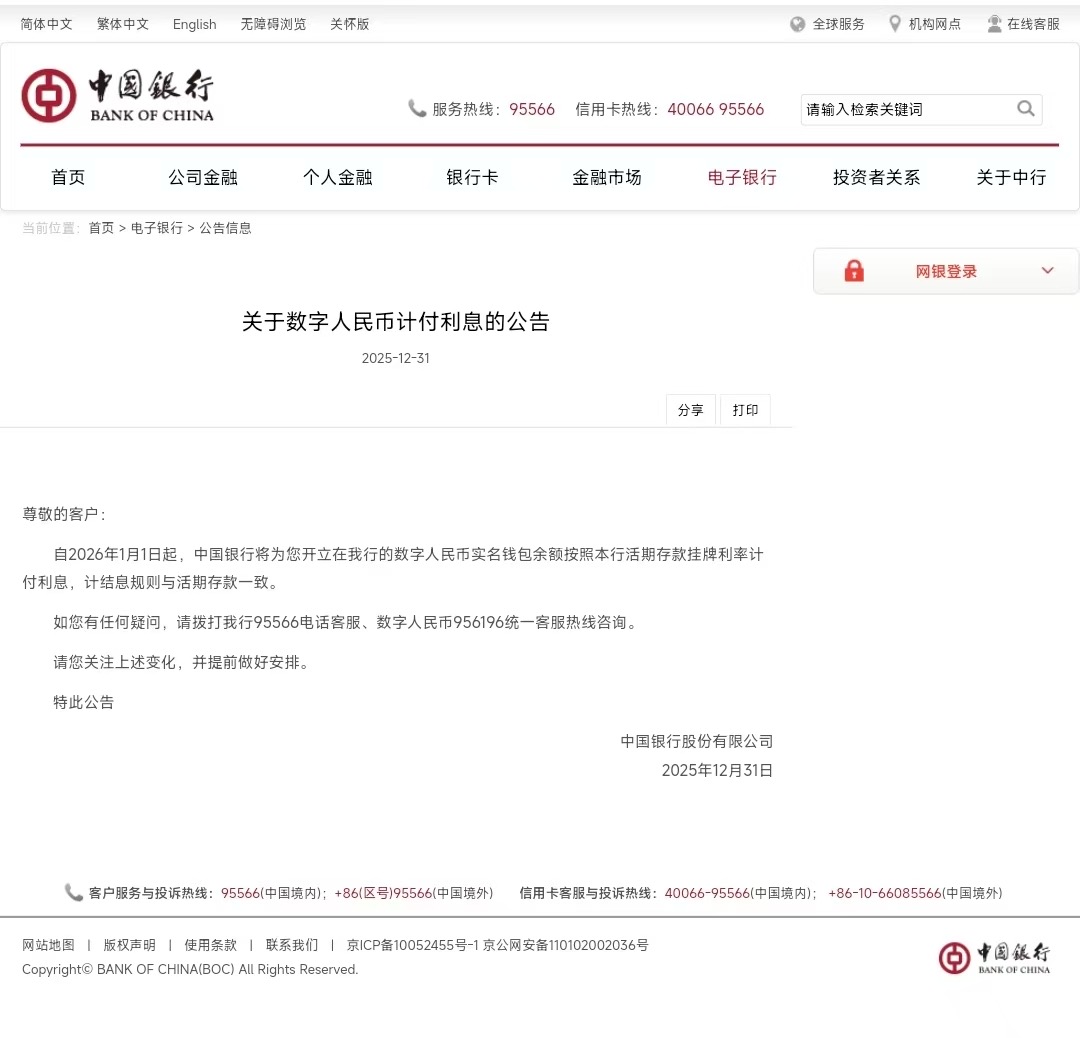
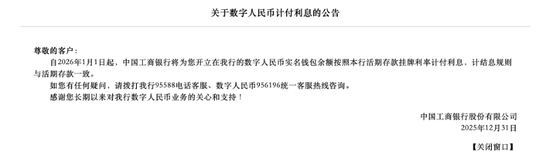
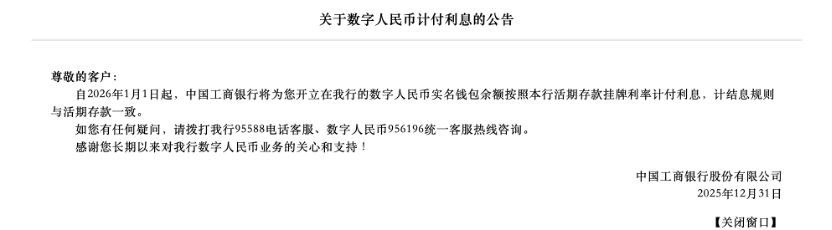
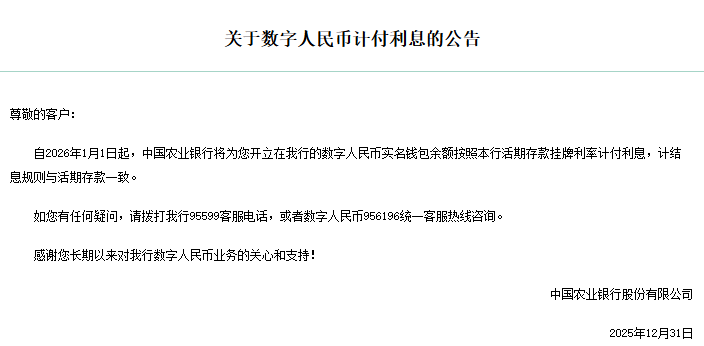
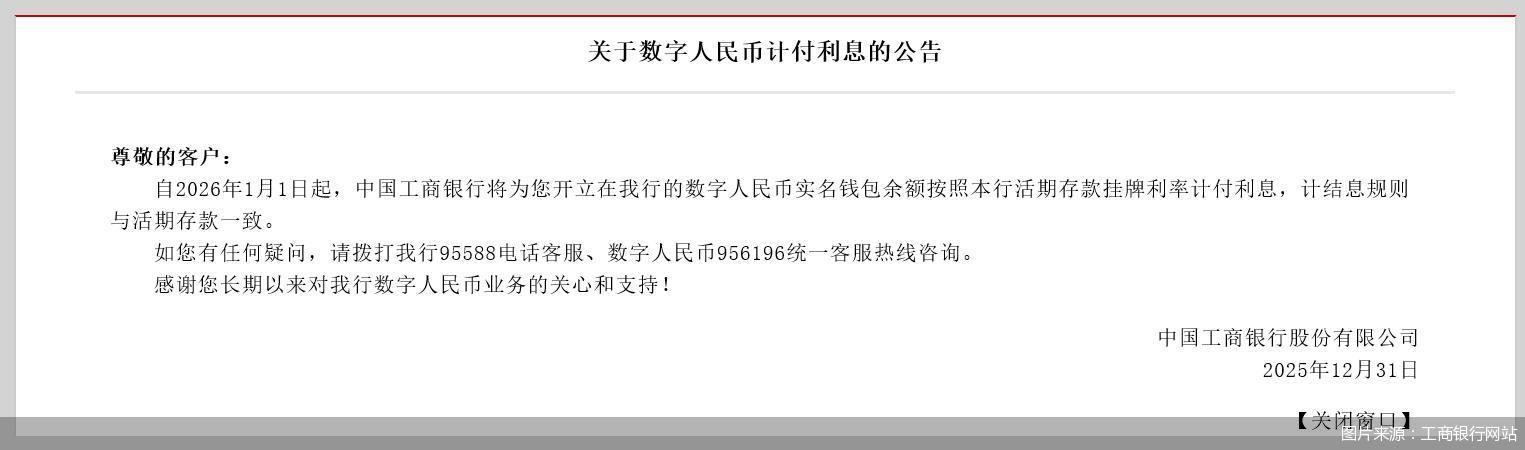
数字人民币将正式告别"无息时代"。 2025年12月31日,工商银行、农业银行、交通银行公告,自2026年1月1日起,为数字人民币实名钱包余 额按照活期存款挂牌利率计付利息,计结息规则与活期存款一致。 工商银行关于数字人民 币计付利息的公告 图/银行官网 农业银行关于数字人民 币计付利息的公告 图/银行官网 交通银行关于数字人民 币计付利息的公告 图/银行官网 交通银行公告亦表示,客户开立在交行的数字人民币实名钱包(包含一类、二类、三类个人钱包和单位 钱包)余额,按照交行公布的活期存款挂牌利率计付利息。如客户开立的数字人民币钱包为四类个人钱 包,则钱包内的余额不计付利息。 此次利息计付政策的落地,源于中国人民银行近期出台的《关于进一步加强数字人民币管理服务体系和 相关金融基础设施建设的行动方案》(以下简称《行动方案》)。中国人民银行党委委员、副行长陆磊 在2025年12月29日公开发文表示,经过十年研发试点,数字人民币将从"数字现金时代"迈入"数字存款 货币"时代。《行动方案》将于2026年1月1日起正式实施,届时新一代数字人民币的计量框架、管理体 系、运行机制与生态体系将同步落地,其中重要的亮点就是,数字人 ...
工行、农行、建行、交行、邮储银行发布公告
Xin Jing Bao· 2025-12-31 06:49
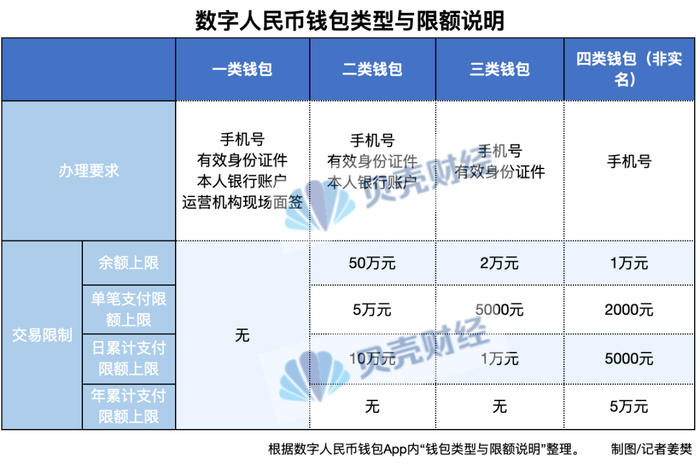
新京报贝壳财经记者 姜樊 编辑 陈莉 校对 杨利 本周一(12月29日),人民银行出台的《关于进一步加强数字人民币管理服务体系和相关金融基础设施 建设的行动方案》(以下简称《行动方案》)明确,从明年起,数字人民币钱包余额将计付利息。 明日起,数字人民币实名钱包余额将开始计息。12月31日,工行、农行、建行、交行、邮储银行等国有 银行公布了数字人民币钱包余额计息的规则。 工行、农行、建行、交行、邮储银行均发布公告称,自2026年1月1日起,银行将为客户开立的数字人民 币实名钱包余额按照本行活期存款挂牌利率计付利息,计结息规则与活期存款一致。 值得注意的是,数字人民币钱包分为四类钱包。其中,一类、二类、三类钱包未实名钱包,四类钱包为 非实名钱包。因此四类钱包不属于各家银行计息的"实名钱包"范畴。交行在公告中明确,如客户开立的 数字人民币钱包为四类个人钱包,则钱包内的余额不计付利息。 数字人民币是指人民银行发行的法定数字货币和相关支付体系,采用双层运营架构,由中国人民银行向 数字人民币业务运营机构发行,再由数字人民币业务运营机构兑换给公众。 ...

三大行集体公告数字钱包生息机制,数字人民币告别“无息时代”
2 1 Shi Ji Jing Ji Bao Dao· 2025-12-31 06:42
Core Viewpoint - The digital renminbi will officially end its "interest-free era" as of January 1, 2026, with major banks announcing that interest will be paid on the balances of real-name digital renminbi wallets based on the current deposit rates [1][6][10]. Group 1: Interest Payment Policy - Starting January 1, 2026, the balance in real-name digital renminbi wallets will earn interest according to the People's Bank of China's current deposit interest rate [6][7]. - The interest calculation will follow the same rules as regular savings accounts, with interest credited on the 21st of each quarter [6][10]. - Balances in anonymous wallets will not earn interest, maintaining a distinction between different wallet types [6][10]. Group 2: Transition to Digital Deposit Currency - The implementation of the interest payment policy marks the transition from "digital cash" to "digital deposit currency," indicating a significant evolution in the digital renminbi's role [7][10]. - The digital renminbi will now be considered a liability of commercial banks, allowing it to earn interest and be subject to deposit insurance, similar to traditional bank deposits [10]. - This change enhances the monetary elasticity of the digital renminbi, enabling it to support credit activities and deposit expansion mechanisms [10]. Group 3: Background and Development - The policy change is part of a broader initiative by the People's Bank of China to strengthen the management and service system for digital renminbi [7]. - The digital renminbi has been in development for over ten years, expanding its pilot programs from select cities to entire provinces [8]. - As of November 2025, the digital renminbi has processed 3.48 billion transactions, amounting to 16.7 trillion yuan, indicating significant adoption and usage [9].
交通银行将给数字人民币计付利息
Xin Hua Cai Jing· 2025-12-31 05:53
Group 1 - The core point of the article is that from January 1, 2026, Bank of Communications will pay interest on the balances of digital RMB wallets opened by customers, based on the bank's announced current deposit rates [1] - Digital RMB interest payment marks the transition from cash-type version 1.0 to deposit currency-type version 2.0 [1] - The People's Bank of China has issued an action plan to strengthen the management and service system of digital RMB, indicating a shift from the digital cash era to the digital deposit currency era [1]
多家银行宣布:2026年起数字人民币钱包余额可计付利息
Sou Hu Cai Jing· 2025-12-31 05:40
Group 1 - The core announcement is that starting from January 1, 2026, major Chinese banks including Agricultural Bank of China, Postal Savings Bank, and others will pay interest on digital RMB wallet balances according to the same rates as regular demand deposits [1][4][8] - The interest calculation rules for digital RMB wallets will align with those of demand deposits, indicating a significant shift in how digital currency is treated [1][8] - This transition marks the evolution of digital RMB from a "digital cash era" to a "digital deposit currency era," following a decade of research and pilot programs [8] Group 2 - The People's Bank of China has introduced a plan to enhance the management and service system for digital RMB, which will officially launch on January 1, 2026 [8] - The new framework will include a measurement system, management structure, operational mechanism, and ecosystem for digital RMB [8]
多家银行官宣:2026年1月1日起,为数字人民币实名钱包余额计付利息
Bei Jing Shang Bao· 2025-12-31 05:25
Core Viewpoint - Major Chinese banks including Industrial and Commercial Bank of China, Agricultural Bank of China, Postal Savings Bank of China, Bank of Communications, and China Construction Bank will start paying interest on digital RMB wallet balances at the same rate as current deposit rates from January 1, 2026, marking a significant transition in the digital currency landscape in China [1][4][5] Group 1: Bank Announcements - Industrial and Commercial Bank of China, Agricultural Bank of China, and Postal Savings Bank of China will apply interest to digital RMB wallet balances according to the current deposit rate, with interest calculation rules consistent with those for current deposits [4] - Bank of Communications will also apply the current deposit rate to digital RMB wallet balances, including various types of personal and corporate wallets, while balances in type four wallets will not earn interest [4] - China Construction Bank will revise its customer service agreement to reflect that digital RMB wallet balances will earn interest based on the current deposit rate starting January 1, 2026 [4] Group 2: Digital RMB Framework - The People's Bank of China has introduced a plan to enhance the management and service system for digital RMB, which will officially implement a new measurement framework and operational mechanism on January 1, 2026 [5] - This transition signifies a shift from the "digital cash era" to the "digital deposit currency era" after a decade of research and pilot programs [5]
罚单近亿、转型之困与掉队之问:交通银行的2025年终复盘
3 6 Ke· 2025-12-31 00:49
年终岁末,银行业再次迎来巨额罚单。 12月20日,交通银行因违反多项金融监管规定,被中国人民银行处以合计6783.43万元的罚款,并没收 违法所得23.98万元。企业预警通显示,该罚单创下该行自2010年以来单笔处罚金额的最高纪录。 经查,交通银行主要存在以下12项违规行为:违反账户与清算管理规定;未落实特约商户实名制;违反 反假货币业务管理要求;占压财政存款或资金;违反国库科目设置和使用规定;违反信用信息采集、提 供、查询等相关规定;未按规定履行客户身份识别义务;未按规定保存客户身份资料和交易记录;未按 规定报送大额或可疑交易报告;与身份不明客户交易或开立匿名、假名账户等。 与此同时,该行12名相关责任人员被问责,涉及个人金融、普惠金融、风险管理、授信管理、营运渠 道、法律合规、国际业务、金融机构、网络金融、机构业务及信用卡中心等多个部门。其中,罚款金额 最高达17万元,多人被处以警告并罚款。 罚单不断、屡查屡犯:如何重塑市场信任? 巨额罚单不仅反映银行的合规漏洞,更深层地影响其品牌声誉与市场公信力。 若将时间轴拉长,交通银行近年频现高额处罚,反映出其在持续合规经营与内控机制建设上仍面临严峻 挑战: 企业预 ...
“不赚钱也要抢单”低息经营贷背后的银行账本
Zhong Guo Zheng Quan Bao· 2025-12-30 21:11
Core Viewpoint - The personal operating loan interest rates have generally entered the "2" range, with some banks offering rates as low as 2.3%, driven by competition and a strategy of attracting customers through lower prices [1][4]. Group 1: Current Loan Rates - Many banks are now offering personal operating loan rates below 2.5%, with slight variations based on region and product type [1][2]. - For instance, the lowest rate for personal mortgage operating loans at one bank is 2.35%, with a loan term of 3 years and a credit limit of up to 30 million yuan [1]. - Another bank reports that the minimum rate for collateralized personal operating loans is 2.5%, while credit-based products start at 2.55% [2]. Group 2: Loan Approval Criteria - Borrowers must meet strict criteria, including having a local household registration and a minimum duration of social security payments [3]. - The collateral property must be within the local jurisdiction, not older than 35 years, and the borrower must have owned it for at least 3 months [3]. - Additionally, the borrowing entity must be a small or micro enterprise with a good credit record and normal operating cash flow [3]. Group 3: Market Dynamics and Risks - The current low interest rates are a result of multiple factors, including policy guidance, industry competition, and reduced funding costs for banks [4][5]. - While lower rates can stimulate demand and reduce interest expenses for borrowers, there are concerns about potential risks, such as narrowing interest margins and the possibility of unhealthy competition [4][5]. - Experts warn that aggressive pricing strategies could lead to a decline in banks' profitability and their ability to support the real economy effectively [4][5]. Group 4: Strategic Responses from Banks - Different banks have varying perspectives on the sustainability of low-interest operating loans, with some viewing it as a necessary strategy to gain market share despite thin margins [5][6]. - Larger banks may benefit from cross-selling additional services to clients attracted by low rates, while smaller banks face challenges in maintaining competitiveness without engaging in price wars [6][7]. - There is a call for financial institutions to adopt differentiated strategies and focus on enhancing product quality and service rather than solely competing on price [6][7].

“消失”的银行监事长
Shang Hai Zheng Quan Bao· 2025-12-30 19:26
Core Viewpoint - The bank supervisory board system, in operation for nearly 30 years, is approaching its end as banks begin to abolish this structure in favor of audit committees, following new regulations from the China Securities Regulatory Commission (CSRC) and the Financial Regulatory Bureau [2][3][4]. Regulatory Framework for Reform - The new Company Law, effective from July 2024, allows financial institutions to replace supervisory boards with audit committees, fundamentally changing the requirement for supervisory boards as mandatory entities [3][4]. - The Financial Regulatory Bureau has issued policies that support the transition, allowing financial institutions to choose between retaining supervisory boards or establishing audit committees to perform supervisory functions [3][4]. Differences in Implementation - There is a differentiation in the approach to abolishing supervisory boards between listed and non-listed banks, with listed banks required to eliminate supervisory boards by 2026, while non-listed banks have the option to retain them [4][5]. - Major state-owned banks have already initiated the process of abolishing supervisory boards, with the five largest banks voting to remove them in April 2025 [5]. Effectiveness and Challenges of Supervisory Boards - The supervisory board has been criticized for its lack of independence, professionalism, and efficiency, often leading to overlapping functions and ineffective oversight [6][7]. - The costs associated with maintaining a supervisory board are significant, with estimates suggesting that listed banks could save millions annually by abolishing this structure [7]. Transition Paths for Supervisory Board Members - Former supervisory board members may transition to roles within the audit committee, take on positions in other financial institutions, or retire from the industry [8]. - The governance mechanism is expected to become more efficient, with fewer decision-making layers and a more direct oversight structure through audit committees [8].