
BANK COMM(601328)

Search documents
交通银行股份有限公司关于境外无固定期限资本债券赎回完成的公告
Shang Hai Zheng Quan Bao· 2025-11-18 18:56
根据本次债券条件与条款,本行已行使其赎回权并于2025年11月18日完成赎回所有未偿付的本次债券。 截至本公告日,本次债券下不再含有未偿付余额。 本行已向香港联合交易所有限公司申请撤回本次债券上市。预期撤回本次债券上市将于2025年11月26日 营业时间结束时生效。 股票代码:601328 股票简称:交通银行 编号:临2025-072 交通银行股份有限公司 关于境外无固定期限资本债券赎回完成的公告 交通银行股份有限公司(以下简称"交通银行"或"本行")董事会及全体董事保证本公告内容不存在任何 虚假记载、误导性陈述或者重大遗漏,并对其内容的真实性、准确性和完整性承担法律责任。 2020年11月18日,本行在境外市场完成发行28亿美元无固定期限资本债券(以下简称"本次债券"),并 于2025年10月15日发布了《交通银行股份有限公司关于赎回境外无固定期限资本债券的公告》(编号: 临2025-066)。 特此公告 交通银行股份有限公司董事会 2025年11月18日 ...
交通银行(601328.SH):境外无固定期限资本债券赎回完成
Ge Long Hui A P P· 2025-11-18 12:29
Core Points - The company, Bank of Communications, issued $2.8 billion perpetual capital bonds in the overseas market on November 18, 2020 [1] - The company has exercised its redemption right and plans to redeem all outstanding bonds by November 18, 2025 [1] - As of the announcement date, there are no outstanding balances remaining for these bonds [1] - The company has applied to withdraw the listing of these bonds from the Hong Kong Stock Exchange, with the withdrawal expected to take effect at the end of business on November 26, 2025 [1]
交通银行发布“京津冀·交通银行综合金融服务方案”
Zheng Quan Ri Bao Wang· 2025-11-18 12:17
Core Insights - The event titled "Integrating Industry and Finance to Build Foundations, AI Leading the Way in Beijing-Tianjin-Hebei" was held on November 18, focusing on the collaboration between funds and enterprises in the Beijing-Tianjin-Hebei region [1] Group 1: Financial Service Solutions - The Bank of Communications officially launched the "Beijing-Tianjin-Hebei Comprehensive Financial Service Plan," targeting key economic areas in the region [1] - The plan includes five sub-service solutions addressing major development areas: non-capital function relocation, "Group Chain Corridor" industrial collaboration, major project investment and financing, cross-border business facilitation, and integrated public service solutions [1][2] Group 2: Sub-Service Solutions - The non-capital function relocation service focuses on supporting enterprises in settling and operating smoothly, offering innovative products like seamless relocation services and "Salary Transfer" [1] - The "Group Chain Corridor" industrial collaboration service aims to create a full lifecycle financial support system for enterprises in the three regions through various loan products [1] - The major project investment and financing service accelerates project approvals and promotes the implementation of significant national projects in transportation integration and ecological protection [1] - The cross-border business facilitation service leverages the bank's offshore business capabilities to create efficient and secure cross-border payment channels [2] - The integrated public service solution explores new models of cooperation between banks and governments, enhancing financial services for new citizens and improving public welfare [2]
交通银行(03328.HK)28亿美元无固定期限资本债券赎回完成
Ge Long Hui· 2025-11-18 12:03
Core Points - The announcement pertains to the redemption of a $2.8 billion perpetual capital bond by the issuer, Bank of Communications Co., Ltd [1] - The redemption will be completed on November 18, 2025, and the bond will be canceled thereafter [1] - The issuer has applied to withdraw the bond from listing on the Hong Kong Stock Exchange, with the withdrawal expected to take effect at the end of business on November 26, 2025 [1] Summary by Sections - **Bond Issuance and Redemption** The issuer exercised its redemption rights and will complete the redemption of the entire bond on November 18, 2025 [1] - **Bond Cancellation** Following the redemption, the bond will be canceled, and there will be no outstanding balance remaining [1] - **Withdrawal from Listing** The issuer has requested the withdrawal of the bond from the Hong Kong Stock Exchange, effective November 26, 2025 [1]
交通银行(03328) - 2,800,000,000美元无固定期限资本债券赎回完成公告(上市代号:...
2025-11-18 11:55
香港交易及結算所有限公司及香港聯合交易所有限公司對本公告之內容概不負責,對其準確性 或完整性亦不發表任何聲明,並明確表示,概不就因本公告全部或任何部分內容而產生或因倚 賴該等內容而引致之任何損失承擔任何責任。 本公告僅供參考,並不構成收購、購買或認購證券的邀請或要約。 承董事會命 交通銀行股份有限公司 何兆斌 公司秘書 (於中華人民共和國註冊成立的股份有限公司) (股份代號:03328) 2,800,000,000美元無固定期限資本債券贖回完成公告 (上市代號:40475) 茲提述交通銀行股份有限公司(「發行人」)於2020 年 1 1 月 1 8 日發佈的關於 2,800,000,000美元無固定期限資本債券(本「債券」)發行及上市之公告,以及2025 年10月15日發佈的關於本債券贖回通知之公告(合稱「該等公告」)。本公告中所使 用的未作定義之大寫簡稱均適用其在該等公告中的含義。 根據本債券條件與條款,發行人已行使其贖回權並於2025年11月18日完成贖回全 部本債券。 贖回完成後,本債券已被註銷。截至本公告之日,本債券不再含有發行的未償付 餘額。 發行人已向香港聯合交易所有限公司申請撤回本債券上市。預期 ...
交通银行(601328) - 交通银行关于境外无固定期限资本债券赎回完成的公告
2025-11-18 11:01
根据本次债券条件与条款,本行已行使其赎回权并于2025年11月18日完成赎 回所有未偿付的本次债券。截至本公告日,本次债券下不再含有未偿付余额。 本行已向香港联合交易所有限公司申请撤回本次债券上市。预期撤回本次债 券上市将于 2025 年 11 月 26 日营业时间结束时生效。 特此公告 交通银行股份有限公司董事会 股票代码:601328 股票简称:交通银行 编号:临 2025-072 交通银行股份有限公司 关于境外无固定期限资本债券赎回完成的公告 交通银行股份有限公司(以下简称"交通银行"或"本行")董事会及全体董事保证本 公告内容不存在任何虚假记载、误导性陈述或者重大遗漏,并对其内容的真实性、准确性和 完整性承担法律责任。 2020年11月18日,本行在境外市场完成发行28亿美元无固定期限资本债券 (以下简称"本次债券"),并于2025年10月15日发布了《交通银行股份有限公 司关于赎回境外无固定期限资本债券的公告》(编号:临2025-066)。 2025 年 11 月 18 日 ...
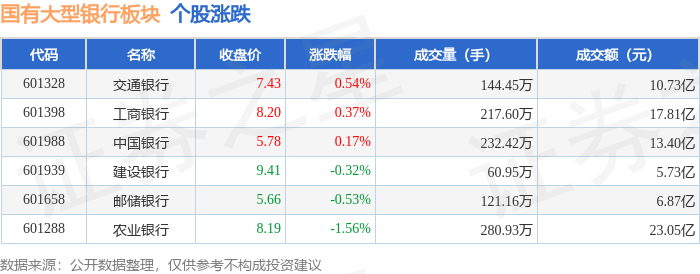
国有大型银行板块11月18日跌0.48%,农业银行领跌,主力资金净流出3.05亿元
Zheng Xing Xing Ye Ri Bao· 2025-11-18 08:11
Core Viewpoint - The state-owned large bank sector experienced a decline of 0.48% on November 18, with Agricultural Bank leading the drop. The Shanghai Composite Index closed at 3939.81, down 0.81%, while the Shenzhen Component Index closed at 13080.49, down 0.92% [1] Summary by Category Stock Performance - The closing prices and performance of major state-owned banks are as follows: - Bank of Communications (601328): Closed at 7.43, up 0.54%, with a trading volume of 1.4445 million shares and a turnover of 1.073 billion yuan - Industrial and Commercial Bank of China (601398): Closed at 8.20, up 0.37%, with a trading volume of 2.176 million shares and a turnover of 1.781 billion yuan - Bank of China (601988): Closed at 5.78, up 0.17%, with a trading volume of 2.3242 million shares and a turnover of 1.340 billion yuan - China Construction Bank (601939): Closed at 9.41, down 0.32%, with a trading volume of 609,500 shares and a turnover of 573 million yuan - Postal Savings Bank of China (601658): Closed at 5.66, down 0.53%, with a trading volume of 1.2116 million shares and a turnover of 687 million yuan - Agricultural Bank of China (601288): Closed at 8.19, down 1.56%, with a trading volume of 2.8093 million shares and a turnover of 2.305 billion yuan [1] Capital Flow - The net capital flow for the state-owned large bank sector showed a net outflow of 305 million yuan from main funds, while retail funds saw a net inflow of 257 million yuan and speculative funds had a net inflow of 48.0376 million yuan [1]




专访交通银行杨立文:零售信贷业务的转型升级之道
2 1 Shi Ji Jing Ji Bao Dao· 2025-11-18 06:04
Core Viewpoint - The article emphasizes the importance of consumer spending as a key driver of economic growth in China, highlighting the various government policies aimed at boosting consumption and the role of financial institutions like Bank of Communications in supporting these initiatives through retail credit services [1][2][3]. Group 1: Government Policies and Economic Context - The Chinese government has prioritized boosting consumption and expanding domestic demand in its economic strategy, with significant policies introduced since March 2023 [1][2]. - The retail credit sector is identified as a crucial component in driving consumption recovery, with various financial support measures implemented by the government [1][3]. - Data indicates that consumer spending has consistently contributed to economic growth, with a projected retail sales total of 48.8 trillion yuan in 2024, reflecting a 3.5% increase from the previous year [2]. Group 2: Bank of Communications' Strategic Response - Bank of Communications has launched initiatives to align with national policies, including the "Support for Boosting Consumption Special Action Plan" to enhance retail credit offerings [2][4]. - The bank is focusing on integrating supply and demand through improved institutional frameworks and leveraging financial technology to reshape its product offerings and service models [1][4]. - The bank's retail credit services are evolving from traditional lending to a more ecosystem-oriented approach, emphasizing customer-centric solutions [3][4]. Group 3: Product Innovations and Service Models - The "Jiaoyin Huidai" personal loan brand was introduced to provide integrated services for both consumer and business loans, addressing diverse customer needs [5][6]. - The bank's service model emphasizes a one-stop solution for various loan products, enhancing customer experience through digital platforms and streamlined processes [6][7]. - Innovations in product design focus on specific consumer scenarios, such as housing, travel, and small business financing, to better meet market demands [6][7]. Group 4: Digital Transformation and Risk Management - The bank is actively pursuing digital transformation to enhance operational efficiency and customer service, utilizing advanced technologies like AI for risk management and service delivery [8][10]. - A comprehensive digital platform has been established to support flexible product customization and rapid response to market changes [10][11]. - The bank is implementing a robust risk management framework that incorporates data analytics and AI to improve risk identification and mitigation strategies [9][16]. Group 5: Future Strategies and Market Expansion - The bank aims to expand its customer base by focusing on new consumer segments, such as new citizens and entrepreneurs, through tailored financial products [14][15]. - Continuous improvement in talent development and risk management practices is emphasized to ensure sustainable growth and high asset quality [14][16]. - The bank's strategic focus includes enhancing service quality in emerging consumption areas and leveraging government policies to drive financial support for key sectors [15][16].
北京首家警银服务延伸柜台落户西城
Xin Jing Bao· 2025-11-18 05:42
Core Viewpoint - The establishment of the "Police-Bank E-Link Service Area" at the Bank of Communications Beijing Branch marks the first trial operation of its kind in the city, aimed at extending convenient public services and enhancing financial security awareness [1] Group 1: Service Extension - The "Police-Bank E-Link Service Area" integrates two main functions: extending convenient services and conducting anti-fraud publicity [1] - A dedicated police officer will be stationed at the bank during business hours to assist residents with ten online application services related to identity documents and other administrative tasks [1] - The service area also provides guidance for an additional 15 administrative tasks that can be processed at police stations or self-service machines [1] Group 2: Public Safety and Awareness - The initiative includes collaborative anti-fraud campaigns, utilizing the bank's network and police social media to promote financial safety knowledge through online lectures and community presentations [1] - This effort is part of a broader push by Beijing police to implement "contactless acceptance, non-face-to-face approval, and zero-run errands" for administrative services [1] - The collaboration between the Xicheng police and the Bank of Communications aims to further enhance the convenience and benefits of public services for residents [1]
红利银行时代系列十八:银行股配置盘的三条核心思路
Changjiang Securities· 2025-11-17 23:30
Investment Rating - The industry investment rating is "Positive" and maintained [12]. Core Insights - The report identifies three core strategies for bank stock allocation: 1) Long-term strategic allocation to large banks using bond and non-standard asset replacement thinking, with recent mid-term dividend acceleration driving market performance; 2) Gradually increasing positions in high-quality city commercial banks in the Yangtze River Delta region to provide dividend yield flexibility; 3) Small and medium-sized insurance companies seeking long-term equity investment opportunities in small and medium-sized banks [2][6][9]. Summary by Sections Market Trends - Since the third quarter, bank stocks have experienced significant adjustments due to market style factors, but the direction of revaluation remains unchanged. The state-owned bank index has recently reached new highs, indicating sustained allocation power [6][7]. Large Banks - Large banks are becoming strategic allocation targets, with a focus on long-term debt cost advantages. The static PB valuation of Agricultural Bank A shares is below 3%, while most mainstream banks maintain dividend yields between 4% and 5.5%. The report recommends focusing on China Merchants Bank, low-valuation Bank of Communications, and state-owned H-shares [7][8]. City Commercial Banks - City commercial banks in the Yangtze River Delta have seen significant price adjustments, with public fund holdings decreasing by 1.4 percentage points to 0.83%. The report highlights the stable growth potential of these banks, with a focus on dividend yields and credit growth rates exceeding national averages [8][9]. Small and Medium-sized Insurance Companies - Small and medium-sized insurance companies are expected to actively seek long-term equity investment opportunities in small banks. Regulatory limits on single-stock investments will drive these companies to target mid-sized banks with market capitalizations in the hundreds of millions [9].
