
BANK COMM(601328)

Search documents
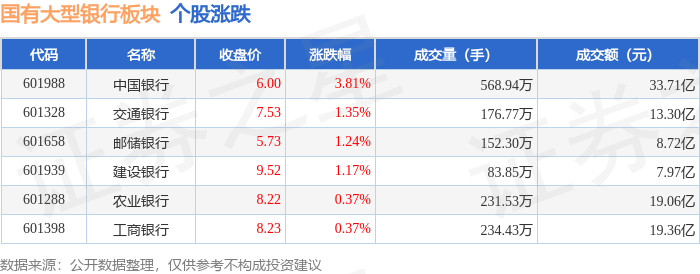
国有大型银行板块11月19日涨1.08%,中国银行领涨,主力资金净流入4.78亿元
Zheng Xing Xing Ye Ri Bao· 2025-11-19 08:52
Group 1 - The core viewpoint of the article highlights that the state-owned large bank sector experienced a 1.08% increase on November 19, with China Bank leading the gains [1] - The Shanghai Composite Index closed at 3946.74, up 0.18%, while the Shenzhen Component Index closed at 13080.09, unchanged [1] - The trading performance of individual stocks in the state-owned large bank sector is detailed, showing varying degrees of increase and decrease in share prices [1] Group 2 - China Bank (601988) saw a closing price of 6.00, with a rise of 3.81% and a trading volume of 5.6894 million shares [1] - Agricultural Bank (601288) and Industrial and Commercial Bank (601398) both had a modest increase of 0.37%, closing at 8.22 and 8.23 respectively [1] - The net inflow of main funds into the state-owned large bank sector was 478 million yuan, while retail investors experienced a net outflow of 75.56 million yuan [1][2] Group 3 - The main fund inflows for China Bank amounted to 331 million yuan, representing 9.82% of the total, while retail investors had a net outflow of 204 million yuan [2] - Agricultural Bank experienced a net outflow of 746.32 million yuan from main funds, but a net inflow of 117 million yuan from retail investors [2] - The overall trend indicates that while main funds are entering the sector, retail investors are withdrawing, suggesting a divergence in investment strategies [2]





专访交通银行杨立文:零售信贷业务的转型升级之道
21世纪经济报道· 2025-11-19 06:12
Core Viewpoint - The article emphasizes the importance of consumer spending as a key driver of economic growth, highlighting the proactive measures taken by the government and financial institutions like Bank of Communications to stimulate consumption through retail credit initiatives [4][5][6]. Group 1: Government Policies and Economic Context - The Chinese government has been actively promoting consumption and expanding domestic demand through various policies, including subsidies, tax incentives, and the issuance of consumption vouchers [5]. - Since 2014, consumption has consistently been one of the three main drivers of economic growth, with a projected retail sales total of 48.8 trillion yuan in 2024, reflecting a 3.5% increase from the previous year [4][5]. - The contribution rate of consumption to economic growth is expected to be 44.5%, underscoring its critical role in the national strategy for expanding domestic demand [4]. Group 2: Bank of Communications' Strategy - Bank of Communications is aligning its retail credit business with national strategies to enhance consumer spending and improve living standards, focusing on integrating supply and demand through institutional frameworks [6][11]. - The bank has launched the "Jiao Yin Hui Dai" personal loan brand, which combines consumer and business loans to meet diverse financial needs, emphasizing a one-stop service model [8][9]. - The bank's retail loan growth has outpaced the market, driven by a commitment to high-quality development and effective risk management [11][12]. Group 3: Digital Transformation and Innovation - The bank is leveraging digital technology to enhance its retail loan services, implementing an integrated credit approval process that simplifies customer interactions [13][14]. - Advanced technologies, including artificial intelligence, are being utilized to improve operational efficiency and risk management across the loan lifecycle [13][14]. - The bank aims to create a digital operating model that enhances customer experience and expands service coverage, particularly for new consumer segments [16][19]. Group 4: Risk Management and Talent Development - Bank of Communications is focusing on intelligent risk management, enhancing its fraud prevention systems and developing a dynamic monitoring and early warning system [20]. - The bank is committed to cultivating a workforce skilled in digital and data analysis to support its evolving business needs and improve frontline operational capabilities [19][20]. - The bank's risk management strategy includes a comprehensive collection and recovery system to maintain asset quality while expanding its loan portfolio [20].

A股权重股行情明显 银行板块走强
Qi Huo Ri Bao Wang· 2025-11-19 05:37
Group 1 - The A-share market showed mixed performance with the Shanghai Composite Index down 0.04% and the Shenzhen Component Index down 0.32%, while the ChiNext Index rose by 0.12% as of the morning close on November 19 [1] - The market saw a significant trading volume exceeding 1.11 trillion yuan, indicating active trading [1] - The insurance sector experienced a notable increase, with China Life Insurance rising over 3%, and the banking sector also strengthened, highlighted by China Bank's 2.77% increase, reaching a historical high [1] Group 2 - Longjiang Securities noted that since the fourth quarter, bank stocks have regained upward momentum, with state-owned bank indices reaching new highs, reflecting ongoing accumulation by institutional investors [1] - The report emphasized that the market's short-term style factors and trading funds have not altered the systemic revaluation direction of bank stocks, suggesting that each adjustment provides an opportunity for accumulation [1] - Longjiang Securities also indicated that large state-owned banks are being strategically allocated with a focus on bond-like thinking and replacing non-standard assets, showing a more lenient tolerance for short-term dividend yields and performance growth compared to market expectations [2]

超4500只个股下跌
第一财经· 2025-11-19 03:53
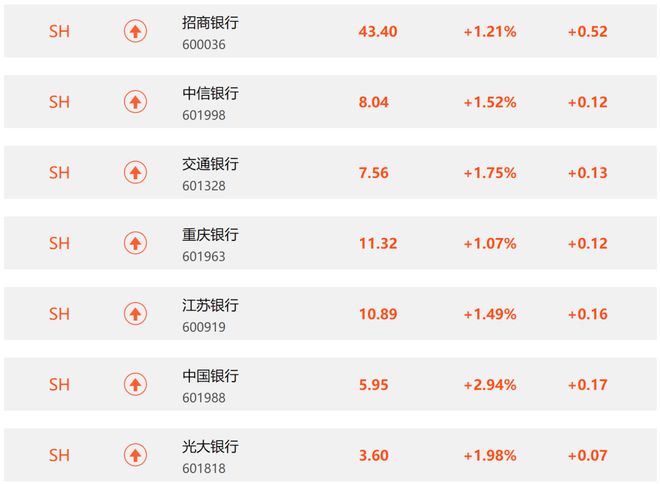
Core Viewpoint - The article provides an overview of the A-share market performance, highlighting the fluctuations in major indices and sector performances, with a focus on the banking sector and specific stocks that have shown significant movements [3][5][9]. Market Performance - As of midday, the Shanghai Composite Index decreased by 0.04%, the Shenzhen Component Index fell by 0.32%, while the ChiNext Index rose by 0.12% [3]. - The total trading volume in the Shanghai and Shenzhen markets reached 1.11 trillion yuan, a decrease of 176.7 billion yuan compared to the previous trading day, with over 4,500 stocks declining [4]. Sector Highlights - The top-performing sectors included the shipbuilding sector, lithium extraction from salt lakes, precious metals, beauty care, and oil and gas [3]. - The banking sector showed strength, with China Bank's stock price reaching a new high, increasing by over 2% [5][6]. Notable Stocks - China Bank's stock rose by 2.60% to 5.93 yuan, while other banks like Everbright Bank and Traffic Bank also saw gains of 1.98% and 1.75%, respectively [6]. - Several high-position stocks continued to decline, with some experiencing limit-down situations [6]. Additional Market Indicators - The shipping index for European routes dropped over 2%, currently at 1649 points [5]. - Lithium carbonate futures saw an increase of over 4% during the day [7]. International Market Context - The Hong Kong market opened with the Hang Seng Index up by 0.09%, and notable gains were seen in companies like Baidu and XPeng Motors [10]. Economic Indicators - The People's Bank of China conducted a 31.05 billion yuan reverse repurchase operation with a rate of 1.40%, while the previous day's reverse repos amounted to 19.55 billion yuan [11]. - The central parity rate of the RMB against the USD was reported at 7.0872, depreciating by 16 basis points from the previous day [12].




区域银行频获增持,银行ETF天弘(515290)规模近62亿元,机构:银行营收端增速有望持续改善
2 1 Shi Ji Jing Ji Bao Dao· 2025-11-19 03:31
Group 1 - The A-share market showed a positive trend on November 19, with the banking index rising by 0.93% [1] - The Tianhong Bank ETF (515290) recorded a trading volume exceeding 35 million yuan, indicating strong investor interest [1] - Major banks such as Bank of China, Everbright Bank, and Postal Savings Bank saw their stock prices increase by over 2% [1] Group 2 - As of November 18, the Tianhong Bank ETF had a total scale of nearly 6.2 billion yuan, covering 42 listed banks across various categories [2] - There has been significant insider buying in regional banks this year, with several banks announcing plans for share buybacks in November [2] - Securities firms noted that the profit growth rate for listed banks improved in Q3, driven by reduced provisioning, stabilized net interest margins, and improved wealth management income [2]


中国银行股价创新高
Di Yi Cai Jing Zi Xun· 2025-11-19 02:53
Core Points - Bank stocks experienced a volatile rise on November 19, with notable gains among several banks [1] - China Bank's stock price reached a new high, increasing by over 2% [1] Group 1: Stock Performance - China Bank's stock rose by 2.94%, reaching a price of 5.95 [2] - Everbright Bank's stock increased by 1.98%, with a price of 3.60 [2] - Jiangsu Bank's stock saw a rise of 1.49%, priced at 10.89 [2] - Traffic Bank's stock rose by 1.75%, reaching 7.56 [2] - Chongqing Bank's stock increased by 1.07%, priced at 11.32 [2] - CITIC Bank's stock rose by 1.52%, with a price of 8.04 [2] - China Merchants Bank's stock increased by 1.21%, priced at 43.40 [2]
交通银行青岛分行:深耕中国特色金融文化建设奋力书写精彩“五篇大文章”
Xin Lang Cai Jing· 2025-11-19 02:35
Core Viewpoint - The establishment of a strong financial culture rooted in Chinese characteristics is essential for the development of a financial powerhouse, emphasizing the importance of integrating traditional culture into modern financial practices [1][2]. Financial Culture Development - The Qingdao Branch of Bank of Communications emphasizes the cultivation and promotion of Chinese financial culture as a key task, integrating it into all aspects of its operations [2][3]. - The bank's leadership prioritizes the establishment of a unified leadership structure to enhance compliance and governance, ensuring adherence to laws and regulations [2][3]. Compliance and Risk Management - The bank has made compliance culture a top priority, conducting extensive education and training on internal controls and compliance, fostering a culture of compliance among all employees [3][4]. - Regular analysis of typical cases and the creation of warning materials are employed to educate employees on correct operational and risk perspectives [4]. Innovation and Service Quality - The bank focuses on "guarding integrity while innovating," ensuring that financial services remain grounded in real economic needs while continuously innovating products and services [5][6]. - As of August, the bank's loans to technology enterprises reached 24.987 billion, with a year-to-date increase of 4.418 billion, reflecting a growth rate of 21.48% [6]. Green and Inclusive Finance - The bank actively supports green finance initiatives, with green loan balances exceeding 32 billion as of August, and is involved in projects that integrate clean energy with modern agriculture [7]. - The bank's inclusive finance strategy has resulted in a 27% increase in inclusive loans, demonstrating its commitment to supporting small and micro enterprises [8]. Rural and Elderly Financial Services - The bank has tailored its services to support rural revitalization, with agricultural loans increasing by over 10% year-to-date, significantly outpacing other loan categories [8]. - The bank has developed a comprehensive pension financial service system, opening 344,600 personal pension accounts and increasing loans to the elderly care industry by over 83% [12]. Digital Financial Services - The bank enhances customer experience through digital financial services, including the establishment of a comprehensive online platform for public services, facilitating over 80 self-service transactions [9]. - The bank has implemented a leading digital RMB payment system, expanding its application scenarios in the local economy [9]. Commitment to Social Responsibility - The bank adheres to the principle of "finance for the people," serving nearly 4.95 million citizens, which is about 50% of the local population, and has been recognized for its consumer rights protection efforts [11][13]. - The bank has introduced innovative services for flexible employment and retirement, receiving national recognition for its contributions to social security [12].
又有银行股创新高!中国银行涨近3%创历史新高
Ge Long Hui A P P· 2025-11-19 02:34
Core Insights - The A-share market saw a collective rise in bank stocks, with notable increases in China Bank, which rose nearly 3%, and other banks like Everbright Bank, Bank of Communications, and Agricultural Bank of China also showing gains of over 1% [1] Summary by Category Stock Performance - China Bank increased by 2.77%, reaching a total market capitalization of 191.39 billion, with a year-to-date increase of 12.62% [2] - Everbright Bank rose by 1.98%, with a market cap of 21.27 billion and a year-to-date decline of 2.61% [2] - Bank of Communications saw a 1.75% increase, with a market cap of 66.80 billion and a year-to-date increase of 2.38% [2] - Agricultural Bank of China increased by 1.10%, with a market cap of 289.79 billion and a year-to-date increase of 62.02% [2] - Other banks such as Construction Bank, Jiangsu Bank, and Industrial and Commercial Bank of China also reported gains, with year-to-date increases ranging from 15.34% to 25.13% [2] Historical Performance - China Bank reached a new historical high, following similar achievements by Agricultural Bank and Industrial and Commercial Bank [1]

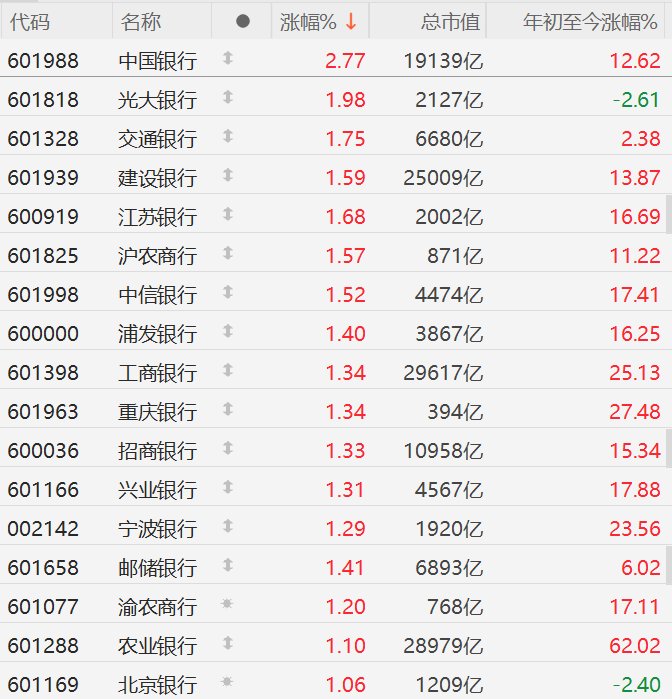
银行股震荡走高,中国银行涨近2%
Mei Ri Jing Ji Xin Wen· 2025-11-19 02:34
Core Viewpoint - Bank stocks experienced fluctuations but ultimately rose, with notable gains in several major Chinese banks on November 19 [1]. Group 1: Stock Performance - China Bank saw an increase of nearly 2% [1]. - Other banks that performed well include Everbright Bank, Jiangsu Bank, Transportation Bank, Chongqing Bank, Citic Bank, and China Merchants Bank, which had significant gains [1].
年内133家公司实施定增,合计募资8397.72亿元
Zheng Quan Shi Bao Wang· 2025-11-19 01:55
Core Points - A total of 133 companies have implemented private placements this year, raising a total of 839.77 billion yuan [1] - The companies involved in private placements span across 24 industries, with the most active sectors being electronics, power equipment, and basic chemicals [1] - The largest fundraising amounts were recorded in the banking sector, with China Bank leading at 165 billion yuan [2] Group 1: Fundraising Overview - 133 companies have conducted private placements, with a total of 1,060.52 million shares issued and a cumulative fundraising amount of 839.77 billion yuan [1] - The distribution of fundraising by market shows that the Shanghai main board raised 706.55 billion yuan, while the Shenzhen main board raised 489.93 billion yuan [1] - The number of companies that raised over 100 billion yuan is 10, while 11 companies raised between 50 billion and 100 billion yuan [1] Group 2: Industry Analysis - The banking sector has the highest fundraising amounts, with China Bank raising 165 billion yuan, followed by Postal Savings Bank at 130 billion yuan and Bank of Communications at 120 billion yuan [2] - The electronics industry had 21 companies participating in private placements, while the power equipment sector had 16 companies [1] - The top three industries by fundraising amount are banking (520 billion yuan), non-bank financials (506.84 billion yuan), and electronics (491.56 billion yuan) [1] Group 3: Price Performance - There are 133 records where the latest closing price exceeds the placement price, with the highest premium recorded by AVIC Aircraft at 877.35% [2][3] - The records showing a discount to the placement price include 13 instances, with the largest discount from Shen High-Speed at -22.14% [2][4] - The average premium and discount rates indicate significant price movements post-placement, reflecting market sentiment and investor confidence [2][4]