BANK COMM(601328)

Search documents
科创集市启航!上海交易集团与嘉定携手打造科技金融生态
Sou Hu Cai Jing· 2025-11-17 15:21
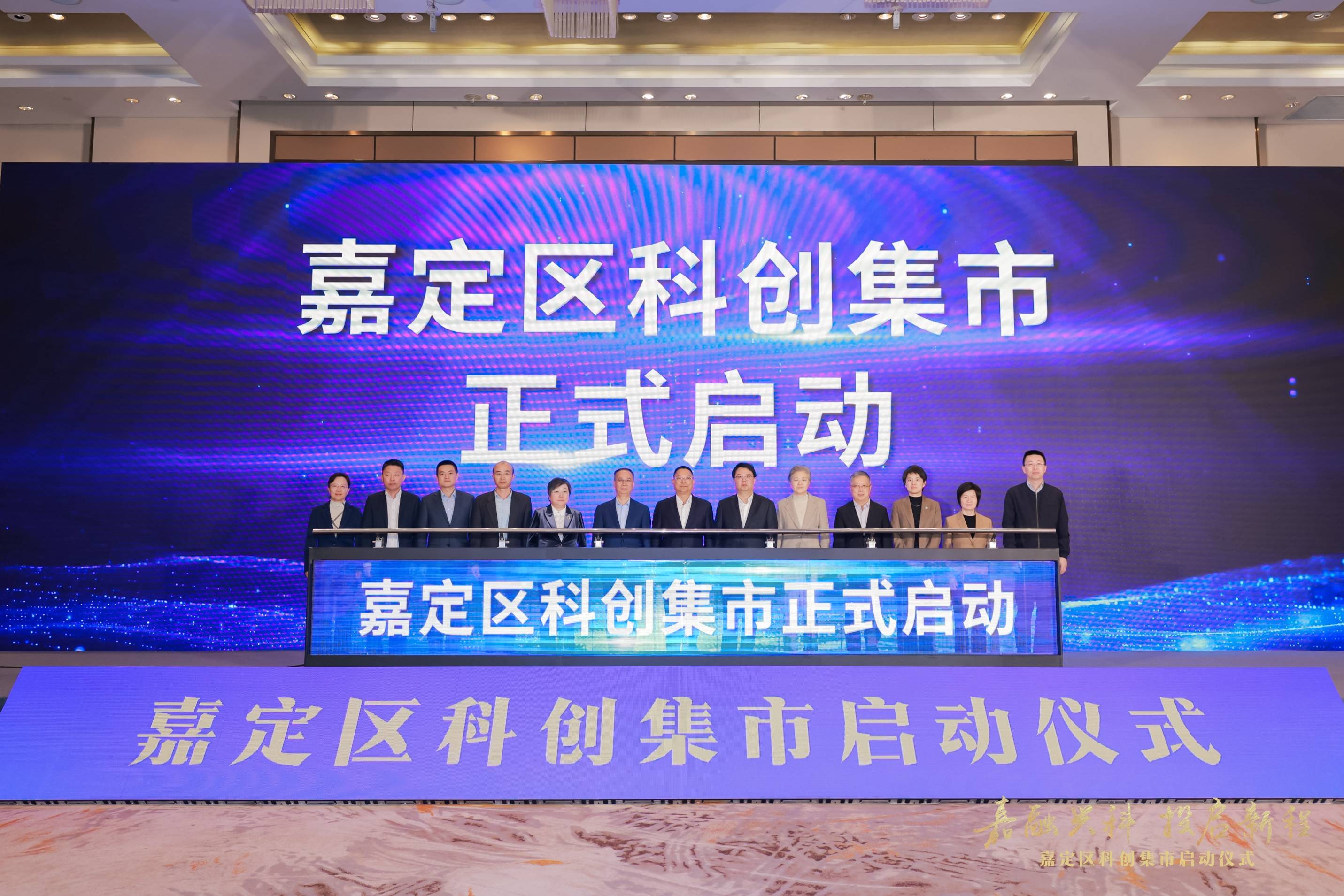
Core Viewpoint - The Shanghai Trading Group and the Jiading District of Shanghai have launched an online section for the "Science and Technology Innovation Market," aiming to bridge the gap between technology and finance, facilitating a comprehensive service platform for information release, resource connection, and policy services [2][5]. Group 1: Platform and Services - The online section is the first of its kind on the Shanghai Trading Group's website, designed to create a "one-stop" service loop that integrates industry layout, support policies, institutional resources, technology projects, and financial support [5]. - The "Science and Technology Innovation Market" will break down information barriers and establish a digital bridge for efficient project-capital connections, accelerating the transformation and implementation of technological achievements [5]. Group 2: Ecosystem and Collaboration - The "Ecological Cooperation Partner Community" of the Jiading District Science and Technology Innovation Market was officially established, focusing on innovation entities such as technology teams and startups, as well as specialized and innovative enterprises throughout their lifecycle [5][8]. - Jiading aims to leverage a dual-driven approach of "city-level platform + district-level ecosystem" to enhance the development of technology-driven enterprises [5][8]. Group 3: Financial Support and Partnerships - The Shanghai Trading Group has developed a one-stop professional service system for technology enterprises, covering financing services, patent and qualification operations, and listing cultivation services [9]. - A total of 10.52 billion yuan in credit was signed on-site between four banks and eight enterprises, indicating strong financial backing for the innovation market [9][12]. - Investment institutions signed agreements with technology companies, with a cumulative signing amount of 3.25 billion yuan, showcasing active capital engagement in the region [12]. Group 4: Investment and Growth - Jiading District has optimized its technology financial service system, focusing on the financial needs throughout the entire lifecycle of enterprises, with a cumulative investment of approximately 8 billion yuan in 93 sub-funds [18]. - The district has 1,343 specialized and innovative enterprises and 36 listed companies, ranking third in Shanghai, with three new companies listed this year [18].




“银行直供房”卷席市场,低于市价!释放了什么信号?
Sou Hu Cai Jing· 2025-11-17 14:12
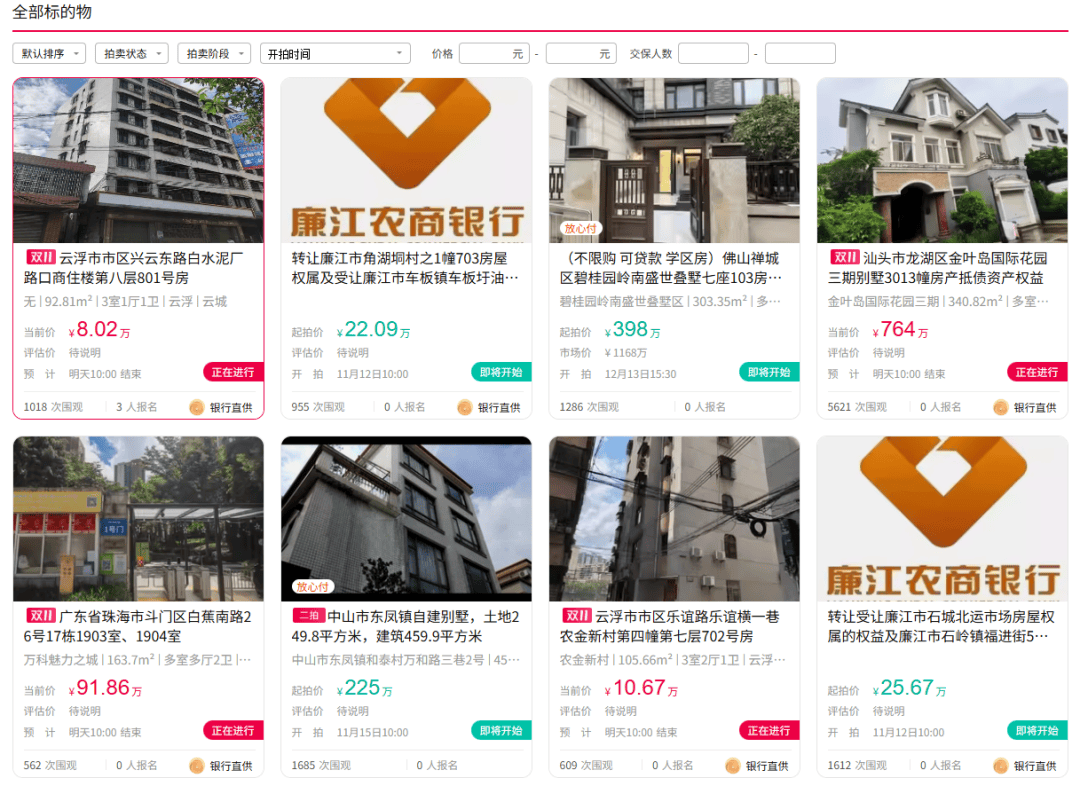
Core Viewpoint - A wave of property asset disposals led by banks is emerging, with "bank direct supply housing" being sold through online platforms like Alibaba and JD.com, indicating a shift in asset management strategies within the banking sector [1][3]. Group 1: Market Dynamics - Banks are accelerating property disposals primarily to enhance debt recovery rates during the real estate market adjustment period, with direct sales becoming a new choice for quickly revitalizing assets [3][4]. - "Bank direct supply housing" offers significant price advantages, often priced below market rates compared to regular second-hand and auctioned properties [4][5]. - As of November 10, 2023, JD.com’s asset trading platform lists 414 residential and 957 commercial properties for auction, significantly exceeding the same period last year [5]. Group 2: Pricing and Sales Strategy - For example, a 125 square meter property auctioned by Lanzhou Rural Commercial Bank sold for 1.51 million yuan, while similar properties in the area were listed between 1.8 million and 2.2 million yuan [4]. - The auction platforms are promoting these properties with slogans like "bank direct supply, sold at no cost," highlighting the aggressive pricing strategy [4][5]. Group 3: Bank Participation and Trends - City commercial banks and rural credit cooperatives are the main players in this direct sale trend, with significant numbers of properties listed for sale, such as over 2,000 by Jilin Bank and nearly 1,300 by Tianjin Bank [9]. - Large state-owned and joint-stock banks are also increasing their direct sales, with Agricultural Bank of China listing 3,436 properties and China Construction Bank 1,571 properties [9][10]. Group 4: Operational Efficiency and Cost Reduction - The direct sale process allows banks to recover funds faster, reducing the time from six months in judicial auctions to about three months [14]. - By bypassing traditional auction costs, banks can retain more revenue from sales, creating a beneficial cycle of "discounting to sell quickly" [15]. Group 5: Strategic Insights and Future Directions - This direct sale trend serves as a market research tool for banks to understand pricing dynamics and property values, which can inform future lending policies [15][16]. - Banks are also exploring partnerships with asset management companies to bundle these properties into real estate investment trusts, transitioning from a "heavy asset" to a "light asset" model [16]. Group 6: Risk Assessment and Market Impact - There are differing opinions on the impact of these direct sales on the real estate market, with some analysts suggesting potential pressure on prices in certain cities, while others believe the scale is too small to significantly affect overall market prices [18][19]. - The risk associated with bank-held properties is considered manageable, particularly in first and second-tier cities, where property values are more stable [18].


银行三季度净息差环比持平,股份行回升1BP!三类银行机构利润下滑
Xin Lang Cai Jing· 2025-11-17 12:24
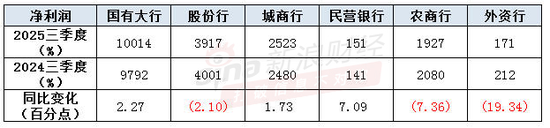
Core Insights - The banking sector in China reported a slight decline in net profit for the first three quarters of 2025, with a total of 1.87 trillion yuan, representing a year-on-year decrease of 0.02%, although the decline has narrowed compared to the first half of the year [1][6] Profitability - State-owned banks, city commercial banks, and private banks saw an increase in net profit, with private banks leading at a growth rate of 7.09% [1][3] - The net profit for state-owned banks was 1.00 trillion yuan, while city commercial banks and private banks reported 252.3 billion yuan and 15.1 billion yuan, respectively [3] - In contrast, joint-stock banks, rural commercial banks, and foreign banks experienced declines in net profit, with decreases of 2.1%, 7.36%, and 19.34%, respectively [1][3] Net Interest Margin - The net interest margin (NIM) for commercial banks remained stable at 1.42% in Q3, with private banks having the highest NIM at 3.83% [1][8] - State-owned banks had the lowest NIM at 1.31%, while joint-stock banks saw a slight increase of 0.01 percentage points to 1.56% [8][9] - Year-on-year, all types of banks experienced a decline in NIM, with state-owned and rural commercial banks both down by 0.14 percentage points [9][10] Asset Quality - As of the end of Q3 2025, the non-performing loan (NPL) balance for commercial banks was 3.5 trillion yuan, with an NPL ratio of 1.52%, reflecting a slight increase of 0.03 percentage points from the previous quarter [13][14] - Foreign banks had the lowest NPL ratio at 1.06%, while rural commercial banks had the highest at 2.82% [14] - Only state-owned banks saw a decrease in NPL ratios compared to the end of the previous year, while other types of banks experienced varying degrees of increase [14] Provision Coverage - The loan loss provision balance for commercial banks was 7.3 trillion yuan, with a provision coverage ratio of 207.15%, both showing a decrease from the previous quarter [16]



国有大型银行板块11月17日跌1.51%,邮储银行领跌,主力资金净流出8.86亿元
Zheng Xing Xing Ye Ri Bao· 2025-11-17 08:49
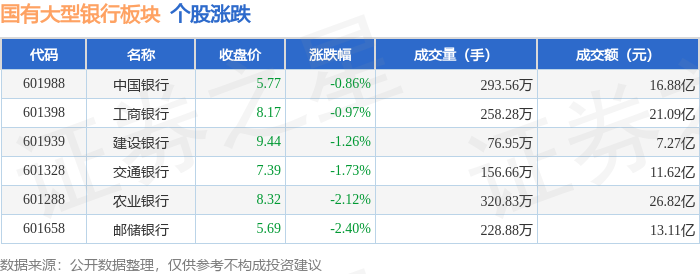
Core Points - The state-owned large bank sector experienced a decline of 1.51% on November 17, with Postal Savings Bank leading the drop [1] - The Shanghai Composite Index closed at 3972.03, down 0.46%, while the Shenzhen Component Index closed at 13202.0, down 0.11% [1] Group 1: Market Performance - The closing prices and percentage changes for major state-owned banks are as follows: - Bank of China: 5.77, -0.86% - Industrial and Commercial Bank of China: 8.17, -0.97% - China Construction Bank: 9.44, -1.26% - Bank of Communications: 7.39, -1.73% - Agricultural Bank of China: 8.32, -2.12% - Postal Savings Bank: 5.69, -2.40% [1] Group 2: Fund Flow Analysis - The net outflow of main funds from the state-owned large bank sector was 8.86 billion yuan, while retail funds saw a net inflow of 3.06 billion yuan [1] - The detailed fund flow for individual banks shows significant net outflows for major banks, with Postal Savings Bank experiencing a net outflow of 219 million yuan [2]
研报掘金丨长江证券:维持交通银行“买入”评级,具备估值修复空间和弹性
Ge Long Hui A P P· 2025-11-17 07:56
Core Viewpoint - State-owned banks are currently undergoing a systematic valuation repair process, with recent mid-term dividends accelerating the revaluation [1] Group 1: Valuation and Dividend Insights - Bank of Communications has the lowest PB valuation among state-owned banks in A-shares and the highest expected dividend yield for 2025, indicating potential for valuation recovery and elasticity [1] - The retail asset quality in the banking sector is under pressure, with Bank of Communications experiencing a quarter-on-quarter increase in retail loan non-performing loan (NPL) ratio, consistent with industry trends [1] Group 2: Financial Performance Metrics - The net interest margin (NIM) for the first three quarters of this year is 1.20%, with the cumulative decline since 2023 being the lowest among state-owned banks at only 8 basis points [1] - Given the current absolute value of NIM being the lowest among state-owned banks and the historically high cost of liabilities, there is significant room for improvement in future liability costs, which is expected to support NIM stabilization and drive ROE towards the average of state-owned banks [1] Group 3: Investment Recommendation - The company is optimistic about the driving force of allocation pushing for valuation recovery and maintains a "buy" rating [1]
银行业发展图景:在复杂环境中蓄势突围,于转型攻坚中彰显韧性
2 1 Shi Ji Jing Ji Bao Dao· 2025-11-17 05:40
Core Insights - The global economic recovery in 2025 is characterized by increasing divergence and intertwined risks, impacting the stability of the global financial system [1] - The Chinese banking industry is experiencing a period of transformation, focusing on quality improvement and efficiency enhancement as core strategic anchors [1][3] - The overall resilience and risk resistance of the banking sector have been further highlighted through structural adjustments and precise support for the real economy [1][3] Financial Performance - In the first half of 2025, A-share listed banks reported stable growth in revenue and net profit, with total revenue reaching 2.92 trillion yuan, a 1% year-on-year increase, and net profit of 1.1 trillion yuan, up 0.8% [3][4] - The net interest margin for A-share listed banks was 1.53%, down 8 basis points from the beginning of the year, but the decline was less severe compared to the previous year [5][6] - The six major state-owned banks contributed significantly to the industry's stability, with total revenue of 1.83 trillion yuan and net profit of 682.52 billion yuan, accounting for over 60% of the total for A-share listed banks [4] Industry Trends - The banking sector is shifting from a focus on scale and speed to a differentiated development path emphasizing quality and effectiveness, as highlighted by the central government's call to prevent "involution" [7][8] - Non-interest income for listed banks grew by 6.97% year-on-year in the first half of 2025, indicating a move towards a diversified income structure [10][11] - The integration and restructuring of small and medium-sized banks have accelerated, with 326 banks exiting the market by mid-October 2025, reflecting a significant optimization of the industry structure [14][15] Strategic Initiatives - Banks are increasingly focusing on non-credit services and high-quality development, with many emphasizing the importance of non-interest income and cost management [9][10] - The trend of "merging and restructuring" among small and medium-sized banks is seen as a key measure for risk prevention and enhancing local financial ecosystems [14][16] - State-owned banks are leading the way in acquiring village banks, enhancing regional financial stability and providing a model for smaller banks [15]
年底“冲量”压力下多家银行密集提示经营贷合规风险,释放何种信号?
Xin Lang Cai Jing· 2025-11-17 05:01
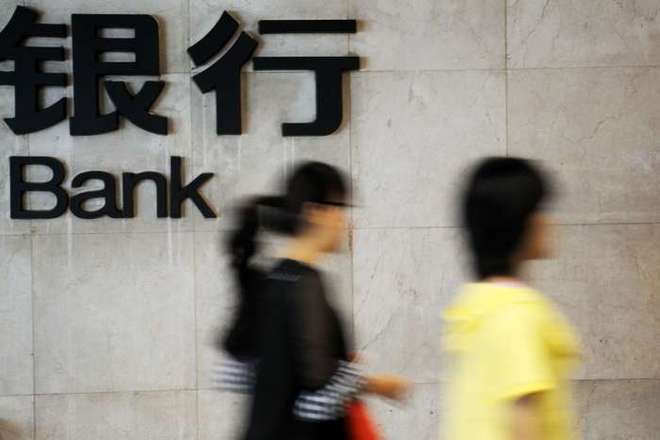
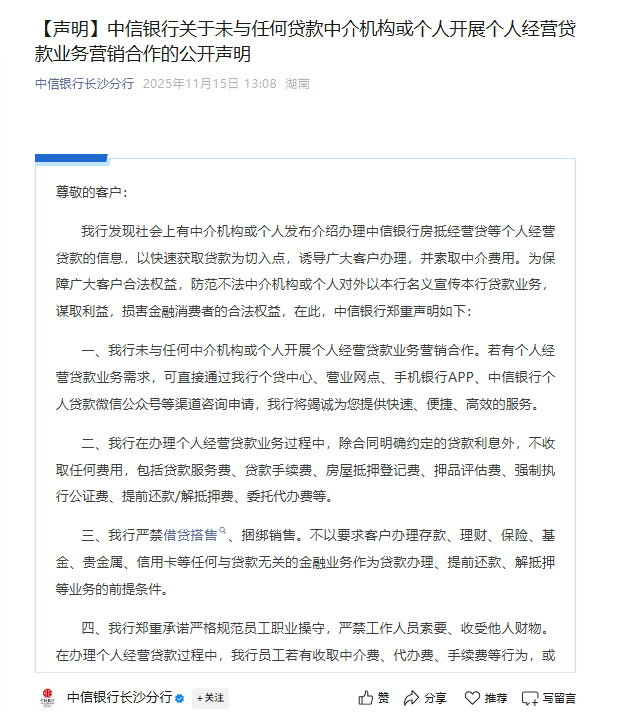
Core Viewpoint - Multiple banks, including CITIC Bank, have issued warnings regarding fraudulent activities related to personal business loans, highlighting the risks posed by intermediaries posing as bank representatives [1][2][4]. Group 1: Bank Warnings and Fraud Alerts - CITIC Bank's Changsha branch announced that it has not partnered with any intermediaries for personal business loan marketing and warned customers against fraudulent schemes [2][4]. - Other banks, such as Postal Savings Bank and Traffic Bank, have also issued alerts about intermediaries misrepresenting their services and soliciting fees from customers [4][5]. - The warnings come as several banks are under pressure to meet year-end lending targets, which may lead to increased vigilance against fraudulent activities [5][6]. Group 2: Loan Market Conditions - The demand for personal business loans has been declining, with banks reporting a decrease in applications and existing loan amounts [6][7]. - Some banks have seen a rise in overdue loans, indicating potential risks in the current lending environment [6][7]. - The economic climate and ongoing declines in real estate prices are contributing to banks' cautious approach towards issuing new business loans [7].

本周各银行在售“固收+”产品哪家强?
2 1 Shi Ji Jing Ji Bao Dao· 2025-11-17 01:20
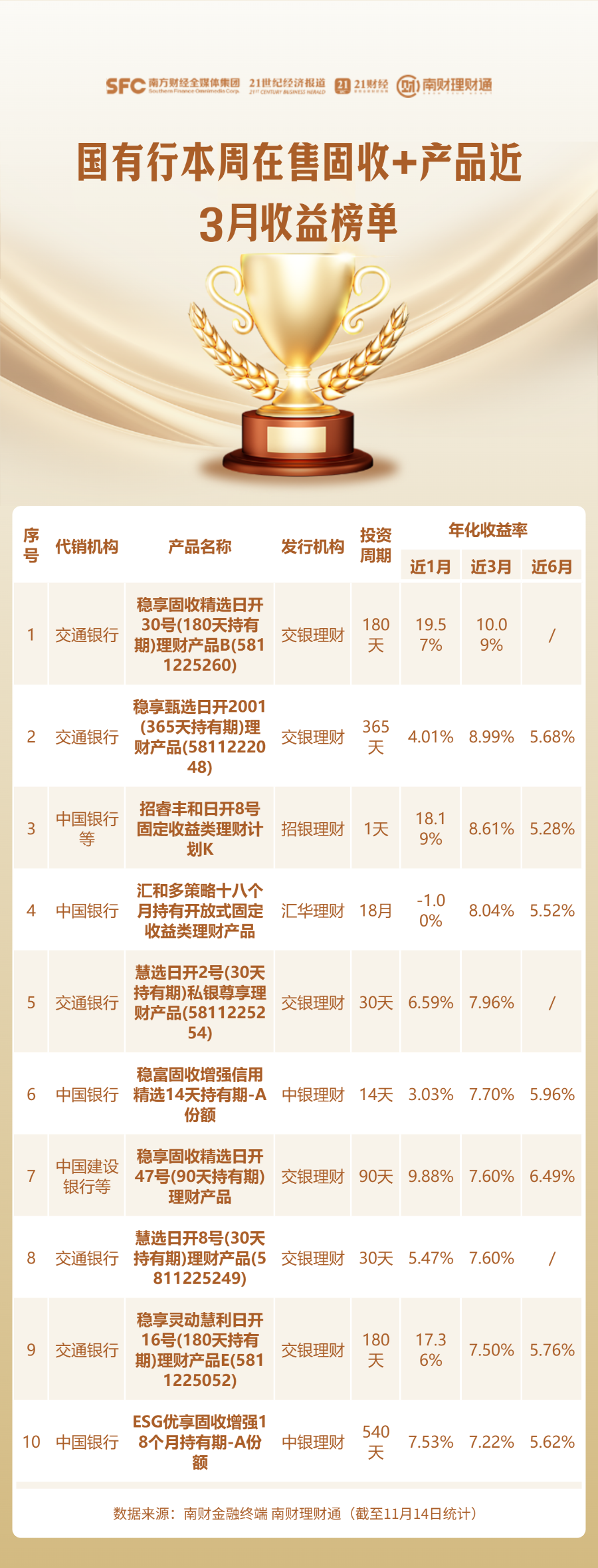
Core Viewpoint - The article emphasizes the importance of selecting suitable wealth management products, particularly "fixed income+" products, from various banks, highlighting the need for investors to discern among numerous similar offerings [1][5]. Summary by Category Performance Ranking - The article presents a performance ranking of wealth management products based on their annualized returns over the past month, three months, and six months, with a focus on the three-month annualized yield for recent market performance [1][5]. Institutions Involved - A total of 28 banks are involved in the distribution of these wealth management products, including major institutions such as Industrial and Commercial Bank of China, Bank of China, Agricultural Bank of China, and others [1]. Product Selection - The ranking aims to assist investors in identifying high-performing products, with specific attention to the "fixed income+" category, which has gained popularity among investors seeking stable returns [1][5]. Market Dynamics - The article notes that the availability of these products may vary due to factors such as sold-out quotas or differences in product listings across banks, suggesting that investors should verify product availability through the respective bank's app [1].




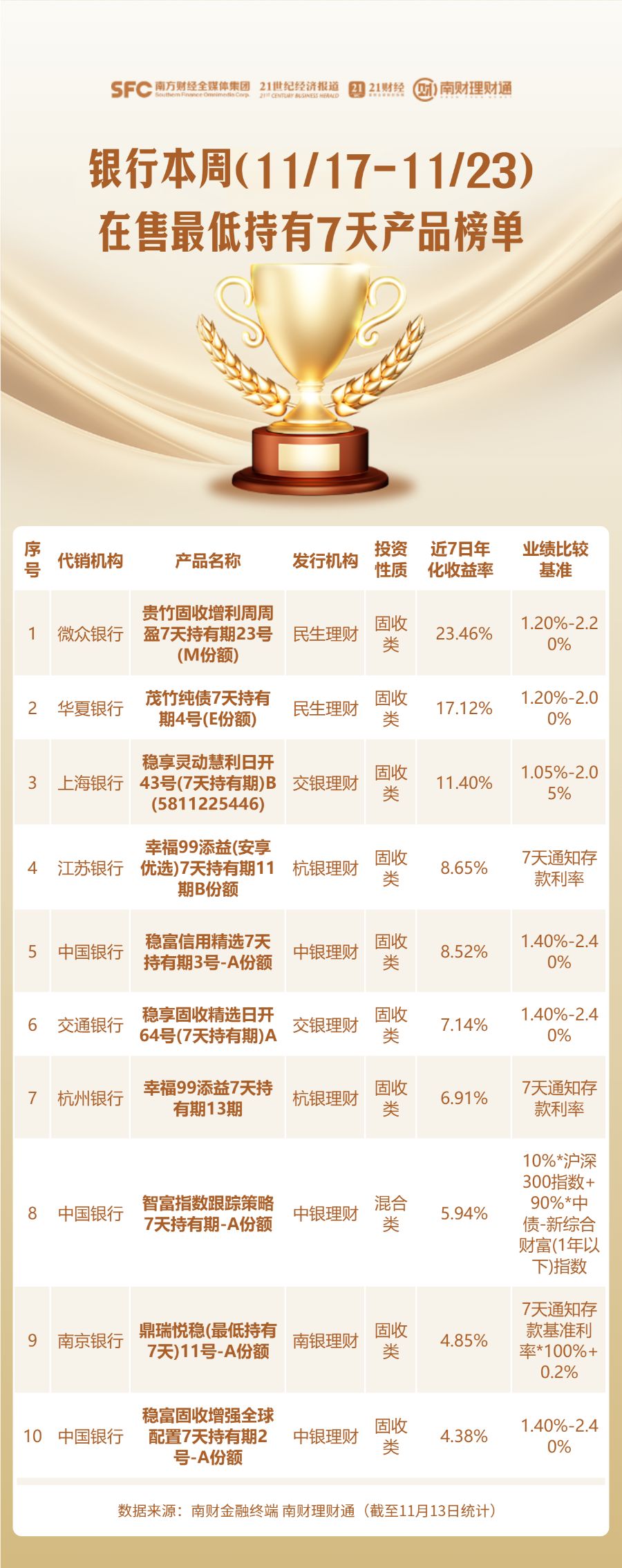
最低持有期榜单出炉!互联网银行7天持有期代销产品收益最高
2 1 Shi Ji Jing Ji Bao Dao· 2025-11-17 01:20
Core Insights - The article focuses on the performance of bank wealth management products with varying minimum holding periods, aiming to help investors identify and select high-performing products [1][5][12] Summary by Category Performance Rankings - The article provides a ranking of wealth management products based on their annualized returns for different holding periods: 7 days, 14 days, 30 days, and 60 days [1][5][12] - For the 7-day holding period, the top-performing product is from Minsheng Bank with an annualized return of 17.12% [4] - For the 14-day holding period, Minsheng Bank's product also leads with a return of 19.88% [6] - In the 30-day category, Minsheng Bank again tops the list with a return of 21.98% [10] - The 60-day holding period shows a leading return of 9.74% from Minsheng Bank [13] Product Categories - The products are categorized into fixed income and mixed types, with specific focus on their respective annualized returns and performance benchmarks [4][10][13] - The rankings are based on data from 28 distribution institutions, including major banks like ICBC, Bank of China, and Agricultural Bank of China [1] Investor Guidance - The article emphasizes the importance of checking the actual availability of products on bank apps, as some may be sold out or not displayed uniformly across different clients [1] - It aims to reduce the selection cost for investors by providing a clear performance overview of available products [1][5]
贴息“红包”撬动消费潜能
Xin Hua Wang· 2025-11-17 00:15
Core Viewpoint - The implementation of the "Personal Consumption Loan Interest Subsidy Policy" aims to stimulate consumer spending and support economic growth by reducing the cost of consumer credit through government subsidies [1] Group 1: Policy Implementation and Impact - The subsidy policy began in September and is designed to lower the cost of consumer loans, thereby enhancing consumer purchasing power and promoting economic recovery [1] - The policy is expected to work synergistically with other initiatives, such as the "old-for-new" consumption policy, creating a greater overall impact on consumer spending [1] - As of the end of October, nearly 1 million customers had signed subsidy agreements, with over 1.8 million transactions recognized as eligible for the subsidy [3] Group 2: Consumer Experience and Benefits - Consumers have reported significant savings; for example, one individual saved over 1,000 yuan in interest on a loan for home appliances due to the subsidy [2] - The process for consumers to access the subsidy has been streamlined, with many banks implementing systems that automatically recognize eligible transactions, making it easier for consumers to benefit from the policy [2][3] - The policy has led to a notable increase in the adoption of interest-free installment payments, particularly during major shopping events like "Double 11," where the coverage of interest-free products increased by 60% [5] Group 3: Financial Institutions' Role - Financial institutions have adapted their services to facilitate the subsidy, with banks creating dedicated teams to ensure compliance and efficiency in processing applications [3] - The Agricultural Bank of China reported that it had provided 1.2 billion yuan in subsidized loans, benefiting over 10,000 customers [8] - Traffic Bank has also streamlined its processes, issuing over 320 million yuan in personal consumption loans, with a significant portion allocated to automobile purchases [13] Group 4: Broader Economic Implications - The collaboration between fiscal and financial tools is seen as a way to enhance the effectiveness of government spending and lower consumer financing costs, ultimately improving living standards [9] - The policy has encouraged businesses to offer additional discounts and incentives, further stimulating consumer demand and contributing to economic growth [5][10]