NCI(601336)
Search documents
保险资金持续加码权益市场
Jin Rong Shi Bao· 2025-09-03 00:50
Group 1: Industry Overview - Insurance companies listed on A-shares have significantly increased their allocation to equity assets, with a total stock investment scale of nearly 1.8 trillion yuan as of June 30, 2025, an increase of 405.36 billion yuan from the end of 2024, reflecting strong confidence in the stock market [1] - By the end of Q2 2025, the total amount of insurance funds invested in stocks reached 3.07 trillion yuan, up approximately 640 billion yuan from the end of Q4 2024, indicating a proactive approach to seizing investment opportunities in equity assets [1] Group 2: China Life Insurance - As of June 30, 2025, China Life's investment assets reached 71,271.53 billion yuan, a growth of 7.8% from the end of 2024, with total investment income of 1,275.06 billion yuan, a year-on-year increase of 4.2% [3] - China Life has significantly increased its equity asset allocation, adding over 150 billion yuan in the first half of the year, with stock investments totaling 620.14 billion yuan, an increase of 119.05 billion yuan from the end of 2024, raising its proportion from 7.58% to 8.70% [3] Group 3: China Ping An - As of June 30, 2025, China Ping An's stock investment scale reached 649.29 billion yuan, an increase of 211.92 billion yuan or 48.5% from the end of 2024, with stock investments accounting for 10.5% of total investments, up 2.9% [4] - The company plans to focus on new productive forces and high-dividend value stocks for future equity investments [4] Group 4: China Pacific Insurance - In the first half of 2025, China Pacific Insurance's stock scale reached 283.13 billion yuan, an increase of 28.06 billion yuan, with core equity (stocks and equity funds) accounting for 11.8% of total assets, up 0.6% from the end of the previous year [5] Group 5: China Reinsurance - As of June 30, 2025, China Re's stock investment totaled 152.13 billion yuan, an increase of 11.95 billion yuan from the end of 2024, with a notable rise in high-dividend OCI-type investments from 30.64 billion yuan to 37.47 billion yuan, an increase of 6.83 billion yuan [7] - The company emphasizes the value of high-dividend stock allocations, which provide stable cash flow and investment returns [7]
上市险企半年报:总投资收益增9%,新华保险收益率领跑行业
Sou Hu Cai Jing· 2025-09-02 19:43
Core Insights - The five major listed insurance companies in the A-share market have released their semi-annual reports for 2025, highlighting significant investment dynamics and performance in the capital market [1] Investment Dynamics - The total stock investment of the five major insurance companies reached 1,846.43 billion yuan by the end of Q2, an increase of 411.86 billion yuan from the beginning of the year, reflecting a nearly 30% growth [1] - This increase indicates the insurance companies' confidence in the equity market and recognition of long-term investment value [1] Investment Performance - The five major insurance companies collectively achieved a total investment income of 367.38 billion yuan in the first half of the year, representing a year-on-year growth of nearly 9% [1] - China Life Insurance led with a total investment income of 127.51 billion yuan, accounting for over 30% of the total, attributed to its large investment asset scale [1] - New China Life Insurance reported an annualized total investment return rate of 5.9%, leading the industry and showcasing its efficient investment strategy [2] Return Rate Disparity - There is a notable disparity in the total investment return rates among the insurance companies, with New China Life and China Pacific Insurance achieving annualized rates of 5.9% and 5.1%, respectively, both showing significant year-on-year growth [2] - In contrast, China Life and China Taiping reported lower return rates of 3.29% and 2.3%, respectively [2] - China Ping An did not disclose its annualized return rate but achieved a non-annualized comprehensive investment return rate of 3.1%, up by 0.3 percentage points year-on-year [2] Asset Scale and Strategy - China Life and China Ping An are in the leading tier with investment assets of 7.13 trillion yuan and 6.20 trillion yuan, respectively [2] - China Taiping, China Pacific Insurance, and New China Life follow closely, with their asset scales gradually converging [2] - The differentiation in asset scale influences the investment strategies and performance of each insurance company [2] Market Adaptation - In response to low bond market interest rates and structural differentiation in the stock market, insurance funds have become a crucial stabilizing force in the capital market [2] - Insurance companies are adjusting their asset allocation strategies to adapt to market changes, such as New China Life expanding its equity layout through private equity funds and China Life increasing its allocation to high-dividend assets [2] Investment Strategy Implementation - China Ping An's co-CEO emphasized that the investment strategy is integral to the company's asset matching, focusing on duration, cost, cash flow, yield, and regulatory requirements to achieve a linkage between investment and liability [4] - This precise implementation of investment strategy allows China Ping An to maintain stable investment returns even in complex market conditions [4] - The trend of increasing stock asset allocation among insurance companies is expected to enhance investment returns and promote stable development in the capital market [4] Overall Performance - The five major listed insurance companies demonstrated robust investment styles and flexible market adaptability in their first-half investment performance [4] - As market conditions continue to evolve, these companies will further adjust and optimize their investment strategies to achieve more sustainable and efficient investment returns [4]
4家上市险企中期分红近300亿元
Bei Jing Shang Bao· 2025-09-02 16:30
Core Viewpoint - The five major listed insurance companies in A-shares announced their mid-term profit distribution plans alongside their 2025 semi-annual reports, with a total dividend amount of approximately 29.336 billion yuan (including tax) [1][3]. Group 1: Profit Distribution - China Ping An plans to distribute a mid-term cash dividend of 0.95 yuan per share, totaling 17.202 billion yuan, with a year-on-year increase of 2.2% in the dividend per share [3][4]. - China Life, China Pacific Insurance, and New China Life plan to distribute mid-term cash dividends of 6.727 billion yuan, 3.317 billion yuan, and 2.09 billion yuan, respectively, contributing to the total dividend of approximately 29.336 billion yuan [3][4]. Group 2: Financial Performance - In the first half of the year, the five major listed insurance companies achieved a total net profit of 178.192 billion yuan, representing a year-on-year growth of 3.7% [3][5]. - The capital market recovery has led to a significant increase in investment income for many listed insurance companies [3]. Group 3: Dividend Policy and Market Impact - Stable dividends enhance market confidence and help shape a robust operational image, attracting long-term value investors [4]. - High dividends can better reward investors but may constrain the company's internal capital accumulation and potential investment capabilities [5]. Group 4: Accounting Standards and Future Outlook - The implementation of new financial instrument standards has increased the volatility of net profits, affecting the continuity and stability of dividend policies [6]. - Companies are considering long-term growth and regulatory guidelines when formulating their dividend policies, aiming for sustainable returns for shareholders [6][7].
资本充足与回馈股东,上市险企中期分红背后的平衡术
Bei Jing Shang Bao· 2025-09-02 13:07
Core Viewpoint - The five major listed insurance companies in A-shares announced a total mid-term profit distribution plan amounting to approximately 29.336 billion yuan (including tax) alongside their 2025 semi-annual reports, reflecting a balance between shareholder returns and business development needs [2][3]. Group 1: Profit Distribution - The total mid-term dividend amount from the four companies, excluding China Pacific Insurance, is approximately 29.336 billion yuan, with China Ping An distributing 17.202 billion yuan, China Life 6.727 billion yuan, China Pacific Insurance 3.317 billion yuan, and New China Life 2.090 billion yuan [3][4]. - China Ping An has maintained a continuous increase in dividends over the past decade, with a mid-term cash dividend of 0.95 yuan per share, representing a year-on-year growth of 2.2% [3][4]. Group 2: Financial Performance - In the first half of the year, the five major listed insurance companies achieved a total net profit of 178.192 billion yuan, marking a year-on-year increase of 3.7% [3]. - The improvement in investment income is attributed to the recovery of the capital market, while key indicators of insurance business have also improved due to factors like the adjustment of preset interest rates and optimization of liability costs [3][6]. Group 3: Dividend Policy Considerations - Insurance companies need to balance shareholder returns with their own business development, considering factors such as investment income volatility and solvency levels [2][6]. - The implementation of new financial instrument standards has increased profit volatility, which may affect the continuity and stability of dividend policies [6][7]. - Executives from various insurance companies emphasized the importance of stable long-term dividend growth while considering regulatory guidelines and industry conditions [6][7]. Group 4: Future Outlook - Despite increased profit volatility due to new financial standards, insurance companies are expected to maintain dividend policy continuity through mechanisms like smoothing distribution and adjusting dividend ratios [7]. - The industry is anticipated to focus more on shareholder returns, with a long-term goal of stable growth in per-share dividends, supported by improved profitability and optimized liability costs [7].
金融中报观|资本充足与回馈股东,上市险企中期分红背后的平衡术
Bei Jing Shang Bao· 2025-09-02 12:11
Core Viewpoint - The five major listed insurance companies in A-shares announced their mid-term profit distribution plan, with a total dividend amount of approximately 29.336 billion yuan (including tax) [1][3]. Group 1: Dividend Distribution - The five major listed insurance companies, excluding China Pacific Insurance, announced mid-term dividends, with China Ping An distributing 17.202 billion yuan, China Life 6.727 billion yuan, China Pacific Insurance 3.317 billion yuan, and New China Life 2.090 billion yuan [3][4]. - The total net profit of these five companies reached 178.192 billion yuan in the first half of the year, reflecting a year-on-year growth of 3.7% [3][5]. - The mid-term dividend distribution is seen as "stable and slightly positive," aligning with the companies' profitability while balancing shareholder returns and capital safety [3][4]. Group 2: Dividend Policy and Market Impact - The continuous dividend policy of these companies enhances market confidence and attracts long-term value investors, contributing to their market capitalization management [4]. - High dividends can improve shareholder returns but may restrict internal capital accumulation and potential investment capabilities [5]. - The implementation of new financial instrument standards has increased profit volatility, affecting the stability of dividend policies [5][6]. Group 3: Future Outlook - Despite increased profit volatility due to new financial standards, insurance companies are expected to maintain dividend policy continuity through smoothing mechanisms and adjusting dividend ratios [6]. - The industry is anticipated to focus more on shareholder returns, with a long-term goal of stable growth in per-share dividends [6].
金融中报观|资本充足与回馈股东 上市险企中期分红背后的平衡术
Bei Jing Shang Bao· 2025-09-02 12:07
Core Viewpoint - The five major listed insurance companies in A-shares announced a mid-term profit distribution plan, with a total dividend amount of approximately 29.336 billion yuan (including tax) [1][2]. Group 1: Mid-term Dividend Distribution - The five major listed insurance companies, excluding China Pacific Insurance, announced mid-term dividends, with China Ping An distributing 17.202 billion yuan, China Life 6.727 billion yuan, China Pacific Insurance 3.317 billion yuan, and Xinhua Insurance 2.090 billion yuan [2][3]. - The total net profit of these companies reached 178.192 billion yuan in the first half of the year, reflecting a year-on-year growth of 3.7% [2]. Group 2: Importance of Stable Dividends - Stable dividends enhance market confidence and attract long-term value investors, contributing to the companies' market position [3]. - The continuous dividend policy of these companies is seen as a strategy for effective market value management [3]. Group 3: Balancing Dividends and Business Development - High dividends can improve shareholder returns but may restrict internal capital accumulation and investment capacity [4]. - The implementation of new financial instrument standards has increased profit volatility, affecting the stability of dividend policies [4]. Group 4: Future Outlook - Despite increased profit volatility due to new financial standards, companies can maintain dividend policy continuity through smoothing mechanisms and adjusting dividend ratios [5]. - The industry is expected to focus more on shareholder returns, with a long-term goal of stable growth in per-share dividends [5].
新华保险(601336):2025年中报点评:投资及价值增长领先行业
Changjiang Securities· 2025-09-02 10:43
Investment Rating - The investment rating for the company is "Buy" and is maintained [8]. Core Views - The long-term logic of the insurance industry is the improvement of profitability, while the short-term focus is on market beta. As a pure life insurance company with a high equity position, the company shows superior sensitivity and elasticity compared to the life insurance sector, making it a recommended quality beta asset allocation [2][12]. - The essence of life insurance is long-term business operations, and fluctuations in present value due to discount rates are merely short-term volatility that should not be overly emphasized [2]. - The company achieved a PEV valuation of 0.73 times for 2025, maintaining a "Buy" recommendation [2]. Summary by Sections Financial Performance - The company reported a net profit attributable to shareholders of 14.8 billion yuan, a year-on-year increase of 33.5%. The new business value reached 6.18 billion yuan, growing by 58.4% year-on-year [6][12]. - The annualized total investment return rate was 5.9%, up by 1.1 percentage points year-on-year, leading the industry in both absolute value and growth [12]. - The company's premium income was 121.26 billion yuan, an increase of 22.7% year-on-year, with long-term insurance new single premiums growing by 113.1% and periodic new single premiums increasing by 64.9% [12]. Business Quality - The company has shown continuous improvement in business quality, with a decrease in the surrender rate by 0.1 percentage points compared to the same period last year, and improvements in both 13-month and 25-month continuation rates [12]. - The individual insurance and bancassurance channels performed strongly, with individual insurance periodic new single premiums increasing by 70.8% and bancassurance periodic new single premiums growing by 55.4% [12]. Market Position - The company is recommended for its high elasticity and sensitivity in the insurance sector, with a focus on long-term profitability improvement and market beta [2][12].
金工定期报告20250902:预期高股息组合跟踪
Soochow Securities· 2025-09-02 09:04
Quantitative Models and Construction Methods - **Model Name**: Expected High Dividend Portfolio **Model Construction Idea**: The model aims to construct a portfolio with high expected dividend yield by leveraging historical dividend data, fundamental indicators, and short-term factors like reversal and profitability[5][10][16] **Model Construction Process**: 1. **Dividend Yield Calculation**: - Phase 1: Calculate dividend yield based on annual report profit distribution announcements - Phase 2: Predict and calculate dividend yield using historical dividend data and fundamental indicators[5][10] 2. **Screening Process**: - Exclude suspended and limit-up stocks from the CSI 300 constituents[15] - Remove the top 20% of stocks with the highest short-term momentum (21-day cumulative return)[15] - Exclude stocks with declining profitability (quarterly net profit YoY growth < 0)[15] 3. **Final Selection**: - Rank the remaining stocks by expected dividend yield - Select the top 30 stocks with the highest expected dividend yield and construct an equally weighted portfolio[11] **Model Evaluation**: The model demonstrates strong historical performance with significant excess returns and controlled drawdowns, making it a robust strategy for high-dividend stock selection[13] Model Backtesting Results - **Expected High Dividend Portfolio**: - Cumulative Return: 358.90% - Cumulative Excess Return (vs CSI 300 Total Return Index): 107.44% - Annualized Excess Return: 8.87% - Maximum Rolling 1-Year Drawdown of Excess Return: 12.26% - Monthly Excess Win Rate: 60.19%[13] Quantitative Factors and Construction Methods - **Factor Name**: Expected Dividend Yield Factor **Factor Construction Idea**: Predict future dividend yield by combining historical dividend data, fundamental indicators, and short-term influencing factors[5][16] **Factor Construction Process**: 1. Calculate historical dividend yield based on profit distribution announcements[5][10] 2. Predict future dividend yield using fundamental indicators and historical dividend patterns[5][10] 3. Incorporate two short-term factors: - **Reversal Factor**: Accounts for short-term price reversals - **Profitability Factor**: Reflects the company's earnings performance[5][16] **Factor Evaluation**: The factor effectively identifies high-dividend stocks and serves as a reliable input for portfolio construction[16] - **Factor Name**: Red Dividend Timing Framework (Composite Signal) **Factor Construction Idea**: Combines multiple single-factor signals to assess the market's outlook on dividend stocks[25][28] **Factor Construction Process**: 1. Evaluate five single-factor signals: - **Inflation**: PPI YoY (High/Low) - **Liquidity**: M2 YoY (High/Low) - **M1-M2 Gap**: Scissors Difference (High/Low) - **Interest Rate**: US 10-Year Treasury Yield (High/Low) - **Market Sentiment**: Dividend Stock Turnover Ratio (Up/Down)[28] 2. Assign binary signals (1 for bullish, 0 for bearish) to each factor 3. Aggregate the signals into a composite indicator[28] **Factor Evaluation**: The framework provides a systematic approach to timing dividend stock investments, though the September 2025 signal suggests a cautious stance[25][28] Factor Backtesting Results - **Expected Dividend Yield Factor**: - August 2025 Portfolio Average Return: 5.69% - Excess Return (vs CSI 300 Index): -4.80% - Excess Return (vs CSI Dividend Index): +4.70%[5][16] - **Red Dividend Timing Framework (Composite Signal)**: - Latest Signal (September 2025): 0 (Neutral)[25][28]
保险板块9月2日跌0%,新华保险领跌,主力资金净流出2948.83万元
Zheng Xing Xing Ye Ri Bao· 2025-09-02 08:59
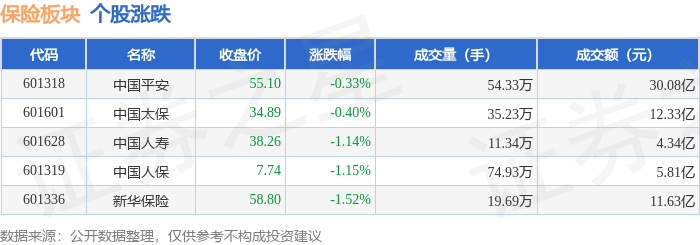
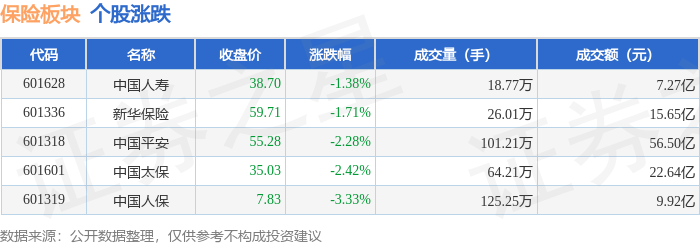
Core Insights - The insurance sector experienced a slight decline of 0.0% on September 2, with Xinhua Insurance leading the drop [1] - The Shanghai Composite Index closed at 3858.13, down 0.45%, while the Shenzhen Component Index closed at 12553.84, down 2.14% [1] Insurance Sector Performance - China Pacific Insurance (601601) closed at 39.83, up 0.58% with a trading volume of 305,500 shares and a transaction value of 1.211 billion [1] - Ping An Insurance (601318) closed at 58.66, up 0.26% with a trading volume of 649,000 shares and a transaction value of 3.798 billion [1] - China Life Insurance (601628) closed at 40.93, down 0.10% with a trading volume of 171,400 shares and a transaction value of 700 million [1] - China Property & Casualty Insurance (601319) closed at 8.72, down 0.34% with a trading volume of 694,000 shares and a transaction value of 607.1 million [1] - Xinhua Insurance (601336) closed at 65.12, down 0.96% with a trading volume of 221,000 shares and a transaction value of 1.443 billion [1] Fund Flow Analysis - The insurance sector saw a net outflow of 29.4883 million from institutional investors and 32.3821 million from retail investors, while retail investors had a net inflow of 61.8704 million [1] - Xinhua Insurance had a net inflow of 19.1986 million from institutional investors but a net outflow of 52.1033 million from retail investors [2] - China Life Insurance experienced a net inflow of 8.5450 million from institutional investors, while retail investors had a net inflow of 867.68 million [2] - China Property & Casualty Insurance had a net outflow of 4.4457 million from institutional investors and a net inflow of 2.70927 million from retail investors [2] - Ping An Insurance faced a net outflow of 13.3982 million from institutional investors but a net inflow of 9.74701 million from retail investors [2] - China Pacific Insurance had a net outflow of 39.3880 million from institutional investors and a net inflow of 30.4738 million from retail investors [2]
长期看好股票市场!保险资金持续加码股市
Sou Hu Cai Jing· 2025-09-02 08:14
Core Insights - Insurance companies have significantly increased their stock market investments in the first half of the year, reflecting a long-term positive outlook on the stock market [1][5]. Group 1: Investment Trends - As of the end of June, five A-share listed insurance companies had a stock investment scale close to 1.8 trillion yuan, an increase of 405.36 billion yuan compared to the end of last year [1]. - China Life Insurance reported an increase of over 150 billion yuan in equity asset allocation during the first half of the year, leading to significant growth in equity investment returns [3]. - China Pacific Insurance's A-share investment scale grew by 26.1% compared to the beginning of the year, with a 1.2 percentage point increase in its proportion within the total portfolio [5]. Group 2: Future Investment Strategies - China Ping An plans to increase equity allocation, focusing on growth sectors representing new productive forces and high-dividend value stocks [7]. - China Life Insurance maintains an optimistic outlook for the A-share market in the second half of the year, with a focus on sectors such as technological innovation, advanced manufacturing, new consumption, and overseas enterprises for investment opportunities [7].