
CPIC(601601)

Search documents
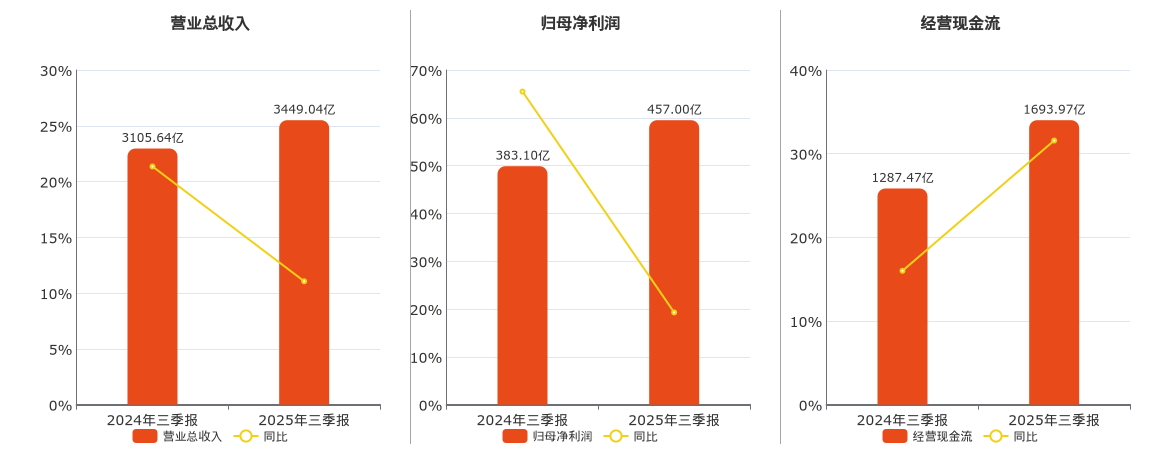
中国太保(601601.SH):2025年三季报净利润为457.00亿元、同比较去年同期上涨19.29%
Xin Lang Cai Jing· 2025-10-31 01:56
Core Insights - China Pacific Insurance (601601.SH) reported a total operating revenue of 344.90 billion yuan for Q3 2025, marking an increase of 34.34 billion yuan compared to the same period last year, achieving a 3-year consecutive growth and a year-on-year increase of 11.06% [1] - The net profit attributable to shareholders reached 45.70 billion yuan, up by 7.39 billion yuan from the previous year, representing a 2-year consecutive increase and a year-on-year growth of 19.29% [1] - The net cash inflow from operating activities was 169.40 billion yuan, an increase of 40.65 billion yuan year-on-year, achieving a 4-year consecutive growth and a year-on-year increase of 31.57% [1] Financial Ratios - The latest debt-to-asset ratio stands at 89.74%, ranking second among disclosed peers [3] - The return on equity (ROE) is 16.08%, an increase of 2.07 percentage points compared to the same period last year [3] - The diluted earnings per share (EPS) is 4.75 yuan, an increase of 0.77 yuan year-on-year, achieving a 3-year consecutive growth and a year-on-year increase of 19.35% [3] - The total asset turnover ratio is 0.12 times, ranking second among disclosed peers [3] Shareholder Structure - The number of shareholders is 102,000, with the top ten shareholders holding a total of 7.255 billion shares, accounting for 75.42% of the total share capital [3] - The top ten shareholders and their respective holdings are as follows: - Hong Kong Central Clearing (Agent) Co., Ltd.: 28.8% - Sheneng (Group) Co., Ltd.: 14.0% - Huabao Investment Co., Ltd.: 13.3% - Shanghai State-owned Assets Management Co., Ltd.: 6.34% - Shanghai Haiyan Investment Management Co., Ltd.: 4.87% - China Securities Finance Corporation: 2.82% - Hong Kong Central Clearing Co., Ltd.: 1.67% - Shanghai Jiushi (Group) Co., Ltd.: 1.52% - Shanghai International Group Co., Ltd.: 1.01% - Yunnan Hehe (Group) Co., Ltd.: 0.95% [3]


4260亿元,历史新高!五大险企盈利,劲升超千亿
证券时报· 2025-10-31 00:11
Core Viewpoint - The profitability of major listed insurance companies in China has reached a record high, with a significant increase in net profit for the first three quarters of 2025 compared to the previous year, driven by strong investment returns and stable performance in the liability sector [1][3][4]. Group 1: Profit Performance - The five major listed insurance companies achieved a total net profit of 426.04 billion yuan in the first three quarters of 2025, an increase of over 100 billion yuan, representing a growth rate of 33.5% compared to the same period last year [1][6]. - In the third quarter alone, the net profit of these companies grew by 68.3% year-on-year, showcasing a remarkable performance [2][4]. - Individual company performances include: - China Life: 167.80 billion yuan, up 60.5% [3][6]. - New China Life: 32.86 billion yuan, up 58.9% [3][6]. - China Pacific: 45.70 billion yuan, up 19.3% [3][6]. - China Ping An: 132.86 billion yuan, up 11.5% [3][6]. - China Property: 46.82 billion yuan, up 28.9% [3][6]. Group 2: Investment Returns - The primary driver of the strong profit performance is the significant increase in investment returns, with companies actively increasing their equity investments to capitalize on favorable market conditions [7][8]. - China Life reported total investment income of 368.55 billion yuan, a year-on-year increase of 41.0% [7]. - China Ping An's investment portfolio achieved a non-annualized comprehensive investment return rate of 5.4%, up 1.0 percentage points year-on-year [7]. - New China Life reported an annualized total investment return rate of 8.6% for the first three quarters [8]. Group 3: Liability Sector Stability - The stability in the liability sector has also contributed to the overall performance, with China Life achieving total premiums of 669.65 billion yuan, a growth of 10.1% [9]. - New business value for Ping An's life and health insurance segment increased by 46.2% [9]. - The shift towards floating income products is expected to enhance investment strategies and improve future profitability [9].




投资负债两端发力 五大上市险企前三季净利同比增逾三成
Zhong Guo Zheng Quan Bao· 2025-10-30 23:26
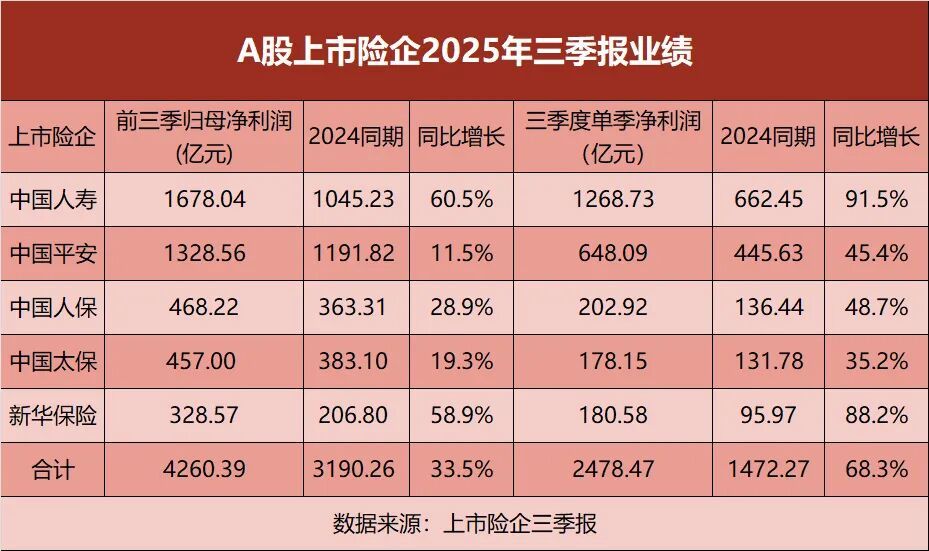
Core Insights - The five major listed insurance companies in A-shares reported impressive results for the third quarter, with a combined net profit exceeding 420 billion yuan, representing a nearly 34% year-on-year growth [1] Group 1: Profit Growth - All five major listed insurance companies achieved positive growth in net profit for the first three quarters, with specific figures as follows: China Life 167.8 billion yuan (up 60.5%), Ping An 132.9 billion yuan (up 11.5%), PICC 46.8 billion yuan (up 28.9%), China Pacific 45.7 billion yuan (up 19.3%), and New China Life 32.9 billion yuan (up 58.9%) [2] - In the third quarter alone, China Life reported a net profit of 126.9 billion yuan, marking a 91.5% increase, the highest among the five companies, while New China Life's net profit reached 18.1 billion yuan, up 88.2% [2] Group 2: Investment Performance - New China Life achieved an annualized total investment return of 8.6% and a comprehensive investment return of 6.7% for the first three quarters, while China Life's total investment income was 368.6 billion yuan, up 41.0%, with a total investment return rate of 6.42% [3] - PICC reported a total investment income of 86.3 billion yuan, up 35.3%, with a total investment return rate of 5.4% [3] Group 3: Asset Allocation - By the end of the third quarter, the total investment assets of the five major listed insurance companies exceeded 20 trillion yuan, with each company showing growth compared to the beginning of the year [4] - China Life's investment assets reached 7.28 trillion yuan, up 10.2%; Ping An's investment assets exceeded 6.41 trillion yuan, up 11.9%; and PICC's total investment assets were 1.83 trillion yuan, up 11.2% [4] Group 4: Business Transformation - The insurance companies are actively promoting product and business structure transformation, with significant improvements in new business value. For instance, China Life's new business value increased by 41.8% year-on-year [6] - New China Life reported a 50.8% increase in new business value, driven by growth in first-year premium income and improved business quality [6] Group 5: Property Insurance Performance - In the property insurance sector, several companies reported improved underwriting profits and optimized comprehensive cost ratios. For example, PICC's property insurance achieved an underwriting profit of 14.9 billion yuan, up 130.7%, with a comprehensive cost ratio of 96.1%, down 2.1 percentage points [7] - Ping An's property insurance reported a comprehensive cost ratio of 97.0%, improving by 0.8 percentage points, with an operating profit of 15.1 billion yuan, up 8.3% [7]
中国太保:10月30日召开董事会会议
Mei Ri Jing Ji Xin Wen· 2025-10-30 23:05
Group 1 - The core point of the article is that China Pacific Insurance (China Taibao) held a board meeting to review the performance assessment results for its executives for the year 2024 [1] - The meeting took place on October 30, 2025, in Shanghai [1] - The revenue composition for China Taibao from January to June 2025 shows that life insurance accounted for 96.49%, commercial auto insurance for 19.6%, health insurance for 7.74%, compulsory insurance for 7.13%, agricultural insurance for 7.13%, and property insurance for 14.63% [1]
4260亿元,历史新高,五大险企盈利劲升超千亿
Zheng Quan Shi Bao· 2025-10-30 22:34
Core Insights - The five major A-share listed insurance companies in China achieved a record net profit of 426.04 billion yuan in the first three quarters of 2025, marking a year-on-year increase of over 100 billion yuan and a growth rate of 33.5% [1][3] - The net profit for the third quarter alone saw a remarkable year-on-year growth of 68.3% [1][3] Financial Performance - China Life reported a net profit of 167.80 billion yuan for the first three quarters, up 60.5% year-on-year, with a third-quarter profit of 126.87 billion yuan, reflecting a 91.5% increase [3][4] - Ping An's net profit for the first three quarters was 132.86 billion yuan, a growth of 11.5%, with a third-quarter profit of 64.81 billion yuan, up 45.4% [3][4] - China Pacific Insurance achieved a net profit of 45.70 billion yuan, growing 19.3% year-on-year, with a third-quarter profit of 17.82 billion yuan, up 35.2% [3][4] - New China Life reported a net profit of 32.86 billion yuan, a 58.9% increase, with a third-quarter profit of 18.06 billion yuan, reflecting an 88.2% growth [3][4] - China Property & Casualty Insurance's net profit was 46.82 billion yuan, up 28.9%, with a third-quarter profit of 20.29 billion yuan, a 48.7% increase [3][4] Investment Performance - The significant increase in profits is attributed to a surge in investment income, with China Life reporting total investment income of 368.55 billion yuan, a year-on-year increase of 41.0% [5][6] - Ping An's investment portfolio achieved a non-annualized comprehensive investment return of 5.4%, up 1.0 percentage points year-on-year [6][7] - China Property & Casualty Insurance reported total investment income of 86.25 billion yuan, a 35.3% increase [6][7] - New China Life's annualized total investment return was 8.6%, with a comprehensive investment return of 6.7% [7] Premium Growth - China Life's total premium income reached 669.65 billion yuan, a 10.1% increase, with all premium categories showing double-digit growth [8] - Ping An's new business value in life and health insurance was 35.72 billion yuan, up 46.2% year-on-year [8] - China Pacific Insurance's total premium income was 263.86 billion yuan, a 14.2% increase, with new business value growing by 7.7% [8]
\t中国太保(601601.SH):第三季度净利润178.15亿元,同比增长35.20%
Ge Long Hui· 2025-10-30 21:14
Core Viewpoint - China Pacific Insurance (601601.SH) reported significant growth in both revenue and net profit for the third quarter of 2025, indicating strong operational performance and financial health [1] Financial Performance - For Q3 2025, the company achieved a revenue of 144.408 billion yuan, representing a year-on-year increase of 24.60% [1] - The net profit attributable to shareholders for Q3 2025 was 17.815 billion yuan, reflecting a year-on-year growth of 35.20% [1] - Basic earnings per share for Q3 2025 stood at 1.85 yuan [1] Year-to-Date Performance - For the first three quarters of 2025, the company reported a total revenue of 344.904 billion yuan, which is an 11.10% increase compared to the same period last year [1] - The net profit attributable to shareholders for the first three quarters was 45.7 billion yuan, showing a year-on-year growth of 19.30% [1] - Basic earnings per share for the first three quarters were 4.75 yuan [1]
五大上市险企前三季净利同比增逾三成
Zhong Guo Zheng Quan Bao· 2025-10-30 21:12
Core Insights - The five major listed insurance companies in A-shares reported a significant increase in net profit for the first three quarters, achieving a total of over 420 billion yuan, representing a year-on-year growth of nearly 34% [1][2] Investment Performance - The five major insurance companies saw positive growth in net profit, with China Life, Ping An, PICC, China Pacific, and New China Life reporting net profits of 167.8 billion yuan, 132.9 billion yuan, 46.8 billion yuan, 45.7 billion yuan, and 32.9 billion yuan respectively, with year-on-year growth rates of 60.5%, 11.5%, 28.9%, 19.3%, and 58.9% [1][2] - In Q3 alone, China Life achieved a net profit of 126.9 billion yuan, marking a year-on-year increase of 91.5%, the highest among the five companies [1] Investment Strategy - The five major insurance companies increased their investment in the equity market, with total investment assets exceeding 20 trillion yuan by the end of Q3, showing growth from the beginning of the year [2][3] - China Life's investment assets reached 7.28 trillion yuan, up 10.2% from the start of the year, while Ping An's investment portfolio exceeded 6.41 trillion yuan, growing by 11.9% [2] Asset Allocation - Companies optimized their asset allocation in response to market conditions, increasing long-duration bond investments and focusing on undervalued, high-dividend, and growth-oriented equity investments [3][4] - China Ping An emphasized a disciplined approach to strategic asset allocation while flexibly adjusting tactical strategies to enhance long-term investment returns [3] New Business Value - The new business value in life insurance continued to improve, with China Life reporting a 41.8% year-on-year increase in new business value, while New China Life saw a 50.8% increase due to growth in first-year premiums and improved business quality [4][5] - The proportion of participating insurance products increased significantly, with China Life reporting a substantial rise in floating income-type business in first-year premiums [5] Property Insurance Performance - The comprehensive cost ratio for property insurance improved, leading to enhanced underwriting profits. For instance, PICC's property insurance achieved an underwriting profit of 14.9 billion yuan, a year-on-year increase of 130.7% [5]
A股五大上市险企2025年前三季度业绩
Zhong Guo Zheng Quan Bao· 2025-10-30 21:12
Core Viewpoint - The report highlights the financial performance of major Chinese insurance companies in the first three quarters, showcasing significant growth in net profit and revenue across the sector [1]. Group 1: Net Profit Performance - China Life Insurance reported a net profit attributable to shareholders of 167.8 billion yuan, reflecting a year-on-year increase of 60.5% [1]. - Ping An Insurance achieved a net profit of 132.9 billion yuan, with an 11.5% year-on-year growth [1]. - China Pacific Insurance recorded a net profit of 45.7 billion yuan, marking a 19.3% increase compared to the previous year [1]. - New China Life Insurance reported a net profit of 32.9 billion yuan, showing a substantial year-on-year growth of 58.9% [1]. - China Insurance reported a net profit of 46.8 billion yuan, with a year-on-year increase of 28.9% [1]. Group 2: Revenue Performance - China Life Insurance's revenue reached 537.9 billion yuan, representing a year-on-year growth of 25.9% [1]. - Ping An Insurance's revenue was 832.9 billion yuan, with a year-on-year increase of 7.4% [1]. - China Pacific Insurance reported revenue of 344.9 billion yuan, reflecting an 11.1% year-on-year growth [1]. - New China Life Insurance achieved revenue of 137.3 billion yuan, marking a 28.3% increase compared to the previous year [1]. - China Insurance's revenue stood at 520.9 billion yuan, with a year-on-year growth of 10.9% [1].
中国太保:同意选举路巧玲为公司第十届董事会副董事长
Xin Lang Cai Jing· 2025-10-30 21:06
Core Viewpoint - China Pacific Insurance (Group) Co., Ltd. has announced the election of a new vice chairman during its 18th meeting of the 10th board of directors, highlighting a significant leadership change within the company [1] Group 1: Company Leadership - The board meeting approved the election of Lu Qiaoling as the vice chairman of China Pacific Insurance [1] - Lu Qiaoling, born in March 1966, holds a master's degree and possesses professional titles as a senior accountant, certified public accountant, and auditor [1] - Currently, Lu serves as a non-executive director of the company and is also a director at Huabao (Shanghai) Equity Investment Fund Management Co., Ltd. [1] Group 2: Professional Background - Lu Qiaoling has held various significant positions, including chief accountant at Hebei Petroleum and Chemical Supply and Marketing Corporation, deputy director of the Industry Guidance Division at the National Chemical Industry Ministry's Audit Bureau, and assistant to the inspector at the State Council's Inspection Special Commission [1] - Lu has also served as a full-time supervisor for large and medium-sized state-owned enterprises under the Central Enterprise Work Committee [1]
投资浮盈成上市险企利润“放大器”
Shang Hai Zheng Quan Bao· 2025-10-30 18:28
Core Insights - The five major listed insurance companies in A-shares reported a significant increase in net profit for the third quarter of 2025, driven primarily by a rising capital market and improved investment performance [1][2][3] Group 1: Financial Performance - The total net profit for the five major listed insurance companies reached approximately 4260.39 billion yuan in the first three quarters of 2025, marking a year-on-year increase of 33.54% [2] - In the third quarter alone, the net profit amounted to about 2478.47 billion yuan, reflecting a substantial year-on-year growth of 68.34% [2] - Notable individual performances include China Life and New China Life, with third-quarter net profit growth rates of 91.5% and 88.2%, respectively [1][2] Group 2: Investment Performance - Investment income for China Life rose to 3685.51 billion yuan in the first three quarters of 2025, representing a year-on-year increase of 41.0% [2] - The overall performance of the capital market, with the Wind All A-Share Index rising approximately 19.46% in the third quarter, significantly contributed to the improved investment results [3] Group 3: Business Operations - The new business value for life insurance showed substantial growth, with China Ping An's new business value increasing by 46.2% and China Life's by 41.8% in the first three quarters of 2025 [3] - The comprehensive cost ratio for property insurance companies improved, with Ping An's ratio at 97.0%, down 0.8 percentage points year-on-year, indicating profitability in underwriting [3] Group 4: Market Dynamics - The volatility in performance of listed insurance companies is attributed to the implementation of new accounting standards and increased investment in equity assets, which amplify the impact of market fluctuations on profits [5][6] - The shift to fair value accounting has led to a direct correlation between market performance and net profit, with higher equity asset allocations resulting in greater profit variability [5][6]