QILU BANK(601665)

Search documents
地方上市银行高管频频增持自家银行股份
Zheng Quan Shi Bao· 2025-11-18 18:13
Core Viewpoint - The announcement from Hu Nong Commercial Bank indicates significant insider buying by top executives, reflecting confidence in the bank's future performance and aligning with a broader trend of regional banks experiencing similar increases in executive and institutional shareholdings [1]. Group 1: Executive Purchases - Five senior executives of Hu Nong Commercial Bank, including the president and several vice presidents, purchased a total of 259,100 shares from November 13 to November 17, 2025, at prices ranging from 9.02 to 9.08 yuan [1]. - This trend of executive share purchases is not isolated, as other regional banks such as Nanjing Bank, Wuxi Bank, and Suzhou Bank have also seen similar actions from their management teams [1]. Group 2: Institutional Purchases - Qingdao Bank reported that its major shareholder, Qingdao Guoxin Financial Holdings Group Co., Ltd., increased its holdings through the Hong Kong Stock Connect, raising its total stake to 15.42%, making it the largest shareholder of the bank [1]. - In addition, Su Nong Bank's executives plan to purchase at least 1.8 million yuan worth of A-shares within six months starting from November 11, 2025 [1]. - Qilu Bank disclosed that its management has already purchased approximately 3.15 million yuan worth of shares, achieving 90% of its planned increase since announcing its buyback plan in mid-September [1].

赋能外贸企业“轻装远航”,齐鲁银行如何让跨境人民币越来越好用?
Qi Lu Wan Bao· 2025-11-18 01:38
Core Viewpoint - The article highlights the rapid growth of cross-border financial activities driven by global economic integration, emphasizing the increasing prominence of the Renminbi as an international currency and the efforts of Qilu Bank to facilitate cross-border RMB settlements for quality enterprises [1][7]. Group 1: Policy Implementation - Qilu Bank has introduced a management mechanism for quality enterprises, allowing them to directly process cross-border RMB settlements without prior submission of authenticity proof, thereby enhancing efficiency [1]. - The bank has successfully included a company from Binzhou in its quality enterprise list, resulting in an additional RMB 100 million in cross-border settlements for the month, contributing to a total of RMB 1.2 billion in such transactions this year [1]. Group 2: Client Engagement and Support - Qilu Bank has conducted over 50 policy promotion activities this year, utilizing various formats such as on-site presentations and online training to ensure that policy benefits reach enterprises effectively [2]. - The bank focuses on key enterprises, sectors, and regions to promote the advantages of RMB settlements, helping clients mitigate foreign exchange risks by converting settlement currencies from USD to RMB [3]. Group 3: Cross-Border Financial Services - Qilu Bank has serviced nearly 1,700 cross-border RMB transactions across 38 countries, supporting over 20 infrastructure, energy, and manufacturing projects under the Belt and Road Initiative [4]. - The bank has added over 200 new cross-border RMB clients this year, with cross-border RMB transactions accounting for over 80% of the total business volume [4]. Group 4: Digital Financial Empowerment - Qilu Bank has upgraded its digital financial product system, "Qilu Spring e-Da," to provide comprehensive online cross-border financial services, enhancing convenience and efficiency for enterprises [5]. - The bank has enabled a manufacturing enterprise to process cross-border RMB transactions entirely online, significantly reducing transaction times and improving cash management efficiency [6]. Group 5: Market Trends and Growth - In response to the rapidly changing global economic landscape and increased exchange rate volatility, Qilu Bank has seen a 135% year-on-year growth in cross-border RMB business volume, effectively doubling its operations [7]. - The proportion of cross-border RMB transactions in total foreign and domestic currency transactions has increased by 18 percentage points, indicating a significant enhancement in service quality for the real economy [7].
年内十余家上市银行 获股东增持
Zhong Guo Ji Jin Bao· 2025-11-17 07:31
Group 1 - Over 10 listed banks have seen significant shareholding increases from shareholders and executives this year, indicating a broader scale of buybacks compared to previous years [1][2] - The increase in shareholding is characterized by a diverse range of stakeholders and a concentration of banks in specific regions [1][3] - This year's buyback activity is occurring during a market uptrend, contrasting with previous years when buybacks were initiated after stock prices fell below net asset value, signaling a shift from defensive to proactive investment strategies [1][4] Group 2 - Notable examples include Changshu Bank, which saw an increase of 561.93 million shares, raising its shareholder's stake to 3.98%, and Qilu Bank, where executives have collectively increased their holdings by approximately 315,000 yuan [2][3] - The participation of local state-owned enterprises has notably increased, with foreign investments also contributing, such as BNP Paribas increasing its stake in Nanjing Bank from 16.14% to 17.02% [3][4] - The overall performance of the banking sector has improved, with 42 A-share listed banks reporting over 4.3 trillion yuan in revenue for the first three quarters, and more than 60% of these banks showing year-on-year revenue growth [4]
齐鲁银行跌2.10%,成交额2.23亿元,主力资金净流入2190.11万元
Xin Lang Zheng Quan· 2025-11-17 05:35
Core Viewpoint - Qilu Bank's stock price has experienced fluctuations, with a current price of 6.07 CNY per share, reflecting a year-to-date increase of 14.01% but a recent decline of 2.10% in the last five trading days [1] Financial Performance - As of September 30, Qilu Bank reported a net profit of 3.963 billion CNY for the first nine months of 2025, marking a year-on-year growth of 15.14% [2] - The bank's cumulative cash distribution since its A-share listing amounts to 4.872 billion CNY, with 3.205 billion CNY distributed over the past three years [3] Shareholder Information - The number of shareholders for Qilu Bank reached 56,100, an increase of 30.16% compared to the previous period, while the average circulating shares per person decreased by 7.07% to 109,647 shares [2] - Among the top ten circulating shareholders, Hong Kong Central Clearing Limited holds 128 million shares, a decrease of 876,500 shares from the previous period [3] Business Overview - Qilu Bank, established on June 5, 1996, and listed on June 18, 2021, operates primarily in corporate banking (59.83% of revenue), personal banking (22.81%), and fund operations (16.05%) [1] - The bank is categorized under the banking sector, specifically as a city commercial bank [1]
齐鲁银行11月14日获融资买入2283.33万元,融资余额13.97亿元
Xin Lang Cai Jing· 2025-11-17 01:29
Group 1 - Qilu Bank's stock price decreased by 0.64% on November 14, with a trading volume of 230 million yuan [1] - On the same day, Qilu Bank had a financing buy-in amount of 22.83 million yuan and a financing repayment of 40.91 million yuan, resulting in a net financing buy of -18.08 million yuan [1] - As of November 14, the total balance of margin trading for Qilu Bank was 1.4 billion yuan, with a financing balance of 1.397 billion yuan, accounting for 3.66% of the circulating market value [1] Group 2 - As of September 30, Qilu Bank had 56,100 shareholders, an increase of 30.16% compared to the previous period [2] - For the period from January to September 2025, Qilu Bank reported an operating income of 0.00 yuan and a net profit attributable to shareholders of 3.963 billion yuan, representing a year-on-year growth of 15.14% [2] Group 3 - Since its A-share listing, Qilu Bank has distributed a total of 4.872 billion yuan in dividends, with 3.205 billion yuan distributed in the last three years [3] - As of September 30, 2025, Hong Kong Central Clearing Limited was the tenth largest circulating shareholder of Qilu Bank, holding 128 million shares, a decrease of 876,500 shares compared to the previous period [3]
落子六年,齐鲁银行欲做实逆周期“粮仓”
Hua Er Jie Jian Wen· 2025-11-16 05:40
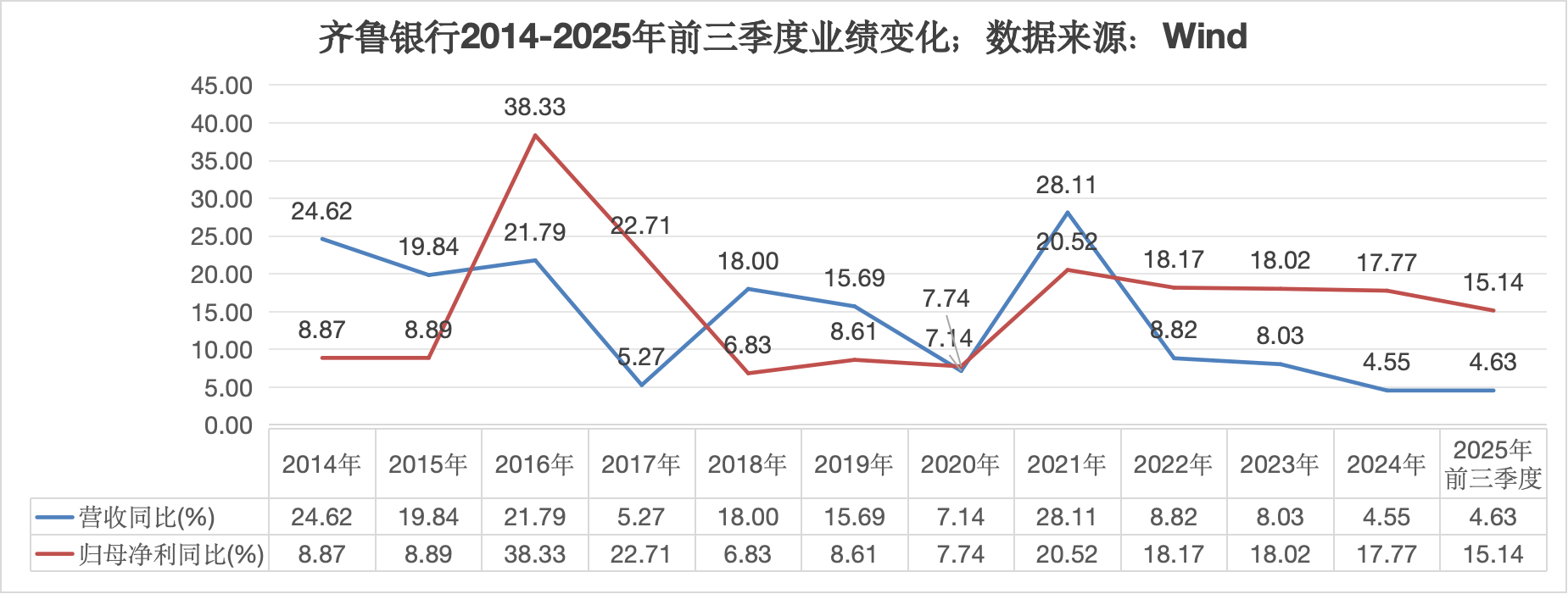
Core Viewpoint - The county-level financial business is emerging as a new value anchor for banks during the downturn cycle, with Qilu Bank showing notable performance despite broader industry challenges [1][3]. Financial Performance - In the first three quarters, Qilu Bank reported revenue and net profit attributable to shareholders of 9.924 billion yuan and 3.963 billion yuan, respectively, with year-on-year growth rates of 4.63% and 15.14% [1]. - Despite a historical low revenue growth rate, Qilu Bank's profit growth is among the few in the industry exceeding 15% [1]. - The bank's interest income, non-interest income, and investment income contributed 78.24%, 10.44%, and 14.82% to total revenue, respectively [4]. Credit and Asset Quality - Qilu Bank's profit growth is attributed to balanced development in "volume, price, and risk," with net interest income increasing by 17.31% [4]. - The bank's asset and liability growth rates were 12.93% and 13.22%, respectively, significantly outpacing industry averages [4]. - The non-performing loan ratio decreased by 10 basis points to 1.09%, indicating improved asset quality [4]. Strategic Focus on County-Level Finance - Qilu Bank has established county-level finance as a core strategy, with loans and deposits from county-level operations accounting for approximately 30% of total [3][10]. - The bank's county-level branches have shown strong growth, with loan growth rates of 40.55%, 32.35%, 26.18%, and 15.49% over the past three years [12]. - The bank has developed a unique "one county, one product" model, launching 80 differentiated financial products tailored to local needs [14]. Expansion and Investment - Qilu Bank has maintained a high expansion rate, opening 21 new branches in the past year and increasing its network without closures [7]. - The bank's capital adequacy ratio stands at 14.7%, providing room for further expansion [7]. - The bank's cost-to-income ratio has improved to 25.91%, reflecting efficient management [7]. Future Outlook - The bank's county-level strategy has shown resilience against economic downturns, with a focus on enhancing service delivery and risk management [10][16]. - However, the growth rate of county-level loans is showing signs of decline, indicating potential limitations in future expansion [15][16]. - The bank's coverage of county-level markets is currently around 60%, suggesting further growth opportunities [17].

银行研思录25:银行股息率排名与中期分红进度梳理-20251114
CMS· 2025-11-14 03:02
Investment Rating - The report does not explicitly state an investment rating for the banking sector, but it provides detailed insights into dividend yields and distribution processes, which can inform investment decisions. Core Insights - The report outlines the latest dividend yields and mid-term dividend processes for A and H shares of listed banks, emphasizing the importance of accurately calculating dynamic dividend yields to avoid discrepancies across periods [1][2]. - It details the two processes for mid-term dividends following the 2023 revision of the regulatory guidelines, highlighting the conventional and simplified processes for implementing mid-term dividends [2]. - The report provides a comprehensive overview of key dates related to dividend distribution for both A and H shares, including the importance of purchasing shares before the ex-dividend date to qualify for dividends [3][4]. Summary by Sections Dynamic Dividend Yield Calculation - A simplified yet accurate method for calculating dynamic dividend yield is introduced, defined as "rolling 12-month EPS * cash dividend rate / share price," which helps avoid issues related to overlapping or missing annual and mid-term dividends [1]. - The report calculates the cash dividend rate using a standardized approach across different banks, resulting in a clear comparison of dividend yields as of November 13, 2025 [1]. Mid-Term Dividend Processes - The report explains the two processes for mid-term dividends: the conventional process requiring shareholder approval and a simplified process allowing for quicker implementation [2]. - The simplified process is designed to enhance flexibility for companies in distributing mid-term dividends, thereby improving shareholder returns [2]. Dividend Distribution Key Dates - For A shares, investors must purchase shares before the ex-dividend date to receive dividends on the same day, while H shares typically see a delay of about one month for dividend payments [3][4]. - The report outlines the differences in the dividend distribution timeline between A and H shares, emphasizing the need for investors to be aware of these timelines to maximize their returns [3][4]. Mid-Term Dividend Progress - As of November 13, 2025, 31 A-share banks have confirmed mid-term dividends, while 11 H-share banks have also confirmed their dividend distributions [9][11]. - The report categorizes banks based on their dividend status, detailing those that have implemented dividends, those that are pending, and those that have opted not to distribute dividends [9][10][11]. - It highlights that the end of 2025 and early 2026 is expected to be a peak period for mid-term dividend distributions, suggesting potential investment opportunities for dividend-seeking investors [11].




齐鲁银行股份有限公司 关于2025年小型微型企业贷款专项金融债券发行完毕的公告
Zhong Guo Zheng Quan Bao - Zhong Zheng Wang· 2025-11-13 23:16
Core Viewpoint - Qilu Bank has successfully issued a special financial bond for small and micro enterprises, amounting to RMB 4 billion, aimed at supporting technological innovation projects [1] Group 1: Bond Issuance Details - The bond issuance was approved by the People's Bank of China and took place in the national interbank bond market [1] - The total issuance scale of the bond is RMB 4 billion, with a fixed interest rate of 1.83% over a three-year term [1] - The bond was recorded on November 11, 2025, and completed issuance on November 13, 2025 [2] Group 2: Fund Utilization - The funds raised from this bond will be exclusively used for issuing loans to small and micro enterprises [1] - Priority will be given to loan projects that focus on technological innovation, enhancing support for technology-driven businesses [1]
齐鲁银行:关于2025年小型微型企业贷款专项金融债券发行完毕的公告
Zheng Quan Ri Bao Zhi Sheng· 2025-11-13 14:11
Core Points - Qilu Bank has successfully issued a special financial bond for small and micro enterprises, approved by the People's Bank of China [1] - The bond issuance size is RMB 4 billion, with a fixed interest rate of 1.83% and a maturity of 3 years [1] - The funds raised will be exclusively used for providing loans to small and micro enterprises, with a focus on supporting technology innovation projects [1]
真金白银出手!A股上市银行迎来“增持潮”
Jin Rong Shi Bao· 2025-11-13 12:47
Core Insights - Recent surge in share buybacks by multiple A-share listed banks indicates a strong confidence from various funding sources in the banking sector [1] Group 1: Share Buybacks by Bank Executives - Local commercial banks' board members and senior management have become the main force behind the share buybacks, demonstrating confidence in their own banks [2] - Qilu Bank disclosed that its board and senior management plan to buy back shares from September 16 to December 31, with a total buyback amount of approximately 3.15 million yuan, accounting for 90% of the planned buyback amount [2] Group 2: Significant Share Purchases by Major Shareholders - Xiamen Bank announced that its board and senior management have cumulatively bought back 254,400 shares for a total of 1.6857 million yuan, completing their buyback plan [5] - Qingdao Bank's major shareholder, Guoxin Chanin Holdings, increased its stake by acquiring 243 million H-shares from September 15 to November 5, amounting to 957 million yuan, thus becoming the largest shareholder with a 19.17% stake [5][6] Group 3: Insurance Capital Involvement - Insurance funds have significantly increased their allocation to the banking sector since the third quarter, with Ping An Life raising its stake in Postal Savings Bank to 16.01% after investing approximately 7.068 million HKD [8] - China Ping An also announced an increase in its holdings of Postal Savings Bank H-shares, raising its stake from 6.09% to 17.01% after investing about 3.441 million HKD [8] - Other insurance companies have also made notable investments in various banks, indicating a trend of insurance capital favoring the banking sector due to its high dividend characteristics [9]