
CHINA TELECOM(601728)

Search documents
通信行业双周报(2025、7、25-2025、8、7):有序推进算力中心建设布局-20250808
Dongguan Securities· 2025-08-08 09:51
Investment Rating - The report maintains an "Overweight" rating for the communication industry, expecting the industry index to outperform the market index by more than 10% in the next six months [2][43]. Core Viewpoints - The communication industry is entering a phase of technological iteration and policy benefits, with new growth drivers from AI, quantum communication, and low-altitude economy. The recovery of cellular IoT modules from inventory adjustments and the ongoing construction of communication facilities such as base stations and data centers are expected to create new demands for devices, equipment, and service operations [3][40]. Summary by Sections 1. Industry Market Review - The communication sector index rose by 3.93% from July 25 to August 7, outperforming the CSI 300 index by 4.75 percentage points, ranking 4th among 31 first-level industries. The sector has seen a cumulative increase of 21.63% this year, surpassing the CSI 300 index by 17.06 percentage points [4][11]. 2. Industry News - The report highlights several key developments: 1. The release of the new GPT-5 series model by OpenAI, which will be integrated into various Microsoft platforms [16]. 2. Omdia's forecast that global cellular IoT connections will reach 5.1 billion by 2030, driven by technologies like 5G RedCap [18]. 3. The Ministry of Industry and Information Technology's initiative to develop leading enterprises in the brain-computer interface sector [19]. 4. A strategic cooperation agreement between China Mobile and Tencent [20]. 5. Shanghai's goal to achieve a computing power center scale of over 100 EFLOPS by the end of 2025 [21]. 3. Company Announcements - Key financial results include: 1. China Mobile reported a revenue of 543.8 billion yuan for the first half of 2025, a slight decrease of 0.5% year-on-year [24]. 2. Weisheng Information's net profit increased by 12.2% year-on-year [26]. 3. Shijia Photon reported a significant revenue growth of 121.12% year-on-year [27]. 4. Industry Data Updates - As of June 2025, the mobile phone user base reached approximately 1.81 billion, a year-on-year increase of 2.66% [28]. The internet broadband access user base was about 684 million, up 4.98% year-on-year [29]. The length of optical cable lines reached approximately 73.77 million kilometers, reflecting a year-on-year growth of 9.91% [31]. The number of 5G base stations reached 4.549 million, with a net increase of 298,000 from the end of the previous year [36]. 5. Investment Recommendations - The report suggests focusing on companies that align with the themes of "technology commercialization, policy catalysis, and performance certainty." Recommended stocks include China Telecom, FiberHome, Yangtze Optical Fibre, and Weisheng Information, each with distinct competitive advantages in the communication sector [40][41].






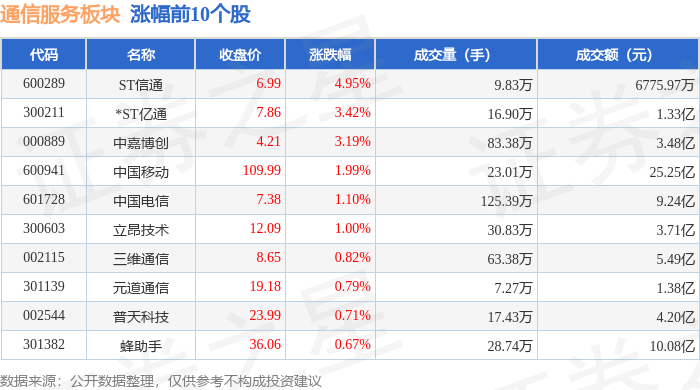
通信服务板块8月8日涨5.11%,ST信通领涨,主力资金净流出1.57亿元
Zheng Xing Xing Ye Ri Bao· 2025-08-08 08:33
证券之星消息,8月8日通信服务板块较上一交易日上涨5.11%,ST信通领涨。当日上证指数报收于 3635.13,下跌0.12%。深证成指报收于11128.67,下跌0.26%。通信服务板块个股涨跌见下表: | 代码 | 名称 | 收盘价 | 涨跌幅 | 成交量(手) | 成交额(元) | | | --- | --- | --- | --- | --- | --- | --- | | 600289 | ST信通 | 66"9 | 4.95% | 9.83万 | | 6775.97万 | | 300211 | *ST亿通 | 7.86 | 3.42% | 16.90万 | | + 1.33亿 | | 000889 | 中嘉博创 | 4.21 | 3.19% | 83.38万 | | 3.48亿 | | 600941 | 中国移动 | 109.99 | 1.99% | 23.01万 | | 25.25 乙 | | 601728 | 中国电信 | 7.38 | 1.10% | 125.39万 | | 9.24亿 | | 300603 | 立昂技术 | 12.09 | 1.00% | 30.83万 | | 3.71亿 ...


险资长钱又现新动向,500亿鸿鹄基金新进持仓中国电信55亿,高股息大蓝筹仍是首选
Zhong Guo Jing Ji Wang· 2025-08-08 07:26
智通财经4月1日讯(记者 王宏)随着上市公司年报披露,保险资金的加仓动态也浮出水面。 智通财经记者注意到,备受关注的首批险资长期投资试点,鸿鹄基金在去年四季度新进中国电信,期末 持仓市值达到了55亿元。此外,鸿鹄基金还在去年三季度新进伊利股份和陕西煤业,期末持仓市值分别 为34.7亿元和19.35亿元。 从选股来看,业内人士指出,中国电信未来三年分红比例不低于75%,可以为险资提供稳定的现金流。 从目前的持仓来看,鸿鹄基金选股紧密拥抱政策,偏好高股息和大蓝筹。 截至今年3月初,鸿鹄基金已全部落地500亿元,新华保险高管表示,鸿鹄基金采用OCI权益法等计量方 式,减小了股价短期波动对资产负债表和损益表的冲击。据悉,第二批保险资金长期投资试点已经开 启,试点规模已经扩大到1620亿元。 最新加仓中国电信,持仓市值55亿 智通财经记者注意到,备受关注的500亿保险资金长期投资试点——鸿鹄志远(上海)私募投资基金有 限公司(以下简称"鸿鹄基金")有了新动向,出现在了中国电信前十大股东之中。 中国电信2024年财报显示,鸿鹄基金在去年四季度新进中国电信761742240股,期末持股数量为 761742240股,持股比例 ...
鸿鹄基金最新重仓股曝光 险资“长钱”加码高股息资产
Zhong Guo Zheng Quan Bao· 2025-08-08 07:19
作为首批保险资金长期股票投资试点,鸿鹄志远(上海)私募投资基金有限公司的动态备受关注。 随着A股上市公司2025年一季报陆续披露,鸿鹄基金的最新持股情况浮出水面。Wind数据显示,截至一 季度末,鸿鹄基金重仓持有中国电信、伊利股份、陕西煤业三只个股,合计持股市值超125亿元。在鸿 鹄基金一期500亿元投资落地之后,鸿鹄基金二期获批200亿元,其投资方向为中证A500指数成分股中 符合条件的大型上市公司A股、H股。 中国证券报记者调研了解到,第二批获批保险资金长期股票投资试点的机构正加快推进相关工作落 地。国家金融监督管理总局局长李云泽5月7日在国新办新闻发布会上表示,近期拟再批复600亿元,进 一步扩大保险资金长期股票投资试点范围。以此来计算,已批复和拟批复的保险资金长期股票投资试点 规模达到2220亿元。 鸿鹄基金三大重仓股 Wind数据显示,2025年一季度末,鸿鹄基金重仓持有中国电信、伊利股份、陕西煤业三只个股, 合计持股数量超10亿股,合计持股市值超125亿元。 具体来看,一季度末,鸿鹄基金分别持有中国电信、伊利股份、陕西煤业7.62亿股、1.53亿股、 1.16亿股,持股市值分别为59.80亿元、4 ...


集中推新套餐 三大运营商欲解成本困局
Bei Jing Shang Bao· 2025-08-08 06:59
Core Viewpoint - The three major telecom operators in China are facing high costs in the transition to commercial 5G, prompting them to introduce new 4G packages to alleviate financial pressure and tap into the remaining potential of the 4G market [1][4]. Group 1: New 4G Packages - China Mobile launched the "Hand Q Treasure Card" with a monthly fee of 19 yuan, offering 1 yuan/GB data and free access to several apps, aiming to attract users from 2G and 3G networks [2]. - China Telecom introduced the "Filial Piety Card" targeting elderly users aged 65 and above, providing 2GB of general data, 10GB of specific app data, and 100 minutes of voice calls [2]. - China Unicom's "Wo Pai Youth Card" targets young consumers with three pricing tiers (56 yuan, 76 yuan, and 96 yuan), offering various data and membership benefits [3]. Group 2: 5G Market Challenges - Despite the rapid growth of 5G users, the high prices of 5G packages remain a significant barrier, with the cheapest 5G package from China Mobile costing 90 yuan and from China Telecom and China Unicom costing 129 yuan [4]. - The investment required for 5G infrastructure is substantially higher than for previous generations, with China Mobile's 5G-related investment reaching 1,025 billion yuan in 2020 and a projected 1,100 billion yuan in 2021 [4][6]. Group 3: 4G Market Potential - The 4G user base remains large, with China Mobile alone having 790 million 4G users as of April 2021, indicating ongoing competition in the 4G market [6]. - The transition of existing 2G and 3G users to 4G presents an opportunity for growth, especially among older demographics who may be more price-sensitive and less inclined to switch to 5G [7].


中国电信在安徽成立数智科技公司
Qi Cha Cha· 2025-08-08 06:43
Group 1 - China Telecom has established a new company named China Telecom Smart Technology (Anhui) Co., Ltd. with a registered capital of 10 million yuan [1] - The legal representative of the new company is Wu Zaichun, indicating a structured leadership [1] - The business scope of the new company includes value-added telecommunications services, software development, 5G communication technology services, computer system services, and internet security services [1] Group 2 - The new company is wholly owned by China Telecom through indirect shareholding, reflecting the company's strategy to expand its technological capabilities [1]
中国电信股价微跌0.68% 运营商重启eSIM业务引关注
Jin Rong Jie· 2025-08-07 17:38
Group 1 - The stock price of China Telecom as of August 7, 2025, is 7.30 yuan, down 0.68% from the previous trading day, with a trading volume of 1.3741 million hands and a turnover of 1.004 billion yuan [1] - China Telecom is one of the three major basic telecom operators in China, providing fixed and mobile communication services, internet access services, and comprehensive information services [1] - The recent resumption of eSIM business by telecom operators has attracted market attention, with China Unicom leading the way in 25 provinces, primarily targeting the IoT and smart wearable device sectors [1] Group 2 - China Telecom is cautious in advancing its eSIM business due to the need for physical SIM cards for authentication in its Tiantong satellite communication services [1] - Major smartphone manufacturers like Huawei and Apple are actively developing eSIM technology, with the first batch of eSIM-supported phones expected to be launched by the end of the year [1] - On August 7, 2025, the net outflow of main funds for China Telecom was 99.5185 million yuan, with a total net outflow of 12.504 million yuan over the past five days [1]

中国电信股份有限公司关于召开2025年中期业绩说明会的公告
Shang Hai Zheng Quan Bao· 2025-08-06 18:55
Core Viewpoint - China Telecom will hold a mid-year performance briefing on August 14, 2025, to discuss its 2025 interim results and engage with investors through a combination of live interaction and online streaming [2][3][4]. Group 1: Event Details - The performance briefing is scheduled for August 14, 2025, from 17:00 to 18:00 [4]. - The event will be broadcasted live on the Shanghai Stock Exchange Roadshow Center and Roadshow China platforms [2][4]. - Investors can submit questions for the briefing from August 7 to August 13, 2025, via the designated websites or the company's email [2][6]. Group 2: Participants - Key participants include the company's Executive Director, Chairman and CEO Ke Ruiwen, Executive Director and President Liu Guiqing, and other senior executives [4][5]. Group 3: Investor Engagement - Investors are encouraged to participate in the briefing and can interact with the company through the online platforms [5][6]. - The company will address commonly asked questions during the briefing [3][6]. Group 4: Contact Information - For inquiries, investors can contact the Investor Relations Department via phone or email [6].
中国电信: 中国电信股份有限公司关于召开2025年中期业绩说明会的公告
Zheng Quan Zhi Xing· 2025-08-06 16:09
证券代码:601728 证券简称:中国电信 公告编号:2025-024 ? 网络直播地址:上海证券交易所上证路演中心(网址: http://roadshow.sseinfo.com ) 、 路 演 中 平 台 ( 网 址 : https://www.roadshowchina.cn/w/meet/rj4B7V)同步直播 ? 会议召开方式:现场交流、网络直播和文字互动 ??投资者可于 2025 年 8 月 7 日(星期四)至 2025 年 8 月 13 日(星期 三)16:00 前登录上证路演中心网站首页点击"提问预征集"栏目或 通过公司邮箱 ir@chinatelecom-h.com 进行提问。公司将在说明会上 对投资者普遍关注的问题进行回答。 中国电信股份有限公司(以下简称"公司")将于 2025 年 8 月 深入地了解公司 2025 年中期业绩,公司计划于 2025 年 8 月 14 日下 午 17:00-18:00 举行 2025 年中期业绩说明会,届时管理层将介绍公 司 2025 年中期业绩,并与投资者进行交流。 中国电信股份有限公司 关于召开 2025 年中期业绩说明会的公告 本公司董事会及全体董事 ...
中国电信:8月14日将召开2025年中期业绩说明会
Zheng Quan Ri Bao Wang· 2025-08-06 13:45
Core Viewpoint - China Telecom announced plans to hold a mid-term performance briefing on August 14, 2025, from 17:00 to 18:00 [1] Group 1 - The company will provide insights into its mid-term performance during the scheduled briefing [1] - The announcement was made on the evening of August 6 [1] - The briefing is part of the company's ongoing communication strategy with stakeholders [1]