CHINA TELECOM(601728)

Search documents
独家:中国电信前11月24家省公司安全业务收入正增长 河南山西福建排前三
Xin Lang Cai Jing· 2026-01-11 06:52
Core Insights - The overall revenue situation of China's telecom security business is improving, with 24 provincial companies reporting positive growth, while 7 provincial companies experienced a decline [1][3] Group 1: Revenue Performance - As of the end of November 2025, the revenue from China's telecom security business exceeded 3 billion yuan, achieving double-digit growth [3] - Among the provincial companies, Henan, Shanxi, Fujian, Inner Mongolia, and Hubei reported the highest revenue growth, while Liaoning, Tianjin, Tibet, Hainan, and Shandong had the lowest growth rates [3] Group 2: Monthly Trends - In November alone, the revenue from the security business experienced a double-digit decline [3] Group 3: Development Challenges - The telecom security business is in a rapid development phase, but some smaller provincial companies, particularly in the northern regions, are facing significant challenges due to limited investment in new business initiatives [3]



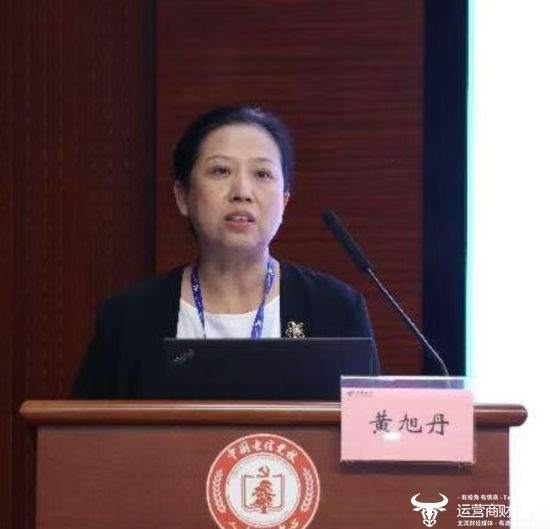
独家:中国电信审计部原总经理黄旭丹动态曝光 任这家央企外部董事
Xin Lang Cai Jing· 2026-01-11 03:47
运营商财经网 吴碧慧/文 其实,黄旭丹这样的职业经历业内还有好几位。比如上海联通原总经理沈洪波2025年初改任央企专职外 部董事,如今也兼任香 港中旅(集团)外部董事; 中国移动投资公司原董事长范冰也同样2025年中转任央企专职外部董事,后来也兼任国家开发投资集团 有限公司外部董事。 运营商财经网副总编刘平表示,他们的受重用,也意味着运营商行业的人才越来越受到其他央企的重 视。 据官方消息,黄旭丹出任中国机械工业集团院外部董事。这也是黄旭丹自2025年11月从中国电信调走后 的又一新动态。 黄旭丹此前是运营商知名的财务女干将,曾先后担任中国联通集团财务部副总经理、中国电信集团财务 部副总经理、天翼融资租赁公司总经理、中国电信财务公司总经理、集团审计部总经理等职。 2025年11月,黄旭丹调离行业,出任央企专职外部董事。该职务与央企外部董事有所区别,是有实职 的,通常享有与央企副总经理同等的待遇。 (责任编辑:吴碧慧) ...

通信行业双周报(2025、12、26-2026、1、8):商用航天建设持续推进-20260109
Dongguan Securities· 2026-01-09 09:31
Investment Rating - The report maintains an "Overweight" rating for the communication industry, expecting the industry index to outperform the market index by more than 10% in the next six months [2][44]. Core Insights - The commercial aerospace sector is showing significant momentum both domestically and internationally, shifting focus from mere technological breakthroughs to the integration of technology, ecosystem development, and market applications. Leading companies are enhancing their commercialization capabilities [3][39]. - The report anticipates that the communication industry will experience a period of technological iteration and policy dividends in 2025, with new growth drivers emerging from AI, quantum communication, and low-altitude economy sectors. The recovery of cellular IoT modules and ongoing construction of communication facilities are expected to create new demands for devices, equipment, and service operations [3][39]. Summary by Sections 1. Communication Industry Market Review - The communication sector index fell by 1.18% over the two weeks from December 26, 2025, to January 8, 2026, underperforming the CSI 300 index by 3.22 percentage points, ranking last among 31 sectors [11][12]. - In January 2026, the communication sector index increased by 0.85%, again underperforming the CSI 300 index by 1.48 percentage points [11][12]. 2. Industry News - The Ministry of Industry and Information Technology and seven other departments jointly issued the "Implementation Opinions on the Special Action of 'Artificial Intelligence + Manufacturing'" [15]. - The first offshore reusable rocket recovery base in China has commenced construction with a total investment of 5.2 billion yuan [21]. - SpaceX's Starlink has connected over 9 million active users across 155 countries, showcasing significant growth from 14.5 million users in December 2021 [22]. 3. Company Announcements - Feiling Kesi plans to indirectly invest in Nanfei Microelectronics, focusing on high-speed network communication interconnect chips, with a total investment of 40.8 million yuan [23][24]. - Guangku Technology expects a net profit growth of 152%-172% for 2025, driven by revenue growth and cost control measures [26]. 4. Industry Data Updates - As of November 2025, the mobile phone user base reached approximately 1.828 billion, a year-on-year increase of 2.20% [27]. - The total number of 5G base stations reached 4.83 million, with a net increase of 579,000 compared to the end of the previous year [36].




高盛:下调中国电信评级至“中性” 创新业务增长短期受压
Zhi Tong Cai Jing· 2026-01-08 09:35
Group 1 - The core viewpoint of the article indicates a stagnation in future growth for telecommunications services due to a slowdown in 5G applications affecting both paid user growth and average revenue per user (ARPU) [1] - Goldman Sachs expresses a positive outlook on the shift of capital expenditure from traditional telecom networks to artificial intelligence (AI) computing infrastructure and new business expansions, although short-term growth in service and innovative businesses is expected to be under pressure [1] - The article highlights a positive view on the long-term revenue contribution from AI-related solutions and the growth of computing capital expenditure, but macroeconomic uncertainties may lead companies to prioritize quality projects, potentially impacting short-term growth [1] Group 2 - Goldman Sachs downgraded the investment ratings for China Telecom (00728) and China Unicom (00762) from "Buy" to "Neutral" due to stagnation in telecom service growth and the longer time required for innovative businesses to accelerate [1] - The target price for China Telecom was reduced from HKD 7.9 to HKD 6, while the target price for China Unicom was lowered from HKD 11.5 to HKD 8.8 [1] - The firm also revised down its earnings forecasts for both companies for the next two years by 6% to 7% [1]

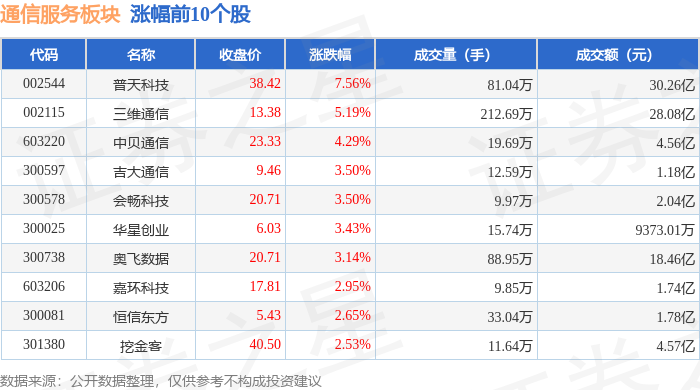
通信服务板块1月8日涨0.75%,普天科技领涨,主力资金净流出2.87亿元
Zheng Xing Xing Ye Ri Bao· 2026-01-08 08:58
Group 1 - The communication services sector increased by 0.75% on January 8, with Putian Technology leading the gains [1] - The Shanghai Composite Index closed at 4082.98, down 0.07%, while the Shenzhen Component Index closed at 13959.48, down 0.51% [1] - Putian Technology's stock price rose by 7.56% to 38.42, with a trading volume of 810,400 shares and a transaction value of 3.026 billion yuan [1] Group 2 - The communication services sector experienced a net outflow of 287 million yuan from institutional investors and 390 million yuan from retail investors, while retail investors saw a net inflow of 677 million yuan [2] - Major stocks in the sector showed varied performance, with China Unicom experiencing a net inflow of 3.25 billion yuan from institutional investors, while retail investors had a net outflow of 1.49 billion yuan [3] - The stock of Sanwei Communication saw a net inflow of 271 million yuan from institutional investors but a net outflow of 201 million yuan from retail investors [3]


68.20亿元主力资金今日撤离通信板块
Zheng Quan Shi Bao Wang· 2026-01-08 08:52
Market Overview - The Shanghai Composite Index fell by 0.07% on January 8, with 20 industries experiencing gains, led by defense and military industry with a rise of 4.18% and media with a rise of 2.00% [1] - The non-bank financial and non-ferrous metals industries saw the largest declines, with drops of 2.81% and 1.56% respectively [1] Capital Flow Analysis - The net outflow of capital from the two markets reached 45.304 billion yuan, with 9 industries experiencing net inflows [1] - The defense and military industry had the highest net inflow of capital at 6.773 billion yuan, followed by the computer industry with a net inflow of 3.917 billion yuan and a daily increase of 1.27% [1] Communication Industry Performance - The communication industry declined by 0.95%, with a total net outflow of 6.820 billion yuan [2] - Out of 124 stocks in the communication sector, 95 stocks rose, including 2 that hit the daily limit, while 28 stocks fell [2] - The top three stocks with the highest net inflow in the communication sector were ZTE Corporation with 561 million yuan, China Unicom with 362 million yuan, and FiberHome Technologies with 303 million yuan [2] Communication Industry Capital Outflow - The communication industry saw significant capital outflows, with the top three stocks being Zhongji Xuchuang with a net outflow of 3.156 billion yuan, Newray Technology with 1.205 billion yuan, and Tianfu Communication with 1.090 billion yuan [4] - Other notable stocks with capital outflows included Nanjing Panda Electronics and China Mobile, with outflows of 434 million yuan and 326 million yuan respectively [4]


独家:中国电信集团科创部总经理张文强调任中电信量子集团董事长
Xin Lang Cai Jing· 2026-01-08 08:42
Group 1 - The core point of the article is the appointment of Zhang Wenqiang as the new chairman and general manager of China Telecom Quantum Group, highlighting his rapid career advancement and the importance of his leadership in the quantum technology sector [1][3]. - Zhang Wenqiang was previously the head of the Technology Innovation Department at China Telecom and has a strong technical background, having worked in various roles within the company since his early career [3]. - The China Telecom Quantum Group, established in 2023, is a key platform for the company's strategy in the quantum technology field and is currently positioned at a medium level of development among the group's subsidiaries [3]. Group 2 - Zhang Wenqiang's career trajectory shows a high frequency of position changes and a rapid promotion rate compared to his peers, indicating his comprehensive capabilities in network technology and enterprise management [3]. - Liu Ping, deputy editor-in-chief of the operator finance network, emphasizes the necessity of having a talent like Zhang Wenqiang to lead the China Telecom Quantum Group due to its critical role in the company's quantum technology initiatives [3].
独家:中国电信集团科创部总经理张文强调任中电信量子集团董事长
Sou Hu Cai Jing· 2026-01-08 08:39
Group 1 - Zhang Wenqiang has been appointed as the chairman and general manager of China Telecom Quantum Group, indicating a significant leadership change within the company [1][3] - China Telecom Quantum Group was established in 2023 as a subsidiary focused on quantum technology, and it has shown strong development momentum, currently ranking at a medium development level among the group's various specialized companies [3] - Zhang Wenqiang has a technical background and has rapidly advanced through the ranks at China Telecom, demonstrating his comprehensive capabilities in network technology and enterprise management [3] Group 2 - The appointment of Zhang Wenqiang is seen as crucial for the leadership of China Telecom Quantum Group, which is a key platform for the company's strategy in the quantum technology sector [3]
大行评级|高盛:下调中国电信及联通评级至“中性” 创新业务增长短期受压
Ge Long Hui· 2026-01-08 06:53
Core Viewpoint - Goldman Sachs expresses a positive outlook on the shift of Chinese telecom operators' capital expenditure from traditional telecom networks to artificial intelligence computing infrastructure and new business expansions, but notes that the growth of service and innovative businesses in the domestic telecom industry is under short-term pressure [1] Telecom Services - Future growth in telecom services is expected to stagnate due to a slowdown in 5G applications affecting both paying users and average revenue per user (ARPU) growth [1] - There is a positive outlook on the increase of value-added services, but the expansion of ARPU will depend on breakthroughs in artificial intelligence applications and functionalities to drive user traffic [1] Innovative Businesses - A long-term positive view is maintained regarding the revenue contribution from AI-related solutions and the growth of computing capital expenditure [1] - However, macroeconomic uncertainties are expected to lead companies to prioritize quality projects, which may impact short-term growth [1] Price Target Adjustments - Goldman Sachs has lowered the target price for China Telecom from HKD 7.9 to HKD 6 and for China Unicom from HKD 11.5 to HKD 8.8, with both ratings downgraded from "Buy" to "Neutral" [1] - The earnings forecasts for both companies for the next two years have been reduced by 6% to 7% [1]
冲刺与破冰:卫星互联网产业趋势洞察
Sou Hu Cai Jing· 2026-01-07 16:56
Core Insights - The Chinese satellite internet industry is entering a critical phase of policy support, technological breakthroughs, and commercial expansion in 2026, following a record 92 launches in 2025, including significant contributions from both state and commercial entities [1][4][31] - The market for satellite internet has surpassed a trillion-dollar scale, driven by diverse applications across various sectors, including aerospace, maritime, and emergency communications [4][5] Industry Overview - The satellite internet industry is characterized by a dual-track development approach, with high and low orbit satellites evolving at different stages [2][4] - The scarcity of orbital spectrum resources is a key factor influencing development priorities, with low Earth orbit (LEO) resources entering a phase of "stock competition" [5][6] Structural Characteristics - China's LEO satellite internet construction is in a phase of large-scale network deployment, with plans for over 25,000 LEO satellites, supported by policy and market demand [5][6] - The high orbit satellite sector has matured, providing comprehensive coverage and laying the groundwork for expanding applications in aviation and maritime sectors [5][6] Application Scenarios - The integration of high and low orbit satellite services is creating a complementary ecosystem, with applications in low-altitude economies, autonomous driving, and satellite broadcasting [6][7] - The high orbit sector is expected to rapidly expand into new commercial markets, leveraging its broad coverage and communication capabilities [6][7] National and Commercial Dynamics - The industry is transitioning from government-led initiatives to a market-driven model, with state-owned enterprises focusing on core technologies and high orbit satellite construction, while commercial companies drive low orbit satellite development [7][8] Future Outlook - The Chinese satellite internet industry has significant growth potential, with advancements in technology and commercial applications expected to enhance its global competitiveness [8] Value Chain Analysis - The satellite internet industry can be segmented into satellite manufacturing, launch services, and operational services, with a clear division of roles among state-owned and private enterprises [11][25] - The satellite manufacturing sector is dominated by state-owned enterprises for large satellites, while private companies are emerging in the small satellite segment [14][17] Launch Services - The satellite launch sector is experiencing a transformation characterized by scale expansion, technological upgrades, and cost optimization, with a notable increase in launch frequency and capacity [20][23] - The demand for LEO satellite constellations is straining existing launch capacities, necessitating improvements in commercial rocket launch frequency and efficiency [23][24] Operational Services - The operational segment is primarily led by state-owned enterprises, with increasing participation from private companies in ground equipment manufacturing and satellite communication services [25][26] - The issuance of satellite internet licenses is expected to accelerate the growth of operational services, particularly in emerging markets [28][31] Investment Landscape - The financing landscape for the satellite internet sector has been heating up since 2019, with a significant increase in notable financing events and amounts in 2024 [31] - The reintroduction of policies allowing unprofitable companies to list on the Sci-Tech Innovation Board is anticipated to spur a new wave of IPOs in the satellite internet sector [31][32]