CEB BANK(601818)

Search documents
优先股隐退永续债上位!银行业资本补充进入密集冲刺期,年利息至少省3%
Xin Lang Cai Jing· 2026-01-04 05:31
Core Viewpoint - The Chinese banking industry is undergoing a significant transformation, with banks redeeming high-cost preferred shares and issuing perpetual bonds as a more cost-effective financing alternative, driven by declining social financing costs and regulatory changes [2][4][11]. Group 1: Redemption of Preferred Shares - By the end of 2025, a total of 9 banks announced the redemption of preferred shares, amounting to 111.8 billion RMB in domestic preferred shares and 5.72 billion USD in foreign preferred shares [4]. - In December 2025 alone, five banks, including Changsha Bank and Beijing Bank, redeemed a total of 45.8 billion RMB in preferred shares [3]. - The redemption of preferred shares is facilitated by their lack of maturity dates but includes redemption clauses, allowing banks to manage capital flexibly [4]. Group 2: Issuance of Perpetual Bonds - As of December 31, 2025, Chinese commercial banks issued 69 perpetual bonds, raising a total of 821.8 billion RMB, marking a historical high in both issuance quantity and scale [5]. - The interest rates for newly issued perpetual bonds generally ranged from 2.0% to 2.9%, the lowest in nearly three years, with a significant issuance peak occurring in the second half of 2025 [5][6]. - The issuance of perpetual bonds is seen as a response to the urgent need for capital replenishment, especially among small and medium-sized banks facing declining capital adequacy ratios [2][6]. Group 3: Cost Savings and Financial Efficiency - By replacing preferred shares with perpetual bonds, banks can save at least 3% annually on interest expenses, significantly reducing their financing costs [8][10]. - For instance, the interest rate on newly issued perpetual bonds is substantially lower than that of previously issued preferred shares, with examples showing potential annual savings of 12.8 million RMB for banks like Industrial Bank [10]. - The transition from preferred shares to perpetual bonds is viewed as a strategic move to optimize capital structure and reduce interest payment burdens, aligning with regulatory requirements [8][10]. Group 4: Regulatory Environment and Market Dynamics - The shift towards perpetual bonds is influenced by regulatory changes that favor capital instruments with loss absorption capabilities, making traditional preferred shares less attractive [11]. - The approval process for issuing perpetual bonds is simpler and faster compared to preferred shares, which require dual regulatory approvals, thus enhancing their appeal to banks [11]. - The current low-interest-rate environment is expected to persist, allowing banks to lock in low financing costs for the next 5 to 10 years, effectively mitigating the pressure from narrowing net interest margins [10].







每周股票复盘:光大银行(601818)与光大金瓯签订30亿关联交易协议
Sou Hu Cai Jing· 2026-01-01 18:03
截至2025年12月26日收盘,光大银行(601818)报收于3.51元,较上周的3.56元下跌1.4%。本周,光大 银行12月22日盘中最高价报3.56元。12月24日盘中最低价报3.49元。光大银行当前最新总市值2062.09亿 元,在股份制银行板块市值排名6/9,在两市A股市值排名69/5181。 以上内容为证券之星据公开信息整理,由AI算法生成(网信算备310104345710301240019号),不构成 投资建议。 本周关注点 公司公告汇总:光大银行与光大金瓯签订30亿元资产转移类交易额度协议 公司公告汇总 中国光大银行于2025年12月26日与光大金瓯签署协议,为其核定人民币30亿元资产转移类累计交易额 度,有效期三年,单笔及每年累计不超过人民币10亿元。光大金瓯为控股股东光大集团的附属公司,构 成关连人士,本次交易属于持续关连交易。交易定价遵循市场原则,采用公开招标、竞价或拍卖方式确 定价格,不优于其他同类业务。该事项需遵守年度申报、公告及审核规定,豁免独立股东批准。 ...
持续打造数字金融服务新范式 光大银行APP获评“年度用户青睐产品”
Cai Jing Wang· 2025-12-31 11:28
Core Insights - The article emphasizes the transformation of financial institutions, particularly through mobile banking, as a key platform for enhancing service experience, security, and convenience, marking a shift from traditional transaction processing to comprehensive financial service platforms [1][2] Group 1: Mobile Banking Evolution - China Everbright Bank has launched the 13.0 version of its mobile app, focusing on wealth management, retirement finance, retail credit, and credit cards, with a goal of connecting users to a better life [1][2] - The new app design is centered around user needs, restructuring the homepage into five main modules: Home, Borrowing, Wealth, Activities, and My Account, indicating a fundamental shift from a bank-centric to a user-centric service logic [2] Group 2: Wealth Management Focus - The retail asset management scale of China Everbright Bank has surpassed 3.15 trillion yuan, with wealth management products reaching 1.89 trillion yuan, showcasing its robust capabilities in providing a reliable wealth management platform [3] - The app's wealth management section emphasizes the "Sunshine Wealth" brand, focusing on trust, security, and professionalism, while introducing the "Four Types of Money" asset allocation concept to guide users in financial planning [3][7] Group 3: Retirement Financial Services - The bank has upgraded its mobile banking features to address the growing demand for diverse retirement solutions, transitioning from a single product sales approach to a comprehensive "finance + ecosystem" service model [5][6] - The app includes dedicated sections for retirement finance and personal pensions, offering a one-stop service that aligns with the national multi-pillar pension system, enhancing the planning of future retirement funds [6] Group 4: User-Centric Innovations - The 13.0 version of the app includes a "Simplified Love" version tailored for elderly users, improving usability through optimized design and simplified processes, thereby lowering barriers for older customers to access digital financial services [6][7] - The bank's initiatives reflect a commitment to redefining the relationship between banks and users in the digital economy, positioning itself as a co-creator of value and an enabler of a better life [7]
股份制银行板块12月31日跌0.01%,平安银行领跌,主力资金净流入1.77亿元
Zheng Xing Xing Ye Ri Bao· 2025-12-31 09:07
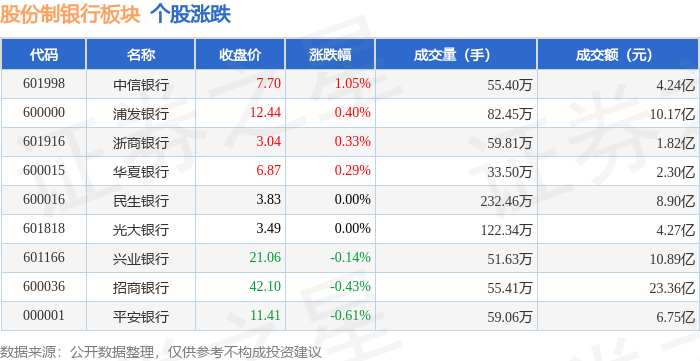
Group 1 - The banking sector experienced a slight decline of 0.01% on December 31, with Ping An Bank leading the drop [1] - The Shanghai Composite Index closed at 3968.84, up 0.09%, while the Shenzhen Component Index closed at 13525.02, down 0.58% [1] - Major banks such as CITIC Bank and Shanghai Pudong Development Bank saw positive price movements, with CITIC Bank increasing by 1.05% to 7.70 and Shanghai Pudong Development Bank rising by 0.40% to 12.44 [1] Group 2 - The net inflow of main funds in the banking sector was 177 million yuan, while retail funds saw a net inflow of 25.68 million yuan [1] - Retail investors showed a mixed response, with significant outflows from major banks like Ping An Bank and Minsheng Bank, while some smaller banks attracted retail inflows [2] - The data indicates that institutional investors favored certain banks, as seen in the net inflow percentages for banks like CITIC Bank and Shanghai Pudong Development Bank [2]




光大银行呼和浩特分行学习贯彻自治区党委十一届十一次全会暨全区经济工作会议精神 以实际行动助力自治区高质量发展
Zhong Guo Jin Rong Xin Xi Wang· 2025-12-31 08:58
Core Viewpoint - The recent meeting of the Inner Mongolia Autonomous Region's 11th Committee emphasized the "1571" work deployment, which is crucial for the long-term development of Inner Mongolia, and highlighted the importance of financial institutions like Everbright Bank in supporting regional economic growth [1][3]. Group 1: Economic Development Initiatives - The "1571" work deployment includes the construction of "two bases," focusing on energy and strategic resources, as well as agricultural and livestock product industries, with Everbright Bank providing comprehensive financial services to large energy enterprises [2]. - The bank has been actively involved in supporting the dairy industry chain, offering financial support from upstream ranch construction to downstream sales networks, facilitating the transition of Inner Mongolia from a major agricultural region to a strong agricultural region [2]. Group 2: Environmental and Social Responsibility - Everbright Bank is committed to developing green finance, supporting ecological protection, pollution prevention, and energy-saving projects, contributing to environmental sustainability in the region [2]. - The bank promotes a "cloud payment" service platform, extending its services to various public welfare sectors, effectively addressing the urgent needs of millions of residents in Inner Mongolia [2]. Group 3: Future Directions - Moving forward, Everbright Bank aims to align its operations with the spirit of the recent regional committee meeting, leveraging its 15 years of experience in Inner Mongolia to contribute to the region's modernization efforts [3].
光大银行龙岩分行被罚115万元 涉贷后管理不到位等
Zhong Guo Jing Ji Wang· 2025-12-31 07:40
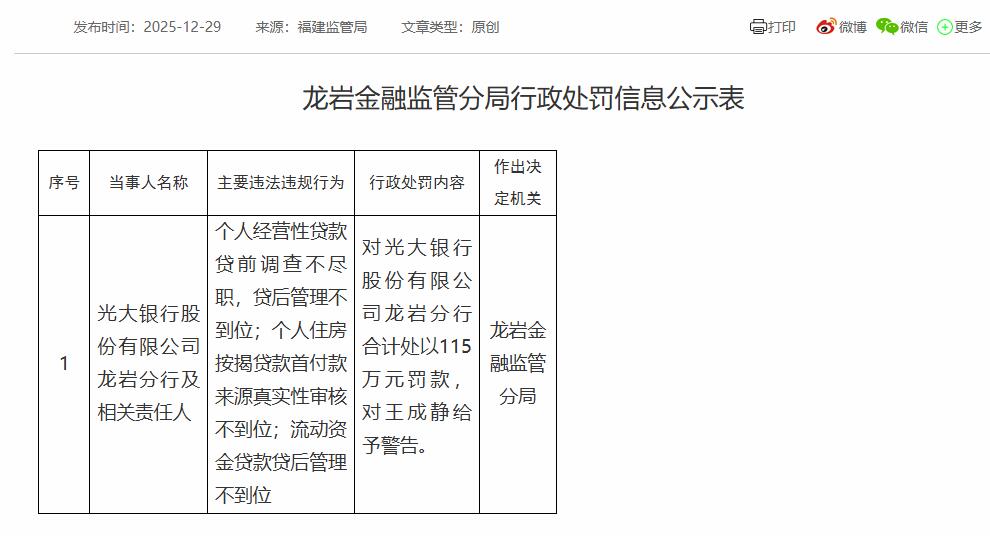
Group 1 - The core viewpoint of the article highlights the administrative penalties imposed on Everbright Bank's Longyan branch due to inadequate pre-loan investigations and post-loan management for personal business loans, as well as insufficient verification of the source of down payments for personal housing loans [1][3] - The Longyan Financial Regulatory Bureau has fined Everbright Bank's Longyan branch a total of 1.15 million yuan for these violations [1][3] - A warning was issued to an individual named Wang Chengjing, who is associated with the violations at the bank [1][3]
光大银行龙岩分行被罚115万元 涉贷后管理不到位等
Zhong Guo Jing Ji Wang· 2025-12-31 06:25
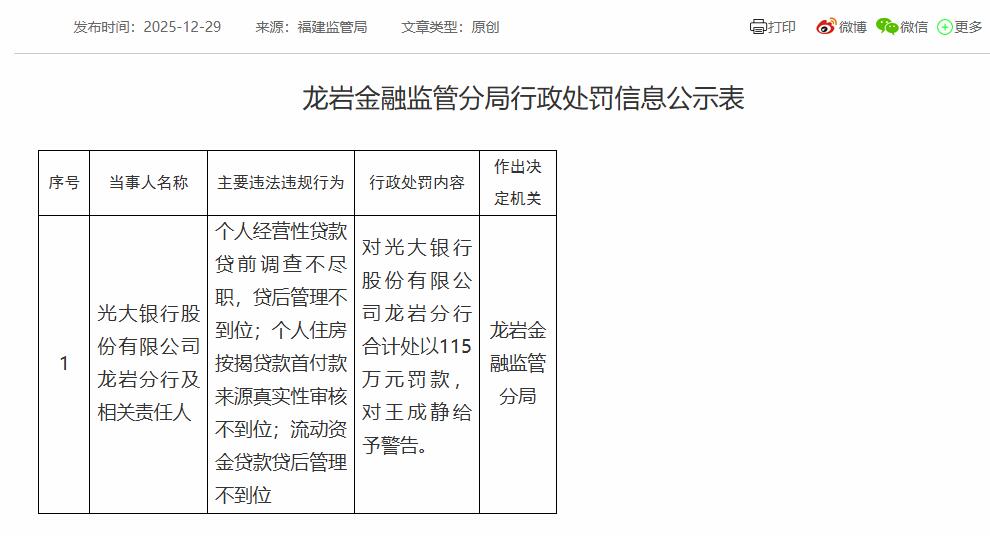
Group 1 - The core viewpoint of the article highlights the administrative penalties imposed on Everbright Bank's Longyan branch due to inadequate pre-loan investigations and post-loan management for personal business loans, as well as insufficient verification of the source of down payments for personal housing loans [1][3] - The Longyan Financial Supervision Bureau has fined Everbright Bank's Longyan branch a total of 1.15 million yuan for these violations [1][3] - Additionally, a warning was issued to an individual named Wang Chengjing, who is associated with the violations [1][3]
融资客看好10股 买入占成交比例超三成
Zheng Quan Shi Bao Wang· 2025-12-31 02:42
Group 1 - The article highlights the behavior of margin traders, indicating that investors are looking for investment opportunities through their activities [1] - On December 30, a total of 3,757 stocks received margin buying funds, with the top three stocks being Sanhua Intelligent Controls at 2.296 billion, Zhongji Xuchuang at 2.293 billion, and Xinyi Sheng at 1.910 billion [1] - Among the stocks with significant margin buying, 10 stocks had a margin buying amount that exceeded 30% of their total trading volume [1] Group 2 - The top stocks by margin buying amount and their respective trading volumes and percentages are detailed, with notable mentions including Qingtang City at 24.35 million and Daya Shengxiang at 12.86 million [2] - The data shows that the margin buying percentage for several stocks is high, with Qingtang City at 43.09%, Daya Shengxiang at 40.80%, and Guangming Meat Industry at 35.66% [1][2] - The article provides a comprehensive table listing various stocks, their margin buying amounts, total trading amounts, margin buying percentages, and daily price changes [1][2]


以金融力量践行“国之大者”,光大银行零售普惠业务迈出高质量发展新步伐
Xin Lang Cai Jing· 2025-12-31 02:13
Core Viewpoint - Everbright Bank is committed to enhancing inclusive finance and supporting the real economy, focusing on product innovation, service expansion, and technology empowerment to create a distinctive retail inclusive finance development path [1] Group 1: Product Development - Everbright Bank has increased credit supply for small and micro enterprises and individual businesses, creating a "Fast, Beneficial, Easy" product system that includes mortgage loans, agricultural loans, and online credit loans [2] - The bank has served 420,000 individual customers, with the "Sunshine Agricultural Loan" providing 2.1 billion yuan in support for agricultural clients across 11 provinces [2] Group 2: Scene Integration - Everbright Bank integrates financial products into various production and living scenarios by establishing strategic partnerships with agricultural guarantee companies and leading agricultural enterprises, creating an efficient inclusive finance service ecosystem [3] - Specific examples include the successful loan disbursement of 90 million yuan for garlic in Jinan and over 1.3 billion yuan for sugarcane in Nanning [3] Group 3: Digital Inclusion - The bank emphasizes technology empowerment to enhance the quality and efficiency of inclusive financial services, implementing a digital and intelligent upgrade of its product system [4] - New features include online applications for loan renewals and direct online access for agricultural clients' needs, aiming to provide a seamless customer experience [4] - Everbright Bank is focused on building a multi-layered, comprehensive, and distinctive service system in retail inclusive finance, with plans to continue enhancing integrated service capabilities and data-driven operations [4]
盛银消金董事长任职资格获核准
Sou Hu Cai Jing· 2025-12-30 14:55
Regulatory - The China Internet Finance Association held a seminar on the self-regulatory management mechanism for internet lending, with 16 participating institutions discussing the development history and current status of lending services [2] - The association emphasized the importance of self-regulation in guiding the healthy development of the internet lending industry during this critical period [2] Banking - Everbright Bank's Longyan branch was fined 1.15 million yuan due to inadequate pre-loan investigations and post-loan management for personal business loans and housing mortgage loans [3] - Minsheng Bank announced the appointment of Huang Hongri as the Chief Compliance Officer, pending approval from the financial regulatory authority [4] Large Companies - Tencent's financial subsidiary, Shenzhen Qianhai Financial Technology Co., received approval to register 10 billion yuan in Asset-Backed Notes (ABN), with a total issuance of nearly 40 billion yuan across two products [5] - The People's Bank of China announced the cancellation of the payment license for Zhonggang Yintong Information Technology Service Co., which previously held licenses for internet payment and prepaid card issuance [6] - The qualification of Zhou Zhi as the chairman of Shengyin Consumer Finance Co. was approved by the Liaoning Financial Regulatory Bureau [6]