
PETROCHINA(601857)

Search documents
中国石油取得电连接线穿越装置专利
Sou Hu Cai Jing· 2026-01-23 02:56
渤海石油装备(天津)中成机械制造有限公司,成立于1996年,位于天津市,是一家以从事通用设备制 造业为主的企业。企业注册资本20847.42万人民币。通过天眼查大数据分析,渤海石油装备(天津)中 成机械制造有限公司共对外投资了2家企业,参与招投标项目1945次,财产线索方面有商标信息2条,专 利信息168条,此外企业还拥有行政许可56个。 国家知识产权局信息显示,中国石油集团渤海石油装备制造有限公司、中国石油天然气集团有限公司、 渤海石油装备(天津)中成机械制造有限公司取得一项名为"电连接线穿越装置、钻井设备及采油设 备"的专利,授权公告号CN120933843B,申请日期为2025年10月。 天眼查资料显示,中国石油集团渤海石油装备制造有限公司,成立于2008年,位于天津市,是一家以从 事专用设备制造业为主的企业。企业注册资本619773.124226万人民币。通过天眼查大数据分析,中国 石油集团渤海石油装备制造有限公司共对外投资了28家企业,参与招投标项目2772次,财产线索方面有 商标信息32条,专利信息1499条,此外企业还拥有行政许可3个。 中国石油天然气集团有限公司,成立于1990年,位于北京市, ...

中国石油取得天然气清管及过滤分离模块专利
Sou Hu Cai Jing· 2026-01-23 02:05
Group 1 - The State Intellectual Property Office of China has granted a patent for a "module for natural gas pigging and filtration separation" to China Petroleum Engineering Construction Co., Ltd. and China National Petroleum Corporation, with the patent announcement number CN116066736B and application date of November 2021 [1] - China Petroleum Engineering Construction Co., Ltd. was established in 1981, located in Beijing, primarily engaged in civil engineering construction, with a registered capital of 2,409.562 million RMB [1] - The company has made investments in 12 enterprises, participated in 5,000 bidding projects, holds 10 trademark registrations, 1,148 patents, and possesses 67 administrative licenses [1] Group 2 - China National Petroleum Corporation was established in 1990, also located in Beijing, primarily engaged in oil and gas extraction, with a registered capital of 48,690 million RMB [1] - The corporation has invested in 107 enterprises, participated in 5,000 bidding projects, holds 1,441 trademark registrations, 5,000 patents, and possesses 28 administrative licenses [1]
中国石油取得地震波旅行时确定方法专利
Sou Hu Cai Jing· 2026-01-23 02:05
Group 1 - The State Intellectual Property Office of China has granted a patent to China National Petroleum Corporation (CNPC) for a method, device, computer equipment, and storage medium for determining seismic wave travel times, with the announcement number CN116136605B and application date in November 2021 [1] - CNPC, established in 1990 and headquartered in Beijing, primarily engages in oil and gas extraction, with a registered capital of 48.69 billion RMB [1] - CNPC has made investments in 107 companies, participated in 5,000 bidding projects, holds 1,441 trademark records, and has 5,000 patent records, along with 28 administrative licenses [1] Group 2 - China National Petroleum Group Geophysical Exploration Co., Ltd., established in 2000 and located in Baoding, focuses on professional technical services, with a registered capital of approximately 1.53 billion RMB [1] - This subsidiary has invested in 32 companies, participated in 2,396 bidding projects, holds 100 trademark records, and has 3,418 patent records, along with 278 administrative licenses [1]
工银新材料新能源股票:2025年第四季度利润1.17亿元 净值增长率8.96%
Sou Hu Cai Jing· 2026-01-23 01:41
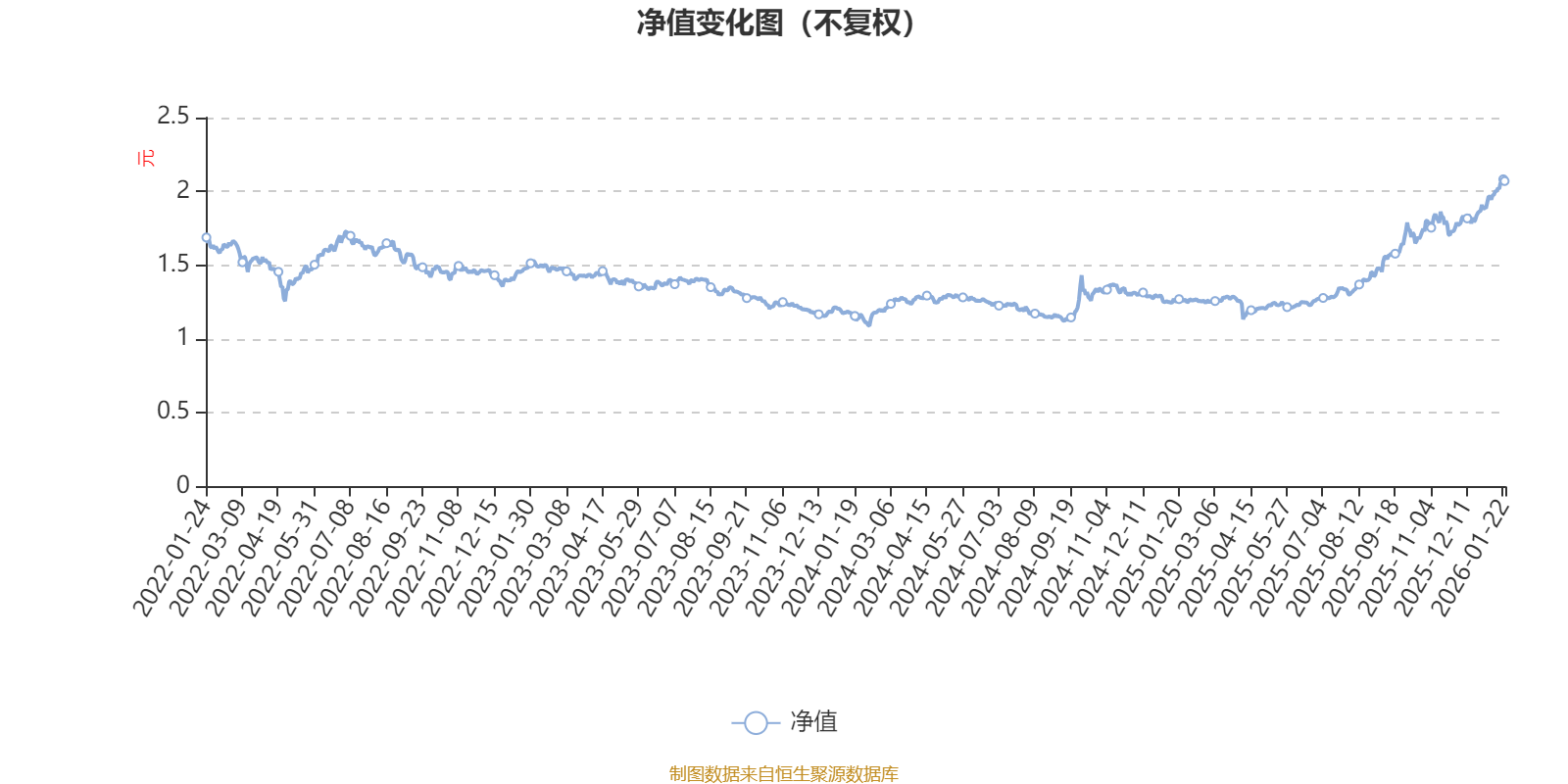
Core Viewpoint - The AI Fund ICBC New Materials New Energy Stock (001158) reported a profit of 117 million yuan in Q4 2025, with a net value growth rate of 8.96% during the reporting period, and a total fund size of 1.342 billion yuan by the end of Q4 2025 [2][12]. Fund Performance - As of January 22, the fund's unit net value was 2.07 yuan, with a one-year cumulative net value growth rate of 63.38%, ranking it 10th out of 57 comparable funds [2][3]. - Over the past three months, the fund achieved a net value growth rate of 23.29%, ranking 1st out of 58 comparable funds, and over the past six months, it recorded a growth rate of 53.45%, ranking 3rd out of 58 [3]. Risk and Return Metrics - The fund's Sharpe ratio over the past three years is 0.8509, placing it 17th out of 56 comparable funds [7]. - The maximum drawdown over the past three years is 28.76%, with the largest single-quarter drawdown occurring in Q1 2021 at 25.09% [8]. Investment Strategy - The fund maintains a high stock position, with an average stock position of 88.03% over the past three years, slightly below the industry average of 88.64% [11]. - The fund's top ten holdings include Zijin Mining, CATL, and Jerry Holdings, indicating a concentrated investment strategy [16]. Market Outlook - The fund manager highlights increasing market attention on resources, particularly non-ferrous metals like copper, driven by geopolitical uncertainties and rising electricity demand from AI computing investments [2].




小红日报 | 奥特维收涨14.41%,标普A股红利ETF华宝(562060)标的指数上涨0.83%创新高
Xin Lang Cai Jing· 2026-01-23 01:16
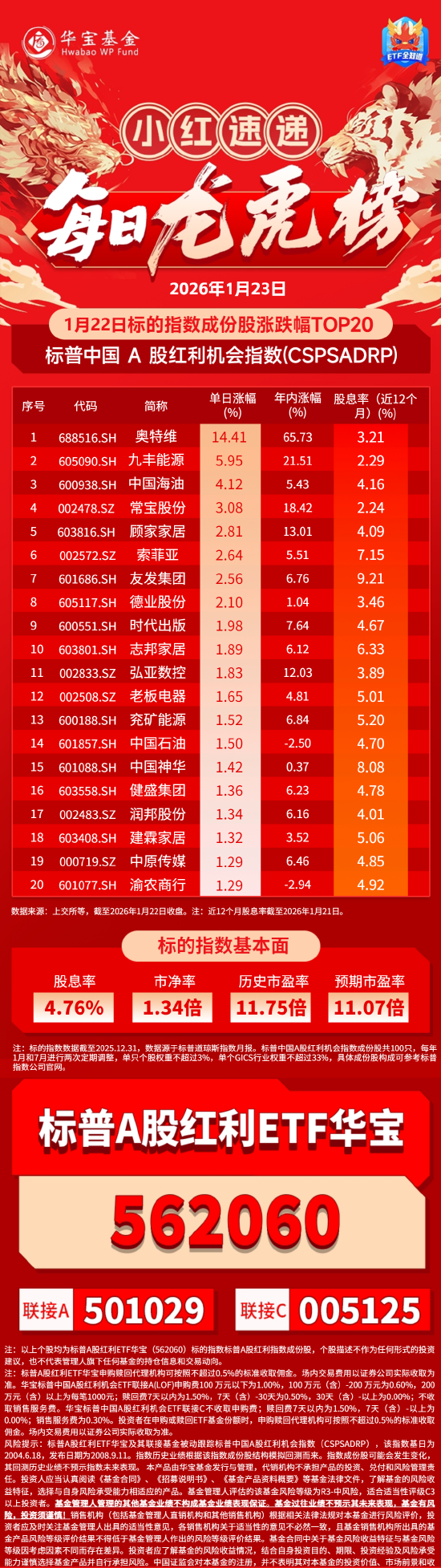
Group 1 - The article highlights the top 20 stocks in the S&P China A-Share Dividend Opportunity Index (CSPSADRP) based on their daily and year-to-date performance as of January 22, 2026 [1][5] - The stock "奥特维" (code: 688516.SH) leads with a daily increase of 14.41% and a year-to-date increase of 65.73%, with a dividend yield of 3.21% [1][5] - Other notable performers include "九丰能源" (code: 605090.SH) with a daily increase of 5.95% and a year-to-date increase of 21.51%, and "中国海滩" (code: 600938.SH) with a daily increase of 4.12% and a year-to-date increase of 5.43% [1][5] Group 2 - The overall dividend yield for the index is reported at 4.76%, with a historical price-to-earnings (P/E) ratio of 11.75 times and an expected P/E ratio of 11.07 times [2] - The data indicates a positive trend in stock performance, with several companies showing significant year-to-date gains, suggesting a favorable investment environment [4][8]




中国石油天然气集团取得气凝胶保温隔热涂料专利
Sou Hu Cai Jing· 2026-01-23 00:53
声明:市场有风险,投资需谨慎。本文为AI基于第三方数据生成,仅供参考,不构成个人投资建议。 来源:市场资讯 国家知识产权局信息显示,中国石油天然气集团有限公司取得一项名为"气凝胶保温隔热涂料及其制备 方法和应用"的专利,授权公告号CN120059593B,申请日期为2023年11月。 天眼查资料显示,中国石油天然气集团有限公司,成立于1990年,位于北京市,是一家以从事石油和天 然气开采业为主的企业。企业注册资本48690000万人民币。通过天眼查大数据分析,中国石油天然气集 团有限公司共对外投资了107家企业,参与招投标项目5000次,财产线索方面有商标信息1441条,专利 信息5000条,此外企业还拥有行政许可28个。 中国石油集团渤海钻探工程有限公司,成立于2008年,位于天津市,是一家以从事石油和天然气开采业 为主的企业。企业注册资本1621400万人民币。通过天眼查大数据分析,中国石油集团渤海钻探工程有 限公司共对外投资了1家企业,参与招投标项目5000次,财产线索方面有商标信息10条,专利信息3347 条,此外企业还拥有行政许可83个。 ...
中石油取得石油工艺120℃高温伴热跨临界CO2循环系统专利
Sou Hu Cai Jing· 2026-01-23 00:46
中国石油天然气股份有限公司,成立于1999年,位于北京市,是一家以从事石油和天然气开采业为主的 企业。企业注册资本18302097万人民币。通过天眼查大数据分析,中国石油天然气股份有限公司共对外 投资了1297家企业,参与招投标项目443次,财产线索方面有商标信息38条,专利信息5000条,此外企 业还拥有行政许可168个。 声明:市场有风险,投资需谨慎。本文为AI基于第三方数据生成,仅供参考,不构成个人投资建议。 来源:市场资讯 国家知识产权局信息显示,中石油深圳新能源研究院有限公司、中国石油天然气股份有限公司取得一项 名为"一种可实现石油工艺120℃高温伴热的跨临界CO2循环系统及其控制方法"的专利,授权公告号 CN120799744B,申请日期为2025年9月。 天眼查资料显示,中石油深圳新能源研究院有限公司,成立于2021年,位于深圳市,是一家以从事科技 推广和应用服务业为主的企业。企业注册资本10000万人民币。通过天眼查大数据分析,中石油深圳新 能源研究院有限公司共对外投资了1家企业,参与招投标项目744次,财产线索方面有商标信息4条,专 利信息275条,此外企业还拥有行政许可21个。 ...
A股四大股指集体飘红 油气开采板块走势强劲
Shang Hai Zheng Quan Bao· 2026-01-22 18:29
1月22日,A股延续横盘震荡态势,以"三桶油"为代表的石油石化板块全天维持强势,商业航天等热点 题材也止跌复苏,带动四大股指收盘集体飘红。 截至收盘,上证指数报4122.58点,涨0.14%;深证成指报14327.05点,涨0.50%;创业板指报3328.65 点,涨1.01%;科创综指报1865.34点,涨0.14%。沪深两市合计成交26918亿元,较前一日放量约900亿 元。 油气开采板块领涨 昨日,A股油气开采板块全天维持强势,油服工程与燃气方向涨势突出。截至收盘,申万石油石化指数 收涨3.07%,洲际油气、蓝焰控股、润贝航科、仁智股份收获涨停,中国石化、中国海油涨超4%,中国 石油收涨1.50%。 消息面上,海外天然气价格近期持续大涨。纽约商业交易所(NYMEX)上市的天然气期货继周三大涨 29%后,昨日继续冲高涨超10%,盘中触及5.50美元/百万英热,创2025年6月以来新高,本周累计涨幅 超过70%。 瑞银财富管理投资总监办公室(CIO)昨日发表观点称,多重因素将继续利好中国股票市场。其中,政 策利好和结构性盈利增长将继续驱动中国市场复苏,尤其看好中国科技板块的发展前景。 瑞银财富管理表示,人工 ...


中石油河北销售公司:打造“路边”爱心站 延伸服务民生链
Zhong Guo Jin Rong Xin Xi Wang· 2026-01-22 11:52
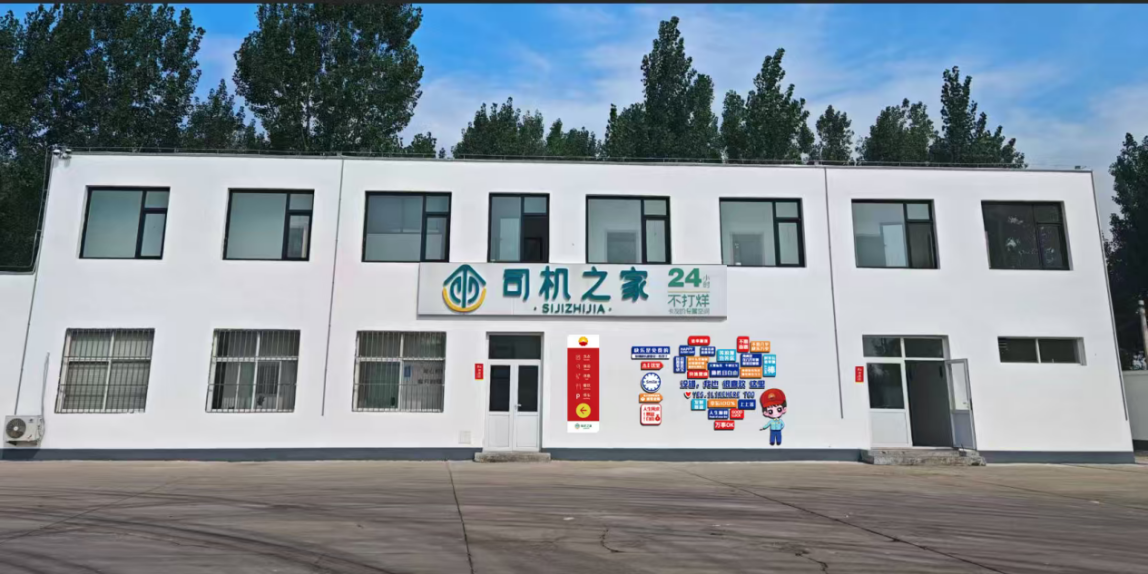
Core Viewpoint - China Petroleum Hebei Sales is enhancing its services for truck drivers by establishing "Driver Homes" that provide essential amenities, reflecting the company's commitment to improving the livelihoods of transportation workers [1][2]. Group 1: Service Development - The company has focused on addressing the challenges faced by truck drivers regarding their "eating, living, and traveling" needs by setting up five "Driver Homes" along major traffic routes [2]. - The "Driver Home" at Handan Fengfeng has significantly improved its service capacity, increasing daily charging from 500 kWh to over 12,000 kWh, a nearly 24-fold increase [2]. - The Cangzhou Huanghua Shenzhou Station offers free meals with dedicated chefs, enhancing the overall experience for drivers [2]. Group 2: Diverse Services - Each "Driver Home" provides unique services based on regional needs, such as the Hengshui Wuyi 103 Station, which has seven functional areas and has served over 14,000 drivers [3]. - The Tangshan Fengrun Station implements standardized parking management and increased inspection frequency for safer nighttime stops [3]. - The Shenzhou South Ring 85 Station is known for its homemade steamed buns, which have become popular among drivers [3]. Group 3: Future Plans and Community Support - To enhance sustainability, the company plans to build 12 new "Driver Homes" by 2026, expanding its service coverage [6]. - The company extends its services to outdoor workers, offering various conveniences such as rest areas, charging stations, and emergency assistance [6]. - A total of 300 "Love Service Stations" have been established, including 36 demonstration types, 80 standard types, and 184 basic types, creating a supportive network for workers [6].

中国石油申请控压钻井的压力流量控制方法专利,实现对节流阀的无人化实时控制
Sou Hu Cai Jing· 2026-01-22 10:32
Group 1 - The core viewpoint of the news is the application for a patent by China National Petroleum Corporation (CNPC) and China Petroleum Group Engineering Technology Research Institute for a method, system, and device related to pressure flow control in pressure-controlled drilling [1] - The patent application, published as CN121363419A, was filed on July 2024 and focuses on real-time control of throttle valve opening to adjust pressure flow during drilling operations [1] - The method involves real-time acquisition of drilling data and sensor data, determining upstream and downstream sampling points, and calculating the throttle valve opening based on these data points [1] Group 2 - China National Petroleum Corporation was established in 1990, located in Beijing, primarily engaged in oil and gas extraction, with a registered capital of 48.69 billion RMB [2] - CNPC has invested in 107 companies, participated in 5,000 bidding projects, and holds 1,441 trademark records and 5,000 patent records [2] - China Petroleum Group Engineering Technology Research Institute, founded in 2006, also based in Beijing, focuses on research and experimental development with a registered capital of approximately 570.39 million RMB [2] - The research institute has invested in 4 companies, participated in 579 bidding projects, and holds 33 trademark records and 2,228 patent records [2]