CCB(601939)

Search documents
六大行三季报业绩:工行挣得最多,农行增速最快,建行派息最高
2 1 Shi Ji Jing Ji Bao Dao· 2025-10-31 15:22
Core Insights - The six major state-owned banks in China reported double growth in revenue and net profit for the first three quarters of the year, achieving a total profit of 1.07 trillion yuan [2] - China Bank had the fastest revenue growth, while Industrial and Agricultural Banks led in total net profit and year-on-year growth [2] - The net interest margin showed a downward trend across all banks, indicating a potential challenge in profitability [3] Revenue Summary - The revenue figures for the six banks are as follows: Industrial Bank 640.03 billion yuan, Agricultural Bank 550.88 billion yuan, Construction Bank 573.70 billion yuan, China Bank 491.20 billion yuan, Postal Savings Bank 265.08 billion yuan, and Transportation Bank 199.65 billion yuan, with year-on-year growth rates of 2.17%, 1.97%, 0.82%, 2.69%, 1.82%, and 1.80% respectively [2] Net Profit Summary - The net profit figures for the banks are: Industrial Bank 269.91 billion yuan, Agricultural Bank 220.86 billion yuan, Construction Bank 257.36 billion yuan, China Bank 177.66 billion yuan, Postal Savings Bank 76.56 billion yuan, and Transportation Bank 69.99 billion yuan, with year-on-year growth rates of 0.33%, 3.03%, 0.62%, 1.08%, 0.98%, and 1.90% respectively [2] Asset Quality - The non-performing loan ratios for the banks as of September 30 are: Industrial Bank 1.33%, Agricultural Bank 1.27%, Construction Bank 1.32%, China Bank 1.24%, Postal Savings Bank 0.94%, and Transportation Bank 1.26%, all showing improvement compared to the end of the previous year [3] Dividend Distribution - The proposed dividend distributions per 10 shares are: Industrial Bank 1.414 yuan, Agricultural Bank 1.195 yuan, Construction Bank 1.858 yuan, China Bank 1.094 yuan, Postal Savings Bank 1.230 yuan, and Transportation Bank 1.563 yuan, totaling 204.66 billion yuan, with Construction Bank having the highest payout [3] Market Performance - The stock prices of the four major banks have seen varying degrees of increase this year, with Agricultural Bank up 57.72%, Industrial Bank 18.05%, Construction Bank 10.06%, and China Bank 7.12%, leading to Agricultural Bank ranking second in global bank market capitalization [3] Analyst Outlook - Morgan Stanley's report suggests that profits for major Chinese banks are expected to remain stable, with dividend yields around 6%-7%, indicating that large state-owned banks are considered safe investment choices [4]




建设银行(601939):资产质量稳中向好
CMS· 2025-10-31 15:16
Investment Rating - The report maintains a strong buy recommendation for the company [5] Core Insights - The company has shown stable asset quality with a positive trend in overall performance, driven by growth in scale, middle-income, and other non-interest income, while effective tax rates have decreased [1][2] - Investment assets have been increased, with a stable credit growth rate of 7.5% and a nearly 20% year-on-year increase in investment assets [2] - The net interest margin has decreased, with a reported value of 1.36%, down 4 basis points from the first half of 2025 [3] Performance Summary - For the first three quarters of 2025, the company's operating income, pre-provision operating profit (PPOP), and net profit attributable to shareholders have shown year-on-year growth rates of 0.82%, 1.03%, and 0.62% respectively [1] - The loan non-performing ratio at the end of Q3 2025 was 1.32%, showing a slight decrease, while the provision coverage ratio stood at 235.05% [2][3] - The company’s total assets reached approximately 45.37 trillion yuan by the end of Q3 2025, with total loans at 27.68 trillion yuan [12] Non-Interest Income - The net fee income growth rate has improved, reaching 5.3% for the first three quarters of 2025, driven by the recovery in wealth management services [2][3] - Other non-interest income has seen a year-on-year growth of 31% in the first three quarters of 2025, although this growth rate has decreased compared to the first half of the year [3][31] Financial Data and Valuation - The projected net profit for 2025 is approximately 341.22 billion yuan, with a year-on-year growth of 1.7% [4] - The price-to-earnings (PE) ratio is projected to be 6.8 for 2025, while the price-to-book (PB) ratio is expected to be 0.7 [4][5] - The company’s return on equity (ROE) is projected to be 10.32% for 2025, reflecting a stable performance [29]
银行业绩下行周期接近尾声 资产质量改善趋势确立
Jing Ji Guan Cha Wang· 2025-10-31 11:50
Core Viewpoint - The apparent stability of bank non-performing loan (NPL) ratios conceals deeper structural changes, indicating that the era of "soft landing" achieved through provisioning adjustments and risk rotation is nearing its end [2][8] Group 1: Banking Performance - China Construction Bank reported a 1.44% year-on-year increase in operating income to 560.281 billion yuan for the first three quarters of 2025, with net profit rising by 0.52% to 258.446 billion yuan [3] - The bank's asset quality remains robust, with a non-performing loan ratio of 1.32%, down 0.02 percentage points from the end of the previous year, and a provisioning coverage ratio of 235.05%, up 1.45 percentage points [3] - Other major banks, such as China Bank and Postal Savings Bank, also show varying levels of asset quality, with China Bank's NPL ratio at 1.24% and Postal Savings Bank's NPL ratio at 0.94% [4] Group 2: Risk Assessment - Some joint-stock banks are experiencing thinner provisioning buffers, with Everbright Bank's NPL ratio at 1.26% and a provisioning coverage ratio of 168.92%, nearing regulatory warning lines [5] - In contrast, certain regional banks demonstrate stronger risk resilience, such as Chengdu Bank with an NPL ratio of only 0.68% and a provisioning coverage ratio of 433.08% [6] - The focus of risk has shifted from corporate to retail, with banks like China Merchants Bank reporting an increase in attention loans, indicating rising concerns in personal lending sectors [7] Group 3: Future Outlook - The banking industry is expected to face a genuine stress test as excess provisioning space narrows and retail risks continue to emerge, marking a transition from scale expansion to quality prioritization [2][8] - The ability to balance risk clearance and sustainable profits will determine the future restructuring of the industry [8]







六大行前三季度赚了多少钱?
Jin Shi Shu Ju· 2025-10-31 11:34
Core Insights - The six major state-owned banks in China reported a total operating income of approximately 2.73 trillion yuan for the first three quarters of 2025, reflecting a year-on-year growth of 1.87% [3] - The net profit attributable to shareholders reached about 1.72 trillion yuan, with a year-on-year increase of 1.22% [3] - All six banks achieved positive year-on-year growth in both revenue and net profit, with significant contributions from the third quarter [4] Revenue and Profit Performance - The revenue growth rates for Bank of China and Industrial and Commercial Bank of China were 2.69% and 2.17%, respectively, while Agricultural Bank of China led in net profit growth at 3.03% [3] - Absolute profit figures for the banks included approximately 269.9 billion yuan for ICBC, 257.4 billion yuan for CCB, and 220.9 billion yuan for ABC [3] Interest Income and Net Interest Margin - Interest income continued to decline, with only the Bank of Communications showing a year-on-year increase of 1.46% in net interest income [6] - The net interest margin for most banks decreased, but the rate of decline has narrowed compared to earlier in the year, with declines ranging from 0.01 to 0.04 percentage points per quarter [6] Asset Growth and Quality - Total assets of the six banks approached 218 trillion yuan, with a growth of approximately 1.85% since mid-year [3] - The non-performing loan ratio improved for five banks compared to the end of last year, while one bank saw a slight increase [7] Market Capitalization - As of October 30, Agricultural Bank of China had a market capitalization of 2.74 trillion yuan, leading among the banks, while ICBC's market cap was 2.59 trillion yuan [8]

建设银行(601939):盈利同比转正,不良率稳中有降
Ping An Securities· 2025-10-31 10:57
Investment Rating - The investment rating for the company is "Recommended" [1] Core Views - The company achieved a year-on-year profit growth of 0.6% in the first three quarters of 2025, marking a turnaround from a decline of 1.4% in the first half of the year. Revenue also grew by 0.8% year-on-year, although the growth rate has slowed compared to the first half of the year [4][7] - The net interest margin (NIM) for the first three quarters of 2025 was 1.36%, a decrease of 16 basis points year-on-year, indicating a continued decline in interest margins [7][8] - The non-performing loan (NPL) ratio stood at 1.32% at the end of the third quarter, showing a slight decrease, which reflects stable asset quality [8] Summary by Sections Financial Performance - For the first three quarters of 2025, the company reported operating income of 573.7 billion yuan and a net profit attributable to shareholders of 257.4 billion yuan [4][9] - The annualized return on equity (ROE) was 10.3% [4] - Total assets reached 45.4 trillion yuan, a year-on-year increase of 10.9%, with loans and deposits both growing by 7.5% [4][7] Revenue Breakdown - The company's net interest income decreased by 3.0% year-on-year, but the decline has narrowed compared to the first half of the year [7] - Non-interest income grew by 14.0% year-on-year, although the growth rate has slowed from the first half of the year [7][9] Asset Quality - The company maintained a high provision coverage ratio of 235%, indicating strong risk management [8] - The loan growth rate was 7.5%, with corporate loans showing a slight increase [7][9] Future Outlook - The company is expected to maintain its earnings forecasts for 2025-2027, with projected earnings per share (EPS) of 1.30, 1.34, and 1.39 yuan respectively [8][10] - The current stock price corresponds to a price-to-book (P/B) ratio of 0.69x for 2025, indicating potential value for investors [8]
高盛:市场关注建设银行净息差趋势 维持“买入”评级
Zhi Tong Cai Jing· 2025-10-31 10:08
Core Viewpoint - Goldman Sachs maintains a "Buy" rating on China Construction Bank (CCB) with a target price of HKD 8.55 [1] Financial Performance - CCB's profit before provisions for the last quarter was 6% lower than expected, primarily due to a net interest margin that fell short of forecasts and an increase in the cost-to-income ratio [1] - The Common Equity Tier 1 (CET1) capital ratio stands at 14.4%, reflecting a year-on-year increase of 26 basis points, but is 32 basis points lower than predictions [1] Future Focus Areas - Investors are expected to pay close attention to the trend in CCB's net interest margin [1] - The outlook for non-interest income is also a key area of interest [1] - The trend in asset quality following a significant release of provisions due to a decline in non-performing loan generation rates will be monitored [1] - Guidance on cost control will be another important factor for investors [1]
建行德州兴德科技支行开展老年群体金融消保公益活动
Qi Lu Wan Bao· 2025-10-31 09:58
Core Viewpoint - The article emphasizes the importance of protecting the financial security of the elderly population through targeted financial education and services, highlighting a series of community outreach activities conducted by the Bank of China in Dezhou [1][2]. Group 1: Financial Education Initiatives - The Bank of China in Dezhou has launched a series of public welfare activities focused on financial education for the elderly, themed "Warm Autumn, Protecting Silver Age" [1]. - Activities include offline lectures, on-site consultations, and community promotions to address high-frequency financial risk scenarios faced by the elderly [1]. - Staff members simplify complex financial concepts such as "fraudulent investment" and "scams impersonating law enforcement" to help elderly clients recognize fraudulent tactics [1]. Group 2: Personalized Support Services - A "one-on-one consultation desk" is set up to address hot topics like "social security card usage" and "pension account security," providing practical advice on account management [1]. - The bank has formed a "financial service task force" to visit communities and nursing homes, educating elderly individuals on key fraud prevention measures [1]. - The bank assists elderly clients in setting up mobile banking in "senior mode," which features larger fonts and simplified interfaces to enhance usability [1]. Group 3: Community Engagement and Well-being - The activities also include free health services such as blood pressure monitoring and nail trimming, integrating financial protection with humanistic care [1]. - The Bank of China in Dezhou plans to continue developing financial services for the elderly, aiming for regular and refined public welfare activities to fulfill its social responsibility [2].
高盛:市场关注建设银行(00939)净息差趋势 维持“买入”评级
智通财经网· 2025-10-31 09:25
Core Viewpoint - Goldman Sachs reported that China Construction Bank's (00939) pre-provision profit for the last quarter was 6% lower than expected, primarily due to a weaker net interest margin and an increase in the cost-to-income ratio [1] Financial Performance - The common equity tier 1 capital ratio for China Construction Bank was 14.4%, which represents a year-on-year increase of 26 basis points, but is 32 basis points lower than forecasted [1] - The bank's net interest margin trend will be a key focus for investors moving forward [1] Future Outlook - Investors will pay attention to the outlook for non-interest income and the trend in asset quality following a significant release of provisions due to a decline in non-performing loan generation rates [1] - Cost control guidance will also be a critical area of interest for investors [1] Investment Rating - Goldman Sachs maintains a "Buy" rating on China Construction Bank with a target price of HKD 8.55 [1]
建行河南省分行打造“家装生态圈” 激活消费动能
Huan Qiu Wang· 2025-10-31 08:43
来源:环球网 在河南郑州一家建材卖场里,市民王杰女士刚用建行装修分期卡支付了新家的地板款项。"正好赶上'家 装节',一年免息,压力小多了。"她笑着说。 建行河南省分行通过资源整合打造"家装生态圈",既让利消费者,又为商户引流,实现多方共赢。正如 那位在卖场里的王女士所言,"装修是大事,有这样的支持,安心不少。" 据悉,活动期间持建行装修分期卡的客户,可在建行优选合作商户享受"一年期分期付款免息",减轻了 居民装修的资金压力。数据显示,自启动至10月22日,全省装修分期业务客户申请量已达2629笔,申请 金额累计6.5亿元,在合作商户的消费交易额达315.9万元。通过银商协同的深度合作模式,合作商户共 同投入贴息资源6.9万元,有效降低了客户融资成本。 除免息权益外,建行还为客户推出了商圈满减礼。截至目前,建行已联合全省超过1500家商户开展此项 活动,通过核销148份礼券,累计为客户节省支出7.4万元。 王女士所体验的,正是建行河南省分行的"建行家装节·零息装新家"专项消费金融服务。该活动自9月28 日开始,预计10月31日结束,在提供优惠的金融产品基础上,联合全省百余家优选家装商户同频减费让 利,让客户享受 ...
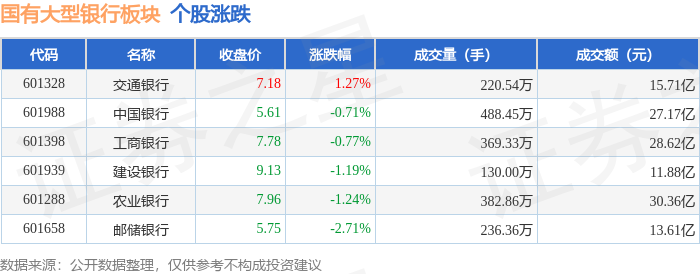
国有大型银行板块10月31日跌1.01%,邮储银行领跌,主力资金净流出1.16亿元
Zheng Xing Xing Ye Ri Bao· 2025-10-31 08:42
Core Insights - The state-owned large bank sector experienced a decline of 1.01% on October 31, with Postal Savings Bank leading the drop [1] - The Shanghai Composite Index closed at 3954.79, down 0.81%, while the Shenzhen Component Index closed at 13378.21, down 1.14% [1] Bank Performance Summary - **Bank of Communications (601328)**: Closed at 7.18, up 1.27%, with a trading volume of 2.2054 million shares and a transaction value of 1.571 billion [1] - **Bank of China (601988)**: Closed at 5.61, down 0.71%, with a trading volume of 4.8845 million shares and a transaction value of 2.717 billion [1] - **Industrial and Commercial Bank of China (601398)**: Closed at 7.78, down 0.77%, with a trading volume of 3.6933 million shares and a transaction value of 2.862 billion [1] - **China Construction Bank (601939)**: Closed at 9.13, down 1.19%, with a trading volume of 1.3 million shares and a transaction value of 1.188 billion [1] - **Agricultural Bank of China (601288)**: Closed at 7.96, down 1.24%, with a trading volume of 3.8286 million shares and a transaction value of 3.036 billion [1] - **Postal Savings Bank (601658)**: Closed at 5.75, down 2.71%, with a trading volume of 2.3636 million shares and a transaction value of 1.361 billion [1] Capital Flow Analysis - The state-owned large bank sector saw a net outflow of 116 million in main funds, while retail funds experienced a net outflow of 8.1972 million [1] - **Bank of Communications**: Main funds net inflow of 224 million, retail funds net outflow of 63.839 million [2] - **Bank of China**: Main funds net outflow of 760.85 thousand, retail funds net outflow of 1.64165 million [2] - **China Construction Bank**: Main funds net outflow of 310.645 thousand, retail funds net inflow of 2.39997 million [2] - **Industrial and Commercial Bank of China**: Main funds net outflow of 519.931 thousand, retail funds net inflow of 1.39323 million [2] - **Postal Savings Bank**: Main funds net outflow of 893.268 thousand, retail funds net outflow of 1.0489 million [2] - **Agricultural Bank of China**: Main funds net outflow of 1.607 million, retail funds net inflow of 4.46154 million [2]