
CCB(601939)

Search documents
前三季度六大行营收净利双增,资产质量持续改善
Bei Jing Ri Bao Ke Hu Duan· 2025-11-02 11:44
Core Viewpoint - The six major state-owned banks in China have reported stable financial performance for the first three quarters of 2025, with all major financial indicators showing positive growth and improved asset quality [1][2]. Financial Performance - The total profit of the six major banks reached 1.07 trillion yuan, with all banks achieving positive net profit growth. The Agricultural Bank of China had the fastest net profit growth rate at 3.03% [2][4]. - The net profits for each bank are as follows: Industrial and Commercial Bank of China (ICBC) 269.9 billion yuan, Agricultural Bank of China 220.9 billion yuan, China Construction Bank 257.4 billion yuan, Bank of China 177.7 billion yuan, Postal Savings Bank 76.6 billion yuan, and Bank of Communications 69.9 billion yuan [2][4]. Asset Quality Improvement - The asset quality of the six banks has improved, with non-performing loan (NPL) ratios decreasing compared to the end of the previous year. The NPL ratios are as follows: ICBC 1.33%, Agricultural Bank 1.27%, China Construction Bank 1.32%, Bank of China 1.24%, Postal Savings Bank 0.94%, and Bank of Communications 1.26% [5][6]. - Postal Savings Bank maintains the lowest NPL ratio among the six banks at 0.94%, reflecting a long-standing trend of low asset quality risk [5][6]. Net Interest Margin Challenges - The net interest margin (NIM) remains under pressure due to overall declining market interest rates and rigid deposit costs. The NIMs for the six banks are: Postal Savings Bank 1.68%, ICBC 1.28%, Agricultural Bank 1.30%, China Construction Bank 1.36%, Bank of China 1.26%, and Bank of Communications 1.20% [7][8]. - The Bank of China has shown a stable NIM trend, while Postal Savings Bank's NIM has decreased by 21 basis points compared to the same period last year [7][8].





超300家银行已消失!
商业洞察· 2025-11-02 09:22
Core Viewpoint - The article discusses the recent regulatory changes in the banking sector, particularly focusing on the new requirements for insurance companies to deposit capital guarantee funds in banks with net assets exceeding 30 billion RMB, which may indicate underlying risks in smaller banks [4][8]. Group 1: Regulatory Changes - The new regulation requires insurance companies to deposit capital guarantee funds in banks with net assets of at least 30 billion RMB, increasing the threshold from 20 billion RMB [7]. - Only about 80 banks, representing 2% of the total, meet the new criteria, suggesting a tightening of the banking landscape [4]. Group 2: Banking Sector Performance - The net interest margin for Chinese commercial banks has dropped to 1.42%, with large banks experiencing even lower margins, which has led to a decline in profitability [9][10]. - The banking sector's net interest income saw a year-on-year decrease of 1.3% in the first half of the year, indicating ongoing challenges in revenue generation [10]. Group 3: Loan Quality and Risks - The non-performing loan (NPL) ratio is on the rise, particularly in the mortgage sector, where the NPL rates have tripled for major banks [13][15]. - There is a concern that the reported NPL rates may not fully reflect the actual situation, as many borrowers are struggling to meet mortgage payments due to declining property values [17][18]. Group 4: Employee Compensation and Morale - Many banks are facing financial strain, leading to reduced performance bonuses and delayed salary payments, with some employees reporting that their total compensation is now lower than that of delivery workers [32][30]. - The average salary for employees in major banks has decreased by 1% compared to the previous year, reflecting the industry's tightening financial conditions [30][31]. Group 5: Industry Outlook - The banking sector is experiencing an oversupply of banks with insufficient demand for loans, leading to increased competition and pressure on profitability [34]. - Over 300 banks have exited the market this year through mergers or closures, primarily affecting local rural commercial banks and village banks, indicating a trend towards consolidation in the industry [34].


银行2025年三季报业绩综述:业绩和息差好于预期
ZHESHANG SECURITIES· 2025-11-02 08:59
Investment Rating - The industry rating is maintained as "Positive" [3] Core Views - The performance of listed banks in Q1-Q3 2025 shows resilience, with state-owned banks achieving positive results across the board, and the improvement in net interest margins for joint-stock and city commercial banks exceeding expectations [4] - The revenue growth rate for listed banks is stable at 0.9% year-on-year, while profit growth has increased to 1.6% [4] - The non-interest income growth rate for listed banks has narrowed, with a year-on-year increase of 5.0% [4] Summary by Sections Performance Overview - Listed banks' revenue growth is stable at 0.9%, and net profit growth has improved to 1.6% in Q1-Q3 2025, slightly slowing from H1 [4] - The net interest margin for listed banks has shown marginal improvement, with a quarterly increase of 0.3 basis points to 1.37% [4] Revenue and Profit Drivers - The asset scale growth for listed banks is 9.3% year-on-year, with a decrease in loan growth to 7.7% and an increase in financial investment growth to 15.8% [4][11] - The non-interest income growth rate has decreased by 2.0 percentage points compared to the previous quarter [4] Risk and Asset Quality - The average non-performing loan (NPL) ratio for 42 sample banks remains stable at 1.23%, while the average attention rate has increased by 2 basis points to 1.69% [5] - Retail loan risks continue to rise, with notable increases in NPL ratios for retail loans at certain banks [5] Dividend Trends - More banks have disclosed mid-term dividend plans for 2025, with some banks increasing their mid-term dividend rates compared to 2024 [6] Investment Recommendations - The report suggests that bank stocks may rebound in Q4, with a focus on small and medium-sized banks in economically developed regions and stable high-dividend large banks [6]


透视六大行三季度“成绩单”:营收净利均实现“双增”,合计日赚约39亿元
Jin Rong Jie· 2025-11-02 04:35
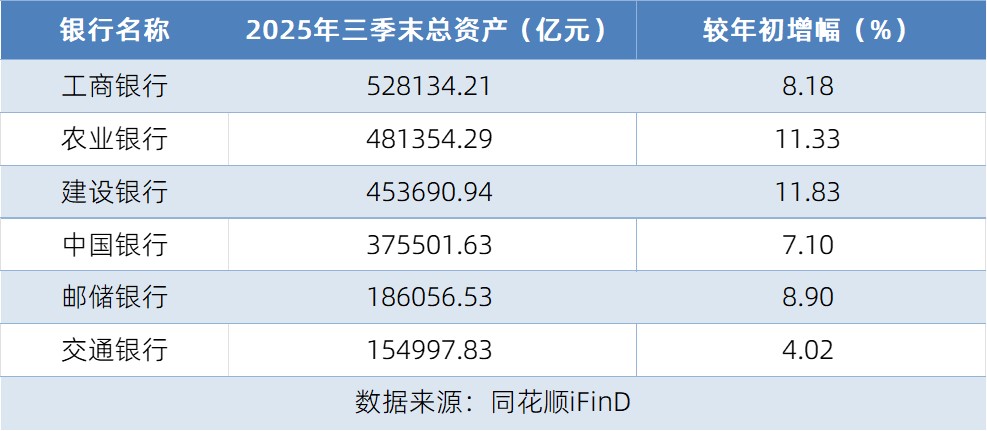
Core Insights - The six major state-owned banks in China reported steady growth in asset scale, operating income, and net profit for the third quarter of 2025, demonstrating strong operational resilience [1] Group 1: Asset Scale - As of the end of Q3 2025, Industrial and Commercial Bank of China (ICBC) leads with total assets of 52.81 trillion yuan, followed by Agricultural Bank of China (ABC) and China Construction Bank (CCB) with 48.14 trillion yuan and 45.37 trillion yuan respectively [2] - The asset growth rates for ABC and CCB were notable at 11.33% and 11.83%, while ICBC and Postal Savings Bank of China (PSBC) showed growth in the 8%-9% range [3] Group 2: Revenue and Profit - In the first three quarters of 2025, ICBC achieved operating income of 6400.28 billion yuan and net profit of 2699.08 billion yuan, maintaining its leading position among the six banks [4] - Agricultural Bank of China reported a net profit growth rate of 3.03%, the highest among the banks, while other banks showed varying growth rates, with some needing to enhance their profit growth momentum [5] Group 3: Asset Quality - The non-performing loan (NPL) ratios for the six major banks mostly declined, with PSBC having the lowest NPL ratio at 0.94%, indicating effective credit risk management [6] - The provision coverage ratios varied significantly, with ABC at 295.08% and PSBC at 240.21%, reflecting strong risk resistance capabilities [7] Group 4: Net Interest Margin - The net interest margins (NIM) for all six banks decreased compared to the end of 2024, with PSBC leading at 1.68% and CCB at 1.36% [8][9] - The overall trend indicates industry-wide pressure on NIM due to deepening interest rate marketization and intensified market competition [9]
汇金、证金持仓动向揭秘
财联社· 2025-11-02 02:19
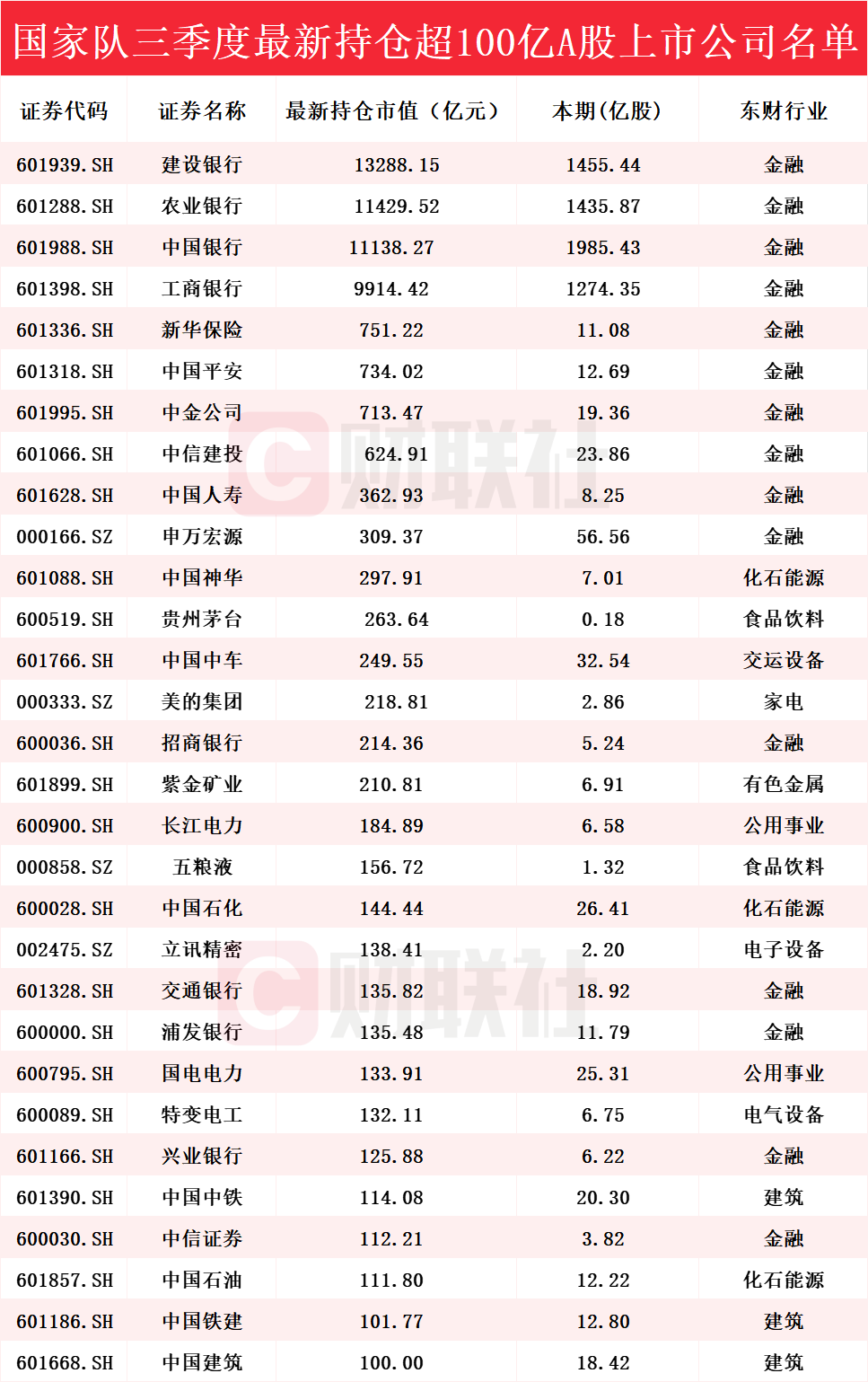
Core Viewpoint - The latest holdings of the "national team" in A-share listed companies have been revealed, with significant investments in major financial institutions and other sectors, indicating a strategic focus on stability and growth in the market [1][2]. Group 1: National Team Holdings - A total of 233 A-share listed companies have the "national team" (China Securities Finance Corporation and Central Huijin) among their top ten shareholders [1]. - There are 30 stocks with a holding value exceeding 10 billion yuan, including major banks like China Construction Bank, Agricultural Bank of China, and Bank of China, with holdings valued at 1.3288 trillion yuan, 1.1429 trillion yuan, and 1.1138 trillion yuan respectively [1][2]. - The top holdings also include companies from various sectors such as insurance, food and beverage, and energy, showcasing a diversified investment strategy [1][2]. Group 2: New Additions and Performance - Farah Electronics has been newly added to the "national team" holdings, with a market value of 158 million yuan [3]. - For the third quarter, Farah Electronics reported a revenue of 3.944 billion yuan, a year-on-year increase of 14.69%, and a net profit of 888 million yuan, also up by 14.58% [3]. - The company’s capacitor products are utilized in ultra-high voltage transmission applications, indicating a focus on high-demand technology sectors [3].





“国家队”持仓动向揭秘!Q3持仓超100亿A股上市公司名单一览
Xin Lang Cai Jing· 2025-11-02 00:45
Core Insights - The latest holdings of the "national team" in A-share listed companies have been revealed, with 233 companies having the "national team" as one of their top ten shareholders [1][2] - In the third quarter, the "national team" held over 10 billion yuan in market value in 30 stocks, including major banks and insurance companies [1] Group 1: Major Holdings - The top three holdings by market value are: - China Construction Bank: 13,288.15 billion yuan - Agricultural Bank of China: 11,429.52 billion yuan - Bank of China: 11,138.27 billion yuan [1] - Other significant holdings include: - Industrial and Commercial Bank of China: 9,914.42 billion yuan - New China Life Insurance: 751.22 billion yuan - Ping An Insurance: 734.02 billion yuan [1][2] Group 2: New Additions - Farah Electronics is a new addition to the "national team" holdings, with a market value of 1.58 billion yuan [2] - The company reported a revenue of 3.944 billion yuan for the first three quarters, a year-on-year increase of 14.69%, and a net profit of 888 million yuan, also up 14.58% [2] - In the third quarter alone, Farah Electronics achieved a revenue of 1.445 billion yuan, reflecting a year-on-year growth of 9.31% [2]
建设银行(601939):利润增速转正 资产增长加速
Ge Long Hui· 2025-11-01 12:42
Core Viewpoint - The performance of the company meets expectations, with a slight year-on-year increase in net profit and operating income for the first three quarters of 2025 [1][2] Financial Performance - The company's net profit and revenue for the first three quarters increased by 0.5% and 0.8% year-on-year, respectively, showing an improvement from the first half of the year [1] - In Q3 alone, net profit and revenue grew by 4.1% and declined by 2.0% year-on-year, respectively, indicating a recovery in profit growth compared to Q2 [1] - The slowdown in asset impairment losses, which increased by 11.2% year-on-year in Q3 compared to 22.8% in the first half, contributed to the positive net profit growth [1] - The decline in revenue growth is attributed to a slowdown in other non-interest income, which grew by 31% year-on-year in the first three quarters, down from 55.6% in the first half [1] - Net interest income decreased by 3.0% year-on-year, showing a slight improvement from a 3.2% decline in the first half, primarily due to a slight decrease in interest margins and slower loan growth [1] Asset Growth - Total assets grew by 10.9% year-on-year in the first three quarters, an increase from 10.3% in the first half, driven by rapid growth in interbank assets [2] - The company's loan balance increased by 7.5% year-on-year, slightly down from 7.9% in the first half, with double-digit growth in key sectors such as "Five Major Articles" [2] Profit Forecast and Valuation - The profit forecast remains unchanged, with the current A-share price corresponding to 0.7x/0.6x P/B for 2025/2026 and H-share price corresponding to 0.5x P/B for both years [2] - The target price for A-shares is maintained at 11.01 yuan, representing a 19.2% upside potential, while the target price for H-shares is 8.91 yuan, indicating a 13.4% upside potential [2]
营收、净利润均回到正增长 六大行三季报传“暖意”
经济观察报· 2025-11-01 10:23
Core Viewpoint - The six major banks have shown positive year-on-year growth in operating income and net profit attributable to the parent company for the first three quarters of 2025, despite facing challenges such as narrowing interest margins [1][2][3]. Financial Performance - All six major banks achieved positive growth in net profit attributable to the parent company in the first three quarters, with Agricultural Bank of China leading at a growth rate of over 3% [6]. - The net profit figures for the first three quarters are as follows: - Agricultural Bank: 220.86 billion yuan, +3.03% - Bank of Communications: 69.99 billion yuan, +1.90% - Bank of China: 177.66 billion yuan, +1.08% - Postal Savings Bank: 76.56 billion yuan, +0.98% - China Construction Bank: 257.36 billion yuan, +0.62% - Industrial and Commercial Bank: 269.91 billion yuan, +0.33% [7]. - The operating income for the first three quarters is as follows: - Bank of China: 491.20 billion yuan, +2.69% - Industrial and Commercial Bank: 640.03 billion yuan, +2.17% - Agricultural Bank: 491.20 billion yuan, +1.97% - Postal Savings Bank: 265.08 billion yuan, +1.82% - Bank of Communications: 199.64 billion yuan, +1.80% - China Construction Bank: 573.70 billion yuan, +0.82% [8]. Income Sources - Interest income for most major banks is in a declining trend, with non-interest income becoming a key growth driver. For the first three quarters, the interest income figures are as follows: - Bank of Communications: 128.65 billion yuan, +1.46% - Other banks experienced declines in interest income ranging from 0.70% to 3.04% [9]. Asset Growth - As of the end of the third quarter, all six major banks saw an increase in total assets compared to the end of the previous year, with China Construction Bank showing the highest growth rate of 11.83% [10]. - The total asset figures are as follows: - China Construction Bank: 45,369.09 billion yuan, +11.83% - Agricultural Bank: 48,135.43 billion yuan, +11.33% - Postal Savings Bank: 18,605.65 billion yuan, +8.90% - Industrial and Commercial Bank: 52,813.42 billion yuan, +8.18% - Bank of China: 37,550.16 billion yuan, +7.10% - Bank of Communications: 15,499.78 billion yuan, +4.02% [11]. Asset Quality - The non-performing loan (NPL) ratio for five of the six major banks decreased compared to the end of the previous year, while Postal Savings Bank's NPL ratio increased slightly by 0.04 percentage points. The NPL ratios are as follows: - Postal Savings Bank: 0.94% - Industrial and Commercial Bank: 1.33% - Agricultural Bank: 1.27% - China Construction Bank: 1.32% - Bank of China: 1.24% - Bank of Communications: 1.26% [11]. Interest Margin Trends - The narrowing of interest margins remains a challenge, but the decline has eased. As of the end of the third quarter, the net interest margins are as follows: - Postal Savings Bank: 1.68% - Industrial and Commercial Bank: 1.28% - Agricultural Bank: 1.30% - China Construction Bank: 1.36% - Bank of China: 1.26% - Bank of Communications: 1.20% [13]. - Bank of China has shown a stable trend in net interest margin, maintaining at 1.26% for the first three quarters [14].

营收、净利润均回到正增长 六大行三季报传“暖意”
Jing Ji Guan Cha Wang· 2025-11-01 08:36
Core Insights - The six major banks have reported a recovery in performance for the first three quarters of 2025, with both revenue and net profit showing positive year-on-year growth [2][3]. Revenue and Net Profit Growth - All six major banks achieved positive growth in net profit attributable to the parent company, with Agricultural Bank of China leading at over 3% growth [3]. - The net profit figures for the first three quarters are as follows: - Industrial and Commercial Bank of China (ICBC): 2699.08 billion yuan, up 0.3% - China Construction Bank (CCB): 2573.60 billion yuan, up 0.6% - Bank of China (BOC): 1776.60 billion yuan, up 1% - Postal Savings Bank: 765.62 billion yuan, up 0.5% - Bank of Communications: 699.94 billion yuan, up 1.5% - Agricultural Bank: 2208.59 billion yuan, up 3% [4]. Revenue Performance - All six banks reported an increase in revenue, with the following figures: - Bank of China: 4912.04 billion yuan, up 2.65% - Industrial and Commercial Bank: 6400.28 billion yuan, up 2.17% - Agricultural Bank: 4912.04 billion yuan, up 1.97% - Postal Savings Bank: 2650.80 billion yuan, up 1.82% - Bank of Communications: 1996.45 billion yuan, up 1.80% - China Construction Bank: 5737.02 billion yuan, up 0.82% [5]. Interest Income and Non-Interest Income - Interest income for most banks is in a declining trend, with only Bank of Communications showing an increase of 1.46% [5]. - Non-interest income is becoming a key growth driver, with significant contributions from: - ICBC: 1666.12 billion yuan, up 11.30% - CCB: 1460.96 billion yuan, up 13.95% - BOC: 1654.12 billion yuan, up 16.20% - Postal Savings Bank: 314.81 billion yuan, up 27.52% [6]. Asset Scale and Quality - All six banks have seen an increase in total assets compared to the end of the previous year, with CCB showing the highest growth at 11.83% [7]. - Non-performing loan ratios have generally decreased, with Postal Savings Bank maintaining the lowest ratio at 0.94% [7]. Net Interest Margin Trends - The narrowing of net interest margins remains a challenge, but the rate of decline has eased [8]. - As of the end of Q3, the net interest margins for the banks are as follows: - Postal Savings Bank: 1.68% - Agricultural Bank: 1.30% - Industrial and Commercial Bank: 1.28% - China Construction Bank: 1.36% - Bank of China: 1.26% - Bank of Communications: 1.20% [9]. Management Strategies - Banks are focusing on optimizing their asset-liability structures and enhancing pricing capabilities to stabilize net interest income [10][11].

新政实施首日,建行江苏省分行率先落地省内首批绿色外债试点业务
Sou Hu Cai Jing· 2025-11-01 02:27
Core Viewpoint - The implementation of the green foreign debt pilot policy in Jiangsu aims to support green low-carbon development and expand financing channels for enterprises, allowing eligible non-financial companies to borrow foreign and domestic currency for green projects while minimizing the impact on their overall cross-border financing limits [1][2]. Group 1: Policy Implementation - The green foreign debt pilot policy was officially launched in Jiangsu on November 1, with the support of the State Administration of Foreign Exchange Jiangsu Branch [1]. - The policy allows eligible non-financial enterprises to raise funds from abroad specifically for green or low-carbon transformation projects, enhancing their cross-border financing capacity [1]. Group 2: Bank's Response - China Construction Bank Jiangsu Branch actively responded to the policy by establishing internal control systems and conducting training, while also promoting the initiative to enterprises [2]. - A successful case involved a grain and oil enterprise in Yancheng, which received 5 million RMB in green foreign debt on the first day of the policy's implementation, highlighting the bank's commitment to providing tailored financial services [2]. Group 3: Benefits for Enterprises - The enterprise benefited from higher efficiency in financing through the green foreign debt channel, which improved the flexibility of cross-border fund management and mitigated exchange rate risks by borrowing in RMB [2]. - The funding is crucial for the successful implementation of the enterprise's green manufacturing projects and supports its sustainable development goals [2]. Group 4: Future Plans - China Construction Bank Jiangsu Branch plans to continue enhancing integrated services for clients and improve the convenience of cross-border investment and financing, aiming to support more quality enterprises in Jiangsu's economic development [2].