
CNCB(601998)

Search documents
基金风险等级大量上调
2 1 Shi Ji Jing Ji Bao Dao· 2025-10-22 01:23
Core Viewpoint - A significant wave of risk level adjustments in the public fund industry has emerged since September, with nearly 20 fund companies issuing over 20 adjustment announcements, affecting hundreds of products. The adjustments primarily involve raising risk levels, with many previously considered "stable" bond funds and "fixed income+" products being upgraded from R2 (medium-low risk) to R3 (medium risk), and some high-volatility equity funds being raised to R4 (medium-high risk) [1][3][8]. Group 1: Adjustment Trends - Since September, nearly 20 fund companies have issued 22 related announcements, a significant increase compared to previous months, which averaged single-digit announcements [3][4]. - Major fund companies involved in these adjustments include Huazhang Fund, Fuguo Fund, and others, with many products seeing risk level increases [2][3]. - The adjustments are not limited to fund companies; banks and third-party sales channels are also involved in synchronizing these changes [5][6]. Group 2: Regulatory and Market Drivers - The core drivers of the risk level adjustments are regulatory requirements and market changes, particularly the implementation of the "Commercial Bank Agency Sales Business Management Measures" which took effect on October 1 [8][10]. - The new regulations require sales institutions to ensure that product risks match the risk tolerance of clients, leading to a more rigorous assessment of fund products [8][10]. - Market volatility has also contributed to the adjustments, with some funds experiencing significant net value fluctuations, prompting a reassessment of their risk characteristics [8][12]. Group 3: Impact on Investors - The adjustments have direct and profound implications for fund investors, necessitating a reevaluation of their risk tolerance in light of the new risk levels [11][13]. - Investors will receive notifications regarding changes in risk characteristics, prompting them to reassess whether these "more dangerous" funds align with their risk profiles [12][13]. - New subscription and investment plans will be restricted if the adjusted risk levels exceed the investors' assessed risk tolerance, serving as a protective measure [13].

基金风险等级大量上调
21世纪经济报道· 2025-10-22 01:19
Core Viewpoint - A significant wave of risk level reassessment has swept through the public fund industry, with nearly 20 fund companies issuing over 20 adjustment announcements since September, affecting hundreds of products. The adjustments primarily involve raising risk levels, with many previously considered "stable" bond funds and "fixed income+" products being upgraded from R2 (medium-low risk) to R3 (medium risk), and some high-volatility equity funds being raised to R4 (medium-high risk) [1][5][6]. Summary by Sections Adjustment Trends - Since September 2025, the frequency of risk level adjustment announcements in public funds has significantly increased, with major fund companies like Huazhang Fund and Fuguo Fund announcing adjustments for multiple products, primarily raising risk levels [3][5]. - For instance, Huazhang Fund announced on October 20 that 17 of its funds would have their risk levels raised, with bond funds moving from R2 to R3 and several equity funds from R3 to R4 [3][5]. - Fuguo Fund also reported on October 9 that 28 out of 31 funds would see their risk levels increased, with 20 funds moving from R2 to R3 and 8 from R3 to R4 [3][5]. Involvement of Sales Channels - The adjustments are not limited to fund companies; banks and third-party sales channels are also involved. For example, CITIC Bank adjusted the risk ratings of 17 asset management products, with some being downgraded and others upgraded [5][6]. - Other banks, such as Agricultural Bank and Construction Bank, have also made similar adjustments to their sold public fund products [6]. Regulatory and Market Drivers - The core drivers of these risk level adjustments are regulatory requirements and market changes. The implementation of the "Commercial Bank Agency Sales Business Management Measures" in October 2025 has been a direct catalyst for banks to adjust risk levels [7][8]. - Market volatility has also played a role, with some thematic funds showing significant performance but increased net value volatility, prompting a reassessment of risk levels [8]. Dynamic Risk Assessment Process - The process for adjusting risk levels involves a combination of third-party evaluations and the fund managers' assessments, with a tendency to adopt the higher of the two ratings. This dynamic assessment is crucial for accurately reflecting the risk characteristics of the funds [9]. - The adjustments are characterized by a "higher not lower" principle, driven by regulatory mandates, with banks, fund companies, and third-party sales channels working in coordination [9]. Impact on Investors - The adjustments have direct implications for fund investors, who will receive notifications about changes in risk levels. Investors are encouraged to reassess their risk tolerance in light of these changes [11][12]. - New investors may face restrictions on purchasing funds if the adjusted risk level exceeds their assessed risk tolerance, serving as a protective measure against taking on excessive risk [11][12].

投资者适配为先 多机构调整基金风险等级
Zhong Guo Zheng Quan Bao· 2025-10-21 21:46
Core Viewpoint - The recent adjustment of risk levels for various fund products in the Chinese market indicates a significant shift in the investment landscape, driven by increased volatility and changes in asset allocation strategies [1][4][6]. Fund Risk Level Adjustments - Multiple fund companies and distribution institutions have announced adjustments to the risk levels of their funds, with a notable increase in risk ratings for many products [2][3]. - Specifically, Citic Bank adjusted the risk levels of 17 asset management products starting October 15, raising the risk levels of 15 funds while only lowering 2 [2][3]. - High-performing funds, such as the Huatai-PB North Exchange Innovation Selected Two-Year Open Fund, saw their risk levels raised from "Medium-High Risk" (PR4) to "High Risk" (PR5) due to significant returns [2][3]. Underlying Causes of Adjustments - The primary reasons for the risk level increases include rising volatility, increased maximum drawdown multiples, and changes in fund scale [1][4][5]. - For bond funds, heightened market volatility and increased equity allocations have contributed to the adjustments in risk ratings [5]. Impact on Fund Sales and Investor Behavior - The adjustments in risk levels will directly affect investor behavior, particularly in systematic investment plans (SIPs), as banks will automatically intercept plans that do not match the new risk levels [1][6]. - Investors are likely to become more cautious regarding high-risk products, especially in light of recent market fluctuations, which may lead to a decline in purchase intentions for these products [6]. Market Dynamics and Investor Considerations - The adjustments reflect a broader trend where high returns are often accompanied by higher volatility, particularly for funds targeting innovative and less liquid companies [4][5]. - Investors are encouraged to regularly review the risk ratings and adjust their investment strategies accordingly, as the risk-return characteristics of funds are subject to change over time [6].
投资者适配为先多机构调整基金风险等级
Zhong Guo Zheng Quan Bao· 2025-10-21 20:18
Core Insights - The recent adjustment of risk levels for various fund products indicates a significant shift in the fund industry, with many funds experiencing an increase in their risk ratings, particularly those with strong performance this year [1][2]. Fund Risk Level Adjustments - Starting from October 15, Citic Bank adjusted the risk levels of 17 asset management products, raising the risk rating of 15 funds while only lowering 2 [2]. - Notably, high-performing funds, such as the Huatai-PineBridge North Exchange Innovation Selected Fund, saw their risk rating increase from "Medium-High Risk" (PR4) to "High Risk" (PR5) due to a return rate exceeding 76% this year [2]. - Other fund companies, including Fortune Fund and Tianhong Fund, have also announced similar risk level adjustments, with a majority of their products experiencing an increase in risk ratings [3]. Underlying Factors for Adjustments - The primary reasons for the increase in risk ratings include rising volatility, increased maximum drawdown multiples, and changes in asset allocation, particularly in bond funds [3][4]. - The bond market's increased volatility and the rising equity allocation in some bond funds have contributed to the adjustments in risk ratings [4][5]. Impact on Fund Sales and Investor Behavior - The adjustments in risk ratings will have a tangible impact on fund sales, as banks will automatically intercept investment plans that do not match the new risk levels [1][5]. - Investors, particularly those purchasing funds through banks, tend to be cautious about high-risk products, especially after recent market fluctuations, leading to a potential decrease in the willingness to invest in products with higher risk ratings [6]. - The adjustments also signal to investors the need to regularly review their fund holdings and risk profiles, as the risk-return characteristics of products are subject to change [6].
厦门金龙汽车集团股份有限公司关于2025年7-9月份委托理财情况的公告
Zhong Guo Zheng Quan Bao - Zhong Zheng Wang· 2025-10-21 10:42
Core Viewpoint - The company aims to enhance the efficiency of fund utilization and reduce financial costs through entrusted wealth management while ensuring the safety of funds [5][4]. Group 1: Overview of Entrusted Wealth Management - The total amount for entrusted wealth management is 498,900 million yuan [3]. - The entrusted wealth management products include various structured deposits linked to gold and exchange rates from multiple banks [3]. - The duration for entrusted wealth management is within one year [4]. Group 2: Purpose and Source of Funds - The purpose of the entrusted wealth management is to ensure fund safety while improving fund utilization efficiency and obtaining certain investment returns [5]. - The source of funds for the entrusted wealth management is the temporarily idle self-owned funds of the company and its subsidiaries [6]. Group 3: Risk Control and Management - The company will conduct strict evaluations and selections of wealth management products, focusing on high safety, good liquidity, and low-risk principal-protected products [7]. - The company aims to avoid investment risks associated with policy changes by selecting short-term bank wealth management products [8]. Group 4: Impact on the Company - The wealth management activities are designed to improve the efficiency of idle funds without affecting the company's main business operations, thus benefiting the overall returns for the company and its shareholders [12]. - The accounting treatment for the wealth management products will be reported under "trading financial assets" according to the new financial instrument standards issued by the Ministry of Finance [12]. Group 5: Decision-Making Process - The decision to conduct wealth management was approved by the company's board of directors and the annual general meeting, emphasizing the importance of fund safety and efficiency [14]. - Independent directors believe that using temporarily idle self-owned funds for low-risk financial institution products aligns with the interests of the company and all shareholders [14].





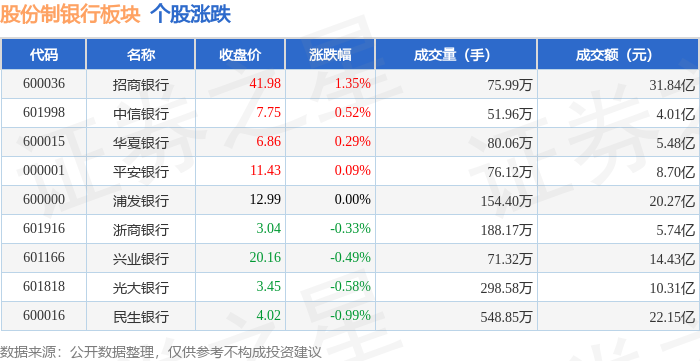
股份制银行板块10月21日涨0.33%,招商银行领涨,主力资金净流出9.73亿元
Zheng Xing Xing Ye Ri Bao· 2025-10-21 08:30
证券之星消息,10月21日股份制银行板块较上一交易日上涨0.33%,招商银行领涨。当日上证指数报收于3916.33,上涨1.36%。深证成指报收于 13077.32,上涨2.06%。股份制银行板块个股涨跌见下表: 以上内容为证券之星据公开信息整理,由AI算法生成(网信算备310104345710301240019号),不构成投资建议。 相关ETF A50ETF (产品代码: 159601) ★ 跟踪:MSCI中国A50互联互通人民币指数 | 代码 | 名称 | 收盘价 | 涨跌幅 | 成交量(手) | 成交额(元) | | --- | --- | --- | --- | --- | --- | | 600036 | 指商银行 | 41.98 | 1.35% | 75.99万 | 31.84亿 | | 661698 | 中信银行 | 7.75 | 0.52% | 51.96万 | 4.01亿 | | 600015 | 华夏银行 | 6.86 | 0.29% | 80.06万 | 5.48 Z | | 000001 | 平安银行 | 11.43 | 0.09% | 76.12万 | 8.70亿 | | 60000 ...



深耕医疗供应链 中信银行济南分行助力破解小微融资难题
Qi Lu Wan Bao· 2025-10-21 08:23
Core Insights - The central financial work conference emphasizes the importance of inclusive finance to support the development of small and micro enterprises [1] - China CITIC Bank Jinan Branch has launched a supply chain inclusive finance service plan to address the financing difficulties faced by upstream small and micro enterprises in the medical supply chain [1] Group 1: Financial Services Initiatives - The bank's "Order e-loan + Credit e-chain" financing service effectively revitalizes accounts receivable for upstream enterprises, alleviating cash flow pressures for small suppliers [1] - As of September, the bank has provided 250 million yuan in funding to numerous hospital suppliers, serving over 100 enterprises [1] Group 2: Future Plans - The bank plans to continue its commitment to serving the real economy by deepening innovations in inclusive finance and expanding the supply chain financial ecosystem [2] - The bank aims to assist more small and micro enterprises in achieving high-quality development, aligning with the "Serve Ten Thousand Enterprises - Trust and Benefit Enterprises" initiative [2]
中信银行济南分行搭建场景化服务体系 创新普惠金融新模式
Qi Lu Wan Bao· 2025-10-21 07:19
Core Insights - The core viewpoint of the articles highlights the proactive measures taken by China CITIC Bank Jinan Branch to support inclusive finance, particularly focusing on small and micro enterprises and individual businesses, by creating a scenario-based service system centered around the "Inclusive Finance Map" [1][2] Group 1: Financial Support Initiatives - The bank has developed a comprehensive service capability by deepening supply chain ecosystems, strengthening technology innovation finance ecosystems, and expanding cooperation models with government and guarantee institutions [1] - Specific financial support is provided to key industries such as healthcare, education, and telecommunications, offering full-scale financing and settlement services to small and micro enterprises [1] - The bank has implemented a "five strategies in one" operational strategy for small and medium-sized industrial clusters, continuously expanding its service coverage [1] Group 2: Policy and Efficiency Improvements - The bank has optimized approval processes and improved efficiency to alleviate the slow financing issues faced by small and micro enterprises [1] - A differentiated interest rate pricing policy has been established based on customer qualifications and operational conditions, effectively reducing financing costs for small and micro enterprises [1] Group 3: Performance Outcomes - As of September 2025, the number of inclusive loan clients at the bank increased by 14% compared to the beginning of the year, with a notable rise in technology-oriented small and micro enterprises [2] - The cumulative issuance of inclusive corporate loans reached 5.65 billion yuan, providing substantial financial support for the development of small and micro enterprises [2] - The bank aims to create a new model of inclusive finance development with regional characteristics, continuously empowering small and micro enterprises and accelerating the development of regional inclusive finance [2]
中信银行济南分行受邀参加“十链百群万企”碳基新材料产业融链固链对接会
Qi Lu Wan Bao· 2025-10-21 07:19
Core Insights - The "Carbon-based New Materials Industry Integration and Connection Conference" was successfully held in Shandong Province, with over 50 key enterprises in the carbon-based new materials sector participating [1] - China CITIC Bank Jinan Branch was invited to the event to provide customized inclusive financial service solutions tailored to the financial needs of the carbon-based new materials industry [1] Group 1: Understanding Enterprise Needs - During the event, China CITIC Bank Jinan Branch engaged with four "chain master enterprises" in the carbon-based new materials industry to understand their production operations, industry chain layout, and funding needs [2] - The bank provided on-site answers and introduced feasible comprehensive financial service solutions based on the actual conditions of the enterprises [2] Group 2: Customized Solutions for Financing Challenges - At the integration meeting, China CITIC Bank Jinan Branch focused on the needs of carbon-based new materials enterprises and explained its "CITIC Easy Loan" series of specialized products, including "Science and Technology Innovation Loan," "Government Procurement Loan," "Bill Loan," and "Mortgage Loan" [3] - The bank committed to providing full lifecycle financial services for "chain master" enterprises and small and micro enterprises in the industry chain, addressing issues of difficult, slow, and expensive financing [3] - Moving forward, China CITIC Bank Jinan Branch aims to continuously innovate financial products and services that meet industry needs, contributing to the high-quality development of the industry chain [3]

破解医药零售运营难题 中信银行济南分行“支付+SaaS”方案让泉城购药更便捷
Qi Lu Wan Bao· 2025-10-21 07:19
当清晨的第一缕晨光洒落街头,济南市一家家连锁药店便开始了忙碌,有序便捷的售药服务背后,是医药零售企业对市民健康需求的及时响应。而这份便捷 服务的保障,也离不开中信银行济南分行的金融助力。该行针对医药零售行业痛点推出的"支付+SaaS"融合方案,为泉城医药零售连锁企业提供了便捷管理 模式,让惠民服务更高效、更贴心。 行业痛点凸显 传统模式成发展阻碍 随着医药分离改革持续深化,处方外流趋势显著加速,我国连锁药店总量已突破68万家,行业进入快速发展阶段。然而,在扩张过程中,传统支付结算模式 的对账周期长、人工核销差错率高、多系统数据孤立等问题,却成为了制约医药零售企业高效运营的"拦路虎"。 济南本地一家拥有80多家门店、年营业额超8000万元的连锁药店,因门店收款依赖人工录入,操作频繁且资金准确率难以保障,长短款问题时有发生;同 时,药品收入数据与财务数据缺乏自动化对账通道,也导致了财务管理效率低下、数据匹配精度低、时效滞后等问题;更关键的是企业各个系统间未形成监 控闭环,销售资金安全存在隐患。这些问题不仅增加了运营成本,也影响了服务市民的效率。 创新方案破局 赋能企业高效运营 针对医药零售企业的痛点,中信银行济南 ...