CNCB(601998)

Search documents
多家银行信用卡业务“瘦身”,行业进入精耕细作新阶段
Zheng Quan Ri Bao· 2025-08-04 23:48
Core Insights - The domestic credit card market is undergoing significant changes, including reduced benefits, discontinuation of certain products, and closure of credit card centers, indicating a transformation in the industry [1][3][4] Group 1: Adjustments in Credit Card Benefits - Several banks, including China Merchants Bank and Everbright Bank, have announced adjustments to high-end credit card benefits, focusing on increasing usage thresholds, modifying point accumulation rules, and reducing high-cost benefits [2][4] - Specific changes include higher thresholds for redeeming points for miles, shortened validity of points, and a shift from premium benefits like airport lounges to more practical benefits such as shopping discounts [2][3] Group 2: Discontinuation of Credit Card Products - Many banks, including Agricultural Bank of China and Postal Savings Bank, have stopped issuing certain credit card products, particularly co-branded cards in sectors like aviation and e-commerce, citing business strategy adjustments and the need to enhance service quality [3][4] Group 3: Shift from Expansion to Optimization - The credit card industry is moving from a phase of rapid expansion to one focused on optimizing existing customer relationships, with banks needing to streamline inefficient products and concentrate on core customer segments [4][5] - This transition is driven by intensified competition in the credit consumption market, pressure on credit assets, and the need to adapt to consumer preferences for high-frequency, essential spending scenarios [4][6] Group 4: Future Development Directions - The focus for future growth will be on maximizing the value of existing customers, creating tiered benefit systems for different customer segments, and enhancing coverage of high-frequency spending scenarios [5][6] - The integration of credit cards with wealth management and private banking services aims to elevate credit cards from mere customer acquisition tools to central components of value creation [6]






多家银行信用卡业务“瘦身” 行业进入精耕细作新阶段
Zheng Quan Ri Bao Zhi Sheng· 2025-08-04 16:09
Core Insights - The domestic credit card market is undergoing significant changes, including reduced benefits, discontinuation of certain products, and closure of credit card centers, indicating a transformation in the industry [1][3][4] Group 1: Adjustments in Credit Card Benefits - Several banks, including China Merchants Bank and Everbright Bank, have announced adjustments to high-end credit card benefits, focusing on increasing usage thresholds, modifying point accumulation rules, and reducing high-cost benefits [2][4] - Specific changes include increased requirements for redeeming points for miles and adjustments to annual fee waivers, such as requiring a minimum spending threshold alongside points [2][3] Group 2: Discontinuation of Credit Card Products - Many banks, including Agricultural Bank of China and Postal Savings Bank, have stopped issuing certain credit card products, particularly co-branded cards in sectors like aviation and e-commerce, citing business strategy adjustments and service quality improvements [3][4] Group 3: Shift in Industry Focus - The credit card industry is transitioning from an expansion phase to a focus on optimizing existing customer value, emphasizing the need for banks to streamline inefficient products and concentrate on core customer segments [4][5] - Factors driving this shift include intensified competition in the credit consumption market, pressure on credit assets, and the need to adapt to consumer preferences for high-frequency, essential spending scenarios [4][5][6] Group 4: Future Development Directions - Future strategies will involve deepening customer engagement through tailored benefits for different customer segments, enhancing self-operated service coverage, and integrating credit cards with wealth management and private banking services [5][6] - The industry is moving towards a model that prioritizes quality over quantity, focusing on value contribution and improving comprehensive financial service quality for high-end customers [6]
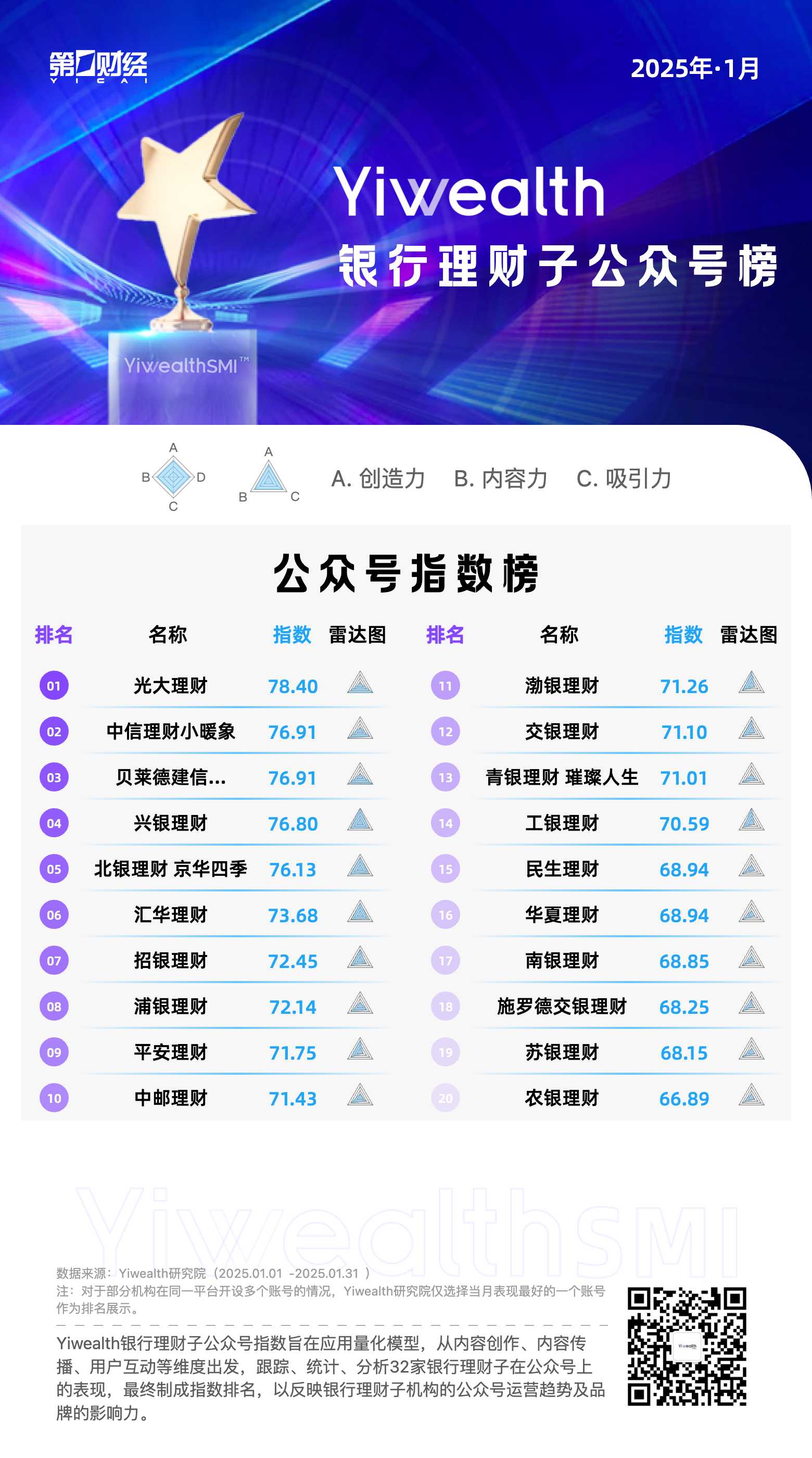
YiwealthSMI|行业首份银行理财子公众号指数榜单8月起发布!
Di Yi Cai Jing· 2025-08-04 10:24
Core Viewpoint - The article discusses the emergence and significance of bank wealth management subsidiaries in China's asset management market, emphasizing their role in connecting the banking system with investors and the challenges they face in a new era of net value operation [1]. Group 1: Industry Overview - As of now, 32 bank wealth management subsidiaries have been approved to operate, managing substantial resident wealth and serving as a crucial bridge for the real economy [1]. - The shift towards net value operation and breaking the "guaranteed return" model presents significant challenges for these subsidiaries, including effectively reaching investors and building independent brand identities [1]. Group 2: Performance Metrics - Starting from August 2025, Yiwealth Research Institute will publish a monthly index ranking of bank wealth management subsidiaries based on their performance on WeChat public accounts, focusing on content creation, dissemination, and user interaction [1][5]. - The index aims to reflect the operational trends and brand influence of these subsidiaries through quantitative models [5][10]. Group 3: Competitive Landscape - In the first half of 2025, 17 bank wealth management subsidiaries consistently ranked in the top 20 of the WeChat public account list, indicating a stable competitive landscape with only three positions changing during this period [30]. - Notably, CITIC Wealth Management and Everbright Wealth Management have maintained top three positions for six consecutive months, showcasing their significant competitive advantage [30]. Group 4: Content Production and User Engagement - On average, bank wealth management accounts published 26 articles per month, with headline articles performing significantly better than the average, highlighting the importance of strategic content placement [32]. - The average reading count for articles was 810, while headline articles achieved an average reading count of 1,228, indicating a strong focus on content quality and user engagement [32]. Group 5: User Interaction Challenges - Despite the stable content production, user interaction rates remain low, suggesting a need for improvement in engaging users and fostering social sharing [32]. - The industry faces challenges of content homogeneity and user interaction fatigue, necessitating innovative content strategies to capture user attention [44]. Group 6: Strategic Content Approaches - CITIC Wealth Management employs a strong brand IP strategy, using relatable metaphors to simplify complex investment concepts and encourage user interaction through incentives like red envelopes [46]. - Everbright Wealth Management focuses on product-oriented content, integrating popular cultural elements to resonate with younger audiences and enhance product awareness [48].




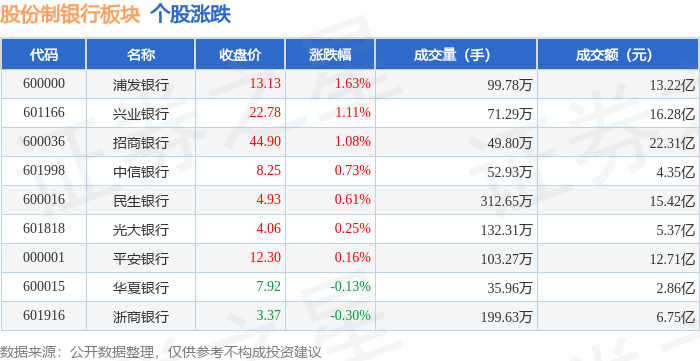
股份制银行板块8月4日涨0.88%,浦发银行领涨,主力资金净流入8.08亿元
Zheng Xing Xing Ye Ri Bao· 2025-08-04 08:30
| 代码 | 名称 | 收盘价 | 涨跌幅 | 成交量(手) | 成交额(元) | | --- | --- | --- | --- | --- | --- | | 600000 | 浦友银行 | 13.13 | 1.63% | 99.78万 | 13.22 乙 | | 601166 | 兴业银行 | 22.78 | 1.11% | 71.29万 | 16.28亿 | | 600036 | 招商银行 | 44.90 | 1.08% | 49.80万 | 22.31亿 | | 665109 | 中信银行 | 8.25 | 0.73% | 52.93万 | 4.35 Z | | 600016 | 民生银行 | 4.93 | 0.61% | 312.65万 | 15.42 乙 | | 601818 | 光大银行 | 4.06 | 0.25% | 132.31万 | 5.37亿 | | 000001 | 平安银行 | 12.30 | 0.16% | 103.27万 | 12.71亿 | | 600015 | 半夏银行 | 7.92 | -0.13% | 35.96万 | 2.86 Z | | 601916 | 浙商银行 ...

青海金融监管局核准喻璠中信银行西宁分行行长助理任职资格
Jin Tou Wang· 2025-08-04 00:08
2025年7月22日,青海金融监管局发布批复称,《中信银行(601998)关于申请核准喻璠任职资格的请 示》(信银字〔2025〕445号)收悉。经审核,现批复如下: 一、核准喻璠中信银行股份有限公司西宁分行行长助理的任职资格。 二、中信银行应要求上述核准任职资格人员严格遵守金融监管总局有关监管规定,自中信银行政许可决 定作出之日起3个月内到任,并按要求及时报告到任情况。未在上述规定期限内到任的,本批复文件失 效,由青海金融监管局办理行政许可注销手续。 三、中信银行应督促上述核准任职资格人员持续学习和掌握经济金融相关法律法规,牢固树立风险合规 意识,熟悉任职岗位职责,忠实勤勉履职。 ...
从3亿元应急贷到一句“陪您重建”:直击北京银行业灾后救援全行动
Jin Rong Shi Bao· 2025-08-03 22:44
Group 1 - Extreme weather in Beijing has caused significant flooding and landslides, affecting over 300,000 people and resulting in major casualties and property damage [1] - Banks in Beijing have activated emergency response mechanisms to ensure timely financial support for disaster relief and recovery efforts [1][2] - China Development Bank Beijing Branch provided an emergency loan of 300 million yuan to support disaster relief efforts [1] Group 2 - Agricultural Bank of China Beijing Branch opened a green channel for emergency funds, completing the entire process in just two and a half hours to support rescue operations [1] - Traffic Bank Beijing Branch prioritized emergency financial services for flood relief and ensured smooth processing of emergency fund requests [2] - China Bank Beijing Branch provided 400 boxes of mineral water to support rescue personnel on the front lines [2] Group 3 - Banks are actively engaging with affected communities to assess financial needs and provide comprehensive support for post-disaster recovery [3] - Industrial and Commercial Bank of China launched targeted credit products to assist residents in repairing homes affected by the disaster [3] - Agricultural Bank of China is implementing various relief policies, including loan extensions and interest reductions, to support small businesses and farmers [3][4] Group 4 - Minsheng Bank Beijing Branch is increasing online loan applications to support disaster recovery and has partnered with local agricultural financing institutions for targeted financial solutions [5] - China Bank Beijing Branch provided non-repayment loans to a severely affected ecological agriculture company to assist with cash flow issues [5][6] - Citic Bank Beijing Branch is actively reaching out to local businesses to understand their financial needs and provide necessary support [6]



银行业周报(20250728-20250803):债券增值税新规推出,高股息红利资产优势凸显-20250803
Huachuang Securities· 2025-08-03 05:44
Investment Rating - The report maintains a "Recommended" investment rating for the banking sector, expecting the industry index to outperform the benchmark index by over 5% in the next 3-6 months [24]. Core Insights - The introduction of new VAT regulations on bond interest income is expected to favor older bonds, as they remain exempt from VAT, thus enhancing their attractiveness and potentially driving up their prices [2][3]. - The banking sector's dividend yield is projected to be around 3.8% in 2025, significantly higher than the 10-year government bond yield of approximately 1.7%, highlighting the advantages of high-dividend assets in a declining interest rate environment [3][8]. - The report emphasizes the importance of strategic allocation within the banking sector, particularly focusing on state-owned banks and select regional banks with strong asset quality and dividend policies [8]. Summary by Sections Market Overview - The report notes a decline in major indices, with the Shanghai Composite Index down by 0.94% and the ChiNext Index down by 0.74% during the week of July 28 to August 3, 2025 [7]. - The average daily trading volume in the A-share market was 11,292.71 billion yuan, reflecting a decrease of 7.96% compared to the previous week [7]. Bond Market Impact - The new VAT regulations apply only to newly issued government bonds, local bonds, and financial bonds, while existing bonds continue to enjoy tax exemptions, making them more favorable for banks [2]. - The proportion of government and policy financial bonds held by major banks exceeds 70%, indicating a strong focus on these assets [2]. Investment Recommendations - The report suggests a diversified investment strategy focusing on high-dividend banks, particularly large state-owned banks and stable joint-stock banks like China Merchants Bank and CITIC Bank [8]. - It also highlights the potential for improved return on equity (ROE) in undervalued joint-stock banks, recommending attention to banks like Shanghai Pudong Development Bank [8]. Company Earnings Forecasts - The report provides earnings per share (EPS) and price-to-earnings (PE) ratios for key banks, with recommendations for several banks based on their projected performance [9]. - For instance, China Merchants Bank is expected to have an EPS of 5.86 yuan in 2025 with a PE ratio of 7.58, indicating a strong investment case [9].
中信银行(00998.HK):被低估的底部股份行 ROE有望更早企稳
Ge Long Hui· 2025-08-01 19:41
Core Viewpoint - The investment community should not overlook the proactive measures taken by the management of CITIC Bank, which has shown early signs of improvement in asset quality, asset structure, and return on equity (ROE), despite ongoing industry pressures. The current valuation presents an opportunity for a premium due to the certainty of these improvements [1]. Group 1: Asset Quality and Risk Management - CITIC Bank has focused on early and thorough exposure of non-performing assets (NPAs), transitioning from a "correction period" to a "health phase." The bank's non-performing loan (NPL) generation rate from 2018 to 2020 was 1.55%, higher than the industry average by approximately 10 basis points [2]. - The bank has written off a total of 239 billion from 2018 to 2021, exceeding the total from 2013 to 2017, leading to a peak in corporate real estate NPLs in 2021, which have since declined [2]. - As of Q1 2025, the NPL ratio has decreased to 1.16%, with a stable NPL generation rate of around 0.9% and a provision coverage ratio of 207%, marking a ten-year high [2]. Group 2: Financial Performance and ROE - CITIC Bank's ROE has stabilized and is expected to continue leading the industry, supported by a shift in loan structure that emphasizes infrastructure and emerging sectors, with a significant reduction in real estate loan ratios [3]. - The bank's net interest margin (NIM) has shown resilience, with a projected decline of only 28 basis points from 2021 to 2024, compared to a 60 basis point decline for peers [3]. - The bank's average daily corporate demand deposits account for 37.5% of total deposits, which is approximately 10 percentage points higher than the industry average, indicating a favorable deposit structure [3]. Group 3: Strategic Management and Future Outlook - The advantages of CITIC Bank's transformation and stable balance sheet are attributed to the resources of CITIC Group, which provides a collaborative advantage and supports credit pricing stability [4]. - The bank's core Tier 1 capital adequacy ratio stands at 9.45%, exceeding regulatory requirements, and the capital position is expected to support up to 1.8 trillion in lending [4]. - The management's strategic focus since 2019 on "burden reduction," "stable interest margins," and "customer acquisition" has yielded significant results, with a new leadership team expected to bring fresh perspectives in the upcoming three-year plan [5].
银行行业点评报告:企业短贷高增与票据利率的窄幅波动
KAIYUAN SECURITIES· 2025-08-01 11:43
Investment Rating - The industry investment rating is "Positive" (maintained) [2] Core Insights - Since 2025, banks have shown a new characteristic of using short-term loans to replace bills for credit expansion, with significant seasonal growth in short-term loans [4][14] - The volatility of bill rates has decreased, and there is a notable inversion between short and long-term rates [24][34] - Investment recommendations focus on state-owned banks with controllable retail risks, joint-stock banks with high safety margins, and city and rural commercial banks with strong profit growth potential [7][36] Summary by Sections 1. New Characteristics of Credit Expansion - In 2025, banks have not prominently used bills to boost loans, but short-term loans have seen significant growth, with new additions of 1.44 trillion and 1.16 trillion yuan in March and June, respectively, exceeding historical averages [14][18] - Bill financing saw a notable contraction in June, with a decrease of 4.109 trillion yuan, significantly higher than the three-year average [14][18] 2. Decreased Volatility of Bill Rates - In the first half of 2025, the 6M national stock bill discount rate fluctuated between 0.98% and 1.60%, showing reduced volatility compared to 170 basis points in 2023 and 105 basis points in 2024 [24][29] - The weakening of the credit attribute of bills is attributed to banks preferring short-term loans for credit scale, leading to a lack of significant fluctuations in bill rates [24][29] 3. Investment Recommendations - Recommended stocks include state-owned banks with controllable retail risks, such as China Construction Bank and Agricultural Bank of China [36] - Joint-stock banks with high safety margins and signs of clearing existing risks, such as CITIC Bank and China Merchants Bank, are also recommended [36] - City and rural commercial banks with growth potential and strong provisioning capabilities, including Jiangsu Bank and Hangzhou Bank, are highlighted [36]
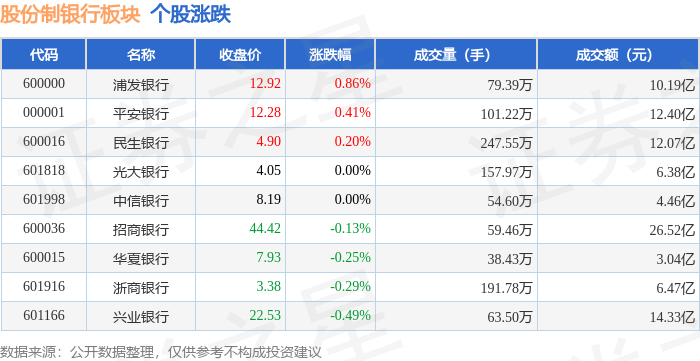
股份制银行板块8月1日涨0.02%,浦发银行领涨,主力资金净流入7.37亿元
Zheng Xing Xing Ye Ri Bao· 2025-08-01 08:42
| 代码 | 名称 | 收盘价 | 涨跌幅 | 成交量(手) | 成交额(元) | | --- | --- | --- | --- | --- | --- | | 600000 | 浦发银行 | 12.92 | 0.86% | 79.39万 | 10.19亿 | | 000001 | 平安银行 | 12.28 | 0.41% | 101.22万 | 12.40 Z | | 600016 | 民生银行 | 4.90 | 0.20% | 247.55万 | 12.07亿 | | 601818 | 光大银行 | 4.05 | 0.00% | 157.97万 | 6.38亿 | | 866109 | 中信银行 | 8.19 | 0.00% | 54.60万 | 4.46 Z | | 600036 | 招商银行 | 44.42 | -0.13% | 59.46万 | 26.52亿 | | 600015 | 华夏银行 | 7.93 | -0.25% | 38.43万 | 3.04亿 | | 601916 | 浙商银行 | 3.38 | -0.29% | 191.78万 | 6.47亿 | | 601166 | 兴业银行 ...