CNCB(601998)

Search documents
10家银行跨入10万亿俱乐部
21世纪经济报道· 2026-02-10 09:08
Core Viewpoint - A-share listed banks have shown positive growth in net profit for 2025, with all 11 banks reporting an increase, and four banks achieving double-digit growth, led by Qingdao Bank at 21.66% [1][5]. Group 1: Financial Performance - Qingdao Bank reported a net profit of 518.77 million yuan, up from 426.41 million yuan, marking a growth rate of 21.66% [2]. - Qilu Bank and Hangzhou Bank followed with net profit growth rates of 14.58% and 12.05%, respectively [5]. - In terms of total assets, China Merchants Bank leads with 13.07 trillion yuan, a year-on-year increase of 7.56% [4]. - The overall asset quality of the banks remains stable, with most banks reporting a decrease or stability in non-performing loan ratios [5][6]. Group 2: Revenue Trends - Revenue growth among the banks is varied, with only CITIC Bank experiencing a slight decline of 0.55% [4]. - Nanjing Bank led in revenue growth with a 10.48% increase, while Ningbo Bank and Qingdao Bank reported increases of 8.01% and 7.97%, respectively [4][5]. - The overall revenue growth for A-share listed banks is expected to improve in 2025, driven by narrowing interest margins and increased impairment contributions [9]. Group 3: Market Outlook - Analysts are cautiously optimistic about the banking sector's performance in 2026, with expectations of stable credit growth and improved profitability [9][10]. - The investment focus for 2026 includes identifying banks with potential for growth, particularly Ningbo Bank and China Merchants Bank, and those with convertible bond expectations like Industrial Bank [10]. - The overall market capitalization of the banking sector has surpassed 15 trillion yuan, reflecting a significant increase from the previous year [6].






A股银行股普涨,建设银行、交通银行续涨超1%
Ge Long Hui A P P· 2026-02-10 05:25
Core Viewpoint - The A-share market saw a broad increase in bank stocks, with Shanghai Bank, Construction Bank, CITIC Bank, Minsheng Bank, Bank of Communications, and Zheshang Bank all rising over 1% [1] Group 1: Stock Performance - Shanghai Bank (601229) increased by 1.82%, with a total market capitalization of 142.8 billion and a year-to-date decline of 0.50% [2] - Construction Bank (601939) rose by 1.58%, holding a market cap of 2,354.4 billion, and has a year-to-date decline of 3.02% [2] - CITIC Bank (601998) saw a rise of 1.47%, with a market cap of 421.8 billion and a year-to-date decline of 1.56% [2] - Minsheng Bank (600016) increased by 1.27%, with a market cap of 174.3 billion and a year-to-date increase of 3.92% [2] - Bank of Communications (601328) rose by 1.19%, with a market cap of 602.6 billion and a year-to-date decline of 5.93% [2] - Zheshang Bank (601916) increased by 1.01%, with a market cap of 82.4 billion and a year-to-date decline of 1.32% [2] Group 2: Additional Bank Performance - Chongqing Rural Commercial Bank (601077) rose by 0.91%, with a market cap of 75.6 billion and a year-to-date increase of 6.49% [2] - Everbright Bank (601818) increased by 0.90%, with a market cap of 198.5 billion and a year-to-date decline of 0.78% [2] - Nanjing Bank (6000009) rose by 0.89%, with a market cap of 140.5 billion and a year-to-date decline of 0.61% [2] - Lanzhou Bank (001227) increased by 0.86%, with a market cap of 13.4 billion and a year-to-date increase of 3.46% [2] - Postal Savings Bank (601658) rose by 0.77%, with a market cap of 626.9 billion and a year-to-date decline of 2.05% [2] - Agricultural Bank (601288) increased by 0.75%, with a market cap of 2,365.9 billion and a year-to-date decline of 11.98% [2] - Bank of China (601988) rose by 0.74%, with a market cap of 1,746.4 billion and a year-to-date decline of 5.41% [2] - Qingdao Bank (002948) increased by 0.72%, with a market cap of 32.5 billion and a year-to-date increase of 24.78% [2]


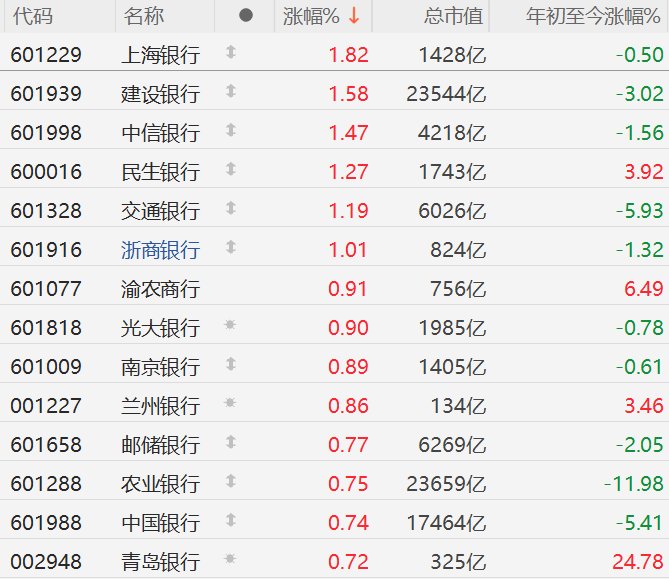
上市银行2025年年报: 业绩增速有望稳中向好,资产质量持续优化
2026-02-10 03:24
Summary of Conference Call on Banking Sector Outlook Industry Overview - The conference focused on the banking sector, specifically discussing the performance and outlook of 11 listed banks in China for the year 2025 and beyond [1][6]. Key Points and Arguments 1. Overall Performance of Banks - The performance of the 11 banks exceeded expectations, indicating a robust resilience in the banking sector [1][6]. - The net interest margin (NIM) showed signs of stabilization, with a narrowing year-on-year decline contributing significantly to interest income and revenue growth [1][2]. 2. Sensitivity of Interest Income - Interest income is highly sensitive to changes in NIM; a decrease of 10 basis points (BP) in NIM could reduce net interest income growth by 7 percentage points, while a 5 BP decrease would result in a 3.5 percentage point reduction [2]. 3. Fee Income Recovery - There has been a recovery in fee income due to improved capital market conditions and asset allocation by residents, leading to a continuous improvement in bank fees [2][4]. 4. Potential for Old Bond Gains - The banks hold significant unrealized gains on old bonds, which presents a substantial opportunity for realization [3]. 5. Positive Outlook for 2026 - The overall judgment is that the situation in 2026 will be better than in 2025, driven by stable basis points, improving fees, and gains from old bonds [3]. 6. Investment Perspective - The investment strategy focuses on absolute returns, targeting a return on equity (ROE) of around 13% and a price-to-book (PB) ratio of 0.67 times, indicating a reasonable pricing range [3][4]. - The recommendation is to select stocks based on high growth and high dividend yield, particularly in regions like Jiangsu, Nanjing, and Qilu [4][5]. 7. Performance of Specific Banks - Notable banks such as China Merchants Bank and Industrial Bank showed positive revenue growth, with some banks transitioning from negative to positive growth [6][7]. - City commercial banks like Nanjing Bank and Qingdao Bank reported double-digit revenue growth, indicating strong performance [7][10]. 8. Asset Quality and Non-Performing Loans (NPLs) - The asset quality remains stable, with many banks reporting a decrease in NPL ratios. For instance, Qingdao Bank's NPL ratio dropped significantly [10][11]. - The overall trend suggests a gradual improvement in asset quality, with expectations for continued stability in 2026 [11][12]. 9. Credit Growth and Demand - Credit growth is expected to remain strong, particularly in major provinces like Sichuan and Jiangsu, which reported credit growth rates above 8% [12][13]. - The demand for corporate loans remains robust, while retail loan demand is weaker [12]. 10. Future Risks and Projections - There are concerns regarding the potential exposure of retail loans, particularly in mortgage and consumer credit segments, but the overall increase in NPLs is expected to be limited [16][17]. - Projections for 2025 indicate a slight increase in NPL ratios for retail loans, but overall asset quality is expected to remain stable [17][18]. 11. Revenue Growth Expectations - The banking sector is projected to achieve a revenue growth rate of approximately 1.2% year-on-year, with city commercial banks leading in net profit growth [19][20]. 12. Stock Selection Strategy - The stock selection strategy emphasizes high ROE and high dividend yield, with recommendations for both Hong Kong and A-share listed banks [20][21]. Additional Important Insights - The conference highlighted the importance of wealth management in driving fee income, with expectations for continued positive contributions to revenue [19]. - The overall sentiment is optimistic regarding the banking sector's ability to navigate challenges and capitalize on growth opportunities in the coming years [22].



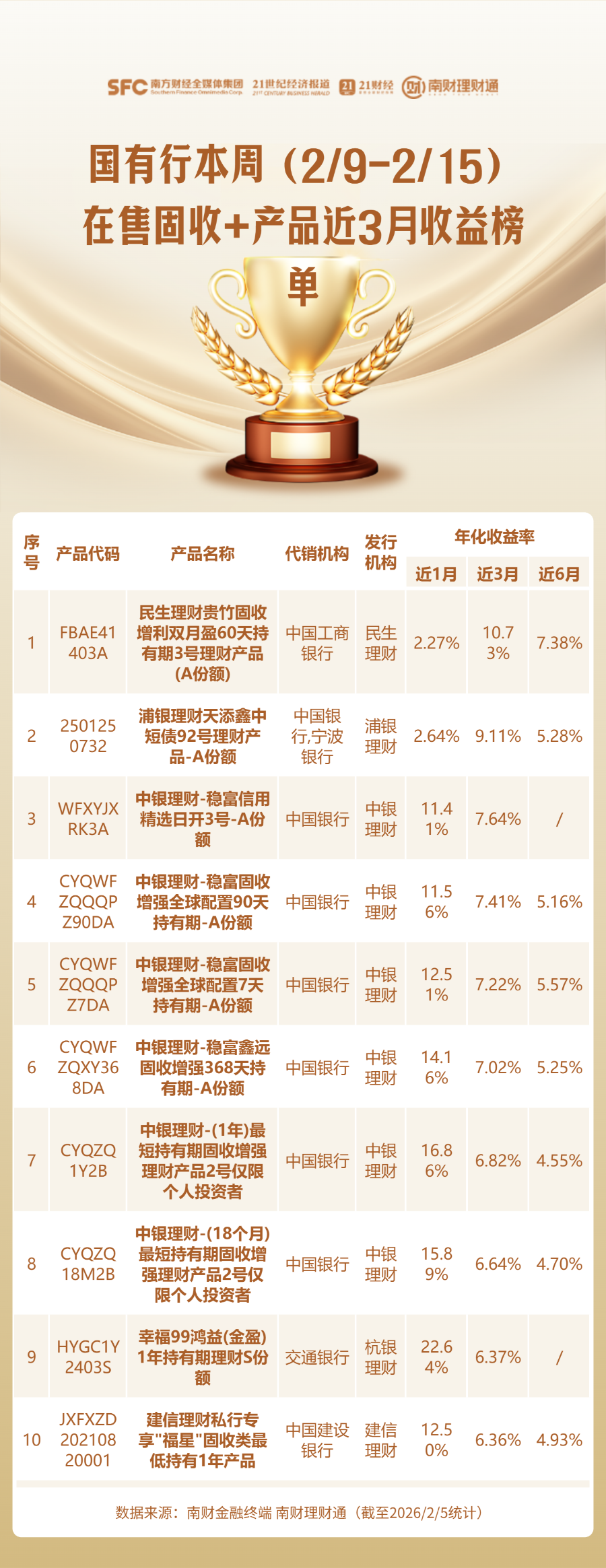
震荡市显韧性,黄金增强策略理财产品近3月收益仍领先
2 1 Shi Ji Jing Ji Bao Dao· 2026-02-09 01:15
Core Insights - The report focuses on fixed income + products issued by wealth management companies, highlighting superior performing products available for investors through distribution channels [1] - A ranking of products is provided based on their annualized performance over the last month, three months, and six months, with a particular emphasis on the three-month annualized yield to reflect their performance amid recent market fluctuations [1] Distribution Channels - The report includes a list of 28 distribution institutions, which consist of major banks such as Industrial and Commercial Bank of China, Bank of China, Agricultural Bank of China, and others [1] Product Performance - The ranking showcases various products with their respective annualized yields, indicating the performance metrics over different time frames, such as 2.64% for one month and 9.11% for three months for a specific product [5] - The data is sourced from the South Finance Financial Terminal, with statistics as of February 5, 2026, providing a snapshot of the current market offerings [5][10]





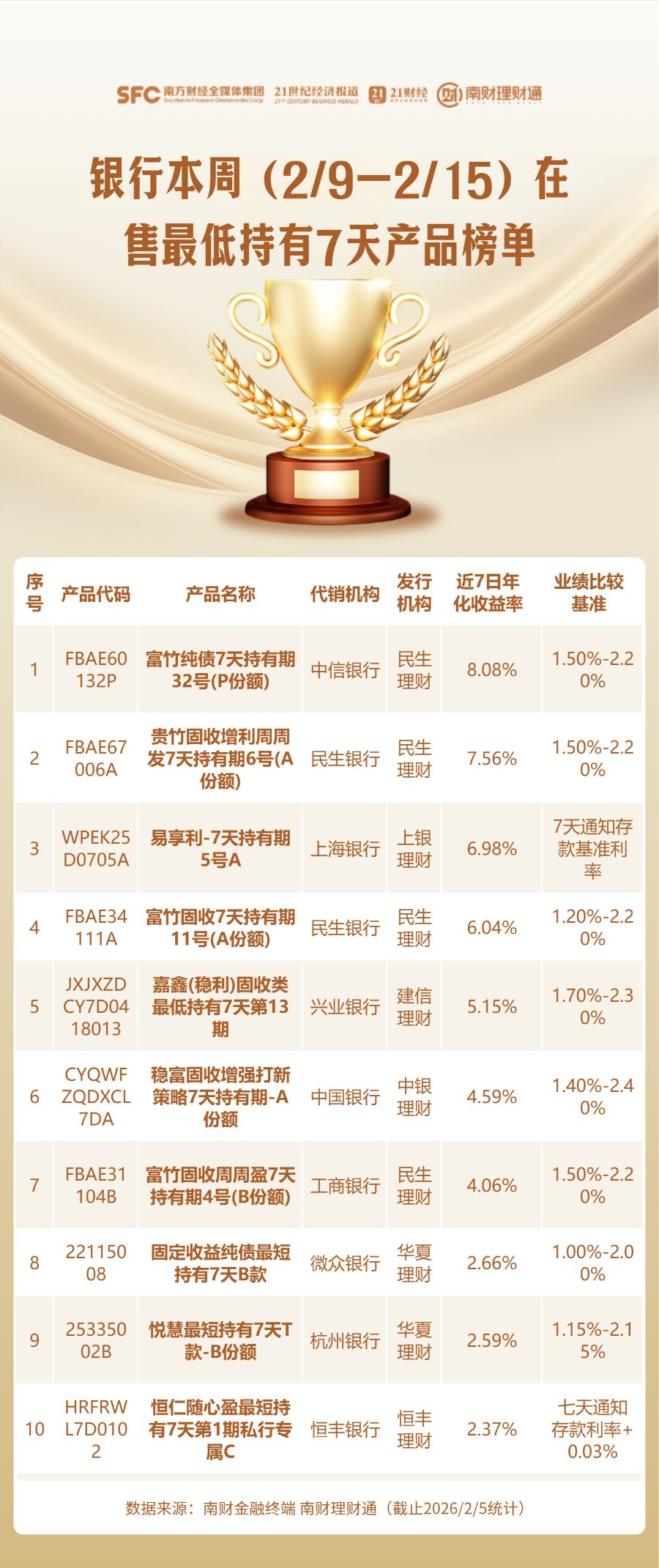
收益率碾压现金产品!这份“闲钱理财”榜单透露了哪些机会?
2 1 Shi Ji Jing Ji Bao Dao· 2026-02-09 01:15
Core Insights - The article focuses on the performance of minimum holding period RMB public offering products, ranking them based on annualized returns for holding periods of 7, 14, 30, and 60 days [1] Group 1: 7-Day Holding Period Products - The top-performing product is from Minsheng Bank with an annualized return of 7.56% [5] - Other notable products include a 6.98% return from Shanghai Bank and a 6.04% return from Minsheng Bank [5] Group 2: 14-Day Holding Period Products - The leading product is from Minsheng Bank with a return of 7.39% [8] - China Bank follows with a return of 4.44% [8] Group 3: 30-Day Holding Period Products - The highest return is 18.14% from Hangzhou Bank [12] - Other significant returns include 12.34% from Minsheng Bank and 9.72% from Minsheng Bank [12][13] Group 4: 60-Day Holding Period Products - The top product is from China Bank with a return of 9.33% [15] - Other products include 5.95% from Shanghai Bank and 5.54% from Huaxia Bank [15][16]
银行业开年首张千万级罚单!三家被点名,都因这项业务违规
券商中国· 2026-02-08 06:23
Core Viewpoint - Recent regulatory actions indicate a strong stance on compliance within the banking sector, particularly regarding loan management practices, signaling a shift towards normalized governance in financial oversight [6][7]. Group 1: Regulatory Actions - Three banks have been penalized for violations related to loan management, with Hangzhou Rural Commercial Bank receiving a fine of 11.1 million yuan, marking the first significant penalty in the banking sector since 2026 [2][3]. - Other banks, including Bohai Bank's Wuhan branch and CITIC Bank's Hangzhou branch, were also fined for inadequate loan management practices, with penalties of 1.75 million yuan and 6.25 million yuan respectively [4][5]. Group 2: Compliance and Accountability - The regulatory environment is characterized by a "zero tolerance" approach towards compliance failures, emphasizing the importance of accurate data reporting and responsible loan management [6][7]. - The penalties imposed on multiple employees reflect a shift towards individual accountability, indicating that the regulatory framework is increasingly focusing on personal responsibility within financial institutions [6][7]. Group 3: Future Directions for Banking - To avoid future compliance issues, banks are encouraged to transition from a focus on scale to a focus on value, emphasizing strategic resource allocation towards innovation and sustainable development [7]. - The implementation of advanced technology for comprehensive risk monitoring is recommended to enhance loan management processes and reduce reliance on traditional methods [7].


1月金融数据前瞻:预计新增贷款5.1-5.25万亿元,社融增速为8.3%
ZHONGTAI SECURITIES· 2026-02-07 07:25
Investment Rating - The industry investment rating is maintained at "Overweight" [2] Core Insights - The report anticipates new RMB loans in January to be between 5.1 to 5.25 trillion yuan, with a corresponding loan growth rate declining to approximately 6.3% [4][6] - The expected new social financing scale for January is projected to be between 7.41 to 7.57 trillion yuan, maintaining a stock growth rate of around 8.3% [21][25] - The report highlights a strong performance in corporate activities, with expectations for increased credit supply due to a favorable lending environment and government policies [8][28] Summary by Sections 1. RMB Loans - New RMB loans are expected to be between 5.1 to 5.25 trillion yuan, with a growth rate declining to around 6.3% [4][6] - The monthly increase is projected to vary between a decrease of 300 million to an increase of 1.2 billion yuan [8] 2. Social Financing - The anticipated new social financing scale for January is between 7.41 to 7.57 trillion yuan, with a stock growth rate around 8.3% [21][25] - The report notes that the net financing scale of local government bonds and corporate credit bonds is expected to be 1.181 trillion yuan and 490.3 billion yuan respectively [25] 3. Liquidity - M1 and M2 growth rates are expected to rise due to a low base effect, with M1 projected at 4.0% and M2 at 8.7% [26] - The report indicates that the increase in government and credit bonds' net financing will impact market liquidity [26] 4. Investment Recommendations - The report suggests a shift in bank stock investment logic from "pro-cyclical" to "weak-cyclical," emphasizing the attractiveness of high-dividend bank stocks during economic stagnation [28] - Two main investment lines are recommended: regional banks with strong certainty and large banks with high dividends [28]

11家A股上市银行率先披露业绩快报,全员盈利正增长、资产规模实现突破
Sou Hu Cai Jing· 2026-02-06 16:47
Core Insights - The overall performance of A-share listed banks shows a trend of "all profitable and positive growth, with stable asset expansion," indicating a robust operational status in the banking sector [2][9] - Qingdao Bank leads with a remarkable 21.66% year-on-year growth in net profit, showcasing strong profit growth momentum among the disclosed banks [2][6] - Both CITIC Bank and Shanghai Pudong Development Bank have crossed the 10 trillion yuan asset threshold, joining the "trillion yuan club," highlighting the scale advantages and resilience of joint-stock banks [5][9] Performance Summary - As of February 5, 2026, 11 A-share listed banks have disclosed their 2025 performance reports, including four joint-stock banks, six city commercial banks, and one rural commercial bank, reflecting a balanced representation of different bank types [3][5] - Qingdao Bank reported an operating income of 14.573 billion yuan, a year-on-year increase of 7.97%, and a net profit of 5.188 billion yuan, with a growth rate of 21.66% [6][8] - Shanghai Pudong Development Bank achieved a net profit growth of 10.52%, while CITIC Bank's net profit increased by 2.98%, both benefiting from their substantial asset scales [5][6] Growth Highlights - All 11 banks reported positive year-on-year net profit growth, with four banks exceeding 10% growth: Qingdao Bank (21.66%), Qilu Bank (14.58%), Hangzhou Bank (12.05%), and Shanghai Pudong Development Bank (10.52%) [8] - Qingdao Bank's asset total surpassed 800 billion yuan, with both deposits and loans growing by over 16%, and its non-performing loan ratio improved to 0.97% [8] - Ningbo Bank also demonstrated strong performance with an operating income of 71.968 billion yuan, a year-on-year increase of 8.01%, and a net profit growth of 8.13% [8] Asset Scale Developments - CITIC Bank and Shanghai Pudong Development Bank's asset totals reached 10.081 trillion yuan and 10.132 trillion yuan respectively, marking significant milestones in their operational scale [9] - The entry of these banks into the "trillion yuan club" not only expands the membership but also underscores the pivotal role of joint-stock banks in the industry [9] - The overall performance of the 11 banks reflects a stable development trend in the banking sector, providing a solid foundation for future growth as more banks disclose their performance reports [9]

◆中远海运开通常态化跨四国汽配联运通道◆天津港与中远海特华北分部首单“重进重出”业务落地
Xin Lang Cai Jing· 2026-02-06 11:25
Group 1: Logistics and Shipping Developments - COSCO Shipping has established a normalized automotive parts intermodal transport corridor spanning four countries, facilitating a logistics chain from Mexico to Uzbekistan, covering approximately 21,800 kilometers [1] - The "Silk Road Maritime" route has surpassed a cumulative container throughput of 26 million TEUs, with a projected growth of 9.11% to over 5.4 million TEUs by 2025 [2] - Tianjin Port and COSCO Shipping have successfully launched their first "import-export" dual business, involving 28,000 tons of imported pulp and 33,000 tons of exported steel, enhancing shipping efficiency and reducing logistics costs [3][12] - Qingdao Port has opened four new container foreign trade routes in January, expanding its total to nearly 240 routes, connecting with over 700 ports globally [4][6] Group 2: Financial and Investment Activities - CITIC Bank plans to increase its investment in CITIC Financial Leasing by 2 billion RMB, raising its registered capital from 10 billion RMB to 12 billion RMB [4][5] - The capital ranking of domestic financial leasing companies places CITIC Financial Leasing at 8th with 12 billion RMB, following larger firms like ICBC Leasing and CMB Leasing [5][13] Group 3: Shipbuilding and Environmental Initiatives - Huangpu Wenchong has signed a contract with Evergreen Marine for 16 new 3,000 TEU container ships, incorporating advanced eco-friendly technologies to reduce fuel consumption and emissions [7][14] - Hapag-Lloyd has won a second ZEMBA tender for zero-emission fuel procurement, committing to use hydrogen-based e-methanol as marine fuel starting in 2027, aiming for significant CO2 emissions reduction [9][16] Group 4: Oil Market Dynamics - Venezuelan oil is flooding into the U.S. market, leading to challenges in absorption due to increased supply, which is putting pressure on oil prices [8][15] - Traders are facing difficulties in finding buyers for Venezuelan crude oil in the Gulf Coast, indicating a supply-demand imbalance [8][15]

一周银行速览(1.30—2.6)
Cai Jing Wang· 2026-02-06 11:01
Industry Focus - The China Banking Association has released guidelines to regulate the collection behavior of credit card and personal consumer loan collections, aiming to promote healthy industry development. The guidelines clarify issues such as collection timing, reasonable frequency, and channels for obtaining contact information, establishing quantitative standards and specific definitions [1] Corporate Dynamics - Citic Bank plans to increase its capital contribution to Citic Financial Leasing by 2 billion yuan, raising the registered capital from 10 billion yuan to 12 billion yuan. This marks the second capital increase for Citic Financial Leasing by Citic Bank in a year [4] Financial Personnel - Qingdao Rural Commercial Bank has elected Liang Yanbo as the chairman of its fifth board of directors, pending approval from the Qingdao Financial Regulatory Bureau [5] - Ningbo Bank has received approval from the Ningbo Financial Regulatory Bureau for Fu Wensheng to serve as the vice president [6] - Guangfa Bank has received approval for Lin Zhaohui to serve as the director, vice chairman, and president, effective from January 30, 2026 [7] - The credit card center of Bank of Communications has appointed He Bo, the former vice president of the Zhejiang branch, as the new general manager, pending regulatory approval [8] - Bai Xiaodong has been appointed as the party secretary of Beijing Rural Commercial Bank, as announced during the bank's recent meeting [9] Market Trends - Despite an overall downward trend in market interest rates, many small and medium-sized banks have raised deposit rates by 5 to 20 basis points ahead of the Spring Festival, with some banks launching limited-time exclusive deposit products [3] Gold Market - Following a significant drop in gold prices, several banks have issued risk warnings and adjusted the entry thresholds for gold-related businesses, including increasing the minimum purchase amount for gold accumulation products [2]