CNCB(601998)

Search documents
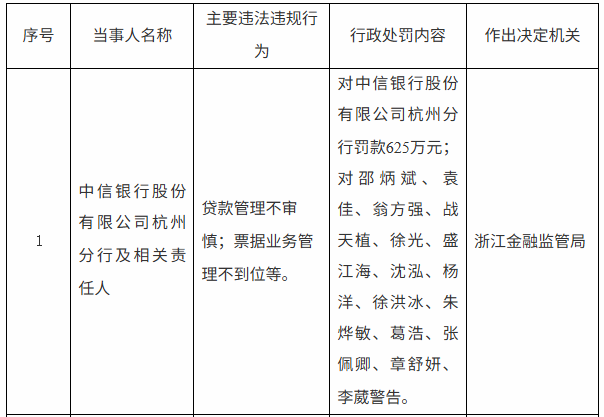
因贷款管理不审慎等,中信银行杭州分行被罚625万元
Bei Jing Shang Bao· 2026-02-06 10:17
Group 1 - China CITIC Bank's Hangzhou branch was fined 6.25 million yuan for improper loan management and inadequate bill business management [1] - Several responsible individuals, including Shao Bingbin and Yuan Jia, received warnings due to these violations [1] - The penalties highlight regulatory scrutiny in the banking sector, particularly regarding compliance and risk management practices [1]

中信银行杭州分行被罚625万,涉贷款管理不审慎等
Xin Lang Cai Jing· 2026-02-06 08:45
Core Viewpoint - Zhejiang Financial Regulatory Bureau has issued an administrative penalty against CITIC Bank's Hangzhou branch for improper loan management and inadequate bill business management, resulting in a fine of 6.25 million yuan [1][2]. Group 1: Penalty Details - CITIC Bank's Hangzhou branch was fined 6.25 million yuan for violations including imprudent loan management and inadequate management of bill business [1][2]. - A total of 12 individuals associated with the bank received warnings from the regulatory authority [1][2]. Group 2: Individuals Involved - The individuals warned include Shao Bingbin, Yuan Jia, Weng Fangqiang, Zhan Tianzhi, Xu Guang, Sheng Jianghai, Shen Hong, Yang Yang, Xu Hongbing, Zhu Yemin, Ge Hao, Zhang Peiqing, Zhang Shuyan, and Li Wei [1][2].

2026年2月:中信银行再增资20亿元,中信金租注册资本升至120亿元
Jing Ji Guan Cha Wang· 2026-02-05 13:02
Core Viewpoint - CITIC Bank has announced a cash injection of 2 billion yuan into its wholly-owned subsidiary, CITIC Financial Leasing Co., Ltd, increasing its registered capital from 10 billion yuan to 12 billion yuan, marking the second significant capital replenishment within a year [1] Group 1: Company Actions - The capital increase positions CITIC Financial Leasing among the leaders in the financial leasing industry [1] - This move reflects a strategic reassessment by the banking group towards the financial leasing sector, which is characterized by "financing and leasing" [1] Group 2: Industry Context - The capital injection occurs against a backdrop of heightened regulatory thresholds and new opportunities arising from the "dual carbon" goals [1]
中信金租再获20亿增资,注册资本跃至120亿
Jing Ji Guan Cha Wang· 2026-02-05 13:02
Group 1 - The core point of the article is that CITIC Bank has approved a cash increase of 2 billion yuan to its wholly-owned subsidiary, CITIC Financial Leasing Co., Ltd, raising its registered capital from 10 billion yuan to 12 billion yuan [1] - This marks the second large-scale capital supplement by CITIC Bank within a year, following a previous increase of 3 billion yuan in cash and a transfer of 3 billion yuan from undistributed profits in February 2025, which raised the registered capital from 4 billion yuan to 10 billion yuan [1] - The repeated capital increase highlights the strategic reassessment of the financial leasing sector by commercial banking groups, indicating an accelerated evolution of deep competition and cooperation within the industry [1]
2026年2月4日中信银行向中信金租增资20亿
Jing Ji Guan Cha Wang· 2026-02-05 13:02
Core Viewpoint - CITIC Bank announced a cash increase of 2 billion yuan to its wholly-owned subsidiary, CITIC Financial Leasing Co., Ltd, which will raise the registered capital from 10 billion yuan to 12 billion yuan, enhancing its strategic position in serving the real economy [1] Group 1 - The capital increase does not require approval from the company's shareholders and does not constitute a related party transaction or a major asset restructuring [1] - The capital increase is pending approval from relevant regulatory authorities [1] Group 2 - CITIC Financial Leasing is a key strategic layout for CITIC Bank to support the real economy [1] - The increase in capital aims to help CITIC Financial Leasing seize development opportunities, accelerate business growth, and enhance competitiveness and influence [1] - This move is expected to create value for the banking group [1]
银行股,资金出手了
3 6 Ke· 2026-02-05 11:21
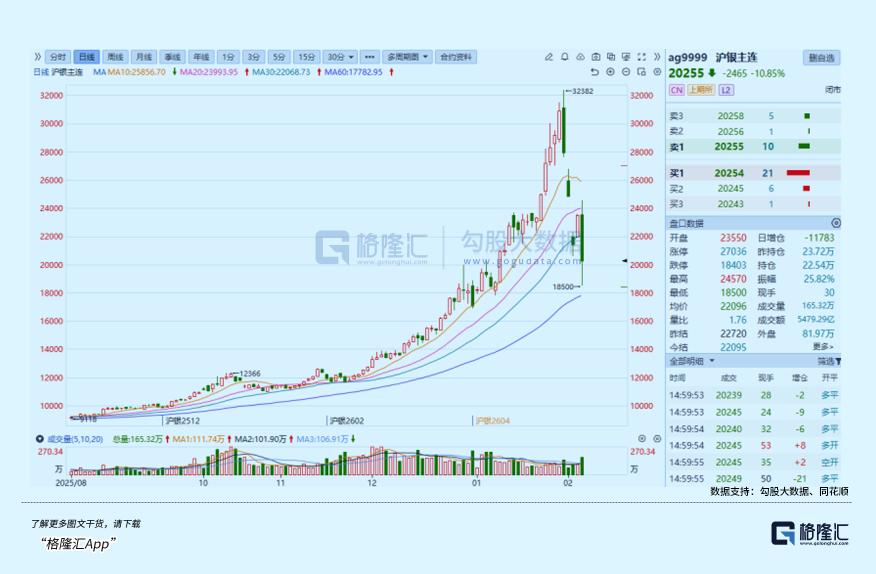
Core Viewpoint - A significant market shift occurred as global funds fled from technology stocks and precious metals, leading to a notable decline in major indices and a surge in bank stocks as a safe haven for investors [1][2][3]. Group 1: Market Reactions - On February 4, U.S. tech stocks experienced a sharp decline, with the Nasdaq dropping over 2% and major companies like Nvidia, Meta, and Tesla falling more than 3%. AMD saw a staggering drop of 17.3%, marking its largest single-day decline in nearly nine years [1][3]. - The panic spread to A-shares and Hong Kong stocks, with sectors like solar energy and precious metals witnessing significant sell-offs. Silver futures plummeted nearly 20% at one point, exacerbating market fears [2][5]. - Despite the overall market turmoil, the banking sector in A-shares rose by 2.1%, with all 42 bank stocks closing in the green, indicating a flight to safety among investors [2][10]. Group 2: Capital Flows - Southbound funds recorded a net purchase of over 22 billion HKD, with major Chinese banks like ICBC, CMB, and CCB becoming core targets for accumulation [3][13]. - A significant shift in capital is underway, with funds moving from tech and precious metals to banks, which are perceived as having a higher safety margin [3][9]. Group 3: Banking Sector Performance - The banking sector is supported by strong earnings growth and historically low valuations, making it an attractive option for risk-averse investors [15][20]. - As of February 4, several banks reported robust earnings, with Qingdao Bank, Hangzhou Bank, and others showing significant profit increases, further solidifying the sector's appeal [16][18]. - The banking sector's average dividend yield ranges from 4.87% to 5.2%, significantly higher than the 10-year government bond yield of around 2%, enhancing its attractiveness in a low-interest-rate environment [21][22]. Group 4: Future Outlook - The recent market volatility raises questions about whether the declines in tech stocks and precious metals will lead to further panic selling. However, the influx of funds into bank stocks suggests a potential shift in market sentiment [23].





银行股,资金出手了!
格隆汇APP· 2026-02-05 10:15
Core Viewpoint - A significant market shift is occurring, characterized by a mass exodus of funds from technology and precious metals sectors, with a notable influx into bank stocks as a safe haven amid rising panic and volatility [2][5][21]. Group 1: Market Dynamics - The U.S. tech stocks experienced a sharp decline, with the Nasdaq dropping over 2%, and major companies like Nvidia, Meta, and Tesla falling more than 3%. AMD saw a staggering drop of 17.3%, marking its largest single-day decline in nearly nine years [2][5]. - Panic spread to A-shares and Hong Kong stocks, with sectors like solar energy and oil equipment witnessing significant sell-offs. Precious metals, which had recently rebounded, also faced a sharp decline, with silver futures plummeting nearly 20% in a single day [3][5]. - The market turmoil was triggered by negative news affecting U.S. tech stocks, leading to a valuation bubble burst. Despite AMD's strong performance, its results fell short of the most optimistic analyst expectations, resulting in a drastic stock price drop [5][6]. Group 2: Bank Sector Resilience - In contrast to the broader market, the banking sector saw a rise, with A-share bank stocks collectively increasing by 2.1%. All 42 bank stocks closed in the green, with Xiamen Bank hitting a rare limit-up and several city commercial banks rising over 3% [3][15]. - Southbound funds significantly targeted bank stocks, with a net purchase exceeding 22 billion HKD, focusing on major banks like ICBC, CMB, and CCB as core investment targets [4][20]. - The banking sector is viewed as a "safe haven" due to its strong earnings growth and historically low valuations, making it an attractive option for risk-averse investors [21][22]. Group 3: Earnings and Valuation - Recent earnings reports from several banks indicate robust growth, with Qingdao Bank, Hangzhou Bank, and Shanghai Pudong Development Bank showing significant increases in net profits. For instance, Qingdao Bank reported a net profit of 51.88 billion CNY, a 21.66% year-on-year increase [23][25]. - The banking sector has undergone a six-month correction, leading to a new valuation bottom. The sector's price-to-earnings ratio stands at a low 6.7 times, and the average dividend yield is between 4.87% and 5.2%, making it appealing in a low-interest-rate environment [27][28]. - Institutional interest in bank stocks is rising, with over 370 institutions conducting research on 11 listed banks, indicating a strategic shift towards these stocks amid market volatility [28][29].





获中信银行20亿元增资,中信金租注册资本升至120亿元
Huan Qiu Lao Hu Cai Jing· 2026-02-05 10:03
Core Viewpoint - CITIC Bank announced a capital increase of 2 billion yuan for CITIC Financial Leasing, raising its registered capital to 12 billion yuan, maintaining 100% ownership [1] Group 1: Company Overview - CITIC Financial Leasing was established in 2015 as a wholly-owned subsidiary of CITIC Bank, focusing on sectors such as aircraft, ships, household photovoltaics, and vehicles [2] - The company currently operates a fleet of 19 aircraft and 5 engines, with 9 aircraft pending delivery, bringing the total fleet size close to 30 [2] Group 2: Financial Performance - In 2024, CITIC Financial Leasing achieved a net operating income of 1.697 billion yuan and a net profit of 936 million yuan [3] - For the first nine months of 2025, the company reported a net operating income of 1.664 billion yuan and a net profit of 1.184 billion yuan [3] - As of September 2025, the total asset size reached 112.928 billion yuan, with total liabilities of 99.671 billion yuan and net assets of 13.258 billion yuan, resulting in an asset-liability ratio of 88.26% [3] Group 3: Industry Context - The capital increase trend in the financial leasing industry is driven by regulatory requirements and the need to address industry competition and business transformation [1] - The financial leasing sector is capital-intensive, and higher registered capital provides stronger risk buffers and meets regulatory capital adequacy and leverage ratio requirements [1]
从40亿到120亿,中信金租上演“资本三级跳” 金融租赁业资本“军备竞赛”硝烟再起
Jing Ji Guan Cha Wang· 2026-02-05 09:24
Core Viewpoint - CITIC Bank has approved a cash capital increase of 2 billion yuan for its wholly-owned subsidiary, CITIC Financial Leasing, raising its registered capital from 10 billion yuan to 12 billion yuan, marking the second significant capital injection within a year, reflecting a strategic reassessment of the financial leasing sector amid regulatory changes and new market opportunities [1][2][4] Group 1: Capital Increase and Strategic Intent - The recent capital increase is part of a clear strategic intent and robust performance support, with CITIC Financial Leasing's registered capital previously raised from 4 billion yuan to 10 billion yuan in a short span [2] - CITIC Financial Leasing focuses on strengthening its core business areas, including aircraft and ship leasing, while also promoting retail models in household photovoltaic and vehicle sectors, achieving significant financial growth [2][5] Group 2: Industry Landscape and Competition - The increase in registered capital to 12 billion yuan positions CITIC Financial Leasing among the top tier in the financial leasing industry, surpassing competitors like CCB Financial Leasing and BOC Financial Leasing [3] - The capital competition among leasing companies is intensifying, driven by regulatory requirements and market opportunities, with many firms increasing their capital to meet new standards [4][6] Group 3: Implications for Competitive Dynamics - The capital boost enhances CITIC Financial Leasing's project bidding, risk pricing, and long-term asset construction capabilities, potentially triggering a new round of competition within the industry [5][6] - As leading institutions upgrade their capital, competition is shifting from mere scale pursuit to a comprehensive contest involving capital efficiency, professional capabilities, and strategic ecosystems [6]
港股午评:恒指跌1.27%、科指跌1.16%再创阶段新低,科网股、贵金属概念股下挫,新消费概念、光伏股逆势走高
Jin Rong Jie· 2026-02-05 04:15
Market Overview - AMD's overnight drop of 17% triggered a significant decline in chip stocks, leading to a 1.95% drop in the Chinese concept index, which negatively impacted the Hong Kong stock market [1] - The Hang Seng Index fell by 340.88 points, or 1.27%, to 26,506.44 points, while the Hang Seng Tech Index decreased by 62.30 points, or 1.16%, to 5,304.14 points [1] - Major tech stocks like Tencent and Alibaba saw declines of nearly 3% and 2.5%, respectively, with Tencent's market value dropping below 500 billion [1] Company Performance - Xinda Biopharmaceuticals (01801.HK) projected total product revenue of approximately RMB 11.9 billion for 2025, reflecting a year-on-year growth of about 45% [2] - Lee & Man Paper Manufacturing (02314.HK) expects profits for 2025 to be between HKD 1.88 billion and HKD 2.00 billion, indicating a year-on-year increase of 38% to 47% [2] - ZTO Express (02057.HK) anticipates total revenue of RMB 48.5 billion to RMB 50 billion for 2025, representing a year-on-year growth of approximately 9.5% to 12.9% [2] - China Resources Cement (01313.HK) forecasts a year-on-year profit increase of about 115% to 135% for 2025, driven by reduced costs and impairment losses [2] Corporate Actions - Goldin Properties (00535.HK) reported a January contract sales total of approximately RMB 239 million, a year-on-year decrease of 61.82% [3] - Fosun International (00656.HK) plans to subscribe for additional registered capital of RMB 105 million in Shangmeng Technology, acquiring a 51.0879% stake post-increase [3] - Shanghai Pharmaceuticals (02607.HK) intends to publicly transfer its 30% stake in Bristol-Myers Squibb, with a minimum listing price of approximately RMB 1.023 billion [3] - China Coalbed Methane (08270.HK) completed the sale of 100% equity in Shanxi Qingshui Shuntai Energy Development [4] Investment Trends - The active repurchase of shares continues, with Kingsoft (03888.HK) repurchasing 1.0886 million shares for approximately HKD 29.99 million [9] - Xiaomi Group (01810.HK) repurchased 4.3 million shares for a total of HKD 146 million [10] - Kingdee International (00268.HK) repurchased 1 million shares for approximately HKD 11.1 million [11] Market Outlook - Guoyuan International's report suggests that the Hong Kong stock market may experience short-term volatility due to external factors, but maintains a positive long-term outlook [12] - CITIC Securities highlights the potential for new investment opportunities in emerging markets, despite risks from rising oil prices and long-term bond yields [12] - Galaxy Securities recommends focusing on technology, energy, precious metals, and consumer sectors for potential rebounds [13]