
JHM(603078)

Search documents
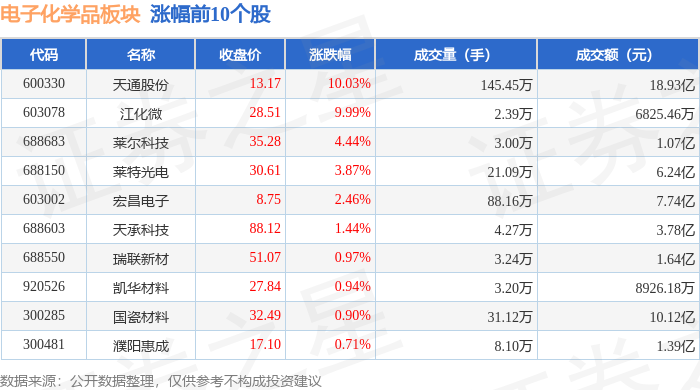
电子化学品板块1月22日跌0.13%,晶瑞电材领跌,主力资金净流出20.5亿元
Zheng Xing Xing Ye Ri Bao· 2026-01-22 09:01
Core Viewpoint - The electronic chemical sector experienced a slight decline of 0.13% on January 22, with Jingrui Electric Materials leading the drop. The Shanghai Composite Index rose by 0.14%, while the Shenzhen Component Index increased by 0.5% [1]. Group 1: Market Performance - The electronic chemical sector's stocks showed mixed performance, with notable gainers including Tiantong Co. (up 10.03% to 13.17) and Jianghuai Micro (up 9.99% to 28.51) [1]. - Jingrui Electric Materials saw a significant decline of 8.97%, closing at 18.48, with a trading volume of 1.81 million shares and a turnover of 3.394 billion [2]. Group 2: Capital Flow - The electronic chemical sector experienced a net outflow of 2.05 billion from institutional investors, while retail investors saw a net inflow of 1.187 billion [2]. - The capital flow data indicates that Tiantong Co. had a net inflow of 4.90 billion from institutional investors, while Jianghuai Micro had a net inflow of 38.71 million [3].


连板股追踪丨A股今日共94只个股涨停 湖南白银3连板
Di Yi Cai Jing· 2026-01-22 08:41
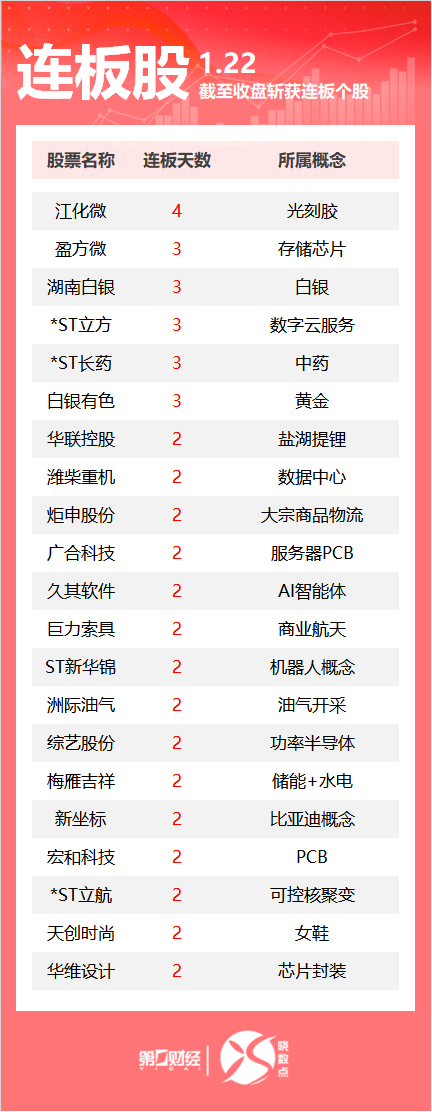
Group 1 - A total of 94 stocks in the A-share market reached the daily limit on January 22, indicating strong market activity [1] - Jianghua Microelectronics, a photoresist concept stock, achieved a four-day limit increase, highlighting its significant market interest [1] - Other notable stocks include Yingfang Microelectronics and Hunan Silver, both achieving three consecutive limit increases, reflecting investor confidence in storage chips and silver sectors respectively [1] Group 2 - Stocks with two consecutive limit increases include Huayuan Holdings in lithium extraction and Weichai Heavy Industry in data centers, indicating emerging trends in these sectors [1] - The list also features companies like Jushen Co. in commodity logistics and Guohe Technology in server PCBs, showcasing diverse investment opportunities across various industries [1] - The presence of companies in AI, renewable energy, and commercial aerospace further illustrates the broadening scope of investor interest in innovative technologies [1]


A股控制权交易现新动向:五家公司收购方集体承诺60个月超长锁定期,资本逻辑几何?
Mei Ri Jing Ji Xin Wen· 2026-01-22 06:56
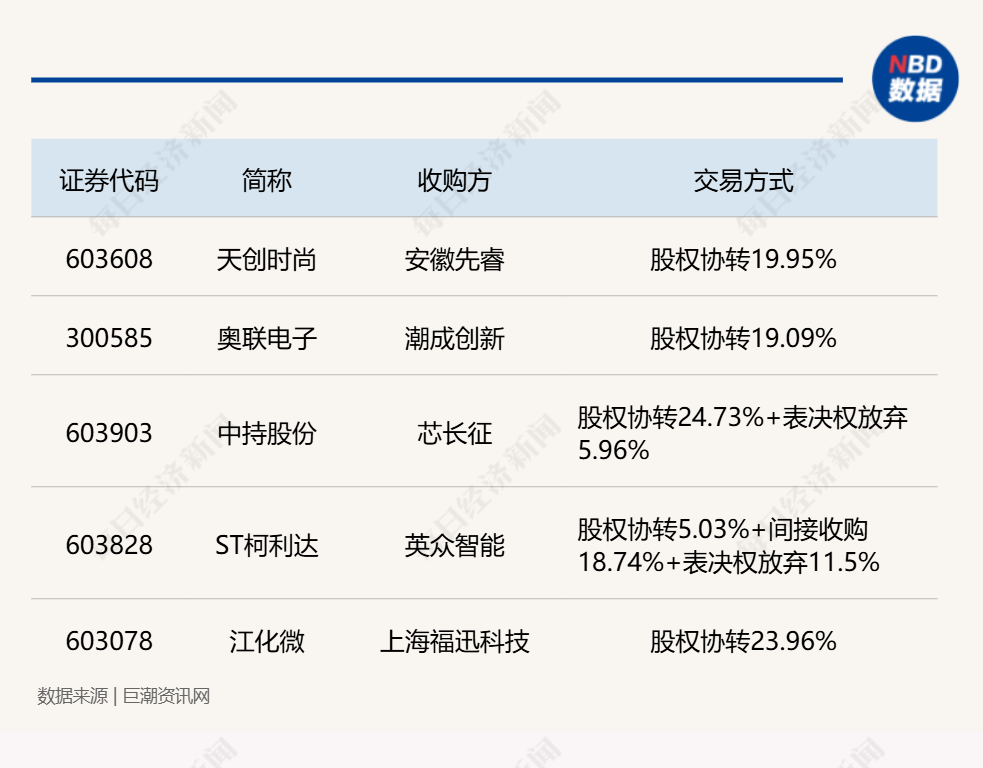
Core Viewpoint - The announcement of a proposed change in control for Jianghua Microelectronics by Shanghai Fuxun Technology, which includes a 60-month share lock-up period, has sparked significant discussion in the capital market regarding extended lock-up periods, which exceed the statutory 18-month requirement by more than double [1]. Group 1: Control Change Cases - Jianghua Microelectronics is the fifth case in the A-share market within a month to feature a 60-month extended lock-up period for control changes, alongside Tianchuang Fashion, Aolian Electronics, Zhongchi Co., and ST Keli Da [1]. - The trend of extending lock-up periods to 60 months reflects a collective shift in the capital logic behind these transactions, indicating a focus on long-term investment strategies [1][11]. Group 2: Transaction Characteristics - The five cases predominantly utilized equity agreement transfers without employing the previously common voting rights entrustment model, likely due to regulatory uncertainties surrounding the latter [2]. - All five cases feature a 60-month lock-up commitment, signaling a strong long-term investment orientation from the acquirers [4]. - The funding sources for these transactions are primarily from the acquirers' own funds, with at least 50% of the total transaction amount being self-funded, enhancing transaction security [5][6]. Group 3: Pricing and Valuation - The transactions generally involved discounted pricing, with the transfer prices being lower than the closing prices prior to the announcements, which helps balance the interests of both parties involved [7][8]. - Jianghua Microelectronics' transfer price was set at 20 yuan per share, reflecting a discount of 6.63% compared to the previous closing price [8]. Group 4: Company Fundamentals - The companies involved are primarily small to mid-cap firms, with Jianghua Microelectronics having a market capitalization close to 10 billion yuan, while the others range between 3 billion to 5 billion yuan [9][10]. - Financial performance indicates that these companies are generally under pressure, with many facing declining profitability or losses, highlighting the need for strategic control changes [9][10].




江化微连收3个涨停板
Xin Lang Cai Jing· 2026-01-22 04:44
江化微盘中涨停,已连收3个涨停板,截至9:26,该股报28.51元,换手率0.13%,成交量51.66万股,成 交金额1472.88万元,涨停板封单金额为16.21亿元。连续涨停期间,该股累计上涨33.10%,累计换手率 为1.54%。最新A股总市值达109.95亿元。 江化微盘中涨停,已连收3个涨停板,截至9:26,该股报28.51元,换手率0.13%,成交量51.66万股,成 交金额1472.88万元,涨停板封单金额为16.21亿元。连续涨停期间,该股累计上涨33.10%,累计换手率 为1.54%。最新A股总市值达109.95亿元。 证券时报·数据宝统计,两融数据来看,该股最新(1月21日)两融余额为2.75亿元,其中,融资余额 2.75亿元,较前一个交易日增加740.58万元,环比增长2.77%,近3日累计增加1956.86万元,环比增长 7.66%。 证券时报·数据宝统计,两融数据来看,该股最新(1月21日)两融余额为2.75亿元,其中,融资余额 2.75亿元,较前一个交易日增加740.58万元,环比增长2.77%,近3日累计增加1956.86万元,环比增长 7.66%。 龙虎榜数据显示,该股因连续三 ...
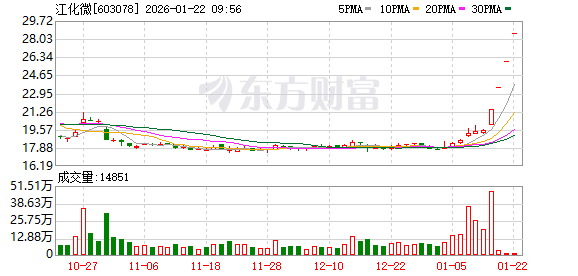
江化微斩获4连板 股价创历史新高
Zheng Quan Shi Bao Wang· 2026-01-22 02:25
Core Viewpoint - Jianghua Microelectronics (江化微) has reached a historical high with its stock price hitting 28.51 yuan per share, marking a continuous limit-up for four trading days [2]. Group 1: Stock Performance - The stock has seen a limit-up with nearly 280,000 shares on the limit-up board as of the latest report [2]. - The company’s stock price has shown significant upward momentum, indicating strong market interest and investor confidence [2]. Group 2: Business Operations - The company announced that its main business activities, including the research, production, and sales of ultra-pure reagents and photolithography supporting reagents, are operating normally [2]. - There have been no significant changes in the business environment, production costs, or sales, and internal operations remain stable [2]. Group 3: Share Transfer Agreement - The controlling shareholder, Zibo Xingheng Tusheng, signed a conditional share transfer agreement with Shanghai Fuxun Technology Co., Ltd., to transfer 92,382,329 shares, representing 23.96% of the total share capital [2]. - Following the completion of this share transfer, the controlling shareholder will change from Zibo Xingheng Tusheng to Shanghai Fuxun Technology, with the actual controller shifting from the Zibo Municipal Finance Bureau to the Shanghai State-owned Assets Supervision and Administration Commission [2]. - The completion of this share transfer is currently in progress, but there is uncertainty regarding its final implementation and timing [2].
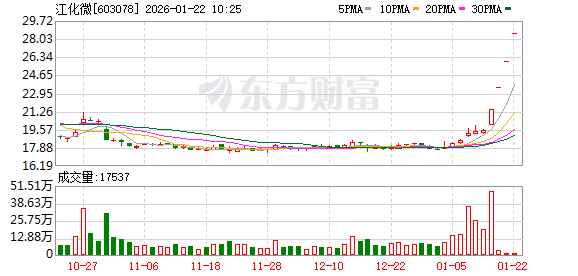
江化微创历史新高,融资客减仓
Zheng Quan Shi Bao Wang· 2026-01-22 02:10
两融数据显示,该股最新(1月21日)两融余额为2.75亿元,其中,融资余额为2.75亿元,近10日减少 6213.50万元,环比下降18.42%。 公司发布的三季报数据显示,前三季度公司共实现营业收入9.10亿元,同比增长10.92%,实现净利润 7878.30万元,同比下降8.66%,基本每股收益为0.2043元,加权平均净资产收益率4.10%。(数据宝) 江化微股价创出历史新高,截至9:32,该股上涨9.99%,股价报28.51元,成交量93.98万股,成交金额 2679.30万元,换手率0.24%,该股最新A股总市值达109.95亿元,该股A股流通市值109.95亿元。 证券时报·数据宝统计显示,江化微所属的电子行业,目前整体涨幅为1.59%,行业内,目前股价上涨的 有370只,涨停的有盈方微、金安国纪等4只。股价下跌的有115只,跌幅居前的有晶瑞电材、格林达、 深纺织A等,跌幅分别为5.71%、3.80%、3.59%。 ...
江化微4天4板!9时25分再度涨停,背后逻辑揭晓
Jin Rong Jie· 2026-01-22 01:46
Group 1 - The stock of Jianghua Microelectronics has experienced a continuous limit-up for four consecutive trading days, achieving a total of four limit-ups in four days [1] - On the latest trading day, the stock reached a limit-up at 9:25 AM with a transaction amount of 0.15 billion yuan, a limit order volume of 16.21 billion yuan, and a turnover rate of 0.13% [1] - The controlling shareholder of the company plans to transfer 23.96% of its shares, which will result in a change of the actual controller to the Shanghai State-owned Assets Supervision and Administration Commission [1] Group 2 - The semiconductor sector has seen an increase in overall activity, drawing market attention to related industry chain companies [1]
淄博国资接连出售上市公司,累计涉及金额超30亿元
Sou Hu Cai Jing· 2026-01-22 00:07
Core Viewpoint - The capital market is witnessing a strategic adjustment by Zibo State-owned Assets, involving the transfer of controlling stakes in two listed companies, totaling over 3 billion yuan, aimed at optimizing state capital allocation and focusing on core responsibilities [1][9]. Group 1: Equity Transfers - Zibo State-owned Assets is transferring a controlling stake in Dongjie Intelligent for 1.62 billion yuan and all shares in Jianghua Micro for 1.848 billion yuan, with a total transaction amount exceeding 3 billion yuan [1][9]. - Jianghua Micro's controlling shareholder, Zibo Xingheng, will transfer 92.38 million shares (23.96% of total shares) at a price of 20 yuan per share, totaling 1.848 billion yuan [1][2]. - The transfer of Jianghua Micro's shares will change its actual controller from Zibo Municipal Finance Bureau to Shanghai State-owned Assets Supervision and Administration Commission [2]. Group 2: Strategic Intent - The series of transactions is not merely a capital exit but a proactive arrangement to optimize state capital allocation and focus on core business areas [1][9]. - The transfer is expected to introduce new resources to both listed companies, facilitating their development [1][9]. - Jianghua Micro's founder is required to commit to not leaving the company or engaging in competition for five years, ensuring a stable transition [4]. Group 3: Financial Performance - During Zibo State-owned Assets' control, Jianghua Micro experienced revenue growth of 6.73% in 2024, reaching 1.099 billion yuan, but net profit declined by 6.29% to 99 million yuan [5]. - Dongjie Intelligent faced continuous revenue decline, with 2024 revenue at 807 million yuan, down 7.41%, and a net loss of 257 million yuan [8]. - However, in Q1 2025, Dongjie Intelligent reported a revenue increase of 22.65% to 260 million yuan, indicating a potential turnaround [8]. Group 4: Future Outlook - The transactions are seen as a means for Zibo State-owned Assets to realize investment returns while enabling the listed companies to access more suitable resources for overcoming development bottlenecks [9]. - The new controlling shareholders are expected to provide support in technology research and development, as well as market expansion, particularly for Jianghua Micro in the wet electronic chemicals sector and for Dongjie Intelligent in overseas markets [9].

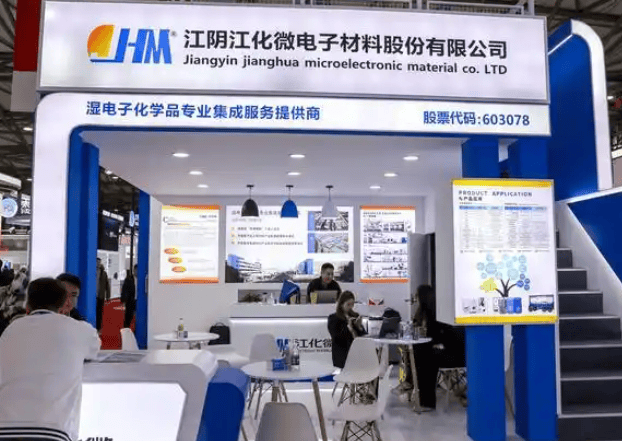
淄博国资半年退出两家上市公司盈利超6亿,地方国资股权投资逻辑生变?
Xin Lang Cai Jing· 2026-01-21 23:33
Core Viewpoint - The rapid divestment of two listed companies by the Zibo Municipal Finance Bureau within six months raises questions about the changing investment logic and the pressures faced by local state-owned assets [1][2]. Group 1: Company Transactions - On January 19, Jianghuai Microelectronics (江化微) announced the transfer of 23.96% of its shares for 1.848 billion yuan to Shanghai Fuxun Technology, changing its controlling shareholder from Zibo Municipal Finance Bureau to Shanghai State-owned Assets Supervision and Administration Commission [1]. - In August 2022, Zibo Municipal Finance Bureau transferred control of Dongjie Intelligent (东杰智能) to individual investor Han Yongguang for 1.62 billion yuan [1]. - Zibo Municipal Finance Bureau initially acquired control of Jianghuai Microelectronics and Dongjie Intelligent in 2021 for 1.372 billion yuan and 1.472 billion yuan, respectively, achieving profits of 514 million yuan and 148 million yuan from these investments [1]. Group 2: Investment Strategy and Performance - The Zibo Municipal Finance Bureau's strategy shifted from a focus on controlling listed companies to divesting them due to stricter local debt management and underperformance of the companies [1][19]. - Over four years, Zibo Municipal Finance Bureau realized a total profit of 662 million yuan from the divestments, indicating a successful financial investment despite the lack of significant operational involvement in the companies [7][18]. - The initial goal of integrating local industries with the acquired companies was not met, as the operational management remained with the original teams, limiting the expected synergies [14][21]. Group 3: Market Context and Future Outlook - The divestment aligns with a broader trend among local state-owned enterprises to sell off control of listed companies, especially when the companies do not meet integration expectations [2][19]. - The financial performance of Dongjie Intelligent showed significant losses in 2023 and 2024, prompting the decision to exit at a favorable time [19]. - The management teams of the acquired companies, including Jianghuai Microelectronics, will remain in place post-divestment, ensuring continuity in operations [21].
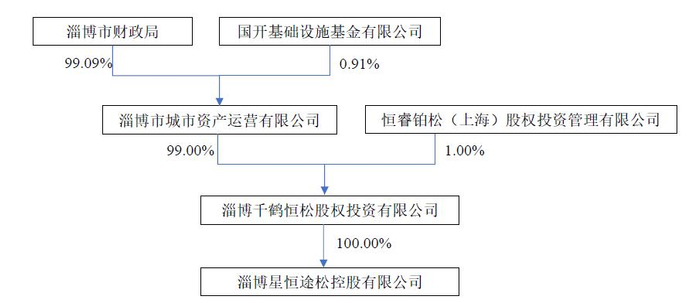
江阴江化微电子材料股份有限公司关于公司股票交易异常波动公告
Shang Hai Zheng Quan Bao· 2026-01-21 19:33
Core Viewpoint - Jiangyin Jianghua Microelectronics Materials Co., Ltd. experienced a significant stock price fluctuation, with a cumulative closing price increase exceeding 20% over two consecutive trading days, triggering an abnormal trading situation as per Shanghai Stock Exchange regulations [2][4]. Group 1: Stock Trading Abnormality - The company's stock (code: 603078) saw a price deviation of over 20% on January 20 and 21, 2026, indicating abnormal trading activity [4]. - The company conducted a self-examination and confirmed that there are no undisclosed significant matters apart from publicly disclosed information [2][8]. Group 2: Business Operations and Financial Performance - The company’s main business involves the research, production, and sales of ultra-pure reagents and photolithography supporting reagents, with normal production and operational activities reported [5]. - For the first three quarters of 2025, the company's net profit attributable to shareholders was 78.783 million yuan, representing a decrease of 8.66% compared to the same period last year [3][12]. Group 3: Share Transfer Agreement - On January 19, 2026, the controlling shareholder, Zibo Xingheng Tusheng Holdings Co., Ltd., signed a conditional share transfer agreement to transfer 92,382,329 shares (23.96% of total shares) to Shanghai Fuxun Technology Co., Ltd. [3][7]. - The completion of this share transfer is uncertain, and it will result in a change of the controlling shareholder from Zibo Xingheng Tusheng to Shanghai Fuxun Technology [7]. Group 4: Market Valuation - As of January 20, 2026, the company's price-to-earnings (P/E) ratio was 92.12, significantly higher than the industry average P/E ratio of 30.65, indicating potential overvaluation [3][11].