
Nanhua Futures(603093)

Search documents
金融期货早评-20251023
Nan Hua Qi Huo· 2025-10-23 02:29
Group 1: Financial Futures - Report industry investment rating: Not provided - Core view: Domestically, the expectation of a缓和 in Sino-US trade relations has increased, but short - term expectations for negotiation results should not be too high. Overseas, the US government shutdown has led to data vacuum, and the market's concerns about the economy have eased but risks remain. The Fed is expected to cut interest rates by 25 basis points in October, but the actual impact may be limited. Attention should be paid to the subsequent release of US employment and inflation data [1] - Summary by relevant catalogs: - Macro: Focus on the Fourth Plenary Session and the APEC Summit. The US government shutdown may cause a temporary rise in unemployment. Trump's actions and statements have affected the oil market. India and the US are close to reaching a trade agreement [1] - RMB exchange rate: The RMB exchange rate has basically stabilized within a narrow range. Although the external environment is uncertain, it is expected to remain stable at a reasonable and balanced level. It is recommended to wait and see [2][3] - Stock index: The stock market is in a wait - and - see state. It is necessary to focus on the release of information from the Fourth Plenary Session. Before there is substantial progress in Sino - US trade, the stock index's sensitivity to it has weakened. It is recommended to pay attention to the opportunity of buying straddle options [4][5] - Treasury bond: The bond market is waiting for news guidance. It is recommended to hold a small number of long positions at low levels and go long on dips for those with empty positions [5][6] - Container shipping European line: The futures price continues to consolidate at a high level. There are both long and short factors. It is expected to maintain a high - level shock in the short term. Trend traders can try long positions lightly, and arbitrage traders can pay attention to the opportunity of spread regression [7][8] Group 2: Commodities Non - ferrous Metals - Report industry investment rating: Not provided - Core view: Different non - ferrous metals have different market trends. Precious metals are in a short - term adjustment stage; copper prices are affected by multiple factors and are expected to fluctuate within a range; the alumina industry is in an oversupply situation; zinc spreads continue to expand; nickel and stainless steel are waiting for clear signals; tin is expected to be strong; lithium carbonate is expected to be strong; industrial silicon and polysilicon are in a shock adjustment; lead is expected to fluctuate within a narrow range [9][13][16][17][19][20][22][24][25] - Summary by relevant catalogs: - Gold & Silver: In the short - term adjustment stage, pay attention to the opportunity of buying on dips in the medium term. London gold has resistance at 4150 and support at 4000; silver has resistance at 50 - 50.5 and strong resistance at 55, support at 48 [9][11] - Copper: In the short term, it is expected to fluctuate within the range of 84000 - 86000. Speculators can go long on dips around 85000 ± 500. Downstream enterprises can adopt a combined strategy to reduce procurement costs, and enterprises with inventory pressure can use call options for hedging [12][13][14] - Aluminum industry chain: Aluminum is expected to fluctuate at a high level; alumina is expected to be weak; cast aluminum alloy is expected to fluctuate at a high level. Pay attention to the APEC Sino - US meeting and the change of alumina cost [14][15][16] - Zinc: The spread continues to expand. The domestic supply is strong and the demand is weak. Pay attention to the opening of the export window and the possibility of macro - upward drive [17] - Nickel, stainless steel: Continue to fluctuate, waiting for clear signals. Pay attention to Sino - US tariff issues and the change of nickel ore quota in 2026 [17][19] - Tin: It is expected to be strong. The supply is weaker than the demand, and it is recommended to hold long positions [20] - Lithium carbonate: The bottom space is stable, and it is expected to be strong. Pay attention to downstream production scheduling and supply - side resumption [21][22] - Industrial silicon & Polysilicon: Industrial silicon may see a small increase in price due to enterprise production cuts in the dry season, but it is restricted by inventory. Polysilicon has production cuts in the southwest region, and the specific impact needs to be observed [23][24] - Lead: It is expected to fluctuate within a narrow range. It is recommended to sell both call and put options to earn option premiums [25] Black Metals - Report industry investment rating: Not provided - Core view: Steel products are expected to rebound in the short term but be weak in the long term. Iron ore is under pressure. Coking coal and coke have a strong bottom support but limited rebound space. Ferrosilicon and ferromanganese are under pressure due to weak downstream demand and high inventory [26][28][30][31] - Summary by relevant catalogs: - Rebar & Hot - rolled coil: It is expected to rebound in the short term but be weak in the long term. Pay attention to the Fourth Plenary Session and the possibility of policy stimulus [26] - Iron ore: Under the dual pressure of macro - sentiment and fundamentals, it is in a weak shock. The key lies in policy signals [28] - Coking coal & Coke: The coking coal spot market is tight, but the downstream contradiction has intensified, and the rebound space is limited. It is recommended to treat it with a shock mindset [29][30] - Ferrosilicon & Ferromanganese: The downstream demand is weak, and the inventory is high. If there is no super - expected stimulus policy, the price will be under pressure [31] Energy and Chemicals - Report industry investment rating: Not provided - Core view: Crude oil has a short - term rebound but long - term concerns. LPG follows the rise of crude oil. PTA - PX follows the cost - end shock. MEG is under pressure and is expected to fluctuate at a low level. Methanol fluctuates under pressure. PP's supply pressure is temporarily relieved. PE's supply is strong and demand is weak. Pure benzene and styrene rebound at a low level. Fuel oil and low - sulfur fuel oil are affected by supply and demand. Asphalt is affected by raw material concerns. Glass, soda ash, and caustic soda need to pay attention to supply changes [33][35][37][38][43][44][48][50][53][54][55][56][57][59][60] - Summary by relevant catalogs: - Crude oil: The short - term rebound is due to sanctions, but there are long - term supply surpluses [33][35] - LPG: Follows the rise of crude oil, and the price is expected to fluctuate with crude oil in the short term [36][37] - PTA - PX: Follows the cost - end shock. It is recommended to wait and see on the one - hand and expand the processing fee on TA01 when it is below 280 [38][39][40] - MEG: Under pressure, it is expected to fluctuate at a low level. It is recommended to sell out - of - the - money call options after the macro situation is determined [41][42][43] - Methanol: Fluctuates under pressure. The port inventory accumulation is smoothed, and the price range is 2250 - 2350 [44] - PP: The supply pressure is temporarily relieved, and it is recommended to shrink the L - P spread in the short term [47][48] - PE: The supply is strong and demand is weak, and it is necessary to pay attention to macro and cost changes [49][50][51] - Pure benzene & Styrene: Rebound at a low level. It is recommended to shrink the price spread in the short term and wait and see on the one - hand [52][53] - Fuel oil: The supply tension is relieved, and the high - sulfur fuel oil cracking is bearish [54] - Low - sulfur fuel oil: The supply is narrowed, the demand is weak, and the upward drive is limited [55] - Asphalt: Affected by raw material concerns, it is recommended to wait and see or short at a high level [56] - Glass, Soda ash, Caustic soda: Soda ash has long - term supply pressure; glass has high inventory and weak demand; caustic soda needs to observe the replenishment demand [57][59][60] Pulp, Logs, etc. - Report industry investment rating: Not provided - Core view: Pulp and offset paper may continue to rise in the short term but are restricted above. Logs have a new low in the month - spread. Propylene is expected to fluctuate [60][61][62][63][65][66] - Summary by relevant catalogs: - Pulp & Offset paper: Pulp prices are expected to fluctuate upward, and offset paper's decline is temporarily interrupted [60][61][62] - Logs: The month - spread reaches a new low. There are potential supply - reduction factors, and it is recommended to use a covered call strategy for the 01 contract [63][64] - Propylene: Expected to fluctuate. The cost provides short - term support, but there is a lack of upward drive [65][66] Agricultural Products - Report industry investment rating: Not provided - Core view: The short - term supply of live pigs decreases. It is recommended to use a 1 - 5 positive spread and go short on rallies [68][69] - Summary by relevant catalogs: - Live pigs: The short - term supply decreases. Pay attention to the game between farmers' sentiment and price on replenishment, and the implementation of capacity - reduction policies [68][69]

南华期货玉米、淀粉产业日报-20251023
Nan Hua Qi Huo· 2025-10-23 01:02
Report Information - Report Title: Nanhua Futures Corn & Starch Industry Daily Report - Date: October 23, 2025 - Analyst: Dai Hongxu (Investment Consulting License No.: Z0021819) - Research Assistant: Kang Quangui (Qualification Certificate No.: F03148699) - Investment Consulting Business Qualification: CSRC License [2011] No. 1290 [1] Core Viewpoint - As the weather in North China improves, the focus returns to the pressure of new - season supply. The spot market is stable, while the futures market shows a downward adjustment. The price may decline later due to selling pressure. Starch sales are improving, but the inventory is still high. The CBOT corn futures rose 0.95% on Wednesday due to expected lower yields [2] Key Points by Category Market Conditions - **Spot Market**: Prices in various ports and regions remained stable on October 23, 2025. For example, the price in Jinzhou Port was 2180 yuan/ton, unchanged from the previous day. The basis of Jinzhou Port's main continuous contract increased by 11 to 47 [3] - **Futures Market**: On October 22, most corn futures contracts closed lower. For instance, the corn 01 contract dropped 11 yuan to 2133 yuan, a 0.51% decline. Some corn starch futures contracts showed small fluctuations, like the corn starch 11 contract rising 11 yuan to 2410 yuan, a 0.46% increase [3] Factors Affecting the Market - **Positive Factors**: The number of state - reserve granary purchase points increased, aiming to support prices. The meteorological problems in North China weakened the downward price momentum, making it difficult to push down prices [5] - **Negative Factors**: The pig industry is in the process of capacity adjustment, which may affect long - term corn feed demand. With the dissipation of weather disturbances, the focus is back on supply pressure, increasing short - term price pressure [5] Other Market Data - **US Market**: On October 23, 2025, the CBOT corn main continuous contract price was 423.75, up 4 with a 0.95% increase. The import profit of US corn from the Gulf of Mexico was 200.69 yuan/ton, and that from the US West Coast was 353.72 yuan/ton [27]
南华期货董事长罗旭峰:期市稳步迈向高质量发展新目标
Qi Huo Ri Bao Wang· 2025-10-22 16:08
Core Viewpoint - The State Council's recent directive emphasizes a "safe, standardized, and steady development" approach for China's futures market, highlighting the importance of strong regulation, risk prevention, and support for the real economy [1] Regulatory Foundation: From Punishment to Prevention - A comprehensive risk prevention system has been established, transitioning regulation to a "function-driven" model, ensuring a solid safety baseline for market development [2] - The industry has seen over 110 regulatory measures and disciplinary actions since 2025, focusing on key areas like internet marketing and risk management, creating a three-dimensional punishment system [2] - Enhanced regulatory capabilities through digital and intelligent transformation have significantly improved the identification of abnormal trading activities [2] - The revised classification evaluation for futures companies emphasizes supporting strong performers while limiting weaker ones, leading to increased industry concentration and resource allocation to quality entities [2] Functional Upgrade: From Tool Supply to Ecological Empowerment - The futures market has shifted from merely providing tools to empowering the entire industrial chain, significantly enhancing service quality for the real economy [3] - The adaptability of futures products to industrial needs has improved, with new products like polysilicon and lithium carbonate being launched, and a 200% year-on-year increase in trading volume for new energy products [3] - Futures companies are innovating service models to address the "last mile" issue, offering customized solutions and technical support [3] - The application of AI technology has transformed hedging from a passive to an active strategy, making it more accessible for small and medium enterprises [3] Open Progress: From Product Opening to Institutional Export - The futures market has expanded its openness, increasing both the quantity and quality of products available for international participation [4] - The number of futures options available to QFII/RQFII has increased from 46 to 75, with new products covering critical sectors like energy and agriculture [4] - The "Chinese price" has gained global influence, with the Shanghai Futures Exchange authorizing the settlement price of natural rubber futures to the Osaka Securities Exchange [4] - Innovations in cross-border delivery mechanisms have improved international participation and facilitated pricing for cross-border trade [5] Future Path: Deepening Reforms to Address Development Challenges - Despite significant progress, challenges remain, such as high participation barriers for small and medium enterprises and the imbalance between transformation pressures and innovation motivation [6] - The industry needs to enhance product and institutional offerings, including launching new futures products and optimizing hedging approval processes [7] - A technology-enabled inclusive service system should be established, promoting data sharing across departments and encouraging collaboration between futures companies and tech firms [7] - The focus should also be on expanding international participation and enhancing the global recognition of "Chinese solutions" in the derivatives market [7] Dynamic Balance of Regulation and Development - A compliance points system is proposed to reward institutions with strong compliance records and effective service to the real economy [8] - Regulatory technology will be utilized for precise regulation, minimizing interference with normal business operations [8] - The establishment of a risk reserve fund and industry guarantee fund is suggested to enhance the market's ability to withstand extreme conditions [8] - The successful implementation of the directive's principles indicates a promising future for the futures market in supporting financial strength and global resource allocation [8]
南华期货碳酸锂企业风险管理日报-20251022
Nan Hua Qi Huo· 2025-10-22 10:34
南华期货碳酸锂企业风险管理日报 2025年10月22日 夏莹莹 投资咨询证书:Z0016569 研究助理:余维函 期货从业证号:F03144703 联系邮箱:yuwh@nawaa.com 投资咨询业务资格:证监许可【2011】1290号 期货价格区间预测 | 品种 | 价格区间预测 | 当前波动率(20日滚动) | 当前波动率历史百分位(3年) | | --- | --- | --- | --- | | 碳酸锂LC2601合约 | 强支撑位:72000 | 17.9% | 13.6% | source: 南华研究,同花顺 锂电企业风险管理策略建议 | 行为导向 | 情景分析 | | 操作思路 | 套保工具 | 操作建议 | 套保比例 | 建议入场 | | --- | --- | --- | --- | --- | --- | --- | --- | | | | | | | | | 区间 | | 采购管理 | 产成品价格无 相关性 | 未来有生产电池材料的计划, 担心未来采购碳酸锂时价格上 | 为防止成本上涨,企业根据生 产计划需买入对应生产计划的 | 期货 场内/场外期权 | 买入对应期货合约 卖出看跌期权 ...
南华镍、不锈钢产业风险管理日报-20251022
Nan Hua Qi Huo· 2025-10-22 09:38
Report Summary 1. Report Industry Investment Rating No information provided. 2. Core Viewpoints - The nickel and stainless steel markets are currently fluctuating with the broader market, with no significant changes in the fundamentals recently. There is still an expectation of interest rate cuts within the year at the macro - level, and the progress of Sino - US tariffs repeatedly adjusts risk preferences [3]. - In the nickel ore sector, Indonesia has announced regulations for 2026 quota applications. The overall quota in 2025 is in surplus, and the quota in 2026 is expected to decline under regulatory restrictions such as environmental reviews. The new energy sector is entering the peak season, with high downstream procurement demand and rising prices. The nickel - iron price has limited upward momentum, and its center of gravity has declined. Stainless steel prices rose slightly during the day, with active spot transactions, but its upward momentum is insufficient, and it may fluctuate widely, waiting for clear signals [3]. - The WTO's ruling that the EU's additional tax on Indonesian stainless steel is non - compliant and the exemption of India's BIS certification until the end of the year are positive for stainless steel exports [5]. 3. Summary by Related Catalogs 3.1 Price and Volatility Forecast - **Nickel**: The price range forecast for Shanghai nickel is 118,000 - 126,000 yuan/ton, with a current 20 - day rolling volatility of 15.17% and a historical percentile of 3.2% [2]. - **Stainless Steel**: The price range forecast for stainless steel is 12,500 - 13,100 yuan/ton, with a current 20 - day rolling volatility of 8.23% and a historical percentile of 3.3% [2]. 3.2 Risk Management Strategies - **Nickel Risk Management Strategies** - **Inventory Management**: When product sales prices fall and inventory has impairment risk, sell Shanghai nickel futures (NI main contract) according to inventory levels to lock in profits and hedge against spot price declines, with a hedging ratio of 60%. Also, sell call options (over - the - counter/on - exchange options) with a hedging ratio of 50% [2]. - **Procurement Management**: When the company has future production procurement needs and is worried about rising raw material prices, buy Shanghai nickel forward contracts (far - month NI contracts) according to the production plan to lock in production costs. Also, sell put options and buy out - of - the - money call options (on - exchange/over - the - counter options) according to the procurement plan [2]. - **Stainless Steel Risk Management Strategies** - **Inventory Management**: When product sales prices fall and inventory has impairment risk, sell stainless steel futures (SS main contract) according to inventory levels to lock in profits and hedge against spot price declines, with a hedging ratio of 60%. Also, sell call options (over - the - counter/on - exchange options) with a hedging ratio of 50% [3]. - **Procurement Management**: When the company has future production procurement needs and is worried about rising raw material prices, buy stainless steel forward contracts (far - month SS contracts) according to the production plan to lock in production costs. Also, sell put options and buy out - of - the - money call options (on - exchange/over - the - counter options) according to the procurement plan [3]. 3.3 Market Data - **Nickel Market Data** - **Futures Prices**: The latest price of Shanghai nickel main contract is 121,380 yuan/ton, with a daily change of 200 yuan and a change rate of 0%. The prices of other contracts also showed different degrees of change [6]. - **Inventory Data**: The domestic social inventory of nickel is 47,708 tons, with no change from the previous period; LME nickel inventory is 250,878 tons, an increase of 402 tons; nickel - pig iron inventory is 29,062 tons, a decrease of 174 tons [7]. - **Stainless Steel Market Data** - **Futures Prices**: The latest price of the stainless steel main contract is 12,710 yuan/ton, with a daily change of 45 yuan and a change rate of 0%. The prices of other contracts also showed different degrees of change [6]. - **Inventory Data**: The stainless steel social inventory is 952.6 tons, an increase of 47 tons [7]. 3.4 Market Influencing Factors - **Positive Factors** - Indonesia shortens the nickel ore quota license period from three years to one year. - The Indonesian forestry working group takes over part of the nickel mining area of PT Weda Bay. - CATL and Antam promote the construction of a nickel integrated smelter. - The WTO rules that the EU's additional tax on Indonesian stainless steel is non - compliant. - India's BIS certification exemption is extended to the end of the year [6]. - **Negative Factors** - The inventory of pure nickel is high. - The center of gravity of nickel - iron has moved down, and the bottom support has loosened. - Stainless steel has re - entered the inventory accumulation cycle. - The stainless steel market shows a situation of "not prosperous in the peak season", and the demand recovery is less than expected [6].
南华期货沥青风险管理日报-20251022
Nan Hua Qi Huo· 2025-10-22 09:38
Report Summary 1. Report Industry Investment Rating No investment rating information is provided in the report. 2. Core View of the Report The current peak season for asphalt has not shown better - than - expected performance. Short - term external disturbances have increased. It is recommended to wait and see in the short term or look for pressure levels after the price rises to arrange short positions. The supply of asphalt remains stable, the demand is weak due to weather and other factors, the cost of crude oil is expected to decline, and the South China region is still the price depression [3]. 3. Summary by Relevant Catalogs 3.1 Price and Volatility - The predicted monthly price range of the asphalt main contract is 3000 - 3450, the current 20 - day rolling volatility is 14.25%, and the historical percentile of the current volatility in the past 3 years is 15.91% [2]. 3.2 Risk Management Strategy - **Inventory Management**: For enterprises with high finished - product inventory, to prevent inventory losses, they can short - sell asphalt futures (bu2512) with a hedging ratio of 25% at an entry range of 3650 - 3750. They can also sell call options (bu2512C3500) with a ratio of 20% at an entry range of 30 - 40 to reduce capital costs [2]. - **Procurement Management**: For enterprises with low regular inventory, to prevent rising procurement costs, they can buy asphalt futures (bu2512) with a hedging ratio of 50% at an entry range of 3300 - 3400. They can also sell put options (bu2512C3500) with a ratio of 20% at an entry range of 25 - 35 to collect premiums and reduce procurement costs [2]. 3.3 Core Contradiction - The news of a possible US military strike on Venezuela has led to a rise in crude oil and asphalt prices. Since Venezuelan crude oil accounts for over 20% of China's asphalt refinery feedstock, the market is worried about raw material supply disruptions. However, the accuracy of the news needs to be verified by tracking Venezuelan crude oil shipments and China's imports [3]. - The refinery's production is stable, and the overall asphalt supply has little change. The demand is weak after the National Day holiday, mainly consuming social inventory. The inventory structure has improved, with stable and low - pressure factory inventories and a declining social inventory. The problem of raw material shortage has not been fundamentally resolved, so the asphalt cracking spread remains high. The cost of crude oil is expected to decline as OPEC continues to increase production. The price of crude oil has dropped rapidly due to the escalation of Sino - US tariffs. The South China region remains the price depression due to crude oil quotas and consumption tax restrictions [3]. 3.4利多解读 - The pressure on asphalt factory inventories is low, providing a basis for manufacturers to support prices [6]. - In Shandong, Shengxing has resumed asphalt production, while Qicheng and Fengli have switched to producing residual oil. In the East China region, some major refineries have reduced production [6]. - There is an atmosphere of anti - cut - throat competition, and the Ministry of Industry and Information Technology has issued a document to resist disorderly price wars [6]. - There is a possibility of an escalation of the conflict between the US and Venezuela [6]. 3.5利空解读 - The escalation of US tariffs on China has weakened the overall sentiment in the risk market [7]. - The recent increase in the arrival of Venezuelan crude oil and the continued production increase by OPEC+ in November are negative factors for asphalt prices [12]. 3.6 Price and Basis Data - **Spot Price**: On October 22, 2025, the spot prices in Shandong, the Yangtze River Delta, North China, and South China were 3330 yuan/ton, 3470 yuan/ton, 3330 yuan/ton, and 3400 yuan/ton respectively. Compared with the previous day, the prices in Shandong and North China decreased by 10 yuan/ton, while those in the Yangtze River Delta and South China remained unchanged [7]. - **Basis**: The basis of Shandong, the Yangtze River Delta, North China, and South China for the 12 - contract decreased by 56 yuan/ton, 46 yuan/ton, 56 yuan/ton, and 46 yuan/ton respectively compared with the previous day [7]. - **Cracking Spread**: The cracking spread of Shandong spot to Brent decreased by 1.7329 yuan/barrel compared with the previous day, while the cracking spread of the futures main contract to Brent increased by 15.9425 yuan/barrel [7].
多元金融板块10月22日跌0.6%,海德股份领跌,主力资金净流出4.04亿元
Zheng Xing Xing Ye Ri Bao· 2025-10-22 08:19
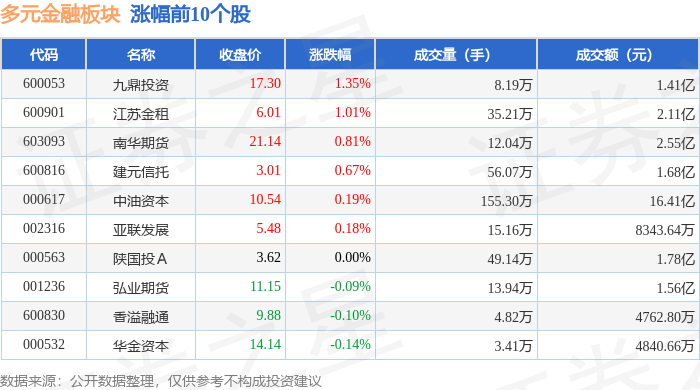
Market Overview - On October 22, the diversified financial sector declined by 0.6% compared to the previous trading day, with Haide Co., Ltd. leading the decline [1] - The Shanghai Composite Index closed at 3913.76, down 0.07%, while the Shenzhen Component Index closed at 12996.61, down 0.62% [1] Stock Performance - Notable gainers in the diversified financial sector included: - Jiuding Investment (600053) with a closing price of 17.30, up 1.35% on a trading volume of 81,900 shares and a turnover of 141 million yuan [1] - Jiangsu Jinzu (600901) closed at 6.01, up 1.01% with a trading volume of 352,100 shares and a turnover of 211 million yuan [1] - Major decliners included: - Haide Co., Ltd. (000567) which closed at 6.93, down 4.68% with a trading volume of 395,200 shares and a turnover of 277 million yuan [2] - Ruida Futures (002961) closed at 21.75, down 3.25% with a trading volume of 170,600 shares and a turnover of 371 million yuan [2] Capital Flow - The diversified financial sector experienced a net outflow of 404 million yuan from institutional investors, while retail investors saw a net inflow of 403 million yuan [2] - The table of capital flow indicates that Jiuding Investment had a net inflow of 8.22 million yuan from institutional investors, while it faced a net outflow of 6.33 million yuan from retail investors [3]


期货新开户增多了休眠户回来了 前三季度,产业客户和境外客户增长最为显著
Zheng Quan Shi Bao· 2025-10-21 17:38
Core Insights - The Chinese futures market has reached a milestone with total funds exceeding 2 trillion yuan, reflecting a 24% increase from the end of 2024 [1] - There has been a significant increase in new account openings, driven by interest in precious metals and stock index futures [1] - The overall performance of the futures industry is recovering, with net profits for the first eight months of 2025 reaching 76.5 billion yuan, a new high in recent years [7] Market Growth - As of September 2025, the number of effective clients in the market has surpassed 2.7 million, a 14% increase year-on-year, with 650,000 new clients added in the first three quarters [2] - Institutional clients have shown steady growth of 3%, while overseas clients have increased by 11%, with traders distributed across 40 countries and regions [2] Client Segmentation - Industrial clients and overseas clients are identified as key growth drivers in the domestic futures market, with industrial clients focusing on risk management and strategic planning [3][5] - A record 1,583 A-share listed companies have issued hedging announcements this year, surpassing the total for 2024, indicating a growing engagement in risk management [3] Service Enhancement - Futures companies are enhancing the service capabilities of frontline staff to meet the increasing demands of industrial and institutional clients [4] - Staff are required to possess in-depth knowledge of industry structures, market dynamics, and risk points, along with strong communication skills to effectively address client needs [4] International Engagement - The acceleration of the Chinese futures market's opening has led to significant interest from overseas clients, with many potential clients ready to participate actively [6] - Feedback from European client interactions indicates a strong familiarity with market entry rules and a readiness to engage in trading [6] Financial Performance - As of August 2025, the total trading volume reached 65.23 trillion yuan, with a net profit of 12.34 billion yuan for the period [7] - There is a notable performance disparity among futures companies, with profits concentrated in a few firms, while traditional brokerage competition remains intense [7] - Specific A-share listed futures companies have shown varied performance, with some experiencing significant profit increases while others have reported losses [7][8]



南华镍、不锈钢产业风险管理日报-20251021
Nan Hua Qi Huo· 2025-10-21 10:21
1. Report Industry Investment Rating - Not provided in the content 2. Core Views of the Report - The nickel and stainless steel markets are currently following the broader market in a volatile pattern, with no significant changes in the fundamentals recently. There are expectations of interest rate cuts within the year at the macro - level, and the progress of Sino - US tariffs repeatedly adjusts risk preferences [3]. - In the nickel ore sector, Indonesia has announced regulations for the 2026 quota application. The overall quota in 2025 is somewhat excessive, and the quota in 2026 is expected to decline under regulatory restrictions such as environmental reviews [3]. - The new energy sector is entering the peak season, with high downstream procurement demand. The current quotes have been rising for several consecutive weeks, the market circulation is tight, inventories are low, and there are still inquiries, which may remain strong [3]. - The price of ferronickel has insufficient upward momentum, and the overall center of gravity has significantly declined. It may operate weakly under the pressure of stainless - steel profits and weak demand. If ferronickel loses its support, the downward space for the downstream may expand [3]. - The spot trading of stainless steel has improved slightly, leading to a small rebound in the futures market. However, the sentiment of a lackluster peak season is strong. Currently, stainless steel has a large amount of inventory accumulation, and the upward momentum is insufficient compared with the previous continuous destocking cycle. The center of gravity of stainless steel may move down slightly, but export is favorable due to WTO rulings and certification exemptions [3][5]. 3. Summary by Relevant Sections Price and Volatility Forecast - **Nickel (Shanghai Futures Exchange)**: The price range is predicted to be 11,800 - 12,600 yuan/ton, with a current 20 - day rolling volatility of 15.17% and a historical percentile of 3.2% [2]. - **Stainless Steel**: The price range is predicted to be 1,250 - 1,310 yuan/ton, with a current 20 - day rolling volatility of 8.79% and a historical percentile of 5.9% [2]. Risk Management Strategies Nickel - **Inventory Management**: When the product sales price falls and inventory has impairment risk, sell Shanghai nickel futures (NI main contract) with a 60% hedging ratio and sell call options (over - the - counter/on - exchange options) with a 50% hedging ratio [2]. - **Procurement Management**: When the company has future production procurement needs and is worried about rising raw material prices, buy far - month NI contracts according to the production plan, sell put options, and buy out - of - the - money call options, with the hedging ratio based on the procurement plan [2]. Stainless Steel - **Inventory Management**: When the product sales price falls and inventory has impairment risk, sell stainless - steel futures (SS main contract) with a 60% hedging ratio and sell call options (over - the - counter/on - exchange options) with a 50% hedging ratio [3]. - **Procurement Management**: When the company has future production procurement needs and is worried about rising raw material prices, buy far - month SS contracts according to the production plan, sell put options, and buy out - of - the - money call options, with the hedging ratio based on the procurement plan [3]. Market Data Nickel - **Futures Prices**: The latest price of the Shanghai nickel main - continuous contract is 121,180 yuan/ton, with a 0% change; the Shanghai nickel continuous - one contract is 120,860 yuan/ton, down 0.39%; the Shanghai nickel continuous - two contract is 121,100 yuan/ton, down 0.34%; the Shanghai nickel continuous - three contract is 121,340 yuan/ton, down 0.34%; the LME nickel 3M contract is 15,230 US dollars/ton, down 0.34% [6]. - **Volume and Open Interest**: The trading volume is 60,391 lots, down 12.28%; the open interest is 50,388 lots, down 14.10% [6]. - **Warehouse Receipts**: The number of warehouse receipts is 27,026 tons, up 0.59% [6]. - **Basis**: The basis of the main contract is - 240 yuan/ton, down 52.0% [6]. Stainless Steel - **Futures Prices**: The latest price of the stainless - steel main - continuous contract is 12,665 yuan/ton, up 1%; the stainless - steel continuous - one contract is 12,595 yuan/ton, down 0.28%; the stainless - steel continuous - two contract is 12,695 yuan/ton, down 0.12%; the stainless - steel continuous - three contract is 12,780 yuan/ton, up 0.24% [7]. - **Volume and Open Interest**: The trading volume is 126,078 lots, up 1.04%; the open interest is 188,332 lots, down 4.98% [7]. - **Warehouse Receipts**: The number of warehouse receipts is 74,497 tons, down 0.16% [7]. - **Basis**: The basis of the main contract is 775 yuan/ton, up 4.73% [7]. Inventory Data - **Domestic Social Inventory of Nickel**: 47,708 tons, unchanged from the previous period [7]. - **LME Nickel Inventory**: 250,476 tons, unchanged from the previous period [7]. - **Stainless - Steel Social Inventory**: 952.6 tons, an increase of 47 tons [7]. - **Ferronickel Inventory**: 29,062 tons, a decrease of 174 tons [7]. Factors Affecting the Market Positive Factors - Indonesia shortens the nickel ore quota license period from three years to one year [6]. - The Indonesian forestry working group takes over part of the nickel mining area of PT Weda Bay [6]. - CATL and Antam are promoting the construction of an integrated nickel smelter [6]. - The WTO rules that the EU's additional tax on Indonesian stainless steel is illegal [5][6]. - The exemption of the Indian BIS certification is extended to the end of the year [5][6]. Negative Factors - The inventory of pure nickel is high [6]. - The center of gravity of ferronickel has moved down, and the bottom support has loosened [6]. - Stainless steel has re - entered the inventory accumulation stage [6]. - The stainless - steel market shows a lackluster peak season, and the demand recovery is less than expected [6].
南华期货工业硅、多晶硅企业风险管理日报-20251021
Nan Hua Qi Huo· 2025-10-21 09:31
1. Report Industry Investment Rating No relevant content provided. 2. Core Views of the Report Industrial Silicon - Supply - The end of the low - electricity - price period in Southwest China during the wet season will slow down and potentially reduce the growth rate of ore - heating furnace start - up rates. The furnace - opening growth rate in Xinjiang is also below expectations. Overall, the overall start - up rate of industrial silicon is expected to peak, and the risk of further inventory accumulation will ease, reducing supply - side pressure [4]. - Demand - The organic silicon industry's start - up rate is slowing, with limited actual demand for industrial silicon. The demand from the recycled aluminum alloy sector remains stable and is expected to maintain rigid procurement. The polysilicon sector is expected to see a steady increase in demand for industrial silicon in the next two months as enterprise profit conditions improve and production schedules increase in October [4]. - Market Outlook - The supply - side incremental space is expected to narrow. Key signals to watch are whether the supply - side start - up rate enters a downward channel and whether the downstream polysilicon demand improves. If both conditions are met, the oversupply situation may ease, and the industry may reach a price bottom - reversal point. The details and implementation of polysilicon industry integration measures are crucial variables [4][6]. Polysilicon - Core Influencing Factors - The core factors determining the polysilicon futures price are the establishment of the photovoltaic storage platform in October, the pressure of concentrated warehouse - receipt cancellation in November, the stability and increase of component bid - winning prices on the demand side, and the increase of photovoltaic grid - connected power prices [9]. - Market Outlook - The short - term trading focus is on whether the storage platform will be established in October, and then it will shift to the expectation game of concentrated warehouse - receipt cancellation in November. The high volatility of polysilicon futures implies high risks, and investors are advised to be cautious [9][10]. 3. Summary by Relevant Catalogs Industrial Silicon Futures Data - The closing price of the industrial silicon main contract is 8505 yuan/ton, with a daily decrease of 60 yuan (- 0.70%) and a weekly decrease of 15 yuan (- 0.18%). The trading volume is 188,642 lots, down 1,690 lots (- 0.89%) daily and 98,635 lots (- 34.33%) weekly. The open interest is 107,518 lots, down 6,718 lots (- 5.88%) daily and 55,156 lots (- 33.91%) weekly [12][13]. Spot Data - The price of 99 industrial silicon in Xinjiang is 8750 yuan/ton, unchanged daily and down 100 yuan (- 1.13%) weekly. The price of 553 in Xinjiang is also 8750 yuan/ton, with the same daily and weekly changes. The prices of different grades and regions show various trends, and the price of downstream products such as trichlorosilane, polysilicon N - type price index, etc., also have corresponding changes [21]. Basis and Warehouse Receipts - The total number of industrial silicon warehouse receipts is 48,851 lots, down 452 lots (- 0.79%) compared to the previous period. The warehouse receipts in different delivery warehouses have different changes, such as a 0.3 - million - ton decrease in the Kunming delivery warehouse (weekly) [35]. Polysilicon Futures Data - The closing price of the polysilicon main contract is 50,715 yuan/ton, with a daily increase of 375 yuan (0.74%) and a weekly increase of 725 yuan (1.45%). The trading volume is 121,870 lots, down 28,902 lots (- 19.17%) daily and 175,833 lots (- 59.06%) weekly. The open interest is 52,237 lots, down 4,569 lots (- 8.04%) daily and 29,151 lots (- 35.82%) weekly [36]. Spot Data - The price of N - type polysilicon, including N - type re - feeding material, N - type dense material, etc., shows different degrees of increase. The prices of silicon wafers, battery cells, and components also have corresponding changes [45]. Basis and Warehouse Receipts - The basis of the polysilicon main contract is 1975 yuan/ton, down 375 yuan (- 15.96%) daily and 685 yuan (- 25.75%) weekly. The total number of polysilicon warehouse receipts is 9290 lots, an increase of 140 lots compared to the previous day [55].