
StarPower(603290)

Search documents
斯达半导跌2.01%,成交额1.41亿元,主力资金净流出117.14万元
Xin Lang Cai Jing· 2025-11-04 02:40
Core Viewpoint - The stock of Sda Semiconductor has experienced fluctuations, with a recent decline of 2.01% and a year-to-date increase of 13.29%, indicating volatility in its market performance [1][2]. Financial Performance - For the period from January to September 2025, Sda Semiconductor reported a revenue of 2.99 billion yuan, representing a year-on-year growth of 23.82%. However, the net profit attributable to shareholders decreased by 9.80% to 382 million yuan [2]. - Cumulative cash dividends since the company's A-share listing amount to 885 million yuan, with 671 million yuan distributed over the past three years [3]. Shareholder Information - As of September 30, 2025, the number of shareholders increased by 21.67% to 65,600, while the average number of circulating shares per person decreased by 17.81% to 3,649 shares [2]. - Among the top ten circulating shareholders, Hong Kong Central Clearing Limited holds 3.18 million shares, a decrease of 1.10 million shares from the previous period. Additionally, the Southern CSI 500 ETF and Guolian An Semiconductor ETF have also seen changes in their holdings [3]. Market Activity - On November 4, the stock price was reported at 101.04 yuan per share, with a trading volume of 141 million yuan and a turnover rate of 0.58%. The total market capitalization stood at 24.20 billion yuan [1]. - The stock has shown a decline of 11.37% over the last five trading days and an increase of 18.93% over the last 60 days [1]. Business Overview - Sda Semiconductor, established on April 27, 2005, specializes in the design, research, and production of power semiconductor chips and modules, primarily focusing on IGBT technology. The revenue composition indicates that 98.12% comes from modules, while other products account for 1.88% [1]. - The company operates within the semiconductor industry, specifically in the electronic sector, and is associated with concepts such as IGBT, third-generation semiconductors, integrated circuits, and silicon carbide [1].

斯达半导股价连续3天下跌累计跌幅10.91%,景顺长城基金旗下1只基金持7.19万股,浮亏损失90.81万元
Xin Lang Cai Jing· 2025-11-03 07:15
Group 1 - The core point of the news is that Stada Semiconductor's stock has experienced a decline of 10.91% over the past three days, with a current price of 103.11 CNY per share and a market capitalization of 24.692 billion CNY [1] - Stada Semiconductor, established on April 27, 2005, specializes in the design, research, and production of power semiconductor chips and modules, primarily focusing on IGBT technology, with 98.12% of its revenue coming from modules [1] - The trading volume for Stada Semiconductor reached 693 million CNY, with a turnover rate of 2.85% [1] Group 2 - In the third quarter, Invesco Great Wall Fund held 71,900 shares of Stada Semiconductor, representing 1.01% of the fund's net value, making it the ninth-largest holding [2] - The fund has incurred a floating loss of approximately 105,700 CNY today and a total floating loss of 908,100 CNY during the three-day decline [2] - The Invesco Great Wall CSI 500 Industry Neutral Low Volatility Index A fund, established on March 3, 2017, has a total asset size of 777 million CNY and has achieved a year-to-date return of 15.91% [2]
斯达半导的前世今生:营收行业第四,净利润第三,2025年Q3负债率33.94%高于去年同期
Xin Lang Cai Jing· 2025-10-30 14:43
Core Viewpoint - Stada Semiconductor is a leading domestic IGBT module company in China, with strong technical capabilities and products widely used in new energy vehicles and photovoltaic energy storage [1] Group 1: Business Performance - In Q3 2025, Stada Semiconductor reported revenue of 2.99 billion yuan, ranking 4th in the industry [2] - The company's net profit for the same period was 386 million yuan, ranking 3rd in the industry [2] - The main business revenue from modules was 1.899 billion yuan, accounting for 98.12% of total revenue [2] Group 2: Financial Ratios - As of Q3 2025, Stada Semiconductor's asset-liability ratio was 33.94%, higher than the industry average of 24.02% [3] - The gross profit margin for the same period was 27.91%, lower than the industry average of 30.71% [3] Group 3: Shareholder Information - As of September 30, 2025, the number of A-share shareholders increased by 21.67% to 65,600 [5] - The average number of circulating A-shares held per shareholder decreased by 17.81% to 3,649.34 [5] Group 4: Management Compensation - The chairman and general manager, Shen Hua, received a salary of 1.3248 million yuan in 2024, an increase of 23,500 yuan from 2023 [4] Group 5: Market Outlook - The company is expected to achieve a total revenue of 4.115 billion yuan for the full year of 2025, driven by strong demand in the new energy vehicle and photovoltaic energy storage markets [5] - The company is actively adjusting its product structure, with revenue from the new energy generation segment increasing by over 200% year-on-year in the first half of 2025 [6]

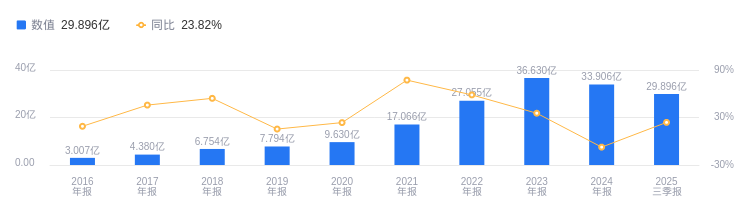
斯达半导(603290)25年三季报业绩点评:25Q3营收增长稳健 盈利能力承压
Xin Lang Cai Jing· 2025-10-30 12:27
Core Insights - The company reported a revenue of 2.99 billion yuan for Q1-Q3 2025, representing a year-over-year increase of 23.82%, while the net profit attributable to the parent company was 382 million yuan, down 9.80% year-over-year [1] - In Q3 2025, the company achieved a revenue of 1.05 billion yuan, showing a year-over-year increase of 19.58% and a quarter-over-quarter increase of 3.70%, with a net profit of 106 million yuan, down 28.39% year-over-year and 38.05% quarter-over-quarter [1][2] - The strong demand in the new energy vehicle and photovoltaic energy storage markets is driving steady revenue growth for the company [1] Revenue and Profitability - The company's gross margin for Q3 2025 was 24.54%, a decline of 7.46 percentage points year-over-year and 4.62 percentage points quarter-over-quarter [2] - Increased R&D investment has further compressed profit margins, with R&D expenses rising by 37.79 million yuan year-over-year and 22.66 million yuan quarter-over-quarter in Q3 2025 [2] Market Outlook - The sales of new energy vehicles in China reached 4.26 million units in Q3 2025, reflecting a year-over-year and quarter-over-quarter increase of 26.18% and 10.34%, respectively, with expectations for further growth in Q4 2025 [1] - The photovoltaic energy storage sector is showing a strong recovery after a destocking cycle in 2024, which is expected to boost the company's related power product shipments [1] - The company forecasts annual revenue of 4.11 billion yuan for 2025, an increase of 21.35% year-over-year [1][2] Future Projections - Revenue projections for 2025 and 2026 are 4.11 billion yuan and 4.92 billion yuan, respectively, with net profits attributable to the parent company expected to be 521 million yuan and 664 million yuan, corresponding to P/E ratios of 53 and 42 times [2]
斯达半导(603290):25年三季报业绩点评:25Q3营收增长稳健,盈利能力承压
Guoyuan Securities· 2025-10-30 10:13
Investment Rating - The report maintains a "Buy" rating for the company [3][5]. Core Views - The company reported a revenue of 2.99 billion yuan for the first three quarters of 2025, representing a year-on-year increase of 23.82%, while the net profit attributable to the parent company was 382 million yuan, down 9.80% year-on-year [1][2]. - In Q3 2025, the company achieved a revenue of 1.05 billion yuan, a year-on-year increase of 19.58% and a quarter-on-quarter increase of 3.70%. However, the net profit attributable to the parent company was 106 million yuan, down 28.39% year-on-year and 38.05% quarter-on-quarter [1][2]. - The gross margin and net margin for Q3 2025 were 24.54% and 10.19%, respectively, showing a decline compared to previous periods [1][2]. Summary by Sections Revenue and Profitability - The company’s revenue is expected to reach 4.115 billion yuan in 2025, with a year-on-year growth of 21.35% [2][3]. - The gross margin for Q3 2025 decreased by 7.46 percentage points year-on-year and 4.62 percentage points quarter-on-quarter [2]. Market Demand - The demand for new energy vehicles and photovoltaic energy storage is driving steady revenue growth for the company. In Q3 2025, China's new energy vehicle sales reached 4.2614 million units, up 26.18% year-on-year and 10.34% quarter-on-quarter [2]. - The company anticipates further growth in new energy vehicle sales in Q4 2025, which will positively impact the shipment expectations for its automotive power chips [2]. Research and Development - The company has increased its R&D investment significantly, with R&D expenses rising by 37.79 million yuan year-on-year and 22.66 million yuan quarter-on-quarter in Q3 2025 [2]. - This high level of R&D investment is aimed at consolidating the company's leading position in downstream industries and capturing market opportunities in emerging sectors such as AI servers, data centers, humanoid robots, and aerial vehicles [2].
半导体板块10月30日跌2.07%,敏芯股份领跌,主力资金净流出95.92亿元
Zheng Xing Xing Ye Ri Bao· 2025-10-30 08:33
Market Overview - The semiconductor sector experienced a decline of 2.07% on October 30, with Minxin Technology leading the drop [1] - The Shanghai Composite Index closed at 3986.9, down 0.73%, while the Shenzhen Component Index closed at 13532.13, down 1.16% [1] Stock Performance - Notable gainers in the semiconductor sector included: - C Yicai: Closed at 30.00, up 12.15% with a trading volume of 812,500 shares and a turnover of 2.373 billion [1] - Guoxin Technology: Closed at 33.27, up 6.67% with a trading volume of 405,200 shares and a turnover of 1.334 billion [1] - Shenkong Technology: Closed at 55.07, up 6.35% with a trading volume of 165,100 shares and a turnover of 888.7 million [1] - Major decliners included: - Minxin Technology: Closed at 85.59, down 12.62% with a trading volume of 53,400 shares and a turnover of 471 million [2] - Jingchen Technology: Closed at 87.00, down 9.71% with a trading volume of 240,000 shares and a turnover of 2.135 billion [2] - Sida Semiconductor: Closed at 107.25, down 7.34% with a trading volume of 126,500 shares and a turnover of 1.369 billion [2] Capital Flow - The semiconductor sector saw a net outflow of 9.592 billion in main funds, while retail funds experienced a net inflow of 4.537 billion [2] - The capital flow for specific stocks indicated varying trends, with some stocks like C Yicai experiencing a net inflow of 1.40 billion from main funds [3]


斯达半导前三季度实现营收29.9亿元,同比增长23.82%
Ju Chao Zi Xun· 2025-10-30 05:20
Core Insights - The company reported a double-digit year-on-year revenue growth in Q3 2025, but net profit declined due to increased R&D expenses [2][5] - The focus on next-generation semiconductor chips and advanced packaging technology aims to capture opportunities in emerging fields such as AI server power and data centers [2][5] Financial Performance - In Q3 2025, the company achieved a revenue of 1.054 billion yuan, a 19.58% increase compared to the same period last year [3] - The net profit attributable to shareholders was 106.39 million yuan, a decrease of 28.39% year-on-year [3][4] - The cumulative revenue from January to September 2025 reached 2.989 billion yuan, reflecting a 23.82% year-on-year growth [3] Profitability Metrics - The basic and diluted earnings per share for Q3 2025 were both 0.44 yuan, down 29.03% from the previous year [4] - The weighted average return on equity was 1.55%, a decrease of 0.73 percentage points compared to the same period last year [4] R&D Investment - R&D expenses increased significantly, with a rise of 37.78 million yuan in Q3 and a total increase of 116 million yuan from January to September 2025 [5] - The R&D focus includes next-generation IGBT, fast recovery diodes, SiCMOSFET, GaN, MCU, and driver ICs, as well as advanced packaging technologies [5] Cash Flow and Assets - The net cash flow from operating activities for January to September 2025 was 383 million yuan, down 41.33% year-on-year [5] - As of September 30, 2025, total assets were 10.606 billion yuan, a 9.96% increase from the end of the previous year [5]
斯达半导前三季度营收29.90亿元同比增23.82%,归母净利润3.82亿元同比降9.80%,毛利率下降3.79个百分点
Xin Lang Cai Jing· 2025-10-29 13:08
Core Insights - The company reported a revenue of 2.99 billion yuan for the first three quarters of 2025, representing a year-on-year growth of 23.82% [1] - The net profit attributable to shareholders was 382 million yuan, showing a decline of 9.80% year-on-year [1] - The basic earnings per share (EPS) for the reporting period was 1.59 yuan [1] Financial Performance - The gross margin for the first three quarters of 2025 was 27.91%, down 3.79 percentage points year-on-year [1] - The net profit margin was 12.93%, a decrease of 4.80 percentage points compared to the same period last year [1] - In Q3 2025, the gross margin was 24.54%, down 7.46 percentage points year-on-year and down 4.62 percentage points quarter-on-quarter [1] - The net profit margin for Q3 2025 was 10.19%, a decline of 6.73 percentage points year-on-year and a decrease of 6.96 percentage points from the previous quarter [1] Expense Analysis - The company's period expenses amounted to 434 million yuan, an increase of 120 million yuan year-on-year [2] - The expense ratio was 14.51%, up 1.50 percentage points from the same period last year [2] - Sales expenses increased by 10.93%, management expenses rose by 48.80%, and R&D expenses grew by 51.13% [2] - Financial expenses decreased significantly by 1471.59% [2] Shareholder Information - As of the end of Q3 2025, the total number of shareholders was 65,600, an increase of 11,700 or 21.67% from the end of the previous half [2] - The average market value per shareholder increased from 360,800 yuan to 401,400 yuan, a growth of 11.25% [2] Company Overview - The company, established on April 27, 2005, is located in Jiaxing, Zhejiang Province, and was listed on February 4, 2020 [2] - The main business involves the design, research, and production of power semiconductor chips and modules, primarily focusing on IGBT [2] - The revenue composition is 98.12% from modules and 1.88% from other products [2] - The company belongs to the semiconductor industry, specifically in the electronic sector, and is associated with concepts such as third-generation semiconductors, solar energy, IGBT, photovoltaic glass, and integrated circuits [2]
斯达半导:10月29日召开董事会会议
Mei Ri Jing Ji Xin Wen· 2025-10-29 13:08
Group 1 - The company, Sda Semiconductor, announced that its 5th Board of Directors' 10th meeting will be held on October 29, 2025, in a hybrid format [1] - The meeting will review the proposal regarding the company's Q3 2025 report and other documents [1] - As of the report, Sda Semiconductor has a market capitalization of 27.7 billion yuan [1] Group 2 - The A-share market has surpassed 4000 points, marking a significant resurgence after a decade of stagnation [1] - The technology sector is leading the market's transformation, indicating the beginning of a "slow bull" market pattern [1]
斯达半导公布三季报 前三季净利减少9.8%
Xin Lang Cai Jing· 2025-10-29 13:08
Core Insights - The company, Sda Semiconductor, reported its third-quarter results, showing a revenue increase of 23.82% year-on-year, amounting to 2,989,616,972.08 yuan [1] - However, the net profit attributable to shareholders decreased by 9.8% year-on-year, totaling 381,840,111.62 yuan [1] - A new shareholder, Guotai Junan Securities Co., Ltd., has entered the top ten circulating shareholders list through an investment fund focused on semiconductor products and equipment [1]